Josh Cousens
Nachrichten und Updates • 5 min lesen

Europas stressigste Städte zum Parken und Fahren

Erstellt: 14.01.2026

Aktualisiert: 15.01.2026

Das Fahren und Parken in Europas Städten kann für Lkw-Fahrer ein tägliches Kopfzerbrechen sein - und ein hoher Stresspegel beeinträchtigt nicht nur das Wohlbefinden, sondern auch die Effizienz der Flotte. Für Logistikmanager ist es für die Routenplanung, die Sicherheit der Fahrer und die betriebliche Leistung entscheidend zu wissen, wo diese Herausforderungen am größten sind.

Mithilfe von Social Listening zur Analyse von Millionen von mit Geotags versehenen Beiträgen in 150 europäischen Städten hat unsere Studie die Orte ermittelt, die Autofahrer am stressigsten finden. Liverpool führt die Liste an (60,5 % der Posts zeigen Stress beim Autofahren), gefolgt von Prag (59,2 %) und Dublin (58,5 %). Liverpool steht auch auf Platz 2 der stressigsten Städte in Bezug auf das Parken im Vereinigten Königreich. Staus, Parkplatzknappheit und schwierige Straßenverhältnisse sind die Hauptprobleme, die von Autofahrern in ganz Europa genannt werden.

Diese Studie kartiert Europas Lkw-Stress-Hotspots anhand realer Fahrerstimmen und zeigt, wie die Bedingungen in den Städten das Wohlbefinden beeinflussen. Es geht nicht darum, ein Ranking der Länder zu erstellen, sondern Flotten- und Logistikmanagern klare, umsetzbare Erkenntnisse zu liefern, um Fahrer zu unterstützen, intelligentere Routen zu planen und den Druck im Stadtverkehr zu verringern.

Erfahrungen der Fahrer anhören

Unsere Forschung analysierte über 14 Millionen mit Geotags versehene Social-Media-Beiträge aus 150 europäischen Städten, die sich mit Themen wie Parken, Verkehr und Straßenbedingungen befassten. Die Beiträge wurden auf Stress untersucht, indem Schlüsselwörter und Phrasen, die mit negativen Emotionen verbunden sind, in Englisch und den lokalen Sprachen verfolgt wurden. Jede Stadt wurde auf der Grundlage des Prozentsatzes der Beiträge, die Stress ausdrücken, bewertet, was ein klares Bild des Drucks auf Autofahrer in ganz Europa ergibt. Die Daten wurden über die wichtigste Social-Media-Plattform X (früher Twitter) im Jahr 2025 gesammelt.

"Stress" umfasst die Belastungen, denen Flottenfahrer auf der Straße ausgesetzt sind, einschließlich Verkehr, Parken, Straßenbedingungen, allgemeines Fahren und Konflikte mit anderen Fahrern. Das Verständnis dieser Faktoren hilft Flottenbetreibern, das Wohlbefinden und die Leistung der Fahrer zu fördern.

*Das Wissen, welche Städte für Lkw-Fahrer am stressigsten sind, ermöglicht es SNAP, Lösungen zu finden, die sowohl die Sicherheit als auch die Effizienz verbessern.

MATTHEW BELLAMY, GESCHÄFTSFÜHRER, SNAP

Stressige EU-Städte: Die wichtigsten Ergebnisse

Ab 2025 für die meisten stressigen Städte für das Fahren:

  1. Liverpool, UK. 60,5 % der gestressten sozialen Beiträge zum Thema Parken - der höchste Anteil an stressbedingten Beiträgen zum Thema Autofahren in Europa.
  2. Prag, Tschechische Republik. 59,2 % der gestressten sozialen Beiträge über das Parken, wahrscheinlich aufgrund des dichten Verkehrs, der historischen Straßengestaltung und des begrenzten Platzes für größere Fahrzeuge in der Stadt.
  3. Dublin, Irland. 58,5 % der gestressten sozialen Beiträge zum Thema Parken - Der Stress der Autofahrer steht in engem Zusammenhang mit Stauverzögerungen, Parkplatzmangel und stark befahrenen Pendlerrouten, die die täglichen Fahrbedingungen beeinträchtigen.

Die Top 3 der stressigsten britischen Städte in Bezug auf das Parken im Jahr 2025:

  1. Newcastle upon Tyne. Diese Stadt in der Grafschaft Tyne and Wear, die gemeinhin als "Newcastle" abgekürzt wird, hat sage und schreibe 65,3 % der gestressten sozialen Beiträge zum Thema Parken und ist damit die Stadt mit dem größten Parkstress im Vereinigten Königreich im Jahr 2025.
  2. Liverpool. In Merseyside drücken 64,4 % der sozialen Beiträge über das Parken in Liverpool Stress aus.
  3. Middlesbrough. 63,9 % der gestressten sozialen Beiträge über das Parken in dieser Stadt in North Yorkshire.

Auch in Schottland ist der Stress beim Parken besonders groß: Edinburgh (61,6 % der stressigen sozialen Beiträge zum Thema Parken) und Glasgow (61,4 % der stressigen sozialen Beiträge zum Thema Parken) gehören zu den Städten im Vereinigten Königreich, in denen das Parken am schwierigsten ist. Darüber hinaus rangiert London auf Platz 17 der stressigsten Orte zum Einparken (57,9 % der stressigen sozialen Beiträge über das Einparken). Zu den Faktoren, die dazu beitragen, gehören enge Straßen, dichte Stadtstrukturen, eine hohe Nachfrage nach begrenztem Parkraum und Einschränkungen im Stadtzentrum, die den Druck auf die Fahrer erhöhen können.

Stress-Hotspots für europäische Autofahrer

Anhand von Millionen von mit Geotags versehenen Social-Media-Beiträgen haben wir jede Stadt nach dem Anteil stressbezogener Beiträge bewertet und Europas Top-Hotspots für Autofahren und Parken aufgedeckt sowie die städtischen Bedingungen hervorgehoben, die Autofahrer am meisten herausfordern.

Unsere Infografik zeigt die Städte, in denen der Fahr- und Parkdruck am höchsten ist, und gibt Aufschluss über die wichtigsten städtischen Hotspots und die Herausforderungen, mit denen die Autofahrer in den einzelnen Märkten konfrontiert sind.
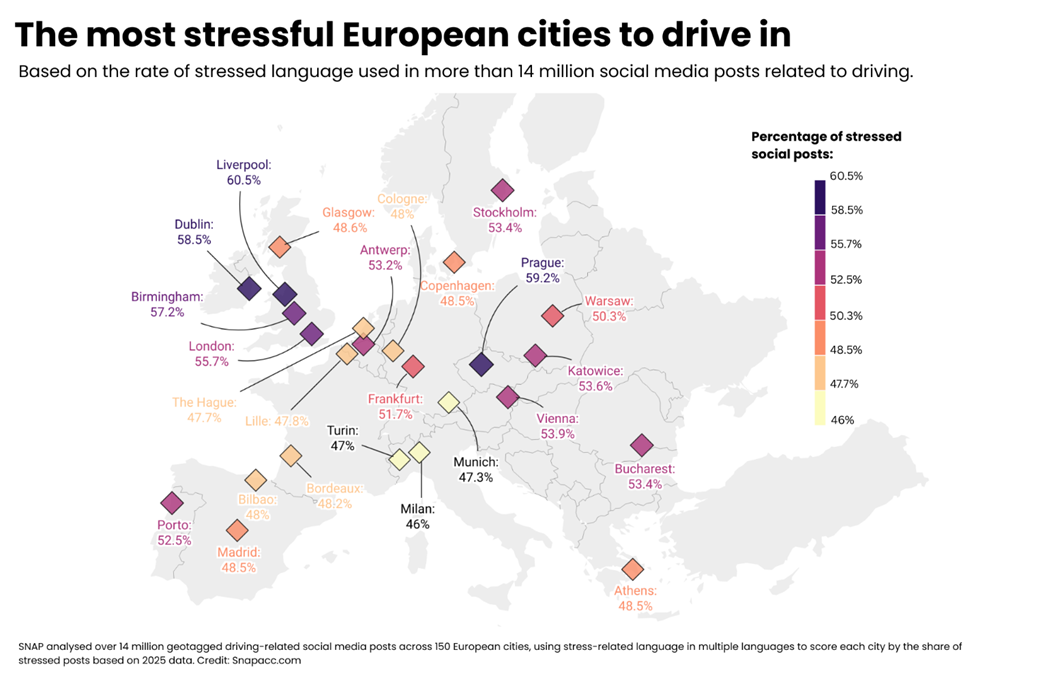
Die stressigsten Städte zum Autofahren

Städte können den Stress für Autofahrer durch Staus, enge Straßen und komplexe Straßenführungen erhöhen.
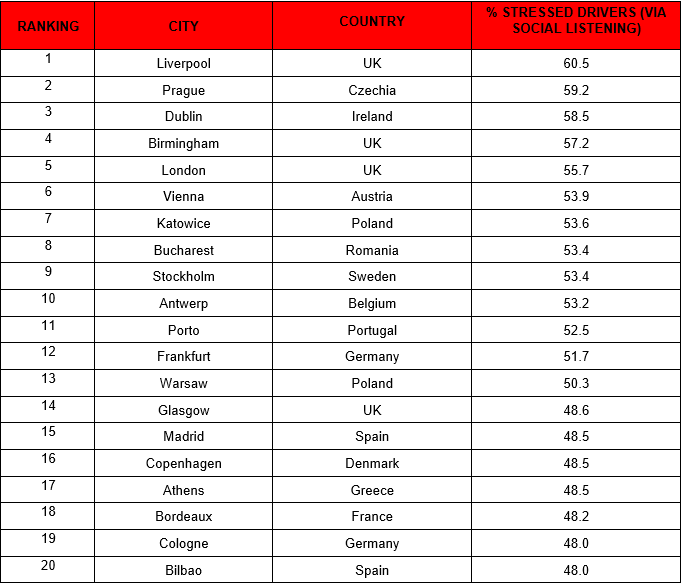
Liverpool (Platz 1), Birmingham (Platz 4) und London (Platz 5) gehören mit Werten zwischen 55,7 % und 60,5 % zu den stressigsten Städten in England. Stau-Hotspots und Engpässe - wie [Liverpool's Mersey Tunnels] (https://www.liverpoolworld.uk/news/mersey-tunnels-chaos-40-minute-delays-4974204) und stark überlastete Strecken wie [London Orbital Motorway (M25)] (https://news.sky.com/story/londons-roads-ranked-most-congested-in-europe-according-to-new-report-13284374) - sind die Hauptursachen für diese hohen Stresswerte.

Dublin liegt auf Platz 3 und ist eine der am stärksten verstopften Städte Europas, mit [durchschnittlichen Verspätungen von 81 Stunden pro Jahr] (https://www.irishtimes.com/transport/2025/01/06/dublin-ranks-as-europes-third-most-congested-city-after-london-and-paris/) aufgrund des starken Verkehrsaufkommens, was den anhaltenden Druck durch Staus auf den städtischen Straßen verdeutlicht.

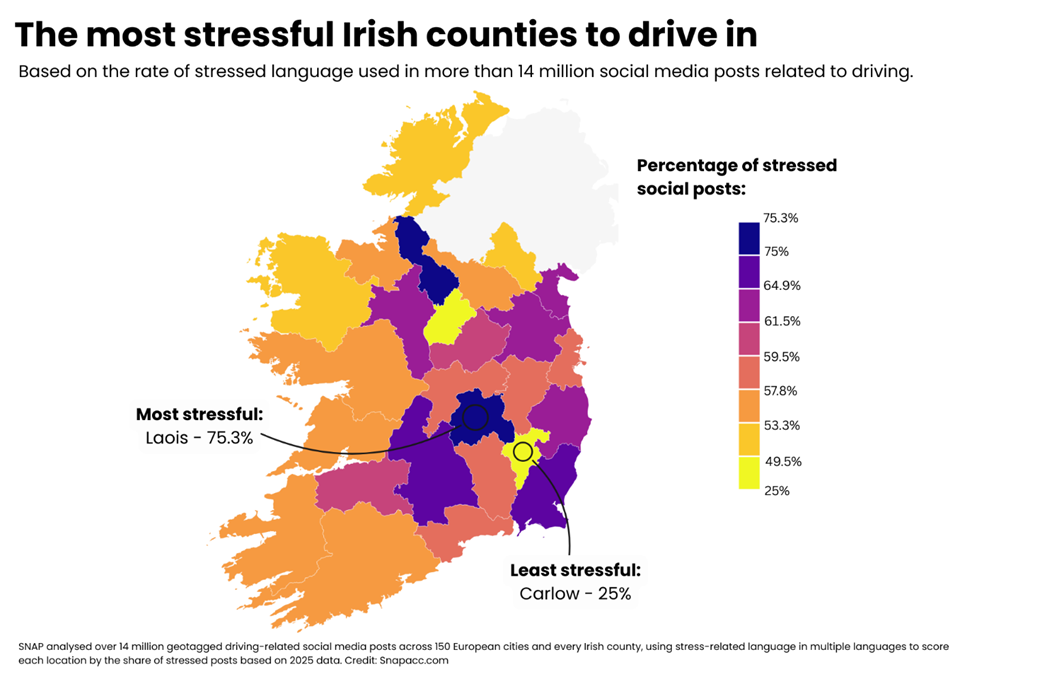
Weitere Befragungen, die sich speziell auf irische Autofahrer konzentrierten, ergaben, dass die Grafschaften Laois und Leitrim mit Werten zwischen 75 % und 75,3 % einen besonders hohen Parkstress aufwiesen. Diese hohen Zahlen verdeutlichen die anhaltenden Herausforderungen für Autofahrer in diesen Gebieten, die größtenteils auf die starke Abhängigkeit vom Auto zurückzuführen sind - [73 % der Pendler in Laois fahren mit dem privaten Auto zur Arbeit], [laut offiziellen Statistiken (Seite. 118)] (https://laois.ie/sites/default/files/2024-05/Appendix%202%20-%20Socio%20Economic%20Profile%20of%20Laois.pdf). Darüber hinaus gibt es in Leitrim lokale Berichte über eine spärliche Straßeninfrastruktur und Liefer-/Parkkonflikte in Städten wie Drumshanbo, die in dieser irischen Grafschaft zum Stress der Fahrer beitragen.
Katowice, Polen (Rang 7) - auch wenn Kattowitz nicht zu den am stärksten verstopften polnischen Städten gehört, so gibt es dennoch [Verspätungen im Berufsverkehr und Verkehrsdruck] (https://www.tomtom.com/traffic-index/katowice-traffic/), wobei die Autofahrer viel Zeit im Verkehr verbringen und auf Hauptverkehrsstraßen wie der S86 und der A4 täglich ein hohes Verkehrsaufkommen herrscht, was zu einem Stresswert von 53,6 % beitragen kann. Ähnlich verhält es sich in Warschau in Polen (Rang 13), wo die Autofahrer etwa 70 Stunden pro Jahr im Verkehr verbringen, was zu einem Stresswert von 50,3 % im Jahr 2025 beiträgt.

Bucharest in Rumänien (Rang 8) ist eine der am stärksten überlasteten Städte Europas, in der die Autofahrer deutlich mehr Zeit im Stau verbringen und [bis zu 12 Arbeitstage pro Jahr] (https://www.romania-insider.com/bucharest-driver-loses-days-annually-traffic-sept-2025) wegen des stockenden Verkehrs verlieren.

Spaniens Hauptstadt Madrid (15.) leidet unter starken Verkehrsstaus, wobei eine 10 km lange Fahrt rund 24 Minuten dauert. Enge Straßen und ständiger Verkehr, vor allem in Gegenden wie Puente de Vallecas, machen das tägliche Fahren langsam und anstrengend. Ähnlich verhält es sich mit Berichten über Unfälle und starkes Verkehrsaufkommen in Bilbao in Spanien (Platz 20) auf wichtigen Strecken wie der A-8 und der BI-30, was zu langen Warteschlangen und langsamem Verkehr führt, was wiederum zu stressigen Fahrbedingungen beiträgt.

Die stressigsten Städte zum Parken

Auch das Parken trägt zum Stress der Fahrer und des Fuhrparkmanagements bei, da die begrenzte Verfügbarkeit, die hohe Nachfrage und die restriktiven Vorschriften in den europäischen Städten die Fahrten verzögern, die Frustration erhöhen und die Routenplanung erschweren können.

Außerdem haben wir durch Social Listening Daten über die Städte gesammelt, in denen Fahrer in ganz Europa den größten Stress beim Parken erleben, insbesondere in Rumänien, Polen, Spanien und Großbritannien. Für Flottenbetreiber ist es wichtig, auf diese Bereiche zu achten, da die begrenzte Verfügbarkeit von Parkplätzen, die hohe Nachfrage und die städtischen Staus den Zeitplan durcheinanderbringen, zu Verspätungen führen und das Wohlbefinden der Fahrer beeinträchtigen können.

Unsere Untersuchung zeigt, dass der Parkstress in Europa in Polen am höchsten ist, wobei Podlachia (83,3 %) und Olsztyn (80 %) mit Problemen wie begrenzten städtischen Parkplätzen und hoher Fahrzeugdichte zu kämpfen haben.

Auch im Vereinigten Königreich sind Newcastle upon Tyne (65,3 %), Liverpool (64,4 %) und Middlesbrough (63,9 %) die Städte mit dem größten Parkstress für Autofahrer. Diese Städte kämpfen mit begrenzten Parkplätzen im Stadtzentrum, [Straßenbenutzungsgebühren] (https://new.newcastle.gov.uk/news/2024/proposed-changes-parking-charges), Staus und [strenge Parkvorschriften] (https://snapacc.com/newsroom/hgv-parking-regulations-in-the-uk-what-every-driver-should-know/) tragen zur Frustration der Autofahrer bei.

Die rumänischen Städte Sibiu und Cluj-Napoca sowie die spanischen Städte Malaga und Bilbao verzeichneten die höchsten Parkstresswerte in ihren jeweiligen Ländern. Im Vergleich zum Vereinigten Königreich und zu Polen sind die Stresswerte jedoch niedriger - sie liegen zwischen 55,6 % und 52,4 % - was darauf hindeutet, dass die Parkbedingungen überschaubarer sind, es weniger Engpässe gibt und der Druck auf die Fahrer in diesen städtischen Gebieten relativ gering ist.

*Unser Ziel bei SNAP ist einfach: Wir wollen den Stress, der mit dem Parken verbunden ist, für Spediteure verringern. Durch die Bereitstellung von Echtzeit-Informationen und intelligenteren Routenoptionen helfen wir den Fahrern, sichere und zugängliche Parkplätze zu finden, was ihre Fahrten stressfreier und effizienter macht.

MATTHEW BELLAMY, GESCHÄFTSFÜHRER, SNAP

Warum erleben Lkw-Fahrer in diesen Städten den größten Stress?

Lkw-Fahrer stehen unter einem anderen Druck als normale Autofahrer. Begrenzte Parkmöglichkeiten für große Fahrzeuge, enge oder verstopfte Straßen und ein hohes Verkehrsaufkommen können das Fahren in der Stadt schwieriger und stressiger machen und Routinefahrten in Zeitdruck und Stress verwandeln.

Lassen Sie uns näher auf die Faktoren eingehen, die Stress für Lkw-Fahrer verursachen:

  • Limited parking for large vehicles. Scarce lorry bays and high demand make it hard to find safe places to stop, especially in urban centres. The RHA’s Roadside Facilities campaign reports an estimated shortage of 11,000 lorry parking spaces in the UK, creating significant stress for HGV drivers who struggle to find safe and legal places to park., creating significant stress for HGV drivers who struggle to find safe and legal places to park.
  • Narrow streets and complex urban layouts. Tight roads and historic city centres require careful navigation, increasing stress and risk of delays in cities like Prague, Dublin, and Liverpool.
  • High traffic volumes and congestion. Heavy commuter and freight traffic slows journeys, increases travel times, and heightens frustration particularly in busier cities like London, Birmingham, Bucharest, and Madrid.
  • Low-emission or Clean Air Zones. Restrictions on vehicle access, extra charges, and rerouting requirements can complicate planning and add pressure. For example, low emission zones in Spain require some HGVs to seek alternate routes.
  • Route restrictions and delivery schedule. Height and weight limits, prohibited turns, and time-specific delivery windows force drivers onto longer or less convenient routes.
  • Isolation and limited facilities. Long urban journeys without access to rest areas, fuelling, or amenities can increase fatigue and mental strain for HGV drivers.

Was bedeuten stressige Städte für Lkw-Fahrer?

Stressige Städte stellen die Lkw-Fahrer vor Herausforderungen. Staus, begrenzte Parkmöglichkeiten und komplexe Stadtstrukturen können zu Zeitverlusten, verpassten Lieferungen, erhöhter Müdigkeit und einem höheren Risiko kleinerer Kollisionen oder Beinaheunfällen führen.

Fahrer können Stress abbauen, indem sie ihre Routen sorgfältig planen, geplante Pausen einlegen und Technologien nutzen, um Verspätungen vorauszusehen oder bei der Budgetierung zu helfen. SNAP unterstützt die Fahrer mit Tools wie der intruck-App, die ihnen hilft, verfügbare Parkplätze zu finden, effiziente Routen zu planen und über Staus informiert zu bleiben, was den Stress reduziert und die Lkw-Fahrten sicherer und überschaubarer macht.

Was bedeuten stressige Städte für die Betreiber von LKW-Flotten?

Stressige Städte wirken sich nicht nur auf die Fahrer, sondern auch auf die Leistung der Flotte aus. Staus und begrenzte Parkmöglichkeiten können zu verspäteten Lieferungen, höheren Kraftstoff- und Betriebskosten, geringerem Wohlbefinden der Fahrer und einem erhöhten Risiko von Bußgeldern oder Strafen führen. Dieser Druck kann sich auf die Gewinnspannen auswirken und die Zeitplanung, [Fahrerbindung oder -mangel] (https://snapacc.com/newsroom/uk-driver-shortage-are-numbers-improving/) und die Kundenzufriedenheit erschweren.

Flottenbetreiber können diese Herausforderungen meistern, indem sie [intelligentere Strategien] (https://snapacc.com/newsroom/6-fleet-management-strategies-that-will-transform-your-bottom-line/) und Unterstützungssysteme einsetzen: Nutzung von Echtzeit-Verkehrs- und Parkinformationen, Erstellung flexibler Zeitpläne und [Priorisierung von Ruhe und Wohlbefinden der Fahrer] (https://snapacc.com/newsroom/how-can-the-haulage-industry-support-driver-mental-health/).

Die SNAP-Flottenzahlungslösung, die bei über 850 Servicepartnern in ganz Europa erhältlich ist, wird auf dem gesamten Kontinent alle 12 Sekunden zur Bezahlung von Lkw-Dienstleistungen genutzt - ohne Bargeld oder Karte.

Europas Städte sollen für Lkw-Fahrer weniger stressig werden

Die Kenntnis der Stress-Hotspots beim Fahren und Parken in ganz Europa hilft Fuhrparks, sicherer und effizienter zu arbeiten. Indem sie diese Erkenntnisse für die Routenplanung, die Fahrerschulung, die Einführung von Technologien und die Risikominderung nutzen, können die Betreiber Verspätungen reduzieren, das Wohlbefinden verbessern und ihre Fahrer schützen. SNAP unterstützt die Fuhrparks bei dieser Aufgabe, indem es sicheres Parken, nahtlose Zahlungen und Tools bietet, die den täglichen Betrieb ruhiger und sicherer machen.
HEUTE NOCH ANMELDEN

Teilen mit

Andere lesen auch...

Header Image

Montag 26 Januar 2026 • Nachrichten und Updates

VORBEREITUNG IHRES FLOTTENBUDGETS 2026 AUF DIE (UN)ERWARTETEN

Guest

Preparing your fleet budget goes beyond simple financial exercises. As a manager, you need strategic oversight to navigate economic headwinds and an evolving regulatory framework. It is essential to prepare your company for unexpected events, as these instances define operational stability and success. Here’s how to build a responsive budget and get ready for future challenges. Being a fleet manager means foreseeing both the predictable trends and significant uncertainties. The following seven strategies are designed to absorb shocks, adapt to change and build resilience. Your budget may have a fixed monetary amount each year. While simple, it could be too static when anticipating unexpected events. Make your financial planning more dynamic by allocating a specific percentage rather than a fixed amount. For instance, your emergency fund could be 5% of the total budget instead of $100,000 annually. Using a percentage is wise because it hedges against inflation. A fixed amount loses purchasing power over the years, whereas a percentage-based fund grows with the budget. You get automatic protection from marketwide surges. Consumer prices in the U.K. , though they can quickly fluctuate due to market conditions. Fleet managers used to determine their budgets based on acquisition prices. Now, they are focusing on budget stability and long-term strategies. Make your process more holistic by managing the total cost of ownership (TCO) and the cost per vehicle over their lifetimes. This approach makes you more meticulous and your budget more dynamic. Mastering TCO involves centralising your data and using dedicated fleet management software. This technology helps your business by and recommending conservation strategies. TCO also enables you to forecast the year for each vehicle based on historical information. Use this to make more informed acquisitions and save money. A volatile economic climate means you need to contain costs. Leverage your company’s position by reviewing supplier contracts and considering renegotiations before renewal. This strategy converts unpredictable expenses into more manageable line items. Your business partner may raise prices on essential goods, so your meetings should lock in prices for tyres and oil. Narrow your negotiation to key areas, such as pricing structure. Your primary focus should be fixed-price agreements for high-volume items and standard labour rates. Savvy fleet managers leverage their spending from the previous year to earn volume discounts and capped increases. These properly managed contracts insulate your business and transfer risk to suppliers. Risk management for your fleet budget also includes insurance optimisation. Managers should turn this annual exercise into an opportunity to protect their business from financial debilitation. The right policy is crucial because it protects against shocks that can result in third-party damage or injury. It also increases predictability by turning repair bills into known variables. Insurance optimisation requires a thoughtful, data-driven process. Give your broker a risk management portfolio to showcase positive trends, such as fewer speeding incidents or less harsh braking. If you have policy excess, ask your insurer to model the premium savings for a higher deductible. Therefore, you can save money on your monthly payment. Maintenance and repairs can be unpredictable and expensive. One breakdown on the M6 could require costly engine work or a transmission replacement. Be proactive by implementing structured service schedules. Beyond the manufacturer's guidelines, you should create detailed plans for each vehicle based on its usage and age. You can dive deeper by including motorway driving and city travel. Your maintenance schedule should also include daily tasks. For example, experts to prevent condensation formation. If the tank is close to empty, sediment buildup and pump damage may occur. Cleaning is another nonnegotiable daily chore, especially when driving over road salts and chemicals. Rinse off dirt and other contaminants before storing vehicles. Accidents are among the most unexpected parts of your fleet budget. Besides the crash, managers must also and solicitor fees. However, proper driver training can mitigate this cost by reducing its frequency. Targeted coaching helps operators understand defensive driving, hazard perception and the specific dynamics of their jobs. Investing in driver training is one element of risk control. Human driving can be unpredictable, but education transforms it into a more consistent variable. By improving your drivers, you also help your insurance premiums. An accident can raise rates, so proper training is one way to control costs. A decrease in incidents can be used as leverage in insurance negotiations. Fleets are becoming more connected as they transform into data hubs. Your vehicles can generate and store vast amounts of information, which is essential for management. However, the connectivity exposes the modern automobile to liabilities. Budget for cybersecurity to protect your assets from digital threats and prepare for the unexpected. Managing this part of your fleet budget involves protecting vehicle systems. You could invest in hardware and software solutions to create firewalls around your GPS and V2X communications. This strategy helps keep your software up to date and protected from external threats. Secure data transmission is another part of preparing for the unexpected. Forward-thinking managers invest in fleet management systems with end-to-end encryption. Before building a resilient operation, it is essential to understand why. You should budget for unexpected events to ensure continuity. If a vehicle breaks down, it could halt operations and delay services. However, planning for these incidents provides a buffer and safeguards your bottom line. All vehicles are subject to failure, so you are preparing for the physical reality. This strategy is also essential for the bigger picture. For instance, economic volatility is a factor outside your control. Sudden inflation, interest rate hikes and price increases are detrimental to static budgets. However, planning for unexpected costs helps absorb them. By accurately forecasting expenses, you build financial discipline and credibility with stakeholders.Building a dynamic budget demonstrates strategic leadership more than defensive measures. As you incorporate wise approaches, you fundamentally shift your organisation’s mindset and promote proactive control. The modern economic climate requires fleet managers to absorb shocks and mitigate asset failure. A strong budgetary framework lets you protect profit margins and guarantee continuity.Discover more from

Header Image

Montag 19 Januar 2026 • Nachrichten und Updates

EINE AUFSCHLÜSSELUNG DER MAUTSYSTEME IN EUROPA

Guest

For many fleets operating across Europe, tolls have quietly become one of the most complex and least predictable costs. What was once a relatively straightforward question of motorway charges has evolved into a patchwork of national systems, technologies and pricing models that now reflect emissions, vehicle weight, axle count, geography and even time of day.As we move into 2026, tolling is no longer just an infrastructure charge. It is increasingly a policy lever, used by governments to fund roads, manage congestion and accelerate the shift towards lower-emission transport. For fleet operators, that shift has real financial consequences.This article breaks down how tolling works across Europe, what fleets actually pay today, and what changes are coming next.Margins in road transport are tight. Fuel, labour, insurance and compliance costs have all risen sharply in recent years. Against that backdrop, tolls are becoming more significant, particularly for long-distance and cross-border operators.In countries such as Germany and Austria, toll costs per kilometre can now rival fuel costs on certain routes. In Central and Eastern Europe, tolls remain lower, but rapid rises and network expansion are closing that gap. At the same time, the introduction of CO₂-based charging means that two otherwise identical vehicles can face very different toll bills depending on their emissions profile.For fleets operating internationally, tolls are a consideration for route planning, vehicle procurement and pricing.There is no single European toll system. Instead, fleets must navigate a mix of national approaches that broadly fall into three categories.Distance-based tolls charge vehicles per kilometre travelled. These are now the dominant model for heavy goods vehicles and are used in countries such as Germany, Austria, Poland, Hungary and Belgium.Time-based vignettes allow vehicles to use the road network for a fixed period of time, such as a day, week or year. These were traditionally a pass displayed in the windscreen, but are increasingly digital.Hybrid systems combine toll roads with toll-free alternatives. France, Italy and Spain all operate models where tolls apply only on specific routes.Across all three models, the EU’s revised Eurovignette Directive is pushing countries towards distance-based, emissions-linked charging. This is steadily reducing the role of flat-rate vignettes and increasing the costs of high-mileage fleets.Operationally, tolling is becoming more digital. Most distance-based systems rely on GNSS or GPS tracking via onboard units (OBU), supported by roadside gantries, toll booths and camera enforcement.For fleets, this means greater reliance on onboard technology, tighter compliance requirements, and less tolerance for administrative error. Missed payments on free-flow roads (where there are no toll booths and no need to stop) can quickly turn into fines, particularly for international drivers unfamiliar with local rules.Interoperable toll services under the European Electronic Toll Service (EETS) framework are becoming more important for cross-border operators. Instead of fitting vehicles with multiple country-specific onboard units, fleets can use a single approved device to pay tolls across several European networks. This simplifies administration, reduces installation and maintenance costs – and lowers the risk of non-compliance when vehicles move between different toll regimes. Germany operates one of Europe’s most comprehensive toll systems. The LKW-Maut applies to all trucks over 3.5 tonnes on motorways and federal roads. Since December 2023, tolls include a CO₂ charge, which has increased costs for diesel vehicles. Official details are published by Austria’s GO-Maut is among the most expensive per kilometre in Europe. A Euro VI articulated truck paid around on motorways in 2025. The system includes infrastructure, noise, air pollution and CO₂ components. Electric trucks benefit from lower rates. Belgium operates a kilometre-based toll for trucks in Flanders, Wallonia and Brussels. Rates vary by region, weight and Euro class, with annual increases. From 2026, zero-emission vehicles will no longer be fully exempt but will still pay reduced infrastructure charges. Official information is available from France uses a motorway concession model. Tolls apply on routes operated by private companies and are paid at toll booths or electronically. Annual increases are modest and regulated. The Italy follows a similar concession-based approach. HGVs pay on the Autostrade network. The government is working towards more dynamic tolling by 2026, potentially linking charges to congestion and emissions. Hungary’s HU-GO system applies to trucks over 3.5 tonnes on motorways and main roads. Following high inflation, toll rates have increased sharply. Official updates are published at Poland’s e-TOLL system charges per kilometre using GNSS (satellite) technology. Rates rose in 2025 and will again in 2026, while the toll network continues to expand. The official platform is Spain is unusual in that many major motorways have become toll-free following the expiry of concessions. Some tolled routes remain and costs vary per kilometre for HGVs. The Spanish government’s position is outlined via the Romania currently operates a vignette system for trucks, with a seven-day pass costing around for the heaviest vehicles. This will change in July 2026, when Romania introduces a distance-based toll system called TollRo. Initial rates are expected to be low, but are likely to rise over time. Several developments make 2026 a pivotal year for European tolling.The Netherlands will introduce a kilometre-based truck toll from 1 July, replacing the Eurovignette. Average rates are expected to be around €0.19 per kilometre, with discounts for low-emission vehicles. Official information is available at As mentioned, Romania will transition from vignettes to distance-based charging, bringing it in line with neighbouring countries.Across Europe, CO₂-based differentiation will become standard, with reduced exemptions and tighter enforcement. Electric trucks will continue to benefit, but full exemptions are gradually being replaced by reduced rates rather than zero tolls.For fleets, this means higher exposure to mileage-based costs and greater incentives to invest in cleaner vehicles and better planning tools.Operators are now evaluating routes to balance toll costs against fuel use and journey time. Investment in Euro VI and zero-emission vehicles is increasingly justified not only by fuel savings but by toll reductions. In addition, toll surcharges are becoming more explicit in customer contracts and digital route optimisation tools are playing a larger role in daily operations.Fleets therefore need accurate forecasting, up-to-date vehicle data and clear visibility of toll exposure by route and customer. Vehicle procurement decisions should factor in toll classes alongside fuel efficiency. Cross-border operators should prioritise interoperable toll solutions and ensure drivers understand local payment rules, particularly on free-flow roads.Most importantly, toll costs need to be reflected transparently in pricing. As tolling becomes more emissions-driven, fleets that plan ahead will be better placed to protect margins and remain competitive.For fleets, the question is no longer whether tolls will rise, but how well prepared they are to manage them. In the years ahead, it will not just be about how far a vehicle travels, but how cleanly, where and under which system.As tolls become more closely linked to emissions, mileage and vehicle type, understanding what you pay and where matters more than ever. SNAP helps fleet managers and operators manage payments and support drivers with access to safe, well-equipped truck stops.

Header Image

Donnerstag 08 Januar 2026 • Nachrichten und Updates

SUTTERTON TRUCK STOP: DER NEUE STANDARD FÜR FAHRERKOMFORT UND SICHERHEIT

Susie Jones

Situated on the A17 and a short drive from Boston is , a haven for truck drivers transporting goods along this stretch of road. The location provides not only a truck stop with the usual amenities one would expect clean showers, toilets, shop, and refuelling options but it also presents drivers with the choice to dine at the Roadside Diner, providing visitors with an American-themed restaurant with a variety of meals. We sat down with Director James Townsend to discuss improvements to the site, driver welfare, site security, and their long-standing relationship with SNAP. explains James. The site has undergone a major refurbishment, prioritising the needs of truck drivers. Nestled inside the truck stop is the new roadside diner. James and the team have recently taken back ownership of this and refurbished it. James says. He goes on to explain that it was more than upgrading existing facilities, but providing drivers with the right facilities to make the site a home away from home. SNAP asked truck drivers parking at Sutterton what they thought of the new facilities on offer. One driver commented:When it came to the design of the truck park, the site worked closely with SNAP to maximise the site’s potential:Driver welfare still remains a huge priority for those working in the industry, with investment into truck parking lacking, something James is all too aware of after working with the DFT. he explains. While investment is valuable, directing it into the right facilities for truck drivers is also imperative. James states. James and the rest of the team work closely with SNAP’s UK Network Team as well as , providing them with a single, clear point of contact should any issues arise. explains James. Having the support in place for complaints and technical issues is a major advantage for a truck stop like Sutterton, which often manages competing demands. Working with SNAP has delivered additional benefits as well, as James goes on to say:To ensure truck drivers get a good night’s rest, ensuring the site is as safe and secure as possible was vital for Sutterton Truck Stop. Working with SNAP Access & Security from the outset has allowed James and the team to do exactly that. says James. The site is a firm believer in training its staff to deal with incidents if they occur. Inspired by what you’ve just read? Catch the full interview with