Josh Cousens
Nieuws en updates • 5 min lezen

De meest stressvolle steden van Europa om in te parkeren en rijden

Gemaakt: 14-01-2026

Bijgewerkt: 15-01-2026

Rijden en parkeren in Europese steden kan een dagelijkse kopzorg zijn voor vrachtwagenchauffeurs - en hoge stressniveaus hebben niet alleen invloed op het welzijn, maar ook op de efficiëntie van het wagenpark. Voor logistiek managers is het van cruciaal belang om te weten waar deze uitdagingen het grootst zijn voor de routeplanning, de veiligheid van de chauffeurs en de operationele prestaties.

Ons onderzoek maakt gebruik van social listening om miljoenen geotagged posts in 150 Europese steden te analyseren en identificeert de plaatsen die chauffeurs het meest stressvol vinden. Liverpool staat bovenaan de lijst (60,5% van de posts tonen rijgerelateerde stress), gevolgd door Praag (59,2%) en Dublin (58,5%). Liverpool staat ook op de 2e plaats van meest stressvolle steden voor parkeren in het Verenigd Koninkrijk. Congestie, schaarse parkeergelegenheid en lastige wegomstandigheden zijn de belangrijkste pijnpunten die door bestuurders in heel Europa naar voren worden gebracht.

Dit onderzoek brengt de stresshaarden voor vrachtwagens in Europa in kaart aan de hand van het sentiment onder chauffeurs uit de praktijk en laat zien hoe de omstandigheden in de stad van invloed zijn op het welzijn. Het gaat niet om het rangschikken van landen, maar om het geven van duidelijke, bruikbare inzichten aan wagenpark- en logistiekmanagers om chauffeurs te ondersteunen, slimmere routes te plannen en de rijdruk in de stad te verminderen.

Luisteren naar ervaringen van bestuurders

Ons onderzoek analyseerde meer dan 14 miljoen geotagged social media posts uit 150 Europese steden, over rij-gerelateerde onderwerpen zoals parkeren, verkeer en wegomstandigheden. Berichten werden beoordeeld op stress door het bijhouden van trefwoorden en zinnen gekoppeld aan negatieve emoties in het Engels en de lokale talen. Elke stad kreeg een score op basis van het percentage berichten waarin stress werd geuit, zodat er een duidelijk beeld ontstond van de druk op chauffeurs in heel Europa. De gegevens werden verzameld op het belangrijkste sociale mediaplatform X (voorheen Twitter) in 2025.

"Stress" heeft betrekking op de druk waaraan bestuurders van wagenparken onderweg worden blootgesteld, zoals verkeer, parkeren, wegomstandigheden, algemeen rijgedrag en conflicten met andere bestuurders. Inzicht in deze factoren helpt wagenparkbeheerders het welzijn en de prestaties van bestuurders te ondersteunen.

*"Als we weten welke steden het meest stressvol zijn voor vrachtwagenchauffeurs, kan SNAP zich richten op oplossingen die zowel de veiligheid als de efficiëntie verbeteren.

MATTHEW BELLAMY, ALGEMEEN DIRECTEUR, SNAP

Stressvolle EU-steden: Belangrijkste bevindingen

Vanaf 2025 voor de meest stressvolle steden om te rijden:

  1. Liverpool, VK. 60,5% van de gestreste sociale berichten over parkeren - het hoogste percentage stressgerelateerde berichten over autorijden in Europa.
  2. Praag, Tsjechië. 59,2% van gestreste sociale berichten over parkeren, waarschijnlijk als gevolg van druk verkeer, historisch straatontwerp en beperkte ruimte voor grotere voertuigen die door de stad navigeren.
  3. Dublin, Ierland. 58,5% van de gestreste sociale berichten over parkeren - stress bij chauffeurs is sterk gekoppeld aan vertragingen door files, parkeertekorten en drukke forenzenroutes die van invloed zijn op de dagelijkse rijomstandigheden.

De top 3 van meest stressvolle Britse steden voor parkeren in 2025:

  1. Newcastle upon Tyne. Gewoonlijk afgekort als "Newcastle" en gelegen in Tyne and Wear, heeft deze stad maar liefst 65,3% van de gestreste sociale berichten over parkeren, waardoor het de meest stressvolle Britse stad is voor parkeren in 2025.
  2. Liverpool. In Merseyside geeft 64,4% van de sociale berichten over parkeren in Liverpool blijk van stress.
  3. Middlesbrough. 63,9% van de sociale berichten over parkeren in deze stad in North Yorkshire geeft blijk van stress.

Schotland laat ook een verhoogde parkeerstress zien, met Edinburgh (61,6% van de gestreste sociale berichten over parkeren) en Glasgow (61,4% van de gestreste sociale berichten over parkeren) op de ranglijst van meest uitdagende steden in het Verenigd Koninkrijk om te parkeren. Daarnaast staat Londen op de 17e plaats van meest stressvolle plaatsen om te parkeren (57,9 van de gestreste sociale berichten over parkeren. Factoren die kunnen bijdragen zijn onder andere smalle straten, dichte stedelijke lay-outs, een grote vraag naar beperkte parkeerruimte en beperkingen in het stadscentrum die de druk op bestuurders kunnen verhogen.

Stress-hotspots voor Europese bestuurders

Met behulp van miljoenen geotagged social media posts hebben we elke stad beoordeeld op het aandeel stressgerelateerde posts, waardoor we de beste rij- en parkeerhotspots van Europa hebben ontdekt en de stedelijke omstandigheden hebben belicht die bestuurders het meest uitdagen.

Onze infografische kaart toont de topsteden voor rij- en parkeerdruk, met de belangrijkste stedelijke hotspots en de uitdagingen waar bestuurders in elke markt mee te maken krijgen.

(https://prodsnapstorage.blob.core.windows.net/public-news/2b1309d2-d01b-4909-9eac-9f3c7bfe6273-image.png)

De meest stressvolle steden om in te rijden

Steden kunnen de stress bij bestuurders verhogen door files, smalle straten en complexe wegindelingen.

(https://prodsnapstorage.blob.core.windows.net/public-news/7b485a8f-90e0-4ec0-922c-d1b12e41f781-image.png)

Liverpool (1e plaats), Birmingham (4e) en Londen (5e) behoren allemaal tot de meest stressvolle steden om te rijden in Engeland, met 55,7% en 60,5% stressscores. Congestie hotspots en knelpunten - zoals Liverpool's Mersey Tunnels en zwaar overbelaste routes zoals London Orbital Motorway (M25) .- dragen in belangrijke mate bij aan deze verhoogde stressniveaus.

Dublin staat op de 3e plaats en is een van de meest overvolle steden van Europa, met automobilisten die jaarlijks gemiddeld 81 uur vertraging oplopen door druk verkeer, wat de aanhoudende congestiedruk op stedelijke wegen benadrukt.

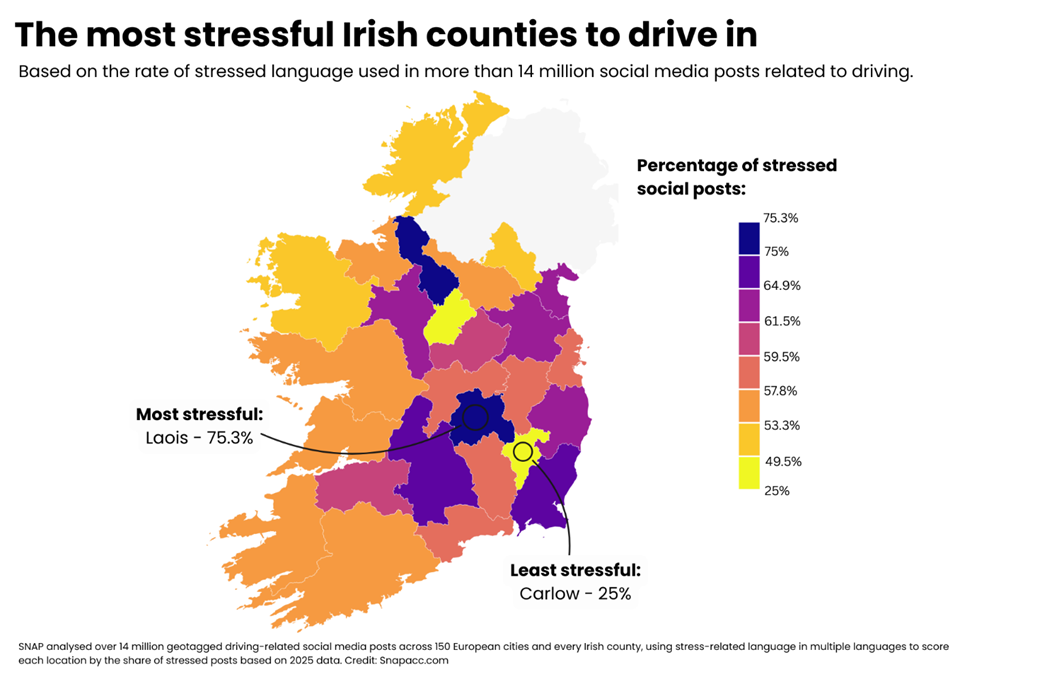
Verder social listening, specifiek gericht op Ierse automobilisten, onthulde dat de graafschappen Laois en Leitrim opmerkelijk hoge parkeerstressniveaus lieten zien, met scores variërend van 75% tot 75,3%. Deze hoge cijfers benadrukken de hardnekkige uitdagingen voor automobilisten in deze gebieden, die grotendeels worden veroorzaakt door de grote afhankelijkheid van de auto - [73% van de forenzen in Laois reist met de eigen auto naar het werk], volgens officiële statistieken (Blz. 118). Daarnaast zijn er in Leitrim lokale rapporten over de schaarse wegeninfrastructuur en conflicten over bezorging/parkeren in steden als Drumshanbo die bijdragen aan de stress bij bestuurders in deze Ierse county.
Katowice, Polen (7e plaats) - hoewel het niet een van de meest overbelaste Poolse steden in het algemeen is, heeft Katowice nog steeds te maken met vertragingen voor forenzen en verkeersdrukte, met bestuurders die veel tijd in het verkeer doorbrengen en belangrijke wegen zoals de S86 en A4 waar dagelijks veel verkeer is dat kan bijdragen aan de stressscore van 53,6%. Ook in Warsaw in Polen (13e plaats) besteden bestuurders ongeveer 70 uur per jaar in het verkeer, wat bijdraagt aan de stressscore van 50,3% in 2025.

Boekarest in Roemenië (8e plaats) heeft te kampen met beruchte files als een van de drukste steden van Europa. Automobilisten brengen aanzienlijk meer tijd door in files en verliezen tot 12 werkdagen per jaar door traag verkeer.

De hoofdstad van Spanje, Madrid (15e), heeft last van verkeersopstoppingen. Een rit van 10 km duurt ongeveer 24 minuten. Smalle straten en aanhoudend verkeer, vooral in gebieden zoals Puente de Vallecas, maken elke dag rijden langzaam en stressvol. Ook meldingen van ongevallen en druk verkeer in Bilbao, in Spanje (20e plaats) op belangrijke routes zoals de A-8 en BI-30, veroorzaken lange wachtrijen en traag verkeer, wat bijdraagt aan stressvolle rijomstandigheden.

De meest stressvolle steden om te parkeren

Parkeren draagt ook bij aan de stress bij bestuurders en wagenparkbeheerders, omdat de beperkte beschikbaarheid, de grote vraag en de beperkende regels in de Europese steden de ritten kunnen vertragen, de frustratie kunnen verhogen en de routeplanning kunnen bemoeilijken.

Via social listening hebben we ook gegevens verzameld over de steden in Europa waar bestuurders de meeste stress ervaren bij het parkeren, met name in Roemenië, Polen, Spanje en het Verenigd Koninkrijk. Aandacht besteden aan deze gebieden is belangrijk voor wagenparkbeheerders, omdat beperkte beschikbaarheid van parkeergelegenheid, grote vraag en stedelijke congestie schema's kunnen verstoren, vertragingen kunnen vergroten en het welzijn van bestuurders kunnen beïnvloeden.

Uit ons onderzoek blijkt dat de hoogste parkeerdruk in Europa te vinden is in Polen, met Podlachia (83,3%) en Olsztyn (80%) die te kampen hebben met problemen zoals beperkte parkeerplaatsen in de stad en een hoge voertuigdichtheid.

In het Verenigd Koninkrijk zijn Newcastle upon Tyne (65,3%), Liverpool (64,4%) en Middlesbrough (63,9%) de steden met de meeste parkeerstress voor automobilisten. Deze steden hebben te kampen met beperkte parkeerplaatsen in het stadscentrum, parkeertarieven, files en strenge parkeerregels die bijdragen aan de frustratie van automobilisten.

De Roemeense steden Sibiu en Cluj-Napoca, samen met de Spaanse steden Malaga en Bilbao, noteerden de hoogste parkeerstressniveaus binnen hun respectievelijke landen. Vergeleken met het Verenigd Koninkrijk en Polen zijn hun stressscores echter lager - variërend van 55,6% tot 52,4% - wat duidt op beter beheersbare parkeeromstandigheden, minder knelpunten en relatief minder druk op bestuurders in deze stedelijke gebieden.

Bij SNAP is ons doel eenvoudig: parkeergerelateerde stress voor transportprofessionals verminderen. Door realtime informatie en slimmere routeopties te bieden, helpen we chauffeurs bij het vinden van veilige, toegankelijke parkeerplekken, waardoor hun reizen minder stressvol en efficiënter worden."

MATTHEW BELLAMY, ALGEMEEN DIRECTEUR, SNAP

Waarom ervaren vrachtwagenchauffeurs de meeste stress in deze steden?

Vrachtwagenchauffeurs hebben te maken met andere problemen dan gewone automobilisten. Beperkte parkeergelegenheid voor grote voertuigen, navigeren door smalle of drukke straten en grote verkeersvolumes kunnen het rijden in de stad uitdagender en stressvoller maken, waardoor routinekilometers veranderen in tijdsdruk en stressvolle ervaringen.

Laten we eens dieper ingaan op de factoren die stress veroorzaken bij vrachtwagenchauffeurs:

  • Limited parking for large vehicles. Scarce lorry bays and high demand make it hard to find safe places to stop, especially in urban centres. The RHA’s Roadside Facilities campaign reports an estimated shortage of 11,000 lorry parking spaces in the UK, creating significant stress for HGV drivers who struggle to find safe and legal places to park., creating significant stress for HGV drivers who struggle to find safe and legal places to park.
  • Narrow streets and complex urban layouts. Tight roads and historic city centres require careful navigation, increasing stress and risk of delays in cities like Prague, Dublin, and Liverpool.
  • High traffic volumes and congestion. Heavy commuter and freight traffic slows journeys, increases travel times, and heightens frustration particularly in busier cities like London, Birmingham, Bucharest, and Madrid.
  • Low-emission or Clean Air Zones. Restrictions on vehicle access, extra charges, and rerouting requirements can complicate planning and add pressure. For example, low emission zones in Spain require some HGVs to seek alternate routes.
  • Route restrictions and delivery schedule. Height and weight limits, prohibited turns, and time-specific delivery windows force drivers onto longer or less convenient routes.
  • Isolation and limited facilities. Long urban journeys without access to rest areas, fuelling, or amenities can increase fatigue and mental strain for HGV drivers.

Wat betekenen stressvolle steden voor vrachtwagenchauffeurs?

Stressvolle steden creëren uitdagingen voor vrachtwagenchauffeurs. Congestie, beperkte parkeergelegenheid en complexe stedelijke lay-outs kunnen leiden tot tijdverlies, gemiste leveringen, verhoogde vermoeidheid en een hoger risico op kleine botsingen of bijna-ongevallen.

Chauffeurs kunnen stress beheersen door routes zorgvuldig te plannen, geplande pauzes te nemen en technologie te gebruiken om te anticiperen op vertragingen of te helpen met budgettering. SNAP ondersteunt chauffeurs met tools zoals de intruck app, waarmee ze beschikbare parkeerplekken kunnen vinden, efficiënte routes kunnen plannen en op de hoogte kunnen blijven van files, wat stress vermindert en vrachtwagenritten veiliger en beter beheersbaar maakt.

Wat betekenen stressvolle steden voor vrachtwagenparkbeheerders?

Stressvolle steden hebben niet alleen gevolgen voor chauffeurs, maar ook voor de prestaties van het wagenpark. Congestie en beperkte parkeergelegenheid kunnen leiden tot vertraagde leveringen, hogere brandstof- en bedrijfskosten, een verminderd welzijn van de chauffeurs en een verhoogd risico op boetes of sancties. Deze druk kan ten koste gaan van de marges en de planning, het behoud of tekort van bestuurders en de klanttevredenheid bemoeilijken.

Wagenparkbeheerders kunnen deze uitdagingen het hoofd bieden door slimmere strategieën en ondersteunende systemen te gebruiken: gebruikmaken van realtime verkeers- en parkeerinzichten, flexibele roosters opstellen en prioriteit geven aan rust en welzijn van de bestuurder.

De SNAP-betaaloplossing voor wagenparken, die beschikbaar is bij meer dan 850 servicepartners in heel Europa, wordt elke 12 seconden in heel Europa gebruikt om te betalen voor diensten van vrachtwagens - zonder contant geld of een kaart.

Europese steden minder stressvol maken voor vrachtwagenchauffeurs

Inzicht in rij- en parkeerstress hotspots in heel Europa helpt wagenparken om veiliger en efficiënter te werken. Door deze inzichten te gebruiken voor routeplanning, chauffeurstraining, het gebruik van technologie en risicovermindering, kunnen transportbedrijven vertragingen verminderen, het welzijn verbeteren en hun chauffeurs beschermen. SNAP ondersteunt deze missie voor transportvloten en biedt veilig parkeren, naadloze betalingen en tools die de dagelijkse werkzaamheden rustiger en veiliger maken.

INSCHRIJVEN OM VANDAAG TE KLIKKEN

Deel naar

Anderen lezen ook...

Header Image

donderdag 11 juni 2026 • Nieuws en updates

REIZEN TIJDENS HET WK VS. VRACHTVERVOER OVER DE WEG: HOE VRACHTWAGENCHAUFFEURS IN EUROPA ELKE WEEK TOERNOOIAFSTANDEN AFLEGGEN

Lucy Black

When football fans think about the FIFA World Cup, they think about big matches, packed stadiums and long journeys.And in 2026, those journeys will be bigger than ever.The expanded FIFA World Cup will feature 48 teams, 104 matches and 16 host cities spread across the United States, Canada and Mexico. It will be the largest and most geographically dispersed World Cup ever staged.Millions of supporters will travel across North America. Teams will cover thousands of kilometres throughout the tournament. Billions of pounds will be spent. Vast amounts of equipment, merchandise, food, drink and technology will need to be moved between venues.But while football fans focus on the journeys made by players and supporters, there is another group of professionals covering similar distances every month.Europe's truck drivers.In fact, a truck driver in Spain could cover more than 10,000 kilometres in just four weeks. That's comparable to the distance some teams could travel throughout an entire World Cup campaign.There's another important similarity too.Without logistics, there is no World Cup.As , explains:Every match, every fan zone and every broadcast relies on goods being delivered to the right place at the right time. From food and drink to merchandise, security infrastructure and broadcasting equipment, road transport plays a critical role behind the scenes.The reality is simple. While football takes centre stage, logistics makes it possible.The 2026 tournament will create one of the most complex logistics operations ever seen in sport.Unlike previous World Cups hosted in a single country, teams could be travelling thousands of kilometres between fixtures throughout the competition.For players, those journeys will be carefully planned and supported by charter flights, recovery teams and world-class facilities.For truck drivers, covering long distances is simply part of everyday life.Across Europe, drivers move goods between manufacturers, ports, warehouses, retailers and customers every day. They connect supply chains, support businesses and keep economies moving.The scale of logistics required for a global event like the World Cup is enormous.As , explains:Every screen, every item of merchandise, every catering delivery and every piece of technical equipment must arrive exactly where it is needed.The same expertise that helps major sporting events run smoothly is being used every day across Europe's transport networks.A team progressing from the group stages to the final could realistically travel between 8,000 and 15,000 kilometres during the 2026 FIFA World Cup.To put that into perspective, SNAP compared projected World Cup travel distances against the average weekly mileage completed by truck drivers across some of Europe's largest freight markets.The results show that truck drivers across Europe routinely cover World Cup-level distances in as little as four weeks.In Spain, Portugal, the Netherlands and Poland, drivers can cover close to or more than 10,000 kilometres over a month.While football teams travel with dedicated support staff and carefully planned schedules, drivers achieve similar distances while managing delivery deadlines, congestion, border crossings, parking shortages and increasingly complex transport networks.It is a reminder of the scale of modern road freight and the critical role drivers play in keeping supply chains moving.Comparing distances only tells part of the story.Players travel between matches.Drivers travel whilst managing deliveries, navigating road networks, complying with regulations and keeping customers supplied.Every week, millions of tonnes of goods move across Europe, supporting supermarkets, manufacturers, construction projects, healthcare providers and countless other industries.The distances may be similar.The challenges are not.Road freight remains the backbone of European trade.Around 75% of inland freight transport across the European Union is moved by road when measured in tonne-kilometres.Every year, billions of tonnes of goods travel across Europe's road networks.Behind every delivery is a transport operation built on the expertise of drivers, fleet managers and logistics professionals.Major sporting events simply make that reality more visible.The World Cup creates additional demand for food, beverages, merchandise, security equipment and event infrastructure. The pressure on transport networks increases significantly.But for transport operators, managing complex logistics is not a once-every-four-years challenge.It's business as usual.Large sporting events often highlight challenges that fleet operators deal with every day.Research from previous World Cups and Olympic Games has shown that host cities experience increased congestion, higher freight demand and greater pressure on transport infrastructure.During major sporting tournaments, cities often see:Increased congestion Higher demand for food and beverage deliveries Greater pressure on parking facilities Increased demand for security logistics Additional passenger transport requirements More complex route planningAs , points out:He's right.Whether it's food and drink for supporters, retail stock, security infrastructure or broadcast technology, major events place huge demands on logistics networks.For fleet managers, those operational pressures are familiar territory.While football teams rely on coaches, analysts and support staff, supply chains rely on drivers.Yet Europe's transport sector continues to face significant challenges.There is an estimated shortage of around 390,000 secure truck parking spaces across Europe.At the same time, driver shortages remain a major concern across many markets.Without drivers, supply chains stop.Without safe, secure places to rest, attracting and retaining drivers becomes even more difficult.As , explains:It's a simple observation, but it highlights an important truth.Whether it's a major sporting tournament or a normal weekend, drivers are the people making sure shelves stay stocked, businesses stay supplied and customers get what they need.For fleet managers, investing in driver welfare is no longer a nice-to-have.It's a business necessity.Providing access to secure parking, quality facilities and efficient payment solutions helps improve driver satisfaction, supports retention and drives operational efficiency.The biggest lesson from the World Cup isn't about football.It's about preparation.The teams that perform best are supported by planning, logistics and infrastructure that allows them to perform when it matters most.The same applies to transport operations.The fleets best positioned for success are those investing in:Driver welfare Secure truck parking Operational visibility Smarter transport payments Fleet efficiency Transport technology Simplified fleet managementThe journeys completed by football teams during the World Cup may capture the headlines.But they also provide a useful reminder of the distances being covered by Europe's transport industry every single day.From Spain and Portugal to Poland, Romania and the United Kingdom, professional drivers routinely travel extraordinary distances whilst supporting businesses, communities and supply chains across the continent.While the world's best footballers compete on the biggest stage, millions of drivers will continue doing what they do every day: keeping goods moving and economies running.At SNAP, we're proud to support those journeys through smarter transport payments, better access to truck parking and driver facilities, and solutions designed to make life easier for fleets and drivers alike.Because while the World Cup only lasts a few weeks, Europe's transport industry operates at that scale every single day.

Header Image

woensdag 25 maart 2026 • Nieuws en updates

HOE VOORSPELLENDE SYSTEMEN DE LEVERINGSONZEKERHEID TEMMEN

Evelyn Long

Delivery operations rarely unfold exactly as planned. Even the most carefully designed logistics schedules must contend with an unpredictable world. Travel congestion can add hours to a route, severe weather can delay entire regions and a single vehicle breakdown can disrupt dozens of deliveries scheduled throughout the day. When these disruptions occur, they often create a chain reaction that affects drivers, warehouses, customers and operational costs. For companies that operate fleets, whether they deliver packages, medical supplies, food or construction materials, this uncertainty can significantly impact business performance. Missed delivery windows frustrate customers and can damage brand reputation. Delays can also increase fuel costs, overtime pay and operational inefficiencies. In industries where margins are tight, even small disruptions can add up quickly.What makes delivery uncertainty especially challenging is how interconnected modern logistics networks have become. A delay at one point in the system can ripple outward, affecting multiple routes and schedules. Without the right tools to anticipate and manage these disruptions, businesses are often forced to react in real time, which can lead to rushed decisions and inefficient solutions.One of the key technologies helping organisations manage delivery uncertainty is the Internet of Things (IoT). IoT refers to networks of connected devices, such as sensors, GPS trackers and telematics systems, that connect and transmit real-time data from vehicles, equipment and infrastructure. In fleet operations, IoT devices can monitor a wide range of conditions. GPS tracking for vehicles on the road. Engine sensors can track vehicle performance and detect early signs of mechanical issues. Temperature sensors can ensure that sensitive cargo remains within required conditions during transit. Together, these data streams create a detailed picture of what’s happening across an entire delivery network. This level of visibility is essential for managing uncertainty. When managers can see where vehicles are, how they’re performing and whether any issues are developing, they can respond much faster. Instead of discovering a problem hours later, they can address it as soon as the warning signs appear. In many cases, this visibility also feeds into predictive systems that analyse the data and forecast potential disruptions before they occur. While IoT provides the data, AI offers the intelligence needed to interpret it. AI systems analyse large volumes of operational information, including traffic patterns, weather forecasts, vehicle performance metrics, delivery history and route efficiency. By identifying patterns in this data, to occur and recommend adjustments. For example, predictive algorithms can analyse historical traffic conditions along a delivery route and estimate when congestion is likely to occur during certain times of day. If the system detects that a particular route will likely experience delays, it can suggest an alternative path before the driver even leaves the depot. Similarly, AI-driven maintenance systems can analyse engine data and identify early warning signs of mechanical problems, allowing repairs to be scheduled before a breakdown occurs on the road. Predictive systems work best when they combine data from multiple sources and translate that information into actionable insights. In a fleet environment, this often means integrating vehicle telematics, weather data, delivery schedules and live traffic information into a single predictive platform. When all of this data is analysed together, the system early. For example, if a severe storm is forecasted along a delivery route, the network can recommend adjusting departure times or rerouting drivers to avoid affected areas. If sensors detect that a vehicle component is likely to fail soon, it can schedule maintenance during planned downtime rather than allowing a breakdown to disrupt deliveries. Over time, these predictive adjustments make delivery operations smoother and more efficient. Routes become more optimised because the system continually learns from previous trips. Maintenance becomes strategic because vehicles are rather than fixed schedules. Even warehouse operations can improve, since more accurate delivery predictions allow teams to better coordinate loading and unloading processes. Beyond preventing disruptions, predictive systems also help fleets operate more efficiently. Businesses that have access to reliable forecasts and operational insights can plan routes, staffing and vehicle usage with greater precision.For instance, predictive analytics can identify patterns in delivery demand, allowing companies to allocate resources where they’re most needed. If certain routes consistently experience delays during specific hours, schedules can be adjusted to avoid those peak periods. Fuel usage can also be optimised by identifying more efficient routes or driving patterns. Over time, these incremental improvements add up. Vehicles spend less time idling in traffic, drivers spend more time completing deliveries rather than waiting or rerouting, and customers receive more accurate delivery estimates, and satisfaction. Another key benefit of predictive technology is the ability to monitor and control systems remotely. As connected devices become more common, consumers and businesses expect this level of oversight and convenience. A survey found that smart garage door openers consider remote monitoring and control to be a crucial feature. While this statistic relates to residential technology, it highlights a broader shift in expectations. People increasingly value the ability to check on systems, receive alerts and manage operations from anywhere. The same mindset is becoming more important in professional logistics environments. Fleet managers want to see vehicle locations in real time, receive notifications about potential issues and make adjustments without needing to be physically present. Predictive systems support this capability by turning complex operational data into clear, actionable insights that can be assessed remotely. While predictive systems provide clear advantages, they also introduce new considerations that businesses must address. In 2024, the of suspected internet crime. As fleets become more connected and reliant on digital platforms, cybersecurity becomes increasingly important. IoT devices, cloud platforms and AI-driven systems all rely on network connectivity and data exchange. Systems that aren’t properly secured could become targets for cyberattacks. A compromised system could disrupt operations, expose sensitive data or interfere with fleet management tools.Delivery uncertainty may never disappear entirely, but predictive systems are making it far more manageable. By combining IoT connectivity with AI-driven analytics, fleet operators can gain deeper visibility into their operations and anticipate problems before they disrupt schedules. As these technologies continue to evolve, they will play an important role in helping fleet-based businesses reduce uncertainty, streamline operations and deliver a more consistent experience for their customers.Discover more from

Header Image

woensdag 11 maart 2026 • Nieuws en updates

PROACTIEVE TIPS VOOR DE VEILIGHEID EN PRESTATIES VAN HET WAGENPARK IN ELK SEIZOEN

Guest

Fleet performance rarely unravels overnight. It slips through small oversights — a missed service interval, worn tread or a delayed depot repair. As a UK fleet manager, the cost of reacting late shows up in downtime, higher insurance premiums and risk to your reputation.Your proactive, seasonal strategy protects the vehicles, drivers and infrastructure before temperature-triggered issues escalate. Align maintenance cycles with weather patterns, operational peaks and compliance demands. Your fleet will be steadier, safer on the road and reduce unwelcome surprises.Reactive fleet management costs you more. Emergency repairs can disrupt tight schedules, strain budgets and frustrate even the best drivers. In contrast, effective forward planning can reduce unplanned downtime and extend vehicle life cycles.Predictive maintenance and seasonal checks are strategic in supporting compliance. The Driver and Vehicle Standards Agency can for roadworthiness at any time, not just during the annual inspection. A prevention-first culture demonstrates your team’s due diligence and strengthens your Operator Compliance Risk Score, without warning.Driver retention links closely to this mindset. Vehicles that are reliable in winter, maintain cabin comfort in summer and feel safe in poor weather send a clear message that your organisation values professionalism and safety.Longer daylight hours and increased road activity shift risk profiles. Construction zones expand, cyclists and pedestrians increase and higher temperatures stress mechanical systems.Introduce quarterly automobile network checks before weather changes set in.: Ensure all vehicles’ air conditioning systems operate efficiently. Comfortable drivers remain more alert and calm on long routes and in heavy traffic, while being hot and bothered behind the wheel fosters reckless driving. : Check radiators, coolant levels and hoses. Heat accelerates wear and can trigger overheating if systems run hot due to environmental factors. : Rising temperatures can affect tyre pressure. Confirm correct inflation and inspect for sidewall damage to reduce the risk of blowouts. Hot road surfaces also wear tyre tread more easily, affecting braking capacity. Reinforce safe driving techniques that consider sun glare, roadworks and higher traffic density. Consider installing tinted windshields when drivers face extreme light conditions.Heat amplifies even minor engine weaknesses. Address mechanical safety early, and you'll prevent mid-season breakdowns or disrupted delivery windows.Shorter days, heavy rain and icy surfaces demand that your team is on top of their game. Autumn brings leaves and debris that litter already-slick roadways, and winter compounds the challenge with frost and failing batteries. Prepare before these conditions set in to keep your mobile assets from deteriorating:: Inspect all headlights, brake lights and indicators. Replace worn wipers, top up the windshield washer reservoirs with de-icing chemicals rated for low-temperature use and add anti-freeze to radiators. : Confirm adequate grip depth on all wheels for additional safety on wet and icy roads and consider swapping to winter sets where routes justify the investment. This is also an ideal time to check your fleet’s tyre ages, as no commercial vehicle may be on the road in the UK with ago, which are considered unroadworthy. : Cold weather reduces battery efficiency. Test older units and replace those nearing the end of life. Trickle chargers help maintain truck batteries' charge when drivers must stop to meet their rest requirements. : Low light and adverse weather can trigger anyone's natural sleep instinct, so manage drivers' alertness levels. Review route planning and rest policies to reduce strain or assign two drivers on longer routes.Vehicle readiness supports road safety, yet infrastructure also plays a role. Poor depot lighting, icy yard surfaces or malfunctioning entry points can delay departures and create hazards before trucks even reach public roads.Mobile asset safety starts at the depot. Vehicles often sit for hours in storage yards or warehouses. A compromised facility exposes high-value assets to theft, weather damage and operational delay. Commercial lots or warehouses are vulnerable matter.Rolling doors and access points demand particular attention in the UK’s damp climate. Corrosion frequently begins at exterior door components, affecting guides and structural elements. Over time, degradation can trigger failures that halt departures or compromise security. Noncorrosive rolling doors made with , like stainless steel, provide safety for the fleet’s vehicles and secure valuable manifests at depots.Businesses operating in high-moisture or coastal environments should invest in corrosion-resistant products. Use cleaning agents and lubricants to prevent hinges and mechanisms from seizing up. Functional doors safeguard operations because a primary access door that fails during peak dispatch hours can result in vehicles missing slots and customer confidence slipping. Proactive facility maintenance reduces that risk.Broader property readiness matters, too. Seasonal inspections of drainage, roofing and external lighting strengthen operational continuity at all hours of the day. Thorough winter preparation should prevent structural and water-related damage. Treat your depot as part of the company's mobility ecosystem by securing doors and maintaining clean yard surfaces. Resilient infrastructure protects vehicles before they reach the road.Technology strengthens your seasonal planning. Telematics platforms provide a wealth of information, including identifying braking patterns, fuel efficiency shifts and early warning codes before faults escalate. Advanced driver-assistance systems add further safeguards, particularly in low-visibility conditions.Use AI to help you analyse data and create workflows that meet each season’s changing needs. Data-driven insights inform scheduling. Use analytics to identify recurring battery failures in cold-region trucks or cooling issues during summer peaks. Adjust the fleet's scheduled maintenance according to telematics guidance.Modern trucks with telematics can of data per minute from hundreds of sensors, which is only useful if you have the computing systems to extrapolate findings and trends that inform maintenance and performance schedules.Proactive company asset management evolves beyond checklists. It becomes a continuous improvement process informed by data, temperatures and infrastructure integrity.Seasonal transitions present predictable challenges from heat-stressing engines, cold-draining batteries and moisture corroding structural components. Increased traffic and vehicle use alter risk patterns.Address these variables before they disrupt your team’s operations. Align maintenance cycles with weather trends, reinforce driver training ahead of weather shifts and invest in resilient depot infrastructure.A fleet that anticipates change operates with confidence and performs consistently with improved safety metrics and decreased downtime. Those incremental advantages compound into measurable operational strength.