Josh Cousens
Nachrichten und Updates • 5 min lesen

Europas stressigste Städte zum Parken und Fahren

Erstellt: 14.01.2026

Aktualisiert: 15.01.2026

Das Fahren und Parken in Europas Städten kann für Lkw-Fahrer ein tägliches Kopfzerbrechen sein - und ein hoher Stresspegel beeinträchtigt nicht nur das Wohlbefinden, sondern auch die Effizienz der Flotte. Für Logistikmanager ist es für die Routenplanung, die Sicherheit der Fahrer und die betriebliche Leistung entscheidend zu wissen, wo diese Herausforderungen am größten sind.

Mithilfe von Social Listening zur Analyse von Millionen von mit Geotags versehenen Beiträgen in 150 europäischen Städten hat unsere Studie die Orte ermittelt, die Autofahrer am stressigsten finden. Liverpool führt die Liste an (60,5 % der Posts zeigen Stress beim Autofahren), gefolgt von Prag (59,2 %) und Dublin (58,5 %). Liverpool steht auch auf Platz 2 der stressigsten Städte in Bezug auf das Parken im Vereinigten Königreich. Staus, Parkplatzknappheit und schwierige Straßenverhältnisse sind die Hauptprobleme, die von Autofahrern in ganz Europa genannt werden.

Diese Studie kartiert Europas Lkw-Stress-Hotspots anhand realer Fahrerstimmen und zeigt, wie die Bedingungen in den Städten das Wohlbefinden beeinflussen. Es geht nicht darum, ein Ranking der Länder zu erstellen, sondern Flotten- und Logistikmanagern klare, umsetzbare Erkenntnisse zu liefern, um Fahrer zu unterstützen, intelligentere Routen zu planen und den Druck im Stadtverkehr zu verringern.

Erfahrungen der Fahrer anhören

Unsere Forschung analysierte über 14 Millionen mit Geotags versehene Social-Media-Beiträge aus 150 europäischen Städten, die sich mit Themen wie Parken, Verkehr und Straßenbedingungen befassten. Die Beiträge wurden auf Stress untersucht, indem Schlüsselwörter und Phrasen, die mit negativen Emotionen verbunden sind, in Englisch und den lokalen Sprachen verfolgt wurden. Jede Stadt wurde auf der Grundlage des Prozentsatzes der Beiträge, die Stress ausdrücken, bewertet, was ein klares Bild des Drucks auf Autofahrer in ganz Europa ergibt. Die Daten wurden über die wichtigste Social-Media-Plattform X (früher Twitter) im Jahr 2025 gesammelt.

"Stress" umfasst die Belastungen, denen Flottenfahrer auf der Straße ausgesetzt sind, einschließlich Verkehr, Parken, Straßenbedingungen, allgemeines Fahren und Konflikte mit anderen Fahrern. Das Verständnis dieser Faktoren hilft Flottenbetreibern, das Wohlbefinden und die Leistung der Fahrer zu fördern.

*Das Wissen, welche Städte für Lkw-Fahrer am stressigsten sind, ermöglicht es SNAP, Lösungen zu finden, die sowohl die Sicherheit als auch die Effizienz verbessern.

MATTHEW BELLAMY, GESCHÄFTSFÜHRER, SNAP

Stressige EU-Städte: Die wichtigsten Ergebnisse

Ab 2025 für die meisten stressigen Städte für das Fahren:

  1. Liverpool, UK. 60,5 % der gestressten sozialen Beiträge zum Thema Parken - der höchste Anteil an stressbedingten Beiträgen zum Thema Autofahren in Europa.
  2. Prag, Tschechische Republik. 59,2 % der gestressten sozialen Beiträge über das Parken, wahrscheinlich aufgrund des dichten Verkehrs, der historischen Straßengestaltung und des begrenzten Platzes für größere Fahrzeuge in der Stadt.
  3. Dublin, Irland. 58,5 % der gestressten sozialen Beiträge zum Thema Parken - Der Stress der Autofahrer steht in engem Zusammenhang mit Stauverzögerungen, Parkplatzmangel und stark befahrenen Pendlerrouten, die die täglichen Fahrbedingungen beeinträchtigen.

Die Top 3 der stressigsten britischen Städte in Bezug auf das Parken im Jahr 2025:

  1. Newcastle upon Tyne. Diese Stadt in der Grafschaft Tyne and Wear, die gemeinhin als "Newcastle" abgekürzt wird, hat sage und schreibe 65,3 % der gestressten sozialen Beiträge zum Thema Parken und ist damit die Stadt mit dem größten Parkstress im Vereinigten Königreich im Jahr 2025.
  2. Liverpool. In Merseyside drücken 64,4 % der sozialen Beiträge über das Parken in Liverpool Stress aus.
  3. Middlesbrough. 63,9 % der gestressten sozialen Beiträge über das Parken in dieser Stadt in North Yorkshire.

Auch in Schottland ist der Stress beim Parken besonders groß: Edinburgh (61,6 % der stressigen sozialen Beiträge zum Thema Parken) und Glasgow (61,4 % der stressigen sozialen Beiträge zum Thema Parken) gehören zu den Städten im Vereinigten Königreich, in denen das Parken am schwierigsten ist. Darüber hinaus rangiert London auf Platz 17 der stressigsten Orte zum Einparken (57,9 % der stressigen sozialen Beiträge über das Einparken). Zu den Faktoren, die dazu beitragen, gehören enge Straßen, dichte Stadtstrukturen, eine hohe Nachfrage nach begrenztem Parkraum und Einschränkungen im Stadtzentrum, die den Druck auf die Fahrer erhöhen können.

Stress-Hotspots für europäische Autofahrer

Anhand von Millionen von mit Geotags versehenen Social-Media-Beiträgen haben wir jede Stadt nach dem Anteil stressbezogener Beiträge bewertet und Europas Top-Hotspots für Autofahren und Parken aufgedeckt sowie die städtischen Bedingungen hervorgehoben, die Autofahrer am meisten herausfordern.

Unsere Infografik zeigt die Städte, in denen der Fahr- und Parkdruck am höchsten ist, und gibt Aufschluss über die wichtigsten städtischen Hotspots und die Herausforderungen, mit denen die Autofahrer in den einzelnen Märkten konfrontiert sind.
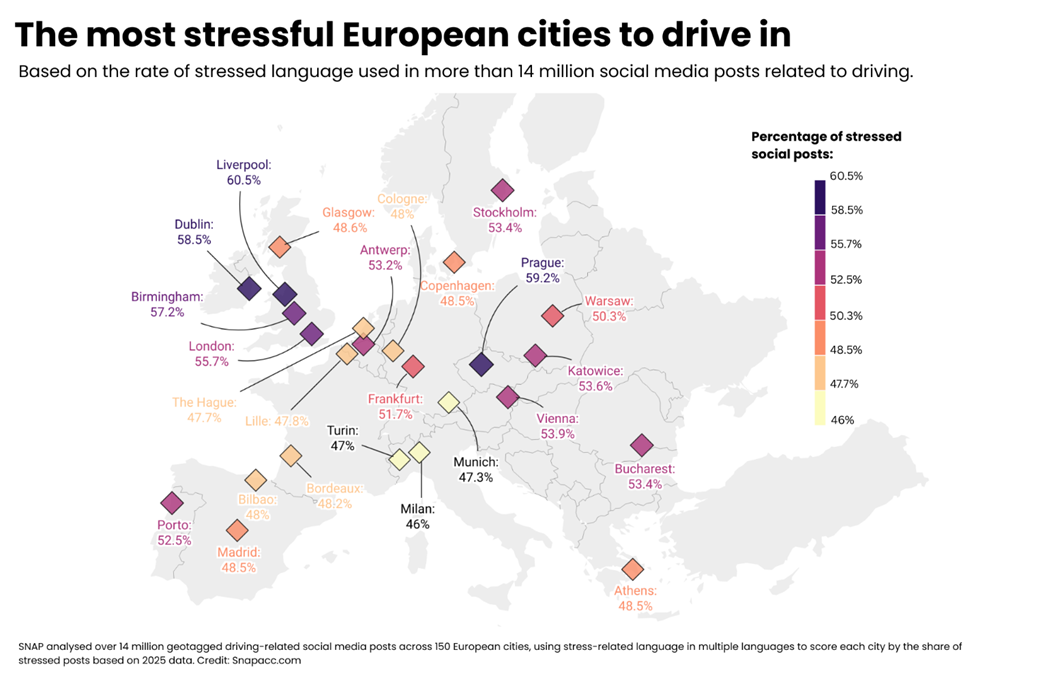
Die stressigsten Städte zum Autofahren

Städte können den Stress für Autofahrer durch Staus, enge Straßen und komplexe Straßenführungen erhöhen.
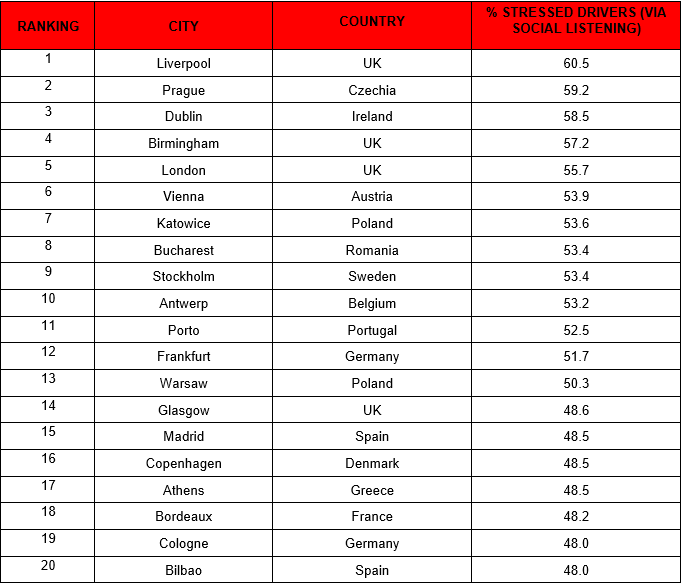
Liverpool (Platz 1), Birmingham (Platz 4) und London (Platz 5) gehören mit Werten zwischen 55,7 % und 60,5 % zu den stressigsten Städten in England. Stau-Hotspots und Engpässe - wie [Liverpool's Mersey Tunnels] (https://www.liverpoolworld.uk/news/mersey-tunnels-chaos-40-minute-delays-4974204) und stark überlastete Strecken wie [London Orbital Motorway (M25)] (https://news.sky.com/story/londons-roads-ranked-most-congested-in-europe-according-to-new-report-13284374) - sind die Hauptursachen für diese hohen Stresswerte.

Dublin liegt auf Platz 3 und ist eine der am stärksten verstopften Städte Europas, mit [durchschnittlichen Verspätungen von 81 Stunden pro Jahr] (https://www.irishtimes.com/transport/2025/01/06/dublin-ranks-as-europes-third-most-congested-city-after-london-and-paris/) aufgrund des starken Verkehrsaufkommens, was den anhaltenden Druck durch Staus auf den städtischen Straßen verdeutlicht.

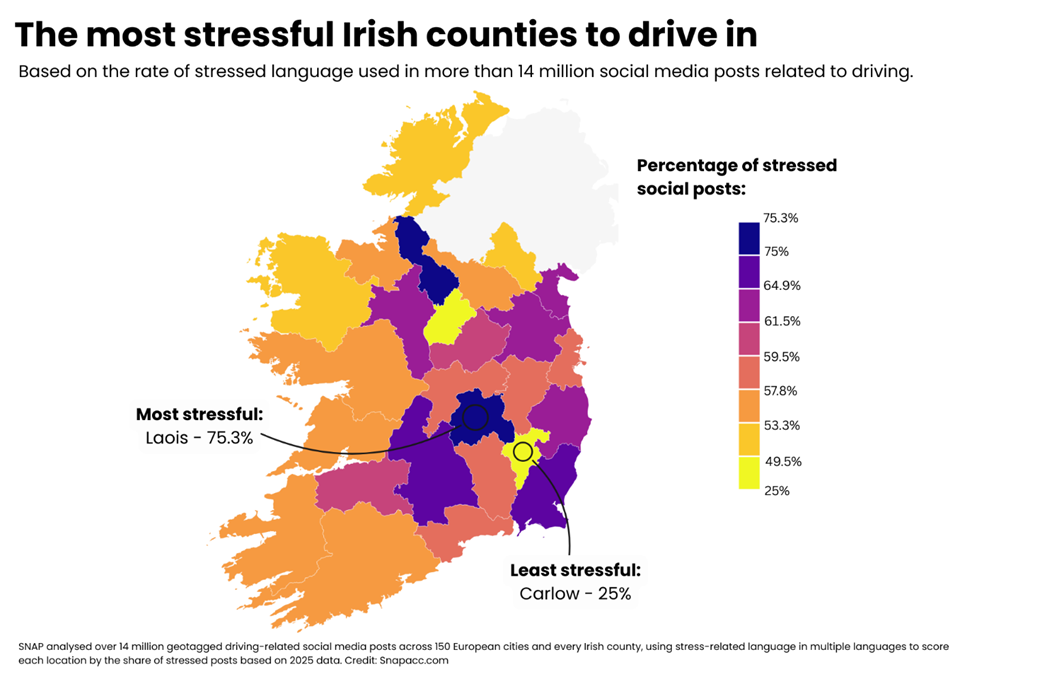
Weitere Befragungen, die sich speziell auf irische Autofahrer konzentrierten, ergaben, dass die Grafschaften Laois und Leitrim mit Werten zwischen 75 % und 75,3 % einen besonders hohen Parkstress aufwiesen. Diese hohen Zahlen verdeutlichen die anhaltenden Herausforderungen für Autofahrer in diesen Gebieten, die größtenteils auf die starke Abhängigkeit vom Auto zurückzuführen sind - [73 % der Pendler in Laois fahren mit dem privaten Auto zur Arbeit], [laut offiziellen Statistiken (Seite. 118)] (https://laois.ie/sites/default/files/2024-05/Appendix%202%20-%20Socio%20Economic%20Profile%20of%20Laois.pdf). Darüber hinaus gibt es in Leitrim lokale Berichte über eine spärliche Straßeninfrastruktur und Liefer-/Parkkonflikte in Städten wie Drumshanbo, die in dieser irischen Grafschaft zum Stress der Fahrer beitragen.
Katowice, Polen (Rang 7) - auch wenn Kattowitz nicht zu den am stärksten verstopften polnischen Städten gehört, so gibt es dennoch [Verspätungen im Berufsverkehr und Verkehrsdruck] (https://www.tomtom.com/traffic-index/katowice-traffic/), wobei die Autofahrer viel Zeit im Verkehr verbringen und auf Hauptverkehrsstraßen wie der S86 und der A4 täglich ein hohes Verkehrsaufkommen herrscht, was zu einem Stresswert von 53,6 % beitragen kann. Ähnlich verhält es sich in Warschau in Polen (Rang 13), wo die Autofahrer etwa 70 Stunden pro Jahr im Verkehr verbringen, was zu einem Stresswert von 50,3 % im Jahr 2025 beiträgt.

Bucharest in Rumänien (Rang 8) ist eine der am stärksten überlasteten Städte Europas, in der die Autofahrer deutlich mehr Zeit im Stau verbringen und [bis zu 12 Arbeitstage pro Jahr] (https://www.romania-insider.com/bucharest-driver-loses-days-annually-traffic-sept-2025) wegen des stockenden Verkehrs verlieren.

Spaniens Hauptstadt Madrid (15.) leidet unter starken Verkehrsstaus, wobei eine 10 km lange Fahrt rund 24 Minuten dauert. Enge Straßen und ständiger Verkehr, vor allem in Gegenden wie Puente de Vallecas, machen das tägliche Fahren langsam und anstrengend. Ähnlich verhält es sich mit Berichten über Unfälle und starkes Verkehrsaufkommen in Bilbao in Spanien (Platz 20) auf wichtigen Strecken wie der A-8 und der BI-30, was zu langen Warteschlangen und langsamem Verkehr führt, was wiederum zu stressigen Fahrbedingungen beiträgt.

Die stressigsten Städte zum Parken

Auch das Parken trägt zum Stress der Fahrer und des Fuhrparkmanagements bei, da die begrenzte Verfügbarkeit, die hohe Nachfrage und die restriktiven Vorschriften in den europäischen Städten die Fahrten verzögern, die Frustration erhöhen und die Routenplanung erschweren können.

Außerdem haben wir durch Social Listening Daten über die Städte gesammelt, in denen Fahrer in ganz Europa den größten Stress beim Parken erleben, insbesondere in Rumänien, Polen, Spanien und Großbritannien. Für Flottenbetreiber ist es wichtig, auf diese Bereiche zu achten, da die begrenzte Verfügbarkeit von Parkplätzen, die hohe Nachfrage und die städtischen Staus den Zeitplan durcheinanderbringen, zu Verspätungen führen und das Wohlbefinden der Fahrer beeinträchtigen können.

Unsere Untersuchung zeigt, dass der Parkstress in Europa in Polen am höchsten ist, wobei Podlachia (83,3 %) und Olsztyn (80 %) mit Problemen wie begrenzten städtischen Parkplätzen und hoher Fahrzeugdichte zu kämpfen haben.

Auch im Vereinigten Königreich sind Newcastle upon Tyne (65,3 %), Liverpool (64,4 %) und Middlesbrough (63,9 %) die Städte mit dem größten Parkstress für Autofahrer. Diese Städte kämpfen mit begrenzten Parkplätzen im Stadtzentrum, [Straßenbenutzungsgebühren] (https://new.newcastle.gov.uk/news/2024/proposed-changes-parking-charges), Staus und [strenge Parkvorschriften] (https://snapacc.com/newsroom/hgv-parking-regulations-in-the-uk-what-every-driver-should-know/) tragen zur Frustration der Autofahrer bei.

Die rumänischen Städte Sibiu und Cluj-Napoca sowie die spanischen Städte Malaga und Bilbao verzeichneten die höchsten Parkstresswerte in ihren jeweiligen Ländern. Im Vergleich zum Vereinigten Königreich und zu Polen sind die Stresswerte jedoch niedriger - sie liegen zwischen 55,6 % und 52,4 % - was darauf hindeutet, dass die Parkbedingungen überschaubarer sind, es weniger Engpässe gibt und der Druck auf die Fahrer in diesen städtischen Gebieten relativ gering ist.

*Unser Ziel bei SNAP ist einfach: Wir wollen den Stress, der mit dem Parken verbunden ist, für Spediteure verringern. Durch die Bereitstellung von Echtzeit-Informationen und intelligenteren Routenoptionen helfen wir den Fahrern, sichere und zugängliche Parkplätze zu finden, was ihre Fahrten stressfreier und effizienter macht.

MATTHEW BELLAMY, GESCHÄFTSFÜHRER, SNAP

Warum erleben Lkw-Fahrer in diesen Städten den größten Stress?

Lkw-Fahrer stehen unter einem anderen Druck als normale Autofahrer. Begrenzte Parkmöglichkeiten für große Fahrzeuge, enge oder verstopfte Straßen und ein hohes Verkehrsaufkommen können das Fahren in der Stadt schwieriger und stressiger machen und Routinefahrten in Zeitdruck und Stress verwandeln.

Lassen Sie uns näher auf die Faktoren eingehen, die Stress für Lkw-Fahrer verursachen:

  • Limited parking for large vehicles. Scarce lorry bays and high demand make it hard to find safe places to stop, especially in urban centres. The RHA’s Roadside Facilities campaign reports an estimated shortage of 11,000 lorry parking spaces in the UK, creating significant stress for HGV drivers who struggle to find safe and legal places to park., creating significant stress for HGV drivers who struggle to find safe and legal places to park.
  • Narrow streets and complex urban layouts. Tight roads and historic city centres require careful navigation, increasing stress and risk of delays in cities like Prague, Dublin, and Liverpool.
  • High traffic volumes and congestion. Heavy commuter and freight traffic slows journeys, increases travel times, and heightens frustration particularly in busier cities like London, Birmingham, Bucharest, and Madrid.
  • Low-emission or Clean Air Zones. Restrictions on vehicle access, extra charges, and rerouting requirements can complicate planning and add pressure. For example, low emission zones in Spain require some HGVs to seek alternate routes.
  • Route restrictions and delivery schedule. Height and weight limits, prohibited turns, and time-specific delivery windows force drivers onto longer or less convenient routes.
  • Isolation and limited facilities. Long urban journeys without access to rest areas, fuelling, or amenities can increase fatigue and mental strain for HGV drivers.

Was bedeuten stressige Städte für Lkw-Fahrer?

Stressige Städte stellen die Lkw-Fahrer vor Herausforderungen. Staus, begrenzte Parkmöglichkeiten und komplexe Stadtstrukturen können zu Zeitverlusten, verpassten Lieferungen, erhöhter Müdigkeit und einem höheren Risiko kleinerer Kollisionen oder Beinaheunfällen führen.

Fahrer können Stress abbauen, indem sie ihre Routen sorgfältig planen, geplante Pausen einlegen und Technologien nutzen, um Verspätungen vorauszusehen oder bei der Budgetierung zu helfen. SNAP unterstützt die Fahrer mit Tools wie der intruck-App, die ihnen hilft, verfügbare Parkplätze zu finden, effiziente Routen zu planen und über Staus informiert zu bleiben, was den Stress reduziert und die Lkw-Fahrten sicherer und überschaubarer macht.

Was bedeuten stressige Städte für die Betreiber von LKW-Flotten?

Stressige Städte wirken sich nicht nur auf die Fahrer, sondern auch auf die Leistung der Flotte aus. Staus und begrenzte Parkmöglichkeiten können zu verspäteten Lieferungen, höheren Kraftstoff- und Betriebskosten, geringerem Wohlbefinden der Fahrer und einem erhöhten Risiko von Bußgeldern oder Strafen führen. Dieser Druck kann sich auf die Gewinnspannen auswirken und die Zeitplanung, [Fahrerbindung oder -mangel] (https://snapacc.com/newsroom/uk-driver-shortage-are-numbers-improving/) und die Kundenzufriedenheit erschweren.

Flottenbetreiber können diese Herausforderungen meistern, indem sie [intelligentere Strategien] (https://snapacc.com/newsroom/6-fleet-management-strategies-that-will-transform-your-bottom-line/) und Unterstützungssysteme einsetzen: Nutzung von Echtzeit-Verkehrs- und Parkinformationen, Erstellung flexibler Zeitpläne und [Priorisierung von Ruhe und Wohlbefinden der Fahrer] (https://snapacc.com/newsroom/how-can-the-haulage-industry-support-driver-mental-health/).

Die SNAP-Flottenzahlungslösung, die bei über 850 Servicepartnern in ganz Europa erhältlich ist, wird auf dem gesamten Kontinent alle 12 Sekunden zur Bezahlung von Lkw-Dienstleistungen genutzt - ohne Bargeld oder Karte.

Europas Städte sollen für Lkw-Fahrer weniger stressig werden

Die Kenntnis der Stress-Hotspots beim Fahren und Parken in ganz Europa hilft Fuhrparks, sicherer und effizienter zu arbeiten. Indem sie diese Erkenntnisse für die Routenplanung, die Fahrerschulung, die Einführung von Technologien und die Risikominderung nutzen, können die Betreiber Verspätungen reduzieren, das Wohlbefinden verbessern und ihre Fahrer schützen. SNAP unterstützt die Fuhrparks bei dieser Aufgabe, indem es sicheres Parken, nahtlose Zahlungen und Tools bietet, die den täglichen Betrieb ruhiger und sicherer machen.

HEUTE NOCH ANMELDEN

Teilen mit

Andere lesen auch...

Header Image

Donnerstag 11 Juni 2026 • Nachrichten und Updates

WM-FAHRTEN VS. REALITÄT IM STRASSENGÜTERVERKEHR: WIE EUROPAS LKW-FAHRER JEDE WOCHE DIE TURNIERSTRECKEN ZURÜCKLEGEN

Lucy Black

When football fans think about the FIFA World Cup, they think about big matches, packed stadiums and long journeys.And in 2026, those journeys will be bigger than ever.The expanded FIFA World Cup will feature 48 teams, 104 matches and 16 host cities spread across the United States, Canada and Mexico. It will be the largest and most geographically dispersed World Cup ever staged.Millions of supporters will travel across North America. Teams will cover thousands of kilometres throughout the tournament. Billions of pounds will be spent. Vast amounts of equipment, merchandise, food, drink and technology will need to be moved between venues.But while football fans focus on the journeys made by players and supporters, there is another group of professionals covering similar distances every month.Europe's truck drivers.In fact, a truck driver in Spain could cover more than 10,000 kilometres in just four weeks. That's comparable to the distance some teams could travel throughout an entire World Cup campaign.There's another important similarity too.Without logistics, there is no World Cup.As , explains:Every match, every fan zone and every broadcast relies on goods being delivered to the right place at the right time. From food and drink to merchandise, security infrastructure and broadcasting equipment, road transport plays a critical role behind the scenes.The reality is simple. While football takes centre stage, logistics makes it possible.The 2026 tournament will create one of the most complex logistics operations ever seen in sport.Unlike previous World Cups hosted in a single country, teams could be travelling thousands of kilometres between fixtures throughout the competition.For players, those journeys will be carefully planned and supported by charter flights, recovery teams and world-class facilities.For truck drivers, covering long distances is simply part of everyday life.Across Europe, drivers move goods between manufacturers, ports, warehouses, retailers and customers every day. They connect supply chains, support businesses and keep economies moving.The scale of logistics required for a global event like the World Cup is enormous.As , explains:Every screen, every item of merchandise, every catering delivery and every piece of technical equipment must arrive exactly where it is needed.The same expertise that helps major sporting events run smoothly is being used every day across Europe's transport networks.A team progressing from the group stages to the final could realistically travel between 8,000 and 15,000 kilometres during the 2026 FIFA World Cup.To put that into perspective, SNAP compared projected World Cup travel distances against the average weekly mileage completed by truck drivers across some of Europe's largest freight markets.The results show that truck drivers across Europe routinely cover World Cup-level distances in as little as four weeks.In Spain, Portugal, the Netherlands and Poland, drivers can cover close to or more than 10,000 kilometres over a month.While football teams travel with dedicated support staff and carefully planned schedules, drivers achieve similar distances while managing delivery deadlines, congestion, border crossings, parking shortages and increasingly complex transport networks.It is a reminder of the scale of modern road freight and the critical role drivers play in keeping supply chains moving.Comparing distances only tells part of the story.Players travel between matches.Drivers travel whilst managing deliveries, navigating road networks, complying with regulations and keeping customers supplied.Every week, millions of tonnes of goods move across Europe, supporting supermarkets, manufacturers, construction projects, healthcare providers and countless other industries.The distances may be similar.The challenges are not.Road freight remains the backbone of European trade.Around 75% of inland freight transport across the European Union is moved by road when measured in tonne-kilometres.Every year, billions of tonnes of goods travel across Europe's road networks.Behind every delivery is a transport operation built on the expertise of drivers, fleet managers and logistics professionals.Major sporting events simply make that reality more visible.The World Cup creates additional demand for food, beverages, merchandise, security equipment and event infrastructure. The pressure on transport networks increases significantly.But for transport operators, managing complex logistics is not a once-every-four-years challenge.It's business as usual.Large sporting events often highlight challenges that fleet operators deal with every day.Research from previous World Cups and Olympic Games has shown that host cities experience increased congestion, higher freight demand and greater pressure on transport infrastructure.During major sporting tournaments, cities often see:Increased congestion Higher demand for food and beverage deliveries Greater pressure on parking facilities Increased demand for security logistics Additional passenger transport requirements More complex route planningAs , points out:He's right.Whether it's food and drink for supporters, retail stock, security infrastructure or broadcast technology, major events place huge demands on logistics networks.For fleet managers, those operational pressures are familiar territory.While football teams rely on coaches, analysts and support staff, supply chains rely on drivers.Yet Europe's transport sector continues to face significant challenges.There is an estimated shortage of around 390,000 secure truck parking spaces across Europe.At the same time, driver shortages remain a major concern across many markets.Without drivers, supply chains stop.Without safe, secure places to rest, attracting and retaining drivers becomes even more difficult.As , explains:It's a simple observation, but it highlights an important truth.Whether it's a major sporting tournament or a normal weekend, drivers are the people making sure shelves stay stocked, businesses stay supplied and customers get what they need.For fleet managers, investing in driver welfare is no longer a nice-to-have.It's a business necessity.Providing access to secure parking, quality facilities and efficient payment solutions helps improve driver satisfaction, supports retention and drives operational efficiency.The biggest lesson from the World Cup isn't about football.It's about preparation.The teams that perform best are supported by planning, logistics and infrastructure that allows them to perform when it matters most.The same applies to transport operations.The fleets best positioned for success are those investing in:Driver welfare Secure truck parking Operational visibility Smarter transport payments Fleet efficiency Transport technology Simplified fleet managementThe journeys completed by football teams during the World Cup may capture the headlines.But they also provide a useful reminder of the distances being covered by Europe's transport industry every single day.From Spain and Portugal to Poland, Romania and the United Kingdom, professional drivers routinely travel extraordinary distances whilst supporting businesses, communities and supply chains across the continent.While the world's best footballers compete on the biggest stage, millions of drivers will continue doing what they do every day: keeping goods moving and economies running.At SNAP, we're proud to support those journeys through smarter transport payments, better access to truck parking and driver facilities, and solutions designed to make life easier for fleets and drivers alike.Because while the World Cup only lasts a few weeks, Europe's transport industry operates at that scale every single day.

Header Image

Mittwoch 25 März 2026 • Nachrichten und Updates

WIE PRÄDIKTIVE SYSTEME DIE UNSICHERHEIT BEI DER LIEFERUNG BÄNDIGEN

Evelyn Long

Delivery operations rarely unfold exactly as planned. Even the most carefully designed logistics schedules must contend with an unpredictable world. Travel congestion can add hours to a route, severe weather can delay entire regions and a single vehicle breakdown can disrupt dozens of deliveries scheduled throughout the day. When these disruptions occur, they often create a chain reaction that affects drivers, warehouses, customers and operational costs. For companies that operate fleets, whether they deliver packages, medical supplies, food or construction materials, this uncertainty can significantly impact business performance. Missed delivery windows frustrate customers and can damage brand reputation. Delays can also increase fuel costs, overtime pay and operational inefficiencies. In industries where margins are tight, even small disruptions can add up quickly.What makes delivery uncertainty especially challenging is how interconnected modern logistics networks have become. A delay at one point in the system can ripple outward, affecting multiple routes and schedules. Without the right tools to anticipate and manage these disruptions, businesses are often forced to react in real time, which can lead to rushed decisions and inefficient solutions.One of the key technologies helping organisations manage delivery uncertainty is the Internet of Things (IoT). IoT refers to networks of connected devices, such as sensors, GPS trackers and telematics systems, that connect and transmit real-time data from vehicles, equipment and infrastructure. In fleet operations, IoT devices can monitor a wide range of conditions. GPS tracking for vehicles on the road. Engine sensors can track vehicle performance and detect early signs of mechanical issues. Temperature sensors can ensure that sensitive cargo remains within required conditions during transit. Together, these data streams create a detailed picture of what’s happening across an entire delivery network. This level of visibility is essential for managing uncertainty. When managers can see where vehicles are, how they’re performing and whether any issues are developing, they can respond much faster. Instead of discovering a problem hours later, they can address it as soon as the warning signs appear. In many cases, this visibility also feeds into predictive systems that analyse the data and forecast potential disruptions before they occur. While IoT provides the data, AI offers the intelligence needed to interpret it. AI systems analyse large volumes of operational information, including traffic patterns, weather forecasts, vehicle performance metrics, delivery history and route efficiency. By identifying patterns in this data, to occur and recommend adjustments. For example, predictive algorithms can analyse historical traffic conditions along a delivery route and estimate when congestion is likely to occur during certain times of day. If the system detects that a particular route will likely experience delays, it can suggest an alternative path before the driver even leaves the depot. Similarly, AI-driven maintenance systems can analyse engine data and identify early warning signs of mechanical problems, allowing repairs to be scheduled before a breakdown occurs on the road. Predictive systems work best when they combine data from multiple sources and translate that information into actionable insights. In a fleet environment, this often means integrating vehicle telematics, weather data, delivery schedules and live traffic information into a single predictive platform. When all of this data is analysed together, the system early. For example, if a severe storm is forecasted along a delivery route, the network can recommend adjusting departure times or rerouting drivers to avoid affected areas. If sensors detect that a vehicle component is likely to fail soon, it can schedule maintenance during planned downtime rather than allowing a breakdown to disrupt deliveries. Over time, these predictive adjustments make delivery operations smoother and more efficient. Routes become more optimised because the system continually learns from previous trips. Maintenance becomes strategic because vehicles are rather than fixed schedules. Even warehouse operations can improve, since more accurate delivery predictions allow teams to better coordinate loading and unloading processes. Beyond preventing disruptions, predictive systems also help fleets operate more efficiently. Businesses that have access to reliable forecasts and operational insights can plan routes, staffing and vehicle usage with greater precision.For instance, predictive analytics can identify patterns in delivery demand, allowing companies to allocate resources where they’re most needed. If certain routes consistently experience delays during specific hours, schedules can be adjusted to avoid those peak periods. Fuel usage can also be optimised by identifying more efficient routes or driving patterns. Over time, these incremental improvements add up. Vehicles spend less time idling in traffic, drivers spend more time completing deliveries rather than waiting or rerouting, and customers receive more accurate delivery estimates, and satisfaction. Another key benefit of predictive technology is the ability to monitor and control systems remotely. As connected devices become more common, consumers and businesses expect this level of oversight and convenience. A survey found that smart garage door openers consider remote monitoring and control to be a crucial feature. While this statistic relates to residential technology, it highlights a broader shift in expectations. People increasingly value the ability to check on systems, receive alerts and manage operations from anywhere. The same mindset is becoming more important in professional logistics environments. Fleet managers want to see vehicle locations in real time, receive notifications about potential issues and make adjustments without needing to be physically present. Predictive systems support this capability by turning complex operational data into clear, actionable insights that can be assessed remotely. While predictive systems provide clear advantages, they also introduce new considerations that businesses must address. In 2024, the of suspected internet crime. As fleets become more connected and reliant on digital platforms, cybersecurity becomes increasingly important. IoT devices, cloud platforms and AI-driven systems all rely on network connectivity and data exchange. Systems that aren’t properly secured could become targets for cyberattacks. A compromised system could disrupt operations, expose sensitive data or interfere with fleet management tools.Delivery uncertainty may never disappear entirely, but predictive systems are making it far more manageable. By combining IoT connectivity with AI-driven analytics, fleet operators can gain deeper visibility into their operations and anticipate problems before they disrupt schedules. As these technologies continue to evolve, they will play an important role in helping fleet-based businesses reduce uncertainty, streamline operations and deliver a more consistent experience for their customers.Discover more from

Header Image

Mittwoch 11 März 2026 • Nachrichten und Updates

PROAKTIVE TIPPS FÜR DIE SICHERHEIT UND LEISTUNG DES FUHRPARKS ZU JEDER JAHRESZEIT

Guest

Fleet performance rarely unravels overnight. It slips through small oversights — a missed service interval, worn tread or a delayed depot repair. As a UK fleet manager, the cost of reacting late shows up in downtime, higher insurance premiums and risk to your reputation.Your proactive, seasonal strategy protects the vehicles, drivers and infrastructure before temperature-triggered issues escalate. Align maintenance cycles with weather patterns, operational peaks and compliance demands. Your fleet will be steadier, safer on the road and reduce unwelcome surprises.Reactive fleet management costs you more. Emergency repairs can disrupt tight schedules, strain budgets and frustrate even the best drivers. In contrast, effective forward planning can reduce unplanned downtime and extend vehicle life cycles.Predictive maintenance and seasonal checks are strategic in supporting compliance. The Driver and Vehicle Standards Agency can for roadworthiness at any time, not just during the annual inspection. A prevention-first culture demonstrates your team’s due diligence and strengthens your Operator Compliance Risk Score, without warning.Driver retention links closely to this mindset. Vehicles that are reliable in winter, maintain cabin comfort in summer and feel safe in poor weather send a clear message that your organisation values professionalism and safety.Longer daylight hours and increased road activity shift risk profiles. Construction zones expand, cyclists and pedestrians increase and higher temperatures stress mechanical systems.Introduce quarterly automobile network checks before weather changes set in.: Ensure all vehicles’ air conditioning systems operate efficiently. Comfortable drivers remain more alert and calm on long routes and in heavy traffic, while being hot and bothered behind the wheel fosters reckless driving. : Check radiators, coolant levels and hoses. Heat accelerates wear and can trigger overheating if systems run hot due to environmental factors. : Rising temperatures can affect tyre pressure. Confirm correct inflation and inspect for sidewall damage to reduce the risk of blowouts. Hot road surfaces also wear tyre tread more easily, affecting braking capacity. Reinforce safe driving techniques that consider sun glare, roadworks and higher traffic density. Consider installing tinted windshields when drivers face extreme light conditions.Heat amplifies even minor engine weaknesses. Address mechanical safety early, and you'll prevent mid-season breakdowns or disrupted delivery windows.Shorter days, heavy rain and icy surfaces demand that your team is on top of their game. Autumn brings leaves and debris that litter already-slick roadways, and winter compounds the challenge with frost and failing batteries. Prepare before these conditions set in to keep your mobile assets from deteriorating:: Inspect all headlights, brake lights and indicators. Replace worn wipers, top up the windshield washer reservoirs with de-icing chemicals rated for low-temperature use and add anti-freeze to radiators. : Confirm adequate grip depth on all wheels for additional safety on wet and icy roads and consider swapping to winter sets where routes justify the investment. This is also an ideal time to check your fleet’s tyre ages, as no commercial vehicle may be on the road in the UK with ago, which are considered unroadworthy. : Cold weather reduces battery efficiency. Test older units and replace those nearing the end of life. Trickle chargers help maintain truck batteries' charge when drivers must stop to meet their rest requirements. : Low light and adverse weather can trigger anyone's natural sleep instinct, so manage drivers' alertness levels. Review route planning and rest policies to reduce strain or assign two drivers on longer routes.Vehicle readiness supports road safety, yet infrastructure also plays a role. Poor depot lighting, icy yard surfaces or malfunctioning entry points can delay departures and create hazards before trucks even reach public roads.Mobile asset safety starts at the depot. Vehicles often sit for hours in storage yards or warehouses. A compromised facility exposes high-value assets to theft, weather damage and operational delay. Commercial lots or warehouses are vulnerable matter.Rolling doors and access points demand particular attention in the UK’s damp climate. Corrosion frequently begins at exterior door components, affecting guides and structural elements. Over time, degradation can trigger failures that halt departures or compromise security. Noncorrosive rolling doors made with , like stainless steel, provide safety for the fleet’s vehicles and secure valuable manifests at depots.Businesses operating in high-moisture or coastal environments should invest in corrosion-resistant products. Use cleaning agents and lubricants to prevent hinges and mechanisms from seizing up. Functional doors safeguard operations because a primary access door that fails during peak dispatch hours can result in vehicles missing slots and customer confidence slipping. Proactive facility maintenance reduces that risk.Broader property readiness matters, too. Seasonal inspections of drainage, roofing and external lighting strengthen operational continuity at all hours of the day. Thorough winter preparation should prevent structural and water-related damage. Treat your depot as part of the company's mobility ecosystem by securing doors and maintaining clean yard surfaces. Resilient infrastructure protects vehicles before they reach the road.Technology strengthens your seasonal planning. Telematics platforms provide a wealth of information, including identifying braking patterns, fuel efficiency shifts and early warning codes before faults escalate. Advanced driver-assistance systems add further safeguards, particularly in low-visibility conditions.Use AI to help you analyse data and create workflows that meet each season’s changing needs. Data-driven insights inform scheduling. Use analytics to identify recurring battery failures in cold-region trucks or cooling issues during summer peaks. Adjust the fleet's scheduled maintenance according to telematics guidance.Modern trucks with telematics can of data per minute from hundreds of sensors, which is only useful if you have the computing systems to extrapolate findings and trends that inform maintenance and performance schedules.Proactive company asset management evolves beyond checklists. It becomes a continuous improvement process informed by data, temperatures and infrastructure integrity.Seasonal transitions present predictable challenges from heat-stressing engines, cold-draining batteries and moisture corroding structural components. Increased traffic and vehicle use alter risk patterns.Address these variables before they disrupt your team’s operations. Align maintenance cycles with weather trends, reinforce driver training ahead of weather shifts and invest in resilient depot infrastructure.A fleet that anticipates change operates with confidence and performs consistently with improved safety metrics and decreased downtime. Those incremental advantages compound into measurable operational strength.