Josh Cousens
Nyheder og opdateringer • 5 min læsning

Europas mest stressende byer at parkere og køre i

Oprettet: 14.01.2026

Opdateret: 15.01.2026

At køre og parkere i Europas byer kan være en daglig hovedpine for lastbilchauffører - og et højt stressniveau påvirker ikke kun velværet, men også flådens effektivitet. For logistikchefer er det afgørende at vide, hvor disse udfordringer er størst, når det gælder ruteplanlægning, chaufførsikkerhed og driftsresultater.

Ved at bruge social lytning til at analysere millioner af geotaggede indlæg i 150 europæiske byer identificerer vores forskning de steder, som bilister finder mest stressende. Liverpool topper listen (60,5 % af indlæggene viser kørselsrelateret stress), efterfulgt af Prag (59,2 %) og Dublin (58,5 %). Liverpool ligger også på 2. pladsen over de mest stressende byer i Storbritannien, når det gælder parkering. Trængsel, mangel på parkeringspladser og vanskelige vejforhold er de største irritationsmomenter, som bilister i hele Europa fremhæver.

Denne undersøgelse kortlægger Europas hotspots for lastbilstress ved hjælp af chaufførernes følelser i den virkelige verden og viser, hvordan byforholdene påvirker trivslen. Det handler ikke om at rangordne lande, men om at give flåde- og logistikchefer klar og brugbar indsigt, så de kan støtte chaufførerne, planlægge smartere ruter og reducere kørselspresset i byerne.

Lytter til chaufførernes erfaringer

Vores forskning analyserede over 14 millioner geotaggede indlæg på sociale medier fra 150 europæiske byer, der dækkede kørselsrelaterede emner som parkering, trafik og vejforhold. Indlæggene blev vurderet for stress ved at spore nøgleord og sætninger, der var forbundet med negative følelser på engelsk og lokale sprog. Hver by fik en score baseret på procentdelen af indlæg, der udtrykte stress, hvilket gav et klart billede af presset på bilisterne i hele Europa. Data blev indsamlet på tværs af de store sociale medieplatforme X (tidligere Twitter) i hele 2025.

"Stress" dækker over det pres, flådechauffører udsættes for på vejen, herunder trafik, parkering, vejforhold, generel kørsel og konflikter med andre chauffører. Forståelse af disse faktorer hjælper flådeoperatører med at støtte chaufførernes trivsel og præstationer.

*"Når vi ved, hvilke byer der er mest stressende for lastbilchauffører, kan SNAP målrette løsninger, der forbedrer både sikkerhed og effektivitet."

MATTHEW BELLAMY, ADMINISTRERENDE DIREKTØR, SNAP.

Stressede byer i EU: De vigtigste resultater

Fra 2025 for de mest stressende byer at køre i:

  1. Liverpool, Storbritannien. 60,5 % af de stressede sociale indlæg handler om parkering - den højeste andel af stressrelaterede indlæg om bilkørsel i Europa.
  2. Prag, Tjekkiet. 59,2 % af stressede sociale opslag om parkering, sandsynligvis på grund af tæt trafik, historisk gadedesign og begrænset plads til større køretøjer, der navigerer i byen.
  3. Dublin, Irland. 58,5 % af stressede sociale opslag om parkering - førerens stress er stærkt forbundet med forsinkelser i trafikken, mangel på parkering og travle pendlerruter, der påvirker de daglige kørselsforhold.

De 3 mest stressende britiske byer for parkering i 2025:

  1. Newcastle upon Tyne. Almindeligvis forkortet til "Newcastle" og beliggende i amtet Tyne and Wear, har denne by svimlende 65,3 % af de stressede sociale opslag om parkering, hvilket gør den til den mest stressende britiske by for parkering i 2025.
  2. Liverpool. I Merseyside er 64,4 % af de sociale opslag om parkering i Liverpool udtryk for stress.
  3. Middlesbrough. 63,9 % af de stressede sociale opslag om parkering i denne by i North Yorkshire.

Skotland viser også forhøjet parkeringsstress, hvor Edinburgh (61,6 % af stressede sociale opslag om parkering) og Glasgow (61,4 % af stressede sociale opslag om parkering) rangerer blandt Storbritanniens mest udfordrende byer at parkere i. Derudover er London rangeret som det 17. mest stressende sted at parkere (57,9 af de stressede sociale indlæg om parkering. Medvirkende faktorer kan være smalle gader, tætte byområder, stor efterspørgsel efter begrænsede parkeringspladser og restriktioner i bymidten, som kan øge presset på bilisterne.

Stress-hotspots for europæiske bilister

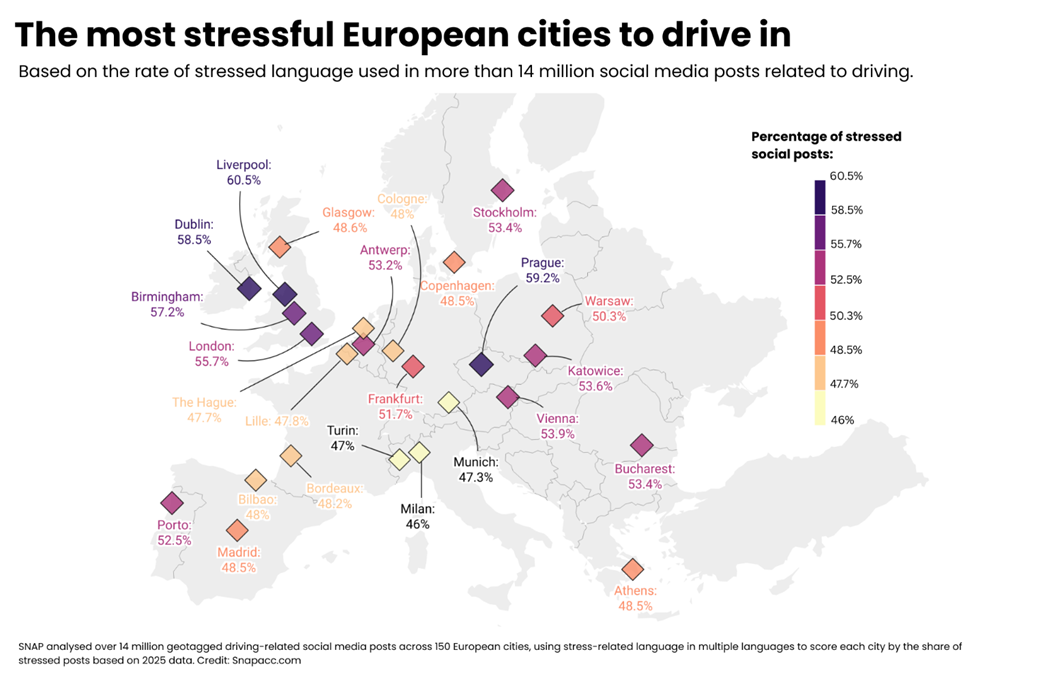
Ved hjælp af millioner af geotaggede opslag på de sociale medier har vi vurderet hver by ud fra andelen af stressrelaterede opslag, afsløret Europas bedste steder at køre og parkere og fremhævet de byforhold, der udfordrer bilisterne mest.

Vores infografik viser de byer, hvor der er størst pres på kørsel og parkering, og afslører de vigtigste hotspots i byerne og de udfordringer, som bilisterne står over for på hvert marked.
De mest stressende byer at køre i

Byer kan øge førerens stress på grund af trængsel, smalle gader og komplekse vejforløb.
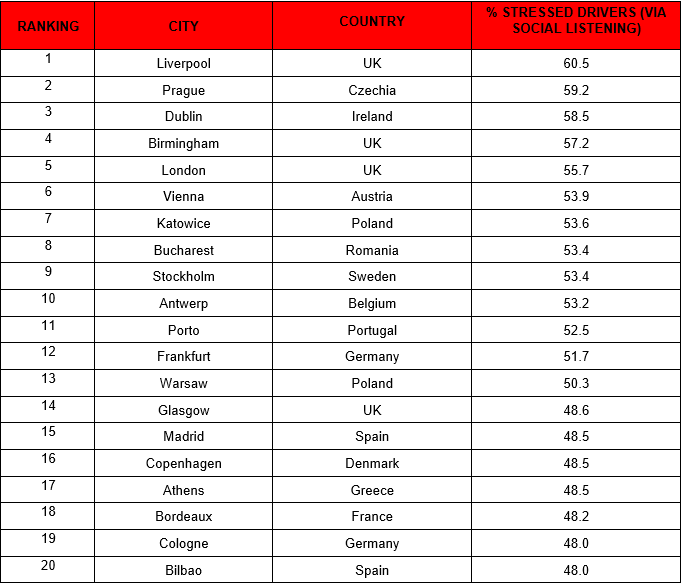
Liverpool (nr. 1), Birmingham (nr. 4) og London (nr. 5) er alle blandt de mest stressende byer at køre i England, med mellem 55,7% og 60,5% stressscore. Trængselshotspots og flaskehalse - såsom Liverpools Mersey Tunnels og stærkt overbelastede ruter som London Orbital Motorway (M25) - er vigtige bidragsydere til disse forhøjede stressniveauer.

Dublin ligger på 3. pladsen og er en af Europas mest overbelastede byer, hvor [bilister i gennemsnit forsinkes med 81 timer om året] (https://www.irishtimes.com/transport/2025/01/06/dublin-ranks-as-europes-third-most-congested-city-after-london-and-paris/) på grund af tæt trafik, hvilket understreger det vedvarende pres på vejene i byerne.

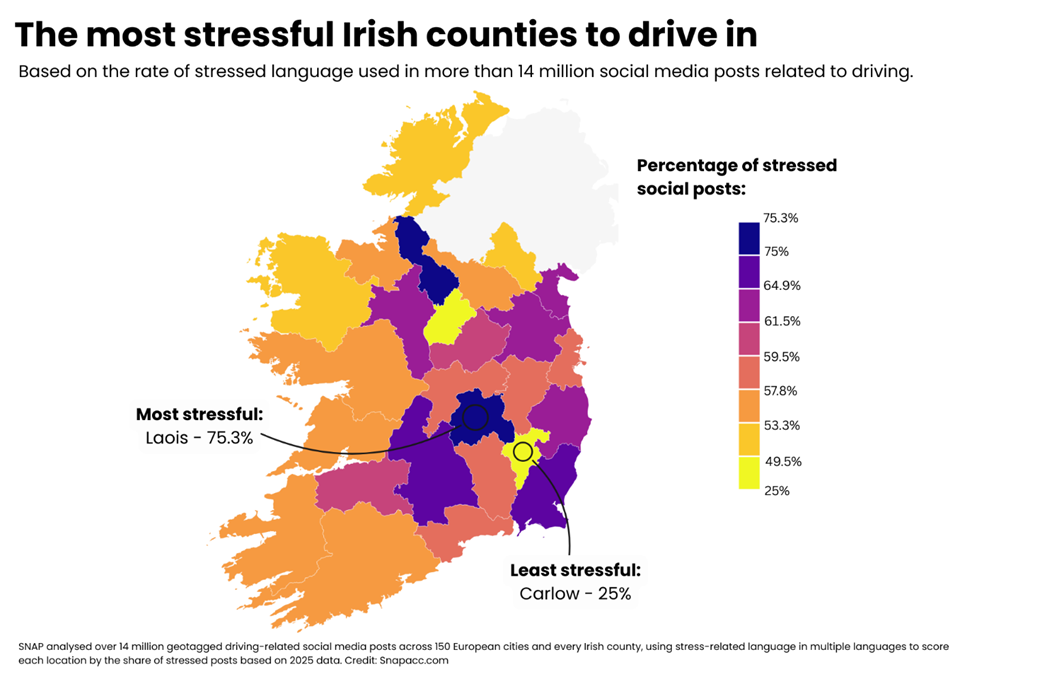
Yderligere social lytning med specifikt fokus på irske bilister afslørede, at amterne Laois og Leitrim registrerede særligt høje parkeringsstressniveauer med scorer fra 75 % til 75,3 %. Disse høje tal fremhæver vedvarende udfordringer for bilister i disse områder, der i høj grad er drevet af stor bilafhængighed - [73 % af pendlerne i Laois kører til arbejde i privatbil], ifølge officielle statistikker (side 118). Derudover har Leitrim lokale rapporter om sparsom vejinfrastruktur og leverings/parkeringskonflikter i byer som Drumshanbo, der bidrager til stress hos chaufførerne i dette irske amt.
Katowice, Polen (nr. 7) - selvom den ikke er en af de mest overbelastede polske byer generelt, oplever Katowice stadig forsinkelser for pendlere og trafikpres, hvor bilisterne bruger meget tid i trafikken, og store veje som S86 og A4 oplever store daglige trafikmængder, der kan bidrage til stressscoren på 53,6 %. I Warszawa i Polen (på 13. pladsen) tilbringer bilisterne cirka 70 timer om året i trafikken, hvilket bidrager til en stressscore på 50,3 % i 2025.

Bukarest i Rumænien (på 8. pladsen) er en af Europas mest overfyldte byer med berygtet trængsel, hvor bilisterne tilbringer betydeligt mere tid i kø og [mister op til 12 arbejdsdage om året] (https://www.romania-insider.com/bucharest-driver-loses-days-annually-traffic-sept-2025) på grund af langsom trafik.

Spaniens hovedstad, Madrid (15.), lider under stor trængsel, hvor en 10 km tur tager omkring 24 minutter. Smalle gader og vedvarende trafik, især i områder som Puente de Vallecas, gør den daglige kørsel langsom og stressende. På samme måde er der rapporter om ulykker og tung trafik i Bilbao i Spanien (rangeret som nummer 20) på vigtige ruter som A-8 og BI-30, hvilket forårsager lange køer og langsom kørsel, som bidrager til stressende kørselsforhold.

De mest stressende byer at parkere i

Parkering bidrager også til stress hos chauffører og flådestyring, da begrænset tilgængelighed, stor efterspørgsel og restriktive regler i Europas byer kan forsinke rejser, øge frustrationen og komplicere ruteplanlægningen.

Gennem social lytning har vi også indsamlet data om de byer, hvor chauffører oplever mest stress, når de parkerer i hele Europa, især i Rumænien, Polen, Spanien og Storbritannien. Det er vigtigt for flådeoperatører at være opmærksomme på disse områder, da begrænset tilgængelighed af parkeringspladser, stor efterspørgsel og trængsel i byerne kan forstyrre tidsplaner, øge forsinkelser og påvirke chaufførernes velbefindende.

Vores undersøgelser viser, at den største parkeringsstress i Europa findes i Polen, hvor Podlachia (83,3 %) og Olsztyn (80 %) står over for problemer som begrænsede parkeringspladser i byerne og høj biltæthed.

I Storbritannien er Newcastle upon Tyne (65,3 %), Liverpool (64,4 %) og Middlesbrough (63,9 %) ligeledes de byer, hvor bilisterne oplever mest parkeringsstress. Disse byer kæmper med begrænsede parkeringspladser i centrum, afgifter på gaden, trafikpropper og strenge parkeringsregler, som bidrager til bilisternes frustration.

De rumænske byer Sibiu og Cluj-Napoca samt de spanske byer Malaga og Bilbao havde de højeste niveauer af parkeringsstress i deres respektive lande. Sammenlignet med Storbritannien og Polen er deres stressscorer dog lavere - fra 55,6 % til 52,4 % - hvilket tyder på mere håndterbare parkeringsforhold, færre flaskehalse og relativt mindre pres på bilisterne i disse byområder.

"Hos SNAP er vores mål enkelt: at reducere parkeringsrelateret stress for vognmænd. Ved at levere information i realtid og smartere rutevalg hjælper vi chauffører med at finde sikker og tilgængelig parkering, hvilket gør deres rejser mindre stressende og mere effektive."

MATTHEW BELLAMY, ADMINISTRERENDE DIREKTØR, SNAP.

Hvorfor oplever lastbilchauffører mest stress i disse byer?

Lastbilchauffører er udsat for et andet pres end almindelige bilister. Begrænset parkering til store køretøjer, navigering i smalle eller overbelastede gader og store trafikmængder kan gøre bykørsel mere udfordrende og stressende og gøre rutinemæssige rejser til tidspressede, stressende oplevelser.

Lad os dykke dybere ned i de faktorer, der forårsager stress hos lastbilchauffører:

  • Limited parking for large vehicles. Scarce lorry bays and high demand make it hard to find safe places to stop, especially in urban centres. The RHA’s Roadside Facilities campaign reports an estimated shortage of 11,000 lorry parking spaces in the UK, creating significant stress for HGV drivers who struggle to find safe and legal places to park., creating significant stress for HGV drivers who struggle to find safe and legal places to park.
  • Narrow streets and complex urban layouts. Tight roads and historic city centres require careful navigation, increasing stress and risk of delays in cities like Prague, Dublin, and Liverpool.
  • High traffic volumes and congestion. Heavy commuter and freight traffic slows journeys, increases travel times, and heightens frustration particularly in busier cities like London, Birmingham, Bucharest, and Madrid.
  • Low-emission or Clean Air Zones. Restrictions on vehicle access, extra charges, and rerouting requirements can complicate planning and add pressure. For example, low emission zones in Spain require some HGVs to seek alternate routes.
  • Route restrictions and delivery schedule. Height and weight limits, prohibited turns, and time-specific delivery windows force drivers onto longer or less convenient routes.
  • Isolation and limited facilities. Long urban journeys without access to rest areas, fuelling, or amenities can increase fatigue and mental strain for HGV drivers.

Hvad betyder stressede byer for lastbilchauffører?

Stressede byer skaber udfordringer for lastbilchauffører. Trængsel, begrænset parkering og kompleks byplanlægning kan føre til tidstab, manglende leverancer, øget træthed og en højere risiko for mindre kollisioner eller nærved-ulykker.

Chauffører kan håndtere stress ved at planlægge ruter omhyggeligt, tage planlagte pauser og bruge teknologi til at forudse forsinkelser eller hjælpe med budgettering. SNAP støtter chauffører med værktøjer som intruck-appen, der hjælper dem med at finde ledige parkeringspladser, planlægge effektive ruter og holde sig orienteret om trafikpropper, hvilket reducerer stress og gør HGV-rejser mere sikre og mere håndterbare.

Hvad betyder stressede byer for lastvognsoperatører?

Stressede byer påvirker ikke kun chaufførerne - de påvirker også flådens præstationer. Trængsel og begrænset parkering kan føre til forsinkede leverancer, højere brændstof- og driftsomkostninger, reduceret chaufførtrivsel og øget risiko for bøder eller sanktioner. Dette pres kan gå ud over marginerne og komplicere planlægningen, [fastholdelse eller mangel på chauffører] (https://snapacc.com/newsroom/uk-driver-shortage-are-numbers-improving/) og kundetilfredsheden.

Flådeoperatører kan overvinde disse udfordringer ved at indføre smartere strategier og støttesystemer: ved at bruge trafik- og parkeringsindsigt i realtid, opbygge fleksible tidsplaner og prioritere chaufførernes hvile og velvære.

SNAPs flådebetalingsløsning er tilgængelig hos over 850 servicepartnere i hele Europa og bruges hvert 12. sekund på hele kontinentet til at betale for lastbilservice - uden kontanter eller kort.

Gør Europas byer mindre stressende for lastbilchauffører

Forståelse af hotspots for kørsels- og parkeringsstress i hele Europa hjælper flåderne med at arbejde mere sikkert og effektivt. Ved at bruge denne indsigt til ruteplanlægning, chaufføruddannelse, indførelse af teknologi og risikoreduktion kan operatørerne reducere forsinkelser, forbedre trivslen og beskytte deres chauffører. SNAP støtter denne mission for vognmandsflåderne ved at tilbyde sikker parkering, problemfri betaling og værktøjer, der gør den daglige drift mere rolig og sikker.

[TILMELD DIG SNAP I DAG] (https://register.snapacc.com/en)

Del til

Andre læser også...

Header Image

torsdag 11 juni 2026 • Nyheder og opdateringer

VM-REJSER VS. VIRKELIGHEDEN FOR VEJGODSTRANSPORT: HVORDAN EUROPAS LASTBILCHAUFFØRER TILBAGELÆGGER TURNERINGENS DISTANCER HVER UGE

Lucy Black

When football fans think about the FIFA World Cup, they think about big matches, packed stadiums and long journeys.And in 2026, those journeys will be bigger than ever.The expanded FIFA World Cup will feature 48 teams, 104 matches and 16 host cities spread across the United States, Canada and Mexico. It will be the largest and most geographically dispersed World Cup ever staged.Millions of supporters will travel across North America. Teams will cover thousands of kilometres throughout the tournament. Billions of pounds will be spent. Vast amounts of equipment, merchandise, food, drink and technology will need to be moved between venues.But while football fans focus on the journeys made by players and supporters, there is another group of professionals covering similar distances every month.Europe's truck drivers.In fact, a truck driver in Spain could cover more than 10,000 kilometres in just four weeks. That's comparable to the distance some teams could travel throughout an entire World Cup campaign.There's another important similarity too.Without logistics, there is no World Cup.As , explains:Every match, every fan zone and every broadcast relies on goods being delivered to the right place at the right time. From food and drink to merchandise, security infrastructure and broadcasting equipment, road transport plays a critical role behind the scenes.The reality is simple. While football takes centre stage, logistics makes it possible.The 2026 tournament will create one of the most complex logistics operations ever seen in sport.Unlike previous World Cups hosted in a single country, teams could be travelling thousands of kilometres between fixtures throughout the competition.For players, those journeys will be carefully planned and supported by charter flights, recovery teams and world-class facilities.For truck drivers, covering long distances is simply part of everyday life.Across Europe, drivers move goods between manufacturers, ports, warehouses, retailers and customers every day. They connect supply chains, support businesses and keep economies moving.The scale of logistics required for a global event like the World Cup is enormous.As , explains:Every screen, every item of merchandise, every catering delivery and every piece of technical equipment must arrive exactly where it is needed.The same expertise that helps major sporting events run smoothly is being used every day across Europe's transport networks.A team progressing from the group stages to the final could realistically travel between 8,000 and 15,000 kilometres during the 2026 FIFA World Cup.To put that into perspective, SNAP compared projected World Cup travel distances against the average weekly mileage completed by truck drivers across some of Europe's largest freight markets.The results show that truck drivers across Europe routinely cover World Cup-level distances in as little as four weeks.In Spain, Portugal, the Netherlands and Poland, drivers can cover close to or more than 10,000 kilometres over a month.While football teams travel with dedicated support staff and carefully planned schedules, drivers achieve similar distances while managing delivery deadlines, congestion, border crossings, parking shortages and increasingly complex transport networks.It is a reminder of the scale of modern road freight and the critical role drivers play in keeping supply chains moving.Comparing distances only tells part of the story.Players travel between matches.Drivers travel whilst managing deliveries, navigating road networks, complying with regulations and keeping customers supplied.Every week, millions of tonnes of goods move across Europe, supporting supermarkets, manufacturers, construction projects, healthcare providers and countless other industries.The distances may be similar.The challenges are not.Road freight remains the backbone of European trade.Around 75% of inland freight transport across the European Union is moved by road when measured in tonne-kilometres.Every year, billions of tonnes of goods travel across Europe's road networks.Behind every delivery is a transport operation built on the expertise of drivers, fleet managers and logistics professionals.Major sporting events simply make that reality more visible.The World Cup creates additional demand for food, beverages, merchandise, security equipment and event infrastructure. The pressure on transport networks increases significantly.But for transport operators, managing complex logistics is not a once-every-four-years challenge.It's business as usual.Large sporting events often highlight challenges that fleet operators deal with every day.Research from previous World Cups and Olympic Games has shown that host cities experience increased congestion, higher freight demand and greater pressure on transport infrastructure.During major sporting tournaments, cities often see:Increased congestion Higher demand for food and beverage deliveries Greater pressure on parking facilities Increased demand for security logistics Additional passenger transport requirements More complex route planningAs , points out:He's right.Whether it's food and drink for supporters, retail stock, security infrastructure or broadcast technology, major events place huge demands on logistics networks.For fleet managers, those operational pressures are familiar territory.While football teams rely on coaches, analysts and support staff, supply chains rely on drivers.Yet Europe's transport sector continues to face significant challenges.There is an estimated shortage of around 390,000 secure truck parking spaces across Europe.At the same time, driver shortages remain a major concern across many markets.Without drivers, supply chains stop.Without safe, secure places to rest, attracting and retaining drivers becomes even more difficult.As , explains:It's a simple observation, but it highlights an important truth.Whether it's a major sporting tournament or a normal weekend, drivers are the people making sure shelves stay stocked, businesses stay supplied and customers get what they need.For fleet managers, investing in driver welfare is no longer a nice-to-have.It's a business necessity.Providing access to secure parking, quality facilities and efficient payment solutions helps improve driver satisfaction, supports retention and drives operational efficiency.The biggest lesson from the World Cup isn't about football.It's about preparation.The teams that perform best are supported by planning, logistics and infrastructure that allows them to perform when it matters most.The same applies to transport operations.The fleets best positioned for success are those investing in:Driver welfare Secure truck parking Operational visibility Smarter transport payments Fleet efficiency Transport technology Simplified fleet managementThe journeys completed by football teams during the World Cup may capture the headlines.But they also provide a useful reminder of the distances being covered by Europe's transport industry every single day.From Spain and Portugal to Poland, Romania and the United Kingdom, professional drivers routinely travel extraordinary distances whilst supporting businesses, communities and supply chains across the continent.While the world's best footballers compete on the biggest stage, millions of drivers will continue doing what they do every day: keeping goods moving and economies running.At SNAP, we're proud to support those journeys through smarter transport payments, better access to truck parking and driver facilities, and solutions designed to make life easier for fleets and drivers alike.Because while the World Cup only lasts a few weeks, Europe's transport industry operates at that scale every single day.

Header Image

onsdag 25 marts 2026 • Nyheder og opdateringer

HVORDAN FORUDSIGELIGE SYSTEMER TÆMMER LEVERINGSUSIKKERHED

Evelyn Long

Delivery operations rarely unfold exactly as planned. Even the most carefully designed logistics schedules must contend with an unpredictable world. Travel congestion can add hours to a route, severe weather can delay entire regions and a single vehicle breakdown can disrupt dozens of deliveries scheduled throughout the day. When these disruptions occur, they often create a chain reaction that affects drivers, warehouses, customers and operational costs. For companies that operate fleets, whether they deliver packages, medical supplies, food or construction materials, this uncertainty can significantly impact business performance. Missed delivery windows frustrate customers and can damage brand reputation. Delays can also increase fuel costs, overtime pay and operational inefficiencies. In industries where margins are tight, even small disruptions can add up quickly.What makes delivery uncertainty especially challenging is how interconnected modern logistics networks have become. A delay at one point in the system can ripple outward, affecting multiple routes and schedules. Without the right tools to anticipate and manage these disruptions, businesses are often forced to react in real time, which can lead to rushed decisions and inefficient solutions.One of the key technologies helping organisations manage delivery uncertainty is the Internet of Things (IoT). IoT refers to networks of connected devices, such as sensors, GPS trackers and telematics systems, that connect and transmit real-time data from vehicles, equipment and infrastructure. In fleet operations, IoT devices can monitor a wide range of conditions. GPS tracking for vehicles on the road. Engine sensors can track vehicle performance and detect early signs of mechanical issues. Temperature sensors can ensure that sensitive cargo remains within required conditions during transit. Together, these data streams create a detailed picture of what’s happening across an entire delivery network. This level of visibility is essential for managing uncertainty. When managers can see where vehicles are, how they’re performing and whether any issues are developing, they can respond much faster. Instead of discovering a problem hours later, they can address it as soon as the warning signs appear. In many cases, this visibility also feeds into predictive systems that analyse the data and forecast potential disruptions before they occur. While IoT provides the data, AI offers the intelligence needed to interpret it. AI systems analyse large volumes of operational information, including traffic patterns, weather forecasts, vehicle performance metrics, delivery history and route efficiency. By identifying patterns in this data, to occur and recommend adjustments. For example, predictive algorithms can analyse historical traffic conditions along a delivery route and estimate when congestion is likely to occur during certain times of day. If the system detects that a particular route will likely experience delays, it can suggest an alternative path before the driver even leaves the depot. Similarly, AI-driven maintenance systems can analyse engine data and identify early warning signs of mechanical problems, allowing repairs to be scheduled before a breakdown occurs on the road. Predictive systems work best when they combine data from multiple sources and translate that information into actionable insights. In a fleet environment, this often means integrating vehicle telematics, weather data, delivery schedules and live traffic information into a single predictive platform. When all of this data is analysed together, the system early. For example, if a severe storm is forecasted along a delivery route, the network can recommend adjusting departure times or rerouting drivers to avoid affected areas. If sensors detect that a vehicle component is likely to fail soon, it can schedule maintenance during planned downtime rather than allowing a breakdown to disrupt deliveries. Over time, these predictive adjustments make delivery operations smoother and more efficient. Routes become more optimised because the system continually learns from previous trips. Maintenance becomes strategic because vehicles are rather than fixed schedules. Even warehouse operations can improve, since more accurate delivery predictions allow teams to better coordinate loading and unloading processes. Beyond preventing disruptions, predictive systems also help fleets operate more efficiently. Businesses that have access to reliable forecasts and operational insights can plan routes, staffing and vehicle usage with greater precision.For instance, predictive analytics can identify patterns in delivery demand, allowing companies to allocate resources where they’re most needed. If certain routes consistently experience delays during specific hours, schedules can be adjusted to avoid those peak periods. Fuel usage can also be optimised by identifying more efficient routes or driving patterns. Over time, these incremental improvements add up. Vehicles spend less time idling in traffic, drivers spend more time completing deliveries rather than waiting or rerouting, and customers receive more accurate delivery estimates, and satisfaction. Another key benefit of predictive technology is the ability to monitor and control systems remotely. As connected devices become more common, consumers and businesses expect this level of oversight and convenience. A survey found that smart garage door openers consider remote monitoring and control to be a crucial feature. While this statistic relates to residential technology, it highlights a broader shift in expectations. People increasingly value the ability to check on systems, receive alerts and manage operations from anywhere. The same mindset is becoming more important in professional logistics environments. Fleet managers want to see vehicle locations in real time, receive notifications about potential issues and make adjustments without needing to be physically present. Predictive systems support this capability by turning complex operational data into clear, actionable insights that can be assessed remotely. While predictive systems provide clear advantages, they also introduce new considerations that businesses must address. In 2024, the of suspected internet crime. As fleets become more connected and reliant on digital platforms, cybersecurity becomes increasingly important. IoT devices, cloud platforms and AI-driven systems all rely on network connectivity and data exchange. Systems that aren’t properly secured could become targets for cyberattacks. A compromised system could disrupt operations, expose sensitive data or interfere with fleet management tools.Delivery uncertainty may never disappear entirely, but predictive systems are making it far more manageable. By combining IoT connectivity with AI-driven analytics, fleet operators can gain deeper visibility into their operations and anticipate problems before they disrupt schedules. As these technologies continue to evolve, they will play an important role in helping fleet-based businesses reduce uncertainty, streamline operations and deliver a more consistent experience for their customers.Discover more from

Header Image

onsdag 11 marts 2026 • Nyheder og opdateringer

PROAKTIVE TIPS TIL FLÅDENS SIKKERHED OG YDEEVNE I ALLE SÆSONER

Guest

Fleet performance rarely unravels overnight. It slips through small oversights — a missed service interval, worn tread or a delayed depot repair. As a UK fleet manager, the cost of reacting late shows up in downtime, higher insurance premiums and risk to your reputation.Your proactive, seasonal strategy protects the vehicles, drivers and infrastructure before temperature-triggered issues escalate. Align maintenance cycles with weather patterns, operational peaks and compliance demands. Your fleet will be steadier, safer on the road and reduce unwelcome surprises.Reactive fleet management costs you more. Emergency repairs can disrupt tight schedules, strain budgets and frustrate even the best drivers. In contrast, effective forward planning can reduce unplanned downtime and extend vehicle life cycles.Predictive maintenance and seasonal checks are strategic in supporting compliance. The Driver and Vehicle Standards Agency can for roadworthiness at any time, not just during the annual inspection. A prevention-first culture demonstrates your team’s due diligence and strengthens your Operator Compliance Risk Score, without warning.Driver retention links closely to this mindset. Vehicles that are reliable in winter, maintain cabin comfort in summer and feel safe in poor weather send a clear message that your organisation values professionalism and safety.Longer daylight hours and increased road activity shift risk profiles. Construction zones expand, cyclists and pedestrians increase and higher temperatures stress mechanical systems.Introduce quarterly automobile network checks before weather changes set in.: Ensure all vehicles’ air conditioning systems operate efficiently. Comfortable drivers remain more alert and calm on long routes and in heavy traffic, while being hot and bothered behind the wheel fosters reckless driving. : Check radiators, coolant levels and hoses. Heat accelerates wear and can trigger overheating if systems run hot due to environmental factors. : Rising temperatures can affect tyre pressure. Confirm correct inflation and inspect for sidewall damage to reduce the risk of blowouts. Hot road surfaces also wear tyre tread more easily, affecting braking capacity. Reinforce safe driving techniques that consider sun glare, roadworks and higher traffic density. Consider installing tinted windshields when drivers face extreme light conditions.Heat amplifies even minor engine weaknesses. Address mechanical safety early, and you'll prevent mid-season breakdowns or disrupted delivery windows.Shorter days, heavy rain and icy surfaces demand that your team is on top of their game. Autumn brings leaves and debris that litter already-slick roadways, and winter compounds the challenge with frost and failing batteries. Prepare before these conditions set in to keep your mobile assets from deteriorating:: Inspect all headlights, brake lights and indicators. Replace worn wipers, top up the windshield washer reservoirs with de-icing chemicals rated for low-temperature use and add anti-freeze to radiators. : Confirm adequate grip depth on all wheels for additional safety on wet and icy roads and consider swapping to winter sets where routes justify the investment. This is also an ideal time to check your fleet’s tyre ages, as no commercial vehicle may be on the road in the UK with ago, which are considered unroadworthy. : Cold weather reduces battery efficiency. Test older units and replace those nearing the end of life. Trickle chargers help maintain truck batteries' charge when drivers must stop to meet their rest requirements. : Low light and adverse weather can trigger anyone's natural sleep instinct, so manage drivers' alertness levels. Review route planning and rest policies to reduce strain or assign two drivers on longer routes.Vehicle readiness supports road safety, yet infrastructure also plays a role. Poor depot lighting, icy yard surfaces or malfunctioning entry points can delay departures and create hazards before trucks even reach public roads.Mobile asset safety starts at the depot. Vehicles often sit for hours in storage yards or warehouses. A compromised facility exposes high-value assets to theft, weather damage and operational delay. Commercial lots or warehouses are vulnerable matter.Rolling doors and access points demand particular attention in the UK’s damp climate. Corrosion frequently begins at exterior door components, affecting guides and structural elements. Over time, degradation can trigger failures that halt departures or compromise security. Noncorrosive rolling doors made with , like stainless steel, provide safety for the fleet’s vehicles and secure valuable manifests at depots.Businesses operating in high-moisture or coastal environments should invest in corrosion-resistant products. Use cleaning agents and lubricants to prevent hinges and mechanisms from seizing up. Functional doors safeguard operations because a primary access door that fails during peak dispatch hours can result in vehicles missing slots and customer confidence slipping. Proactive facility maintenance reduces that risk.Broader property readiness matters, too. Seasonal inspections of drainage, roofing and external lighting strengthen operational continuity at all hours of the day. Thorough winter preparation should prevent structural and water-related damage. Treat your depot as part of the company's mobility ecosystem by securing doors and maintaining clean yard surfaces. Resilient infrastructure protects vehicles before they reach the road.Technology strengthens your seasonal planning. Telematics platforms provide a wealth of information, including identifying braking patterns, fuel efficiency shifts and early warning codes before faults escalate. Advanced driver-assistance systems add further safeguards, particularly in low-visibility conditions.Use AI to help you analyse data and create workflows that meet each season’s changing needs. Data-driven insights inform scheduling. Use analytics to identify recurring battery failures in cold-region trucks or cooling issues during summer peaks. Adjust the fleet's scheduled maintenance according to telematics guidance.Modern trucks with telematics can of data per minute from hundreds of sensors, which is only useful if you have the computing systems to extrapolate findings and trends that inform maintenance and performance schedules.Proactive company asset management evolves beyond checklists. It becomes a continuous improvement process informed by data, temperatures and infrastructure integrity.Seasonal transitions present predictable challenges from heat-stressing engines, cold-draining batteries and moisture corroding structural components. Increased traffic and vehicle use alter risk patterns.Address these variables before they disrupt your team’s operations. Align maintenance cycles with weather trends, reinforce driver training ahead of weather shifts and invest in resilient depot infrastructure.A fleet that anticipates change operates with confidence and performs consistently with improved safety metrics and decreased downtime. Those incremental advantages compound into measurable operational strength.