Josh Cousens
Новини та оновлення • 5 хв читання

Найскладніші міста Європи для паркування та водіння

Створено: 14.01.2026

Оновлено: 14.01.2026

Водіння та паркування в європейських містах може стати щоденним головним болем для водіїв вантажівок, а високий рівень стресу впливає не лише на самопочуття, але й на ефективність роботи автопарку. Для менеджерів з логістики знання того, де ці проблеми є найбільшими, має вирішальне значення для планування маршрутів, безпеки водіїв та операційної ефективності.

Використовуючи соціальне прослуховування для аналізу мільйонів постів з географічними тегами у 150 європейських містах, наше дослідження виявило місця, які водії вважають найбільш стресовими. Ліверпуль очолює список (60,5% постів свідчать про стрес, пов'язаний з водінням), за ним йдуть Прага (59,2%) і Дублін (58,5%). Ліверпуль також посідає 2-е місце як місто з найбільш стресовою ситуацією з паркуванням у Великобританії. Затори, нестача місць для паркування та складні дорожні умови - основні проблеми, на які вказують водії по всій Європі.

Це дослідження показує, як міські умови впливають на самопочуття водіїв вантажних автомобілів, використовуючи реальні думки водіїв, і наносить їх на карту Європи. Мета дослідження - не складання рейтингу країн, а надання менеджерам автопарків та логістичних компаній чітких, дієвих рекомендацій щодо підтримки водіїв, планування більш раціональних маршрутів та зменшення тиску на водіїв у містах.

Вислуховування досвіду водіїв

У нашому дослідженні було проаналізовано понад 14 мільйонів постів у соціальних мережах з географічними тегами зі 150 європейських міст, які охоплюють теми, пов'язані з водінням, такі як паркування, дорожній рух та стан доріг. Пости оцінювалися на предмет стресу шляхом відстеження ключових слів і фраз, пов'язаних з негативними емоціями, англійською та місцевими мовами. Кожне місто було оцінене на основі відсотка постів, що виражають стрес, що дає чітке уявлення про тиск на водіїв по всій Європі. Дані збиралися на головній платформі соціальних мереж X (раніше Twitter) протягом 2025 року.

"Стрес" охоплює тиск, з яким водії автопарку стикаються на дорозі, включаючи рух, паркування, дорожні умови, загальний стиль водіння та конфлікти з іншими водіями. Розуміння цих факторів допомагає операторам автопарків підтримувати добробут і продуктивність водіїв.

*"Знання того, в яких містах водії вантажівок відчувають найбільший стрес, дозволяє SNAP знаходити рішення, які підвищують безпеку та ефективність".

**МЕТЬЮ БЕЛЛАМІ, КЕРУЮЧИЙ ДИРЕКТОР КОМПАНІЇ "SNAP

Стресові міста ЄС: Основні висновки

Станом на 2025 рік для найбільш стресових для водіння міст:

  1. Ліверпуль, Великобританія. 60,5% стресових соціальних постів про паркування - найвищий відсоток стресових постів про водіння в Європі.
  2. Прага, Чехія. 59,2% постів про паркування з акцентом на стрес, ймовірно, через щільний трафік, історичний дизайн вулиць та обмежений простір для великих транспортних засобів, що пересуваються містом.
  3. Дублін, Ірландія. 58,5% постів про паркування - Стрес водія тісно пов'язаний із заторами, нестачею місць для паркування та завантаженістю приміських маршрутів, що впливають на щоденні умови водіння.

Топ-3 найбільш напружених міст Великобританії для паркування у 2025 році:

  1. Ньюкасл-на-Тайні. Це місто, яке зазвичай скорочують до "Ньюкасл", розташоване в графстві Тайн і Уїр, має приголомшливі 65,3% підкреслених соціальних постів про паркування, що робить його найбільш напруженим містом Великобританії з точки зору паркування у 2025 році.
  2. Ліверпуль. У Мерсісайді 64,4% соціальних постів про паркування в Ліверпулі виражають стрес.
  3. Мідлсбро. 63,9% стресових соціальних постів про паркування в цьому місті Північного Йоркширу.

Шотландія також демонструє підвищений стрес через паркування: Единбург (61,6% постів про паркування) та Глазго (61,4% постів про паркування) є одними з найскладніших міст Великої Британії для паркування. Крім того, Лондон посідає 17-те місце серед міст, де паркування викликає найбільший стрес (57,9 постів у соціальних мережах про паркування, що викликають стрес). Фактори, що сприяють цьому, можуть включати вузькі вулиці, щільну забудову міста, високий попит на обмежені паркувальні місця та обмеження в центрі міста, що може збільшити тиск на водіїв.

Гарячі точки стресу для європейських водіїв

Використовуючи мільйони постів у соціальних мережах з географічними тегами, ми оцінили кожне місто за часткою постів, пов'язаних зі стресом, визначивши найкращі в Європі місця для водіння, паркування та висвітливши міські умови, які кидають водіям найбільше викликів.

Наша інфографіка показує найбільші міста з точки зору навантаження на водіння та паркування, розкриваючи основні міські "гарячі точки" та проблеми, з якими стикаються водії на кожному з ринків.
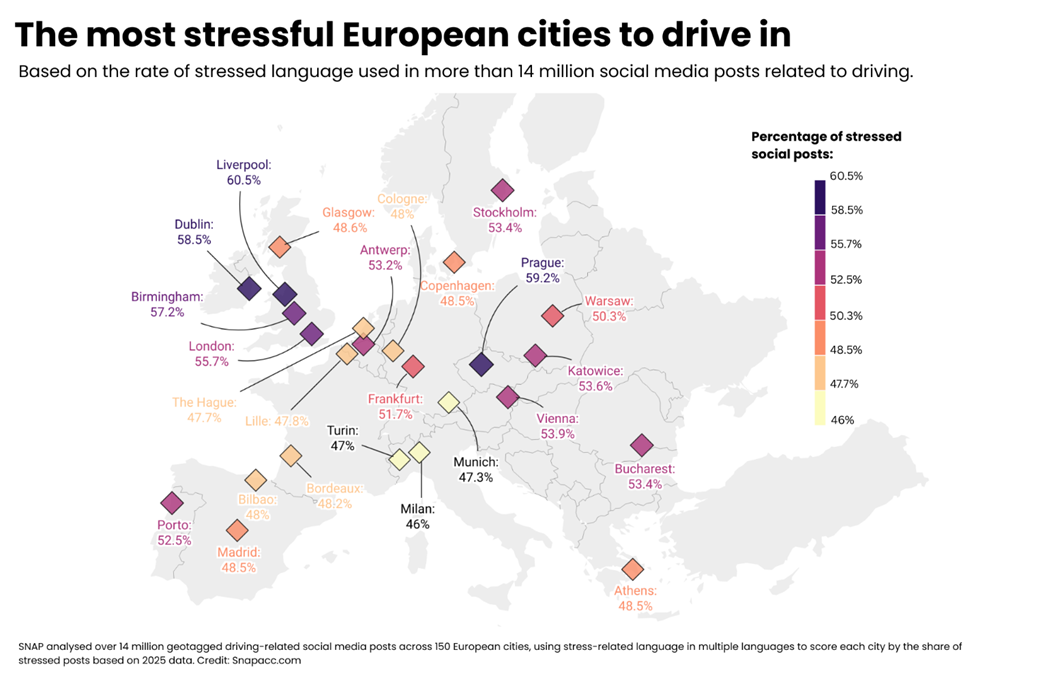
Найбільш стресові міста для водіння

Міста можуть збільшувати стрес водія через затори, вузькі вулиці та складну схему доріг.
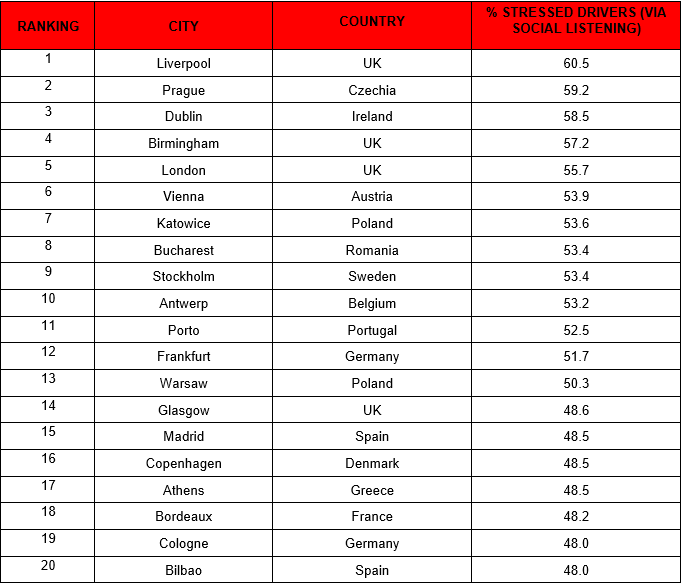
Ліверпуль (1-е місце), Бірмінгем* (4-е) та Лондон* (5-е) є одними з найбільш стресових міст для водіння в Англії, з показниками стресу від 55,7% до 60,5%. Гарячі точки та вузькі місця, такі як [Ліверпульські тунелі Мерсі] (https://www.liverpoolworld.uk/news/mersey-tunnels-chaos-40-minute-delays-4974204) та перевантажені дороги, такі як [Лондонська орбітальна автомагістраль (M25)] (https://news.sky.com/story/londons-roads-ranked-most-congested-in-europe-according-to-new-report-13284374), є ключовими факторами, що сприяють підвищеному рівню стресу.

Дублін посідає 3-тє місце і є одним з найбільш перевантажених міст Європи, де водії затримуються в середньому на 81 годину щороку через інтенсивний рух транспорту, що підкреслює постійний тиск заторів на міських дорогах.

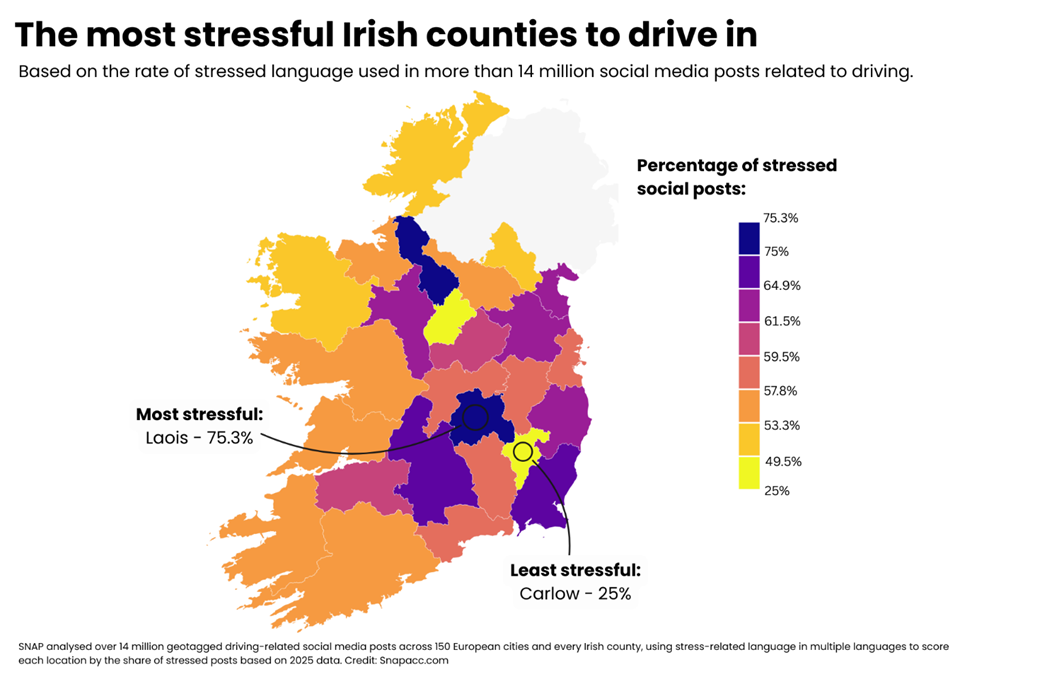
Подальше соціальне слухання, зосереджене на ірландських автомобілістах, показало, що в графствах Лаойс і Лейтрім зафіксовано надзвичайно високий рівень стресу від паркування, з показниками від 75% до 75,3%. Ці високі цифри підкреслюють постійні проблеми для водіїв у цих регіонах, що значною мірою зумовлені великою залежністю від автомобілів - [73% жителів Лаосу їздять на роботу на приватних автомобілях], [згідно з офіційною статистикою (стор. 118)] (https://laois.ie/sites/default/files/2024-05/Appendix%202%20-%20Socio%20Economic%20Profile%20of%20Laois.pdf). Крім того, Leitrim має місцеві повідомлення про нерозвинену дорожню інфраструктуру та [конфлікти з доставкою/паркуванням у таких містах, як Драмшанбо] (https://www.leitrimobserver.ie/news/ballinamore/1951614/loading-problems-an-issue-in-leitrim-town-with-lorries-parking-in-the-middle-of-the-road.html), що посилює стрес для водіїв у цьому ірландському графстві.
Катовіце, Польща (7-е місце) - хоча Катовіце не є одним з найбільш перевантажених польських міст, [Катовіце все ще відчуває затримки в русі та транспортний тиск] (https://www.tomtom.com/traffic-index/katowice-traffic/), водії проводять значний час у заторах, а основні автомагістралі, такі як S86 та A4, мають велику щоденну інтенсивність руху, що може призвести до оцінки стресу на рівні 53,6%. Аналогічно, у Варшаві в Польщі (13-те місце) водії проводять приблизно [70 годин на рік у заторах] (https://notesfrompoland.com/2025/01/10/warsaw-has-europes-sixth-worst-traffic-finds-global-study/), що сприятиме досягненню показника стресу на рівні 50,3% у 2025 році.

**Бухарест у Румунії (8 місце) стикається з відомими заторами як одне з найбільш переповнених міст Європи, де водії проводять значно більше часу в заторах і [втрачають до 12 робочих днів на рік] (https://www.romania-insider.com/bucharest-driver-loses-days-annually-traffic-sept-2025) через повільний рух транспорту.

Столиця Іспанії, Мадрид** (15-те місце), страждає від великих заторів: [поїздка на 10 км займає близько 24 хвилин] (https://www.tomtom.com/traffic-index/madrid-traffic/). Вузькі вулиці і постійний трафік, особливо в таких районах, як Пуенте-де-Вальєкас,, роблять щоденну їзду повільною і напруженою. Аналогічно, повідомлення про аварії та інтенсивний рух у Більбао в Іспанії (20 місце) на таких ключових трасах, як A-8 та BI-30, спричиняють довгі черги та повільний рух, що призводить до стресових умов водіння.

Міста, в яких найважче паркуватися

Паркування також сприяє стресу для водіїв та менеджменту автопарку, оскільки обмежена доступність, високий попит та обмежувальні правила в європейських містах можуть затримувати поїздки, збільшувати розчарування та ускладнювати планування маршрутів.

Крім того, за допомогою соціального слухання ми зібрали дані про міста, де водії відчувають найбільший стрес під час паркування** в Європі, зокрема в Румунії, Польщі, Іспанії та Великобританії. Звернути увагу на ці регіони важливо для операторів автопарків, оскільки обмежена кількість місць для паркування, високий попит та затори в містах можуть порушувати графіки, збільшувати затримки та впливати на самопочуття водіїв.

Наше дослідження показує, що найвищий рівень паркувального стресу в Європі спостерігається в Польщі, де Підляшшя (83,3%) та Ольштин (80%) стикаються з такими проблемами, як обмеженість міських паркувальних місць та висока щільність транспортних засобів.

Аналогічно, у Великій Британії Ньюкасл-на-Тайні (65,3%), Ліверпуль (64,4%) та Мідлсбро (63,9%) є містами з найбільшим парковочним стресом для автомобілістів. У цих містах існує проблема обмеженого простору в центрі міста, вуличні збори, затори та суворі правила паркування, що призводять до розчарування водіїв.

Румунські міста Сібіу та Клуж-Напока, а також іспанські міста Малага та Більбао зафіксували найвищі рівні паркувального стресу у своїх країнах. Однак, порівняно з Великобританією та Польщею, показники стресу в цих містах нижчі - від 55,6% до 52,4% - що свідчить про більш керовані умови паркування, меншу кількість "вузьких місць" і відносно менший тиск на водіїв у цих міських районах.

"У SNAP наша мета проста: зменшити стрес, пов'язаний з паркуванням, для професіоналів у сфері вантажоперевезень. Надаючи інформацію в режимі реального часу та більш розумні варіанти маршрутів, ми допомагаємо водіям знаходити безпечні, доступні парковки, роблячи їхні поїздки менш напруженими та ефективнішими. ".

**МЕТЬЮ БЕЛЛАМІ, КЕРУЮЧИЙ ДИРЕКТОР КОМПАНІЇ "SNAP

Чому водії вантажівок відчувають найбільший стрес у цих містах?

Водії вантажівок стикаються з тиском, який відрізняється від тиску водіїв звичайних автомобілів. Обмежена кількість місць для паркування великогабаритних транспортних засобів, пересування вузькими або перевантаженими вулицями та висока інтенсивність руху можуть зробити водіння містом більш складним і напруженим, перетворюючи рутинні поїздки на досвід, пов'язаний з обмеженим часом і високим рівнем стресу.

Давайте зануримося глибше у фактори, що викликають стрес у водіїв вантажівок:

  • Limited parking for large vehicles. Scarce lorry bays and high demand make it hard to find safe places to stop, especially in urban centres. The RHA’s Roadside Facilities campaign reports an estimated shortage of 11,000 lorry parking spaces in the UK, creating significant stress for HGV drivers who struggle to find safe and legal places to park., creating significant stress for HGV drivers who struggle to find safe and legal places to park.
  • Narrow streets and complex urban layouts. Tight roads and historic city centres require careful navigation, increasing stress and risk of delays in cities like Prague, Dublin, and Liverpool.
  • High traffic volumes and congestion. Heavy commuter and freight traffic slows journeys, increases travel times, and heightens frustration particularly in busier cities like London, Birmingham, Bucharest, and Madrid.
  • Low-emission or Clean Air Zones. Restrictions on vehicle access, extra charges, and rerouting requirements can complicate planning and add pressure. For example, low emission zones in Spain require some HGVs to seek alternate routes.
  • Route restrictions and delivery schedule. Height and weight limits, prohibited turns, and time-specific delivery windows force drivers onto longer or less convenient routes.
  • Isolation and limited facilities. Long urban journeys without access to rest areas, fuelling, or amenities can increase fatigue and mental strain for HGV drivers.

Що означають стресові міста для водіїв вантажівок?

Стресові міста створюють проблеми для водіїв вантажівок. Затори, обмежена кількість місць для паркування та складне міське планування можуть призвести до втрати часу, пропущених доставок, підвищеної втоми та підвищеного ризику незначних зіткнень або аварійних ситуацій.

Водії можуть керувати стресом, ретельно плануючи маршрути, роблячи заплановані перерви та використовуючи технології, щоб передбачити затримки або допомогти з [бюджетуванням] (https://snapacc.com/newsroom/a-truck-drivers-guide-to-budgeting/). SNAP підтримує водіїв за допомогою таких інструментів, як додаток для вантажівок, допомагаючи їм знаходити вільні місця для паркування, планувати ефективні маршрути та бути в курсі заторів, зменшуючи стрес і роблячи поїздки вантажних автомобілів безпечнішими та більш керованими.

Що означають стресові міста для операторів автопарків вантажівок?

Стресові міста впливають не лише на водіїв, але й на продуктивність автопарку. Затори та обмежена кількість місць для паркування можуть призвести до затримок у доставці, збільшення витрат на пальне та експлуатаційних витрат, погіршення самопочуття водіїв та збільшення ризику штрафів або покарань. Цей тиск може з'їдати маржу і ускладнювати планування, утримання або нестачу водіїв і задоволення клієнтів.

Оператори автопарків можуть подолати ці виклики, впроваджуючи розумніші стратегії та системи підтримки: використовуючи інформацію про трафік і паркування в режимі реального часу, створюючи гнучкі графіки та надаючи пріоритет відпочинку і добробуту водія.

Доступне у понад 850 сервісних партнерів по всій Європі, рішення SNAP для оплати послуг автопарку використовується кожні 12 секунд по всьому континенту для оплати послуг вантажних автомобілів - без готівки або картки.

Зробити міста Європи менш напруженими для водіїв вантажівок

Розуміння "гарячих точок" водіння та паркування в Європі допомагає автопаркам працювати безпечніше та ефективніше. Використовуючи цю інформацію для планування маршрутів, навчання водіїв, впровадження технологій та зниження ризиків, оператори можуть зменшити затримки, покращити самопочуття та захистити своїх водіїв. SNAP підтримує цю місію для автопарків, пропонуючи безпечне паркування, безперебійні платежі та інструменти, які роблять щоденну роботу спокійнішою та безпечнішою.

[ПІДПИШІТЬСЯ НА ЗЙОМКУ СЬОГОДНІ] (https://register.snapacc.com/en)
Поділіться на

Читайте також...

Header Image

четвер 08 січня 2026 • Новини та оновлення

СТОЯНКА ДЛЯ ВАНТАЖІВОК У САТТЕРТОНІ: ПІДВИЩЕННЯ СТАНДАРТІВ КОМФОРТУ ТА БЕЗПЕКИ ВОДІЇВ

Susie Jones

Situated on the A17 and a short drive from Boston is , a haven for truck drivers transporting goods along this stretch of road. The location provides not only a truck stop with the usual amenities one would expect clean showers, toilets, shop, and refuelling options but it also presents drivers with the choice to dine at the Roadside Diner, providing visitors with an American-themed restaurant with a variety of meals. We sat down with Director James Townsend to discuss improvements to the site, driver welfare, site security, and their long-standing relationship with SNAP. explains James. The site has undergone a major refurbishment, prioritising the needs of truck drivers. Nestled inside the truck stop is the new roadside diner. James and the team have recently taken back ownership of this and refurbished it. James says. He goes on to explain that it was more than upgrading existing facilities, but providing drivers with the right facilities to make the site a home away from home. SNAP asked truck drivers parking at Sutterton what they thought of the new facilities on offer. One driver commented:When it came to the design of the truck park, the site worked closely with SNAP to maximise the site’s potential:Driver welfare still remains a huge priority for those working in the industry, with investment into truck parking lacking, something James is all too aware of after working with the DFT. he explains. While investment is valuable, directing it into the right facilities for truck drivers is also imperative. James states. James and the rest of the team work closely with SNAP’s UK Network Team as well as , providing them with a single, clear point of contact should any issues arise. explains James. Having the support in place for complaints and technical issues is a major advantage for a truck stop like Sutterton, which often manages competing demands. Working with SNAP has delivered additional benefits as well, as James goes on to say:To ensure truck drivers get a good night’s rest, ensuring the site is as safe and secure as possible was vital for Sutterton Truck Stop. Working with SNAP Access & Security from the outset has allowed James and the team to do exactly that. says James. The site is a firm believer in training its staff to deal with incidents if they occur. Inspired by what you’ve just read? Catch the full interview with

Header Image

пʼятниця 19 грудня 2025 • Новини та оновлення

ЧИ Є ВАШ ФЛОТ МІШЕННЮ? ПРІОРИТЕТ БЕЗПЕКИ В ТЕХНОЛОГІЧНО ПІДКОВАНОМУ СВІТІ

Guest

Cybersecurity readiness must be a top priority for fleet owners and managers in the United Kingdom. The rapid digital transformation in the transportation and logistics industry has made fleets attractive targets for hackers. Learn about the cybersecurity trends fleet operators must be aware of and strategies you should adopt to lower your susceptibility to attacks.The advent of connected vehicles, push for fleet electrification, integration of Internet of Things (IoT) devices and reliance on automation have expanded the attack surface opportunistic cybercriminals can exploit to infiltrate your network.Vulnerable telematics back-end systems, insecure over-the-air firmware updates and buggy APIs are common entry points for phishers, data thieves, business saboteurs and ransomware attackers. Threat actors are also increasingly leveraging artificial intelligence to launch more believable scams.Falling victim to a cyberattack can cause more than extended, unscheduled downtime. A high-profile security incident can inflict severe reputational damage on your organisation and harm your business in the long term.Although your cyber insurance coverage may compensate you millions for losses, the financial impact can lead to insolvency — as happened to KNP Logistics in June 2025. An Akira ransomware attack exacerbated this major logistics group’s preexisting financial struggles, and let go of 730 employees.Every business is at risk from cyberattacks, but these strategies can help make your fleet management software and vehicles less vulnerable.A robust threat intelligence platform strengthens cybersecurity, as it allows you to proactively defend your assets from malicious actors and minimise your losses if they target you. Here are the primary ways to use threat intel to improve your security posture:Contextualisation enables your team to identify the perpetrators behind specific attacks, understand their motives and capabilities, determine what they want from your organisation, and comprehend their methods. Context transforms raw threat data into actionable intelligence, enabling you to inform your decision-making.Attackers evolve, so learning how they operated in the past is not enough to accurately anticipate their future actions. A threat intelligence platform can help you keep pace with known malicious actors and familiarise your team with relatively unknown ones. Some organisations use deception technologies to lure cybercriminals and watch them in action in a controlled environment.A software solution that can integrate into your company’s existing tools breaks down silos and allows threat intelligence to flow freely across teams. Cross-departmental collaboration is the key to implementing an organisation-wide cybersecurity strategy effectively.A threat intelligence platform can monitor your network activity and sense attack patterns early enough to notify your Security Operations Centre or IT professionals immediately. Early detection is vital to count threats before they infiltrate deeply into your system and cause more harm.Responding to urgent incidents involves less manual work with a threat intelligence platform. This software solution can orchestrate essential tasks to mitigate breaches, enabling your in-house cybersecurity professionals to focus on activities where human input is more impactful.Regulatory frameworks and data privacy standards are becoming more stringent over time. A threat intelligence platform aids compliance by ensuring that your team handles sensitive data responsibly and generates detailed reports to document your best practices.Zero trust minimises the likelihood of unauthorised access to fleet management systems by continuously verifying every user and device and enforcing identity-centric access control.This approach acknowledges that threats can come from within the organisation. Assuming that each request may come from a malicious actor reflects the level of vigilance you must exercise to protect your operation from sophisticated attacks and help your team adapt to complex, dynamic environments involving remote users, IoT devices and cloud services.After verification, zero trust gives users and devices just enough access to perform specific tasks. The principle of least privilege enables effective threat containment if a cybercriminal gets in.According to Cybersecurity Insiders’ 2024 Insider Threat Report, insider threat attacks have spiked. In October 2024, 51% of the 413 respondents in IT and cybersecurity reportedly over the past year. 29% reported spending over $1 million on remediation.The adoption of new technologies is a primary driver behind the rise in these cyberattacks. Investing in employee training is crucial for preventing team members from becoming insider threats.Provide target users with sufficient resources to familiarise themselves with the technologies. Highlight the ways they may inadvertently leak sensitive information or compromise the system. Tell them the red flags to watch out for to identify malicious schemes and teach them safe, responsible ways to deal with cybercriminals.Tight physical security can safeguard your assets from digital hijackers. Effective physical protection often involves a layered approach, which includes perimeter fencing, strategic placement of surveillance equipment and tamper-evident vehicle electronics casings. Additionally, limiting visibility with opaque doors , thereby adding an extra layer of protection to your physical security. Blending physical safeguards with digital solutions can restrict what hackers can do, even if they manage to gain control over fleet vehicles. In 2022, a group of hacktivists attacked the Russian ride-hailing service Yandex Taxi and directed in the same place in western Moscow. The incident should serve as a wake-up call to embrace measures to immobilise your assets if criminals remotely take control of the driver’s seat.Your company is only as strong as the weakest link in your supply chain. The positive impact of impregnable internal cybersecurity diminishes when third-party vendors make it easy for lawbreakers to steal your data from elsewhere. For instance, temporarily could jeopardise your cybersecurity if your lessor has outdated software.Working with supply chain partners that are as particular about cybersecurity reduces your risk exposure. Integrating your suppliers’ systems into your threat intelligence platform ensures better coordination during data breaches. Close collaboration with critical external parties promotes cybersecurity readiness and helps everyone prepare for potential attacks.Contending with online threat actors is inevitable in modern fleet management. Prioritise proactive strategies to stay ahead of hackers. By implementing a multi-layered defence that combines technology, employee training and strategic partnerships, you can build a resilient operation. This stance protects your current assets and secures your company’s future in an increasingly connected world.Discover more from

Header Image

понеділок 08 грудня 2025 • Новини та оновлення

TRUCK TRENDS: ПРОГНОЗИ НА 2026 РІК

Guest

Major changes are coming for the mobility sector.The next 12 months will bring some of the most significant regulatory and technological shifts European transport has seen in years. New emissions rules, driver-monitoring systems, hydrogen trials and autonomous pilots will reshape how fleets operate across the UK and EU.For operators and professional drivers, understanding these changes now will make the difference between adapting confidently and struggling to keep up. come into force in 2026, introducing new requirements for fleets. Nitrogen oxide and carbon monoxide limits will tighten further, with the permitted particle size dropping from 23 nanometres to 10. In addition, for the first time.Every new truck sold will need to comply with Euro VII. While vehicle pricing is likely to be affected, the bigger impact will fall on procurement timelines, fleet renewal cycles and long-term decarbonisation.. These monitor eye and head movement to identify early signs of fatigue or inattention, enabling safer interventions and supporting accident-reduction goals across Europe. By 2029, new cab designs must minimise blind spots through improved glass visibility rather than camera reliance. This will particularly influence urban operations, vulnerable road user safety and future vehicle specification.. After years of exemption, this change effectively brings smaller commercial vehicles under full drivers’ hours enforcement.For operators with mixed fleets, this means introducing:● new driver cards● regular data downloads● updated monitoring processes● revised routing and rest-time planningThousands of vehicles that previously operated freely will need compliance systems in place almost immediately. requires companies with more than 250 employees or €40 million revenue to collect and report verified CO₂ emissions – including Scope 3 transport activity.This will cascade through supply chains. Smaller hauliers without reliable emissions reporting risk losing access to larger contracts, accelerating the push toward better data systems and standardised reporting.Electric HGV production will rise rapidly in 2026. are all expanding manufacturing capacity.To support this, electric charging is also expanding. , as part of HyHAUL's M4 corridor project. Three refuelling stations, each supplying up to two tonnes of hydrogen daily, support the pilot. If successful, the project aims for 30 trucks on the road by the end of 2026 and 300 by 2030. Alongside this, . Five more will follow by 2027.Vehicle manufacturers are taking different approaches to developing hydrogen-fuelled trucks: ● and DAF are planning similar systems. ● will introduce its next-generation hydrogen fuel cell stack in 2026 with improved durability and lower operating costs.Hydrotreated Vegetable Oil (HVO) is emerging as a notable transitional fuel for haulage in 2026, thanks to two factors: stricter biofuel mandates in north-western Europe and its compatibility with existing diesel engines. Reports by confirm that HVO is a “drop-in” fuel: it can be used in many existing heavy-duty vehicles without engine or infrastructure changes, which gives operators a practical pathway to immediate CO₂ reductions. Meanwhile, forecast that HVO consumption could reach record highs in 2026. Germany alone may need an additional 1.5 million tonnes – almost four times 2025 levels – to meet demand. Although uptake remains modest when compared with battery-electric or hydrogen alternatives, the current regulatory push and infrastructure compatibility mean HVO is likely to gain traction in 2026.From spring 2026, in controlled zones – a full year ahead of plans. Enabled by the , this transition supports an industry expected to contribute £42 billion to the UK economy by 2035 and create an estimated 38,000 jobs. Germany is close behind. , supported by €20 million in seed funding. Across northern Europe, autonomous freight along the 1,200-km Rotterdam-Oslo corridor. The programme runs until March 2026 and examines how autonomous vehicles perform across borders, terrain types and logistics hubs.In Sweden, already move goods between warehouses, processing five million data points per second. Their controlled deployments demonstrate the potential for automation in predictable, repeatable routes.Despite this progress, humans will continue to play a central role. . So while automation will support specific functions, such as port operations, depot shuttles and fixed urban routes, long-haul and complex international transport will remain human-led.The scale and speed of change arriving in 2026 is unlike any previous year for European road transport. Multiple regulatory, technological and sustainability shifts will land simultaneously, reshaping how fleets operate across borders."The operators who succeed in 2026 won't be those who resist change but those who prepare for it systematically," says Nick Long, European Strategic Partnership and Development Manager at SNAP. "We're working with fleets across Europe to build the infrastructure that tomorrow's industry needs. Secure parking. Integrated payments for new toll structures. The building blocks of success are available now for those ready to use them."SNAP helps fleets prepare for the future with integrated solutions for parking, payments and fleet management across Europe. Visit snapacc.com to discover how we can support your transition to 2026 and beyond.