Josh Cousens
Știri și actualizări • 5 min citește

Cele mai stresante orașe din Europa în care se parchează și se conduce

Creat: 14.01.2026

Actualizat: 15.01.2026

Conducerea și parcarea în orașele din Europa pot fi o bătaie de cap zilnică pentru șoferii de camioane grele - iar nivelurile ridicate de stres nu afectează doar bunăstarea, ci și eficiența flotei. Pentru managerii de logistică, cunoașterea locului unde aceste provocări sunt cele mai mari este esențială pentru planificarea rutelor, siguranța șoferilor și performanța operațională.

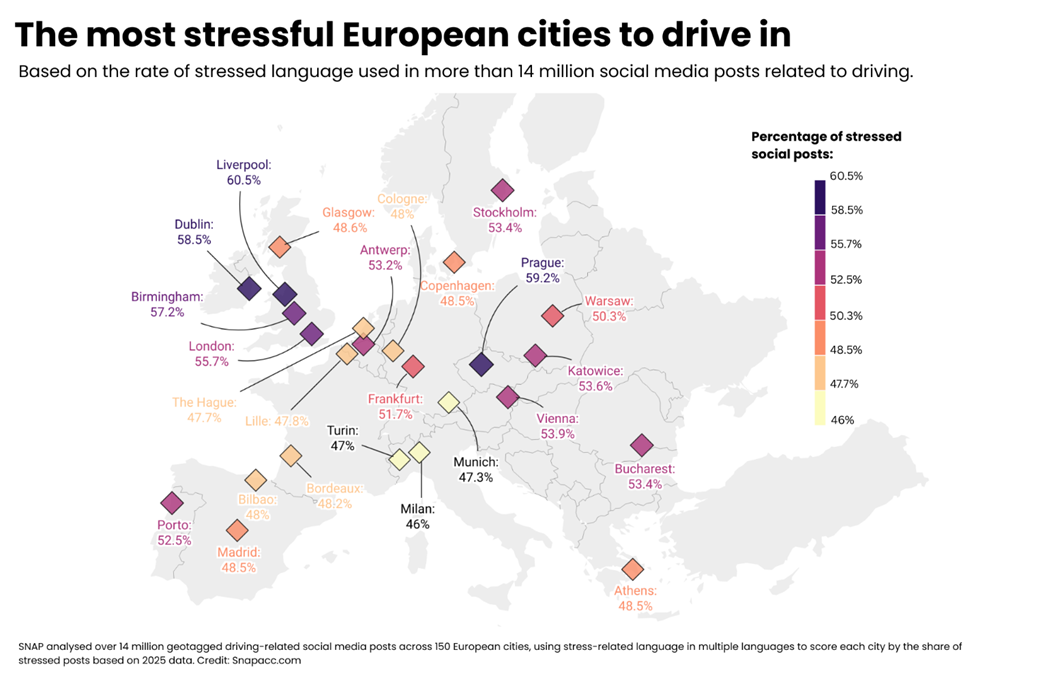
Folosind social listening pentru a analiza milioane de postări cu etichetă geografică din 150 de orașe europene, cercetarea noastră identifică locurile pe care șoferii le consideră cele mai stresante. Liverpool se află în fruntea listei (60,5% din postări prezintă stres legat de condus), urmat de Praga (59,2%) și Dublin (58,5%). Liverpool ocupă, de asemenea, locul 2 în topul celor mai stresante orașe din Regatul Unit în ceea ce privește parcarea. Congestia, lipsa locurilor de parcare și condițiile rutiere dificile sunt principalele motive de durere evidențiate de șoferii din întreaga Europă.

Acest studiu cartografiază punctele nevralgice ale Europei în ceea ce privește stresul provocat de vehiculele grele de transport de marfă, utilizând sentimentele reale ale șoferilor, arătând modul în care condițiile urbane afectează bunăstarea. Studiul nu urmărește să clasifice țările, ci să ofere managerilor de flote și de logistică informații clare și utile pentru a sprijini șoferii, pentru a planifica rute mai inteligente și pentru a reduce presiunea la volan în mediul urban.

Ascultarea experiențelor conducătorilor auto

Cercetarea noastră a analizat peste 14 milioane de postări geoetichetate pe rețelele de socializare din 150 de orașe europene, acoperind subiecte legate de condus, cum ar fi parcarea, traficul și starea drumurilor. Mesajele au fost evaluate pentru stres prin urmărirea cuvintelor-cheie și a frazelor legate de emoțiile negative în limba engleză și în limbile locale. Fiecare oraș a fost evaluat pe baza procentului de mesaje care exprimă stres, oferind o imagine clară a presiunii șoferilor din Europa. Datele au fost colectate prin intermediul platformei majore de social media X (fostul Twitter) pe parcursul anului 2025.

"Stresul" acoperă presiunile cu care se confruntă șoferii de flote pe șosea, inclusiv traficul, parcarea, condițiile de drum, conducerea în general și conflictele cu alți șoferi. Înțelegerea acestor factori ajută [operatorii de flote] (https:///snapacc.com/fleet-operators/) să sprijine bunăstarea și performanța șoferilor.

"Știind care sunt orașele cele mai stresante pentru șoferii de vehicule grele, SNAP poate găsi soluții care să îmbunătățească atât siguranța, cât și eficiența."

MATTHEW BELLAMY, DIRECTOR GENERAL, SNAP

Orașe stresante din UE: Principalele constatări

Începând cu 2025 pentru cele mai stresante orașe pentru condus:

  1. Liverpool, Marea Britanie. 60,5% din postările sociale stresate despre parcare - cea mai mare proporție de postări legate de stresul la volan din Europa.
  2. Praga, Cehia. 59,2% din postările sociale stresate cu privire la parcare, probabil din cauza traficului dens, a designului istoric al străzilor și a spațiului limitat pentru vehiculele mari care navighează prin oraș.
  3. Dublin, Irlanda. 58,5% dintre postările sociale stresate cu privire la parcare - Stresul șoferilor este strâns legat de întârzierile cauzate de aglomerație, de lipsa locurilor de parcare și de rutele aglomerate pentru navetiști care afectează condițiile zilnice de conducere.

Top 3 cele mai stresante orașe din Marea Britanie pentru parcare în 2025:

  1. Newcastle upon Tyne. Prescurtat în mod obișnuit ca "Newcastle" și situat în comitatul Tyne and Wear, acest oraș are un procent uluitor de 65,3% din postările sociale stresante despre parcare, ceea ce îl face cel mai stresant oraș din Marea Britanie pentru parcare în 2025.
  2. Liverpool. În Merseyside, 64,4% dintre postările sociale despre parcarea în Liverpool exprimă stres.
  3. Middlesbrough. 63,9% dintre postările sociale despre parcarea în acest oraș din North Yorkshire sunt stresante.

Scoția prezintă, de asemenea, un nivel ridicat de stres în ceea ce privește parcarea, Edinburgh (61,6% din postările sociale stresate cu privire la parcare) și Glasgow (61,4% din postările sociale stresate cu privire la parcare) numărându-se printre cele mai dificile orașe din Regatul Unit în care este dificil să parchezi. În plus, Londra se situează pe locul 17 în topul celor mai stresante locuri pentru parcare (57,9 din postările sociale stresate despre parcare. Printre factorii care pot contribui la această situație se numără străzile înguste, configurația urbană densă, cererea mare pentru un spațiu limitat de parcare și restricțiile din centrul orașului, care pot crește presiunea asupra șoferilor.

Puncte de stres pentru șoferii europeni

Utilizând milioane de postări geoetichetate de pe rețelele de socializare, am evaluat fiecare oraș în funcție de ponderea postărilor legate de stres, dezvăluind cele mai importante puncte fierbinți din Europa în ceea ce privește condusul și parcarea și evidențiind condițiile urbane care pun cel mai mult la încercare șoferii.

Harta noastră infografică arată cele mai importante orașe în ceea ce privește presiunea de a conduce și de a parca, dezvăluind principalele puncte fierbinți urbane și provocările cu care se confruntă șoferii în fiecare piață.
Cele mai stresante orașe în care să conduci

Orașele pot crește stresul șoferilor din cauza aglomerației, a străzilor înguste și a configurației complexe a drumurilor.
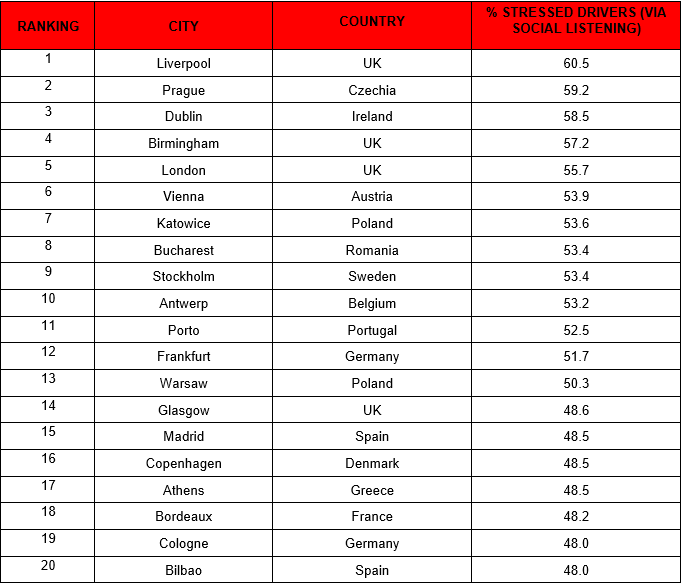
Liverpool (locul 1), Birmingham (locul 4) și Londra (locul 5) se numără printre cele mai stresante orașe din Anglia pentru a conduce, cu scoruri de stres cuprinse între 55,7% și 60,5%. Punctele critice de congestie și blocajele - cum ar fi tunelurile Mersey din Liverpool și rutele foarte aglomerate, cum ar fi autostrada Orbitală din Londra (M25) .- sunt principalele cauze ale acestor niveluri ridicate de stres.

Dublin ocupă locul 3 și este unul dintre cele mai aglomerate orașe din Europa, cu [șoferii întârziați în medie cu 81 de ore anual] (https://www.irishtimes.com/transport/2025/01/06/dublin-ranks-as-europes-third-most-congested-city-after-london-and-paris/) din cauza traficului intens, subliniind presiunile persistente de congestionare a drumurilor urbane.

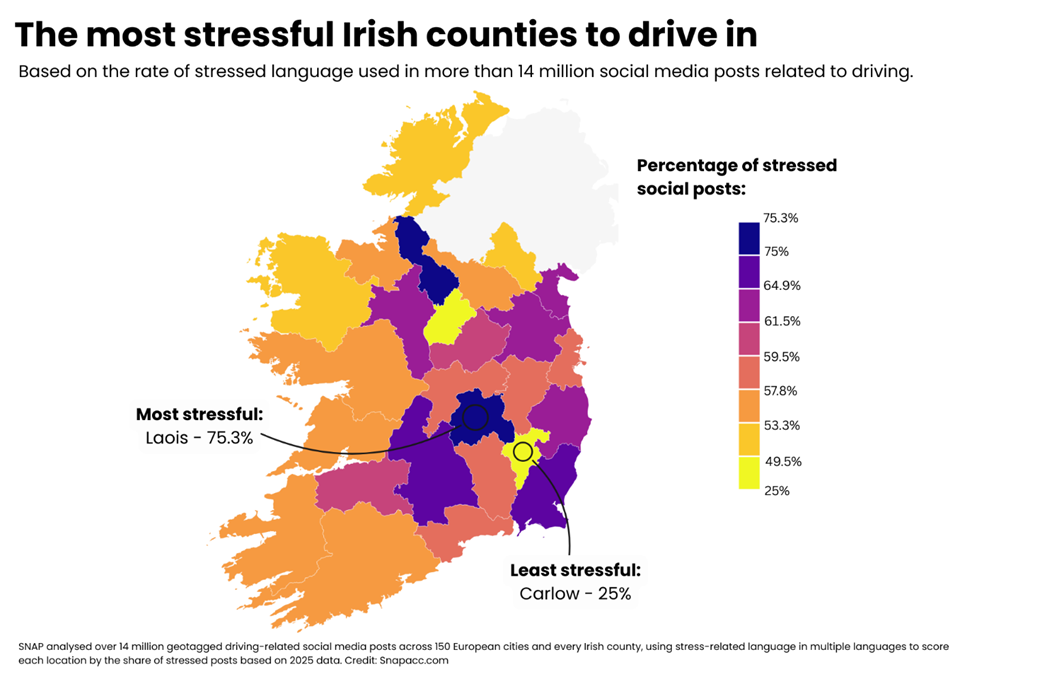
Ascultarea socială suplimentară axată în special pe automobiliștii irlandezi a arătat că județele Laois și Leitrim au înregistrat niveluri deosebit de ridicate de stres legat de parcare, cu scoruri cuprinse între 75% și 75,3%. Aceste cifre ridicate evidențiază provocările persistente pentru conducătorii auto din aceste zone, determinate în mare parte de dependența puternică de mașină - [73% dintre navetiștii din Laois se deplasează la serviciu cu mașina personală], conform statisticilor oficiale (pagina 118). În plus, în Leitrim există rapoarte locale privind infrastructura rutieră redusă și conflicte legate de livrări/parcare în orașe precum Drumshanbo care contribuie la stresul șoferilor din acest comitat irlandez.
Katowice, Polonia (locul 7) - deși nu este unul dintre cele mai aglomerate orașe poloneze în general, Katowice încă se confruntă cu întârzieri ale navetiștilor și presiune în trafic, șoferii petrecând mult timp în trafic, iar drumurile principale, cum ar fi S86 și A4, înregistrând volume mari de trafic zilnic care pot contribui la scorul de stres de 53,6%. În mod similar, Varșovia din Polonia (locul 13) are șoferi care petrec aproximativ 70 de ore pe an în trafic, contribuind la scorul său de stres de 50,3% în 2025.

Bucureștiul din România (locul 8) se confruntă cu o aglomerație de notorietate, fiind unul dintre cele mai aglomerate orașe din Europa, șoferii petrecând mult mai mult timp în blocaje și [pierzând până la 12 zile lucrătoare pe an] (https://www.romania-insider.com/bucharest-driver-loses-days-annually-traffic-sept-2025) din cauza traficului lent.

Capitala Spaniei; Madrid (locul 15) suferă de aglomerație, o călătorie de 10 km necesitând aproximativ 24 de minute. Străzile înguste și traficul persistent, în special în zone precum Puente de Vallecas, fac condusul zilnic lent și stresant. În mod similar, se raportează accidente și trafic intens în Bilbao, Spania (locul 20), pe rute cheie precum A-8 și BI-30, ceea ce provoacă cozi prelungite și o circulație lentă, ceea ce contribuie la condiții de conducere stresante.

Cele mai stresante orașe în care să parchezi

De asemenea, parcarea contribuie la stresul șoferilor și al managerilor de flote, deoarece disponibilitatea limitată, cererea ridicată și reglementările restrictive din orașele europene pot întârzia călătoriile, pot crește frustrarea și pot complica planificarea rutelor.

De asemenea, prin ascultarea socială, am colectat date privind orașele în care șoferii se confruntă cu cel mai mare stres la parcare în Europa, în special în România, Polonia, Spania și Regatul Unit. Acordarea de atenție acestor zone este importantă pentru operatorii de flote, deoarece disponibilitatea limitată a locurilor de parcare, cererea ridicată și aglomerația urbană pot perturba programele, crește întârzierile și afecta bunăstarea șoferilor.

Cercetările noastre arată că cel mai mare stres în materie de parcări din Europa se înregistrează în Polonia, unde Podlachia (83,3%) și Olsztyn (80%) se confruntă cu probleme precum spațiile de parcare urbane limitate și densitatea ridicată a vehiculelor.

În mod similar, în Regatul Unit, Newcastle upon Tyne (65,3%), Liverpool (64,4%) și Middlesbrough (63,9%) sunt orașele cu cele mai multe probleme de parcare pentru conducătorii auto. Acestea se confruntă cu spații limitate în centrul orașului, taxele de parcare pe stradă, aglomerația și reglementările stricte privind parcarea contribuie la frustrarea șoferilor.

Orașele românești Sibiu și Cluj-Napoca, împreună cu orașele spaniole Malaga și Bilbao, au înregistrat cele mai ridicate niveluri de stres legate de parcare în țările lor respective. Cu toate acestea, în comparație cu Marea Britanie și Polonia, scorurile lor de stres sunt mai mici - variind între 55,6% și 52,4% - ceea ce sugerează condiții de parcare mai ușor de gestionat, mai puține blocaje și o presiune relativ mai mică asupra șoferilor din aceste zone urbane.

"La SNAP, obiectivul nostru este simplu: să reducem stresul legat de parcare pentru profesioniștii din transporturi. Prin furnizarea de informații în timp real și opțiuni de traseu mai inteligente, îi ajutăm pe șoferi să găsească locuri de parcare sigure și accesibile, făcând călătoriile lor mai puțin stresante și mai eficiente."

MATTHEW BELLAMY, DIRECTOR GENERAL, SNAP

De ce șoferii de vehicule grele de marfă se confruntă cu cel mai mare stres în aceste orașe?

Șoferii de vehicule grele se confruntă cu presiuni diferite de cele ale șoferilor obișnuiți. Parcarea limitată pentru vehiculele de mari dimensiuni, navigarea pe străzi înguste sau aglomerate și volumele mari de trafic pot face condusul urban mai dificil și mai stresant, transformând călătoriile de rutină în experiențe de stres ridicat și presate de timp.

Să analizăm în profunzime factorii care cauzează stres pentru șoferii de vehicule grele:

  • Limited parking for large vehicles. Scarce lorry bays and high demand make it hard to find safe places to stop, especially in urban centres. The RHA’s Roadside Facilities campaign reports an estimated shortage of 11,000 lorry parking spaces in the UK, creating significant stress for HGV drivers who struggle to find safe and legal places to park., creating significant stress for HGV drivers who struggle to find safe and legal places to park.
  • Narrow streets and complex urban layouts. Tight roads and historic city centres require careful navigation, increasing stress and risk of delays in cities like Prague, Dublin, and Liverpool.
  • High traffic volumes and congestion. Heavy commuter and freight traffic slows journeys, increases travel times, and heightens frustration particularly in busier cities like London, Birmingham, Bucharest, and Madrid.
  • Low-emission or Clean Air Zones. Restrictions on vehicle access, extra charges, and rerouting requirements can complicate planning and add pressure. For example, low emission zones in Spain require some HGVs to seek alternate routes.
  • Route restrictions and delivery schedule. Height and weight limits, prohibited turns, and time-specific delivery windows force drivers onto longer or less convenient routes.
  • Isolation and limited facilities. Long urban journeys without access to rest areas, fuelling, or amenities can increase fatigue and mental strain for HGV drivers.

Ce înseamnă orașele stresante pentru șoferii de vehicule grele?

Orașele stresante creează provocări pentru șoferii de vehicule grele. Congestia, numărul limitat de locuri de parcare și configurația urbană complexă pot duce la pierderi de timp, livrări ratate, oboseală crescută și un risc mai mare de coliziuni minore sau cvasi-accidentări.

Șoferii pot gestiona stresul planificându-și cu atenție rutele, luându-și pauze programate și folosind tehnologia pentru a anticipa întârzierile sau pentru a ajuta la [elaborarea bugetului] (https://snapacc.com/newsroom/a-truck-drivers-guide-to-budgeting/). SNAP sprijină șoferii cu instrumente precum aplicația intruck, ajutându-i să localizeze locurile de parcare disponibile, să planifice rute eficiente și să fie informați cu privire la aglomerație, reducând stresul și făcând călătoriile vehiculelor grele de marfă mai sigure și mai ușor de gestionat.

Ce înseamnă orașele stresante pentru operatorii de flote HGV?

Orașele stresante nu afectează doar șoferii - ci și performanța flotei. Congestia și numărul limitat de locuri de parcare pot duce la întârzieri ale livrărilor, la costuri mai mari cu combustibilul și costurile de exploatare, la reducerea bunăstării șoferilor și la creșterea riscului de amenzi sau penalități. Aceste presiuni pot afecta marjele și pot complica programarea, [menținerea sau lipsa șoferilor] (https://snapacc.com/newsroom/uk-driver-shortage-are-numbers-improving/) și satisfacția clienților.

Operatorii de flote pot depăși aceste provocări adoptând strategii mai inteligente și sisteme de sprijin: folosind informații în timp real despre trafic și parcări, creând programe flexibile și acordând prioritate odihnei și bunăstării conducătorilor auto.

Disponibilă la peste 850 de parteneri de servicii din întreaga Europă, soluția SNAP de plată pentru flote este utilizată la fiecare 12 secunde pe continent pentru a plăti serviciile pentru camioane - fără numerar sau card.

Să facem orașele Europei mai puțin stresante pentru șoferii de camioane

Înțelegerea punctelor nevralgice în materie de stres la volan și parcare în Europa ajută flotele să funcționeze mai sigur și mai eficient. Prin utilizarea acestor informații pentru planificarea rutelor, instruirea șoferilor, adoptarea tehnologiei și reducerea riscurilor, operatorii pot reduce întârzierile, pot îmbunătăți starea de bine și își pot proteja șoferii. SNAP sprijină această misiune pentru flotele de transportatori, oferind parcări sigure, plăți fără probleme și instrumente care fac operațiunile zilnice mai calme și mai sigure.

ÎNSCRIE-TE ASTĂZI

Share to

Alții citesc de asemenea...

Header Image

luni 26 ianuarie 2026 • Știri și actualizări

PREGĂTIREA BUGETULUI FLOTEI 2026 PENTRU (NE)AȘTEPTĂRI

Guest

Preparing your fleet budget goes beyond simple financial exercises. As a manager, you need strategic oversight to navigate economic headwinds and an evolving regulatory framework. It is essential to prepare your company for unexpected events, as these instances define operational stability and success. Here’s how to build a responsive budget and get ready for future challenges. Being a fleet manager means foreseeing both the predictable trends and significant uncertainties. The following seven strategies are designed to absorb shocks, adapt to change and build resilience. Your budget may have a fixed monetary amount each year. While simple, it could be too static when anticipating unexpected events. Make your financial planning more dynamic by allocating a specific percentage rather than a fixed amount. For instance, your emergency fund could be 5% of the total budget instead of $100,000 annually. Using a percentage is wise because it hedges against inflation. A fixed amount loses purchasing power over the years, whereas a percentage-based fund grows with the budget. You get automatic protection from marketwide surges. Consumer prices in the U.K. , though they can quickly fluctuate due to market conditions. Fleet managers used to determine their budgets based on acquisition prices. Now, they are focusing on budget stability and long-term strategies. Make your process more holistic by managing the total cost of ownership (TCO) and the cost per vehicle over their lifetimes. This approach makes you more meticulous and your budget more dynamic. Mastering TCO involves centralising your data and using dedicated fleet management software. This technology helps your business by and recommending conservation strategies. TCO also enables you to forecast the year for each vehicle based on historical information. Use this to make more informed acquisitions and save money. A volatile economic climate means you need to contain costs. Leverage your company’s position by reviewing supplier contracts and considering renegotiations before renewal. This strategy converts unpredictable expenses into more manageable line items. Your business partner may raise prices on essential goods, so your meetings should lock in prices for tyres and oil. Narrow your negotiation to key areas, such as pricing structure. Your primary focus should be fixed-price agreements for high-volume items and standard labour rates. Savvy fleet managers leverage their spending from the previous year to earn volume discounts and capped increases. These properly managed contracts insulate your business and transfer risk to suppliers. Risk management for your fleet budget also includes insurance optimisation. Managers should turn this annual exercise into an opportunity to protect their business from financial debilitation. The right policy is crucial because it protects against shocks that can result in third-party damage or injury. It also increases predictability by turning repair bills into known variables. Insurance optimisation requires a thoughtful, data-driven process. Give your broker a risk management portfolio to showcase positive trends, such as fewer speeding incidents or less harsh braking. If you have policy excess, ask your insurer to model the premium savings for a higher deductible. Therefore, you can save money on your monthly payment. Maintenance and repairs can be unpredictable and expensive. One breakdown on the M6 could require costly engine work or a transmission replacement. Be proactive by implementing structured service schedules. Beyond the manufacturer's guidelines, you should create detailed plans for each vehicle based on its usage and age. You can dive deeper by including motorway driving and city travel. Your maintenance schedule should also include daily tasks. For example, experts to prevent condensation formation. If the tank is close to empty, sediment buildup and pump damage may occur. Cleaning is another nonnegotiable daily chore, especially when driving over road salts and chemicals. Rinse off dirt and other contaminants before storing vehicles. Accidents are among the most unexpected parts of your fleet budget. Besides the crash, managers must also and solicitor fees. However, proper driver training can mitigate this cost by reducing its frequency. Targeted coaching helps operators understand defensive driving, hazard perception and the specific dynamics of their jobs. Investing in driver training is one element of risk control. Human driving can be unpredictable, but education transforms it into a more consistent variable. By improving your drivers, you also help your insurance premiums. An accident can raise rates, so proper training is one way to control costs. A decrease in incidents can be used as leverage in insurance negotiations. Fleets are becoming more connected as they transform into data hubs. Your vehicles can generate and store vast amounts of information, which is essential for management. However, the connectivity exposes the modern automobile to liabilities. Budget for cybersecurity to protect your assets from digital threats and prepare for the unexpected. Managing this part of your fleet budget involves protecting vehicle systems. You could invest in hardware and software solutions to create firewalls around your GPS and V2X communications. This strategy helps keep your software up to date and protected from external threats. Secure data transmission is another part of preparing for the unexpected. Forward-thinking managers invest in fleet management systems with end-to-end encryption. Before building a resilient operation, it is essential to understand why. You should budget for unexpected events to ensure continuity. If a vehicle breaks down, it could halt operations and delay services. However, planning for these incidents provides a buffer and safeguards your bottom line. All vehicles are subject to failure, so you are preparing for the physical reality. This strategy is also essential for the bigger picture. For instance, economic volatility is a factor outside your control. Sudden inflation, interest rate hikes and price increases are detrimental to static budgets. However, planning for unexpected costs helps absorb them. By accurately forecasting expenses, you build financial discipline and credibility with stakeholders.Building a dynamic budget demonstrates strategic leadership more than defensive measures. As you incorporate wise approaches, you fundamentally shift your organisation’s mindset and promote proactive control. The modern economic climate requires fleet managers to absorb shocks and mitigate asset failure. A strong budgetary framework lets you protect profit margins and guarantee continuity.Discover more from

Header Image

luni 19 ianuarie 2026 • Știri și actualizări

O DEFALCARE A SISTEMELOR DE TAXARE ÎN EUROPA

Guest

For many fleets operating across Europe, tolls have quietly become one of the most complex and least predictable costs. What was once a relatively straightforward question of motorway charges has evolved into a patchwork of national systems, technologies and pricing models that now reflect emissions, vehicle weight, axle count, geography and even time of day.As we move into 2026, tolling is no longer just an infrastructure charge. It is increasingly a policy lever, used by governments to fund roads, manage congestion and accelerate the shift towards lower-emission transport. For fleet operators, that shift has real financial consequences.This article breaks down how tolling works across Europe, what fleets actually pay today, and what changes are coming next.Margins in road transport are tight. Fuel, labour, insurance and compliance costs have all risen sharply in recent years. Against that backdrop, tolls are becoming more significant, particularly for long-distance and cross-border operators.In countries such as Germany and Austria, toll costs per kilometre can now rival fuel costs on certain routes. In Central and Eastern Europe, tolls remain lower, but rapid rises and network expansion are closing that gap. At the same time, the introduction of CO₂-based charging means that two otherwise identical vehicles can face very different toll bills depending on their emissions profile.For fleets operating internationally, tolls are a consideration for route planning, vehicle procurement and pricing.There is no single European toll system. Instead, fleets must navigate a mix of national approaches that broadly fall into three categories.Distance-based tolls charge vehicles per kilometre travelled. These are now the dominant model for heavy goods vehicles and are used in countries such as Germany, Austria, Poland, Hungary and Belgium.Time-based vignettes allow vehicles to use the road network for a fixed period of time, such as a day, week or year. These were traditionally a pass displayed in the windscreen, but are increasingly digital.Hybrid systems combine toll roads with toll-free alternatives. France, Italy and Spain all operate models where tolls apply only on specific routes.Across all three models, the EU’s revised Eurovignette Directive is pushing countries towards distance-based, emissions-linked charging. This is steadily reducing the role of flat-rate vignettes and increasing the costs of high-mileage fleets.Operationally, tolling is becoming more digital. Most distance-based systems rely on GNSS or GPS tracking via onboard units (OBU), supported by roadside gantries, toll booths and camera enforcement.For fleets, this means greater reliance on onboard technology, tighter compliance requirements, and less tolerance for administrative error. Missed payments on free-flow roads (where there are no toll booths and no need to stop) can quickly turn into fines, particularly for international drivers unfamiliar with local rules.Interoperable toll services under the European Electronic Toll Service (EETS) framework are becoming more important for cross-border operators. Instead of fitting vehicles with multiple country-specific onboard units, fleets can use a single approved device to pay tolls across several European networks. This simplifies administration, reduces installation and maintenance costs – and lowers the risk of non-compliance when vehicles move between different toll regimes. Germany operates one of Europe’s most comprehensive toll systems. The LKW-Maut applies to all trucks over 3.5 tonnes on motorways and federal roads. Since December 2023, tolls include a CO₂ charge, which has increased costs for diesel vehicles. Official details are published by Austria’s GO-Maut is among the most expensive per kilometre in Europe. A Euro VI articulated truck paid around on motorways in 2025. The system includes infrastructure, noise, air pollution and CO₂ components. Electric trucks benefit from lower rates. Belgium operates a kilometre-based toll for trucks in Flanders, Wallonia and Brussels. Rates vary by region, weight and Euro class, with annual increases. From 2026, zero-emission vehicles will no longer be fully exempt but will still pay reduced infrastructure charges. Official information is available from France uses a motorway concession model. Tolls apply on routes operated by private companies and are paid at toll booths or electronically. Annual increases are modest and regulated. The Italy follows a similar concession-based approach. HGVs pay on the Autostrade network. The government is working towards more dynamic tolling by 2026, potentially linking charges to congestion and emissions. Hungary’s HU-GO system applies to trucks over 3.5 tonnes on motorways and main roads. Following high inflation, toll rates have increased sharply. Official updates are published at Poland’s e-TOLL system charges per kilometre using GNSS (satellite) technology. Rates rose in 2025 and will again in 2026, while the toll network continues to expand. The official platform is Spain is unusual in that many major motorways have become toll-free following the expiry of concessions. Some tolled routes remain and costs vary per kilometre for HGVs. The Spanish government’s position is outlined via the Romania currently operates a vignette system for trucks, with a seven-day pass costing around for the heaviest vehicles. This will change in July 2026, when Romania introduces a distance-based toll system called TollRo. Initial rates are expected to be low, but are likely to rise over time. Several developments make 2026 a pivotal year for European tolling.The Netherlands will introduce a kilometre-based truck toll from 1 July, replacing the Eurovignette. Average rates are expected to be around €0.19 per kilometre, with discounts for low-emission vehicles. Official information is available at As mentioned, Romania will transition from vignettes to distance-based charging, bringing it in line with neighbouring countries.Across Europe, CO₂-based differentiation will become standard, with reduced exemptions and tighter enforcement. Electric trucks will continue to benefit, but full exemptions are gradually being replaced by reduced rates rather than zero tolls.For fleets, this means higher exposure to mileage-based costs and greater incentives to invest in cleaner vehicles and better planning tools.Operators are now evaluating routes to balance toll costs against fuel use and journey time. Investment in Euro VI and zero-emission vehicles is increasingly justified not only by fuel savings but by toll reductions. In addition, toll surcharges are becoming more explicit in customer contracts and digital route optimisation tools are playing a larger role in daily operations.Fleets therefore need accurate forecasting, up-to-date vehicle data and clear visibility of toll exposure by route and customer. Vehicle procurement decisions should factor in toll classes alongside fuel efficiency. Cross-border operators should prioritise interoperable toll solutions and ensure drivers understand local payment rules, particularly on free-flow roads.Most importantly, toll costs need to be reflected transparently in pricing. As tolling becomes more emissions-driven, fleets that plan ahead will be better placed to protect margins and remain competitive.For fleets, the question is no longer whether tolls will rise, but how well prepared they are to manage them. In the years ahead, it will not just be about how far a vehicle travels, but how cleanly, where and under which system.As tolls become more closely linked to emissions, mileage and vehicle type, understanding what you pay and where matters more than ever. SNAP helps fleet managers and operators manage payments and support drivers with access to safe, well-equipped truck stops.

Header Image

joi 08 ianuarie 2026 • Știri și actualizări

SUTTERTON TRUCK STOP: RIDICAREA STANDARDULUI PENTRU CONFORTUL ȘI SIGURANȚA ȘOFERULUI

Susie Jones

Situated on the A17 and a short drive from Boston is , a haven for truck drivers transporting goods along this stretch of road. The location provides not only a truck stop with the usual amenities one would expect clean showers, toilets, shop, and refuelling options but it also presents drivers with the choice to dine at the Roadside Diner, providing visitors with an American-themed restaurant with a variety of meals. We sat down with Director James Townsend to discuss improvements to the site, driver welfare, site security, and their long-standing relationship with SNAP. explains James. The site has undergone a major refurbishment, prioritising the needs of truck drivers. Nestled inside the truck stop is the new roadside diner. James and the team have recently taken back ownership of this and refurbished it. James says. He goes on to explain that it was more than upgrading existing facilities, but providing drivers with the right facilities to make the site a home away from home. SNAP asked truck drivers parking at Sutterton what they thought of the new facilities on offer. One driver commented:When it came to the design of the truck park, the site worked closely with SNAP to maximise the site’s potential:Driver welfare still remains a huge priority for those working in the industry, with investment into truck parking lacking, something James is all too aware of after working with the DFT. he explains. While investment is valuable, directing it into the right facilities for truck drivers is also imperative. James states. James and the rest of the team work closely with SNAP’s UK Network Team as well as , providing them with a single, clear point of contact should any issues arise. explains James. Having the support in place for complaints and technical issues is a major advantage for a truck stop like Sutterton, which often manages competing demands. Working with SNAP has delivered additional benefits as well, as James goes on to say:To ensure truck drivers get a good night’s rest, ensuring the site is as safe and secure as possible was vital for Sutterton Truck Stop. Working with SNAP Access & Security from the outset has allowed James and the team to do exactly that. says James. The site is a firm believer in training its staff to deal with incidents if they occur. Inspired by what you’ve just read? Catch the full interview with