Josh Cousens
Noticias • 5 min leer

Las ciudades europeas más estresantes para aparcar y conducir

Creado: 14/01/2026

Actualizado: 15/01/2026

Conducir y aparcar en las ciudades europeas puede ser un quebradero de cabeza diario para los conductores de camiones, y los altos niveles de estrés no sólo afectan al bienestar, sino también a la eficiencia de la flota. Para los directores de logística, saber dónde se dan los mayores problemas es crucial para la planificación de rutas, la seguridad de los conductores y el rendimiento operativo.

Gracias a la escucha social para analizar millones de mensajes geoetiquetados en 150 ciudades europeas, nuestro estudio identifica los lugares más estresantes para los conductores. Liverpool encabeza la lista (el 60,5 % de las publicaciones muestran estrés relacionado con la conducción), seguida de Praga (59,2 %) y Dublín (58,5 %). Liverpool también ocupa el segundo puesto como ciudad más estresante para aparcar en el Reino Unido. Los atascos, la escasez de aparcamiento y el mal estado de las carreteras son los principales problemas señalados por los conductores de toda Europa.

Este estudio traza un mapa de los focos de estrés de los vehículos pesados en Europa a partir de la opinión real de los conductores, mostrando cómo las condiciones de la ciudad afectan al bienestar. No se trata de clasificar países, sino de ofrecer a los gestores de flotas y logística información clara y práctica para ayudar a los conductores, planificar rutas más inteligentes y reducir la presión de la conducción urbana.

Escuchar las experiencias de los conductores

Nuestra investigación analizó más de 14 millones de publicaciones geoetiquetadas en redes sociales de 150 ciudades europeas sobre temas relacionados con la conducción, como el aparcamiento, el tráfico y el estado de las carreteras. Los mensajes se evaluaron en función del estrés mediante el rastreo de palabras clave y frases relacionadas con emociones negativas en inglés y en los idiomas locales. Cada ciudad recibió una puntuación basada en el porcentaje de mensajes que expresaban estrés, lo que proporcionó una imagen clara de la presión de los conductores en toda Europa. Los datos se recogieron en la principal plataforma de redes sociales, X (antes Twitter), a lo largo de 2025.

El "estrés" abarca las presiones a las que se enfrentan los conductores de flotas en la carretera, como el tráfico, el aparcamiento, las condiciones de la carretera, la conducción en general y los conflictos con otros conductores. Comprender estos factores ayuda a los operadores de flotas a apoyar el bienestar y el rendimiento de los conductores.

"Saber qué ciudades son las más estresantes para los conductores de camiones permite a SNAP orientar soluciones que mejoren tanto la seguridad como la eficiencia ".

MATTHEW BELLAMY, DIRECTOR GENERAL, SNAP

Stressful EU cities: Principales conclusiones

A partir de 2025 para las ciudades más estresantes para conducir:

  1. Liverpool, Reino Unido. El 60,5% de las publicaciones sociales estresadas tratan sobre el aparcamiento: la proporción más alta de Europa de publicaciones relacionadas con el estrés al volante.
  2. Praga, Chequia. El 59,2% de las publicaciones sociales estresadas sobre el aparcamiento se deben probablemente al denso tráfico, el diseño histórico de las calles y el espacio limitado para los vehículos más grandes que circulan por la ciudad.
  3. Dublín, Irlanda. El estrés de los conductores está estrechamente relacionado con los retrasos por atascos, la escasez de aparcamiento y las rutas de cercanías con mucho tráfico, que afectan a las condiciones de conducción diarias.

Las 3 ciudades británicas más estresantes para aparcar en 2025:

  1. Newcastle upon Tyne. Comúnmente abreviada como "Newcastle" y ubicada en el condado, Tyne and Wear, esta ciudad tiene un asombroso 65,3% de publicaciones sociales estresantes sobre estacionamiento, lo que la convierte en la ciudad del Reino Unido más estresante para estacionar en 2025.
  2. Liverpool. En Merseyside, el 64,4% de las publicaciones sociales sobre aparcamiento en Liverpool expresan estrés.
  3. Middlesbrough. El 63,9% de los posts sociales sobre aparcamiento en esta ciudad de North Yorkshire expresan estrés.

Escocia también muestra un elevado estrés a la hora de aparcar, con Edimburgo (61,6% de publicaciones sociales estresadas sobre el aparcamiento) y Glasgow (61,4% de publicaciones sociales estresadas sobre el aparcamiento) entre las ciudades del Reino Unido donde es más difícil aparcar. Además, Londres ocupa el 17º lugar entre los lugares más estresantes para aparcar (57,9 de las publicaciones sociales estresadas sobre el aparcamiento. Entre los factores que contribuyen a esta situación se encuentran la estrechez de las calles, la densidad del trazado urbano, la elevada demanda de plazas de aparcamiento limitadas y las restricciones en el centro de las ciudades, que pueden aumentar la presión sobre los conductores.

Puntos conflictivos para los conductores europeos

A partir de millones de mensajes geoetiquetados en las redes sociales, hemos puntuado cada ciudad en función de la proporción de mensajes relacionados con el estrés, revelando los principales puntos conflictivos de Europa en cuanto a conducción y aparcamiento, y poniendo de relieve las condiciones urbanas que suponen un mayor reto para los conductores.

Nuestro mapa infográfico muestra las principales ciudades en cuanto a presión al volante y aparcamiento, revelando los principales puntos urbanos conflictivos y los retos a los que se enfrentan los conductores en cada mercado.
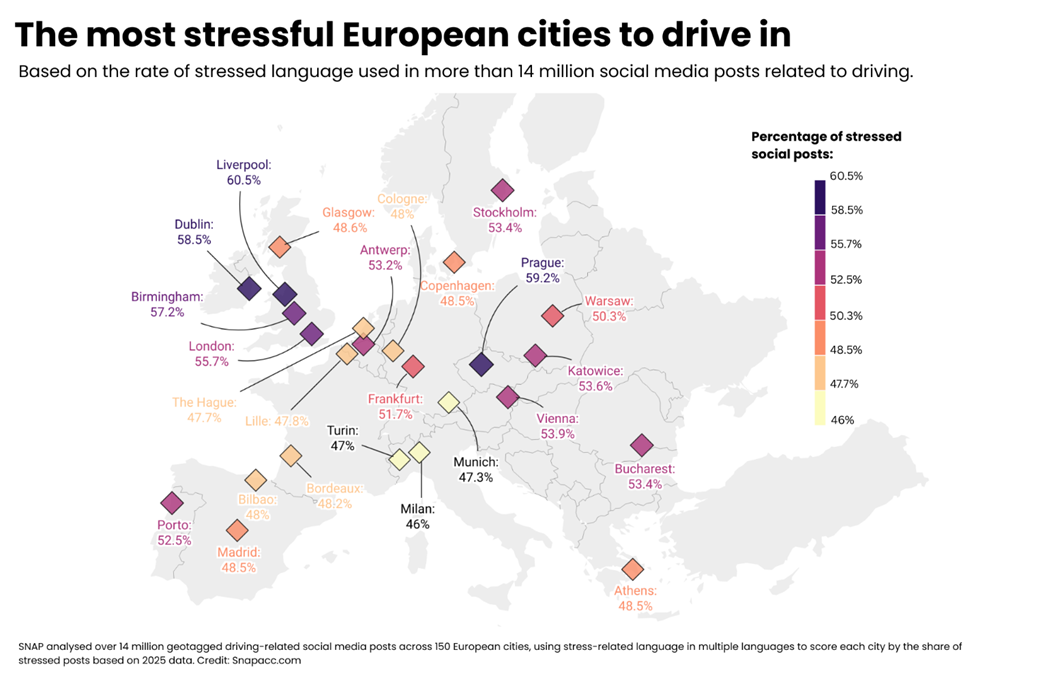
Las ciudades más estresantes para conducir

Las ciudades pueden aumentar el estrés de los conductores debido a los atascos, las calles estrechas y el complejo trazado de las carreteras.
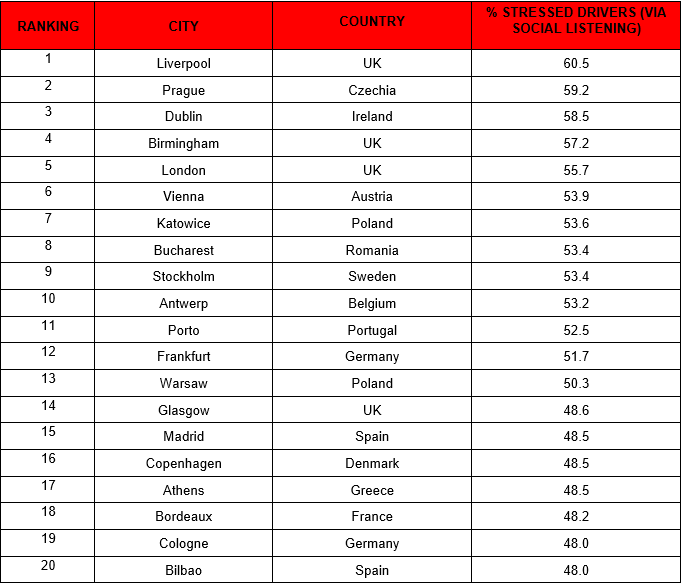
Liverpool (1ª), Birmingham* (4ª) y Londres* (5ª) figuran entre las ciudades más estresantes para conducir en Inglaterra, con puntuaciones de entre el 55,7%* y el 60,5%*. Los puntos de congestión y los cuellos de botella, como los túneles de Mersey en Liverpool y las rutas muy congestionadas, como la autopista orbital de Londres (M25), son los principales responsables de estos elevados niveles de estrés.

Dublín ocupa el 3er puesto y es una de las ciudades más congestionadas de Europa, con los conductores sufren retrasos de una media de 81 horas anuales debido al denso tráfico, lo que pone de manifiesto la persistente presión de la congestión en las vías urbanas.

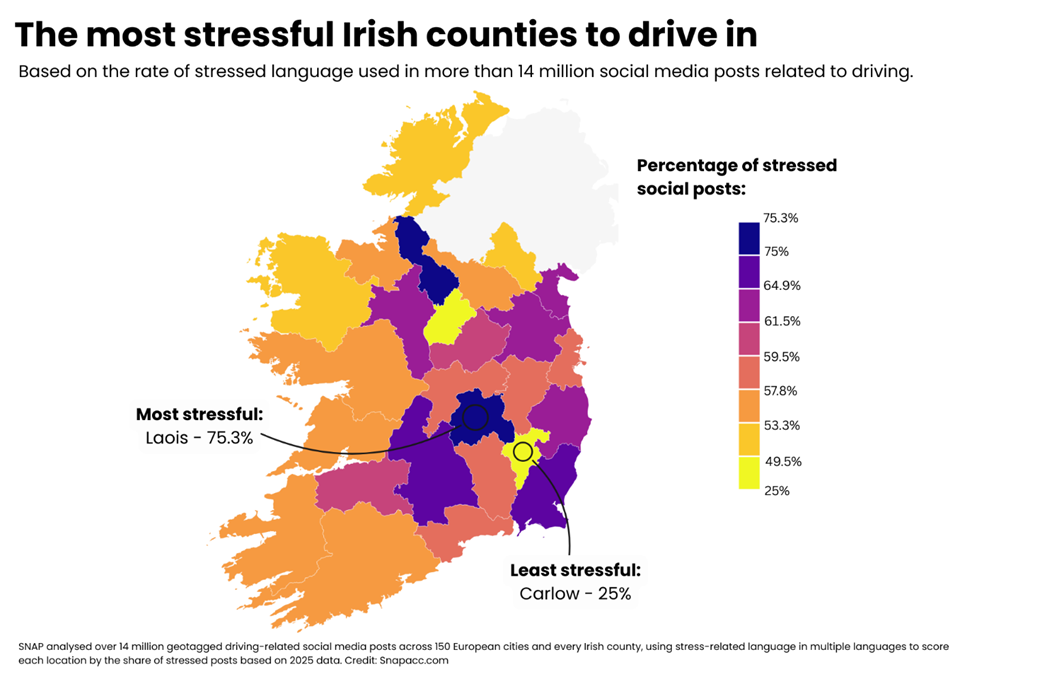
La escucha social centrada específicamente en los automovilistas irlandeses reveló que los condados de Laois y Leitrim registraron niveles de estrés por aparcamiento notablemente elevados, con puntuaciones que oscilaron entre el 75% y el 75,3%. Estas elevadas cifras ponen de manifiesto los persistentes retos a los que se enfrentan los conductores de estas zonas, en gran medida impulsados por la fuerte dependencia del automóvil: [el 73% de los trabajadores de Laois se desplazan al trabajo en coche privado], según las estadísticas oficiales (Página. 118). Además, Leitrim cuenta con informes locales sobre escasas infraestructuras viarias y conflictos de reparto/aparcamiento en ciudades como Drumshanbo que contribuyen al estrés de los conductores en este condado irlandés.
Katowice, Polonia (puesto 7) - aunque no es una de las ciudades polacas más congestionadas en general, Katowice sigue sufriendo retrasos en los desplazamientos al trabajo y presión del tráfico, con conductores que pasan mucho tiempo en el tráfico y carreteras principales como la S86 y la A4 con grandes volúmenes de tráfico diario que pueden contribuir a la puntuación de estrés del 53,6%. Del mismo modo, Varsovia, en Polonia (puesto 13), tiene conductores que pasan aproximadamente 70 horas al año en el tráfico, lo que contribuye a su puntuación de estrés del 50,3% en 2025.

Bucarest, en Rumanía (8ª posición), es una de las ciudades europeas más congestionadas. Los conductores pasan mucho más tiempo en atascos y pierden hasta 12 días laborables al año debido a la lentitud del tráfico.

La capital de España, Madrid (15ª), sufre grandes atascos, con un trayecto de 10 km en 24 minutos. Las calles estrechas y el tráfico persistente, especialmente en zonas como Puente de Vallecas, hacen que la conducción diaria sea lenta y estresante. Del mismo modo, informes de accidentes y tráfico intenso en Bilbao, en España (puesto 20) en vías clave como la A-8 y la BI-30, provocan largas colas y lentitud de circulación, lo que contribuye a crear condiciones de conducción estresantes.

Las ciudades más estresantes para aparcar

El aparcamiento también contribuye al estrés de los conductores y la gestión de flotas, ya que la disponibilidad limitada, la alta demanda y las normativas restrictivas en las ciudades europeas pueden retrasar los viajes, aumentar la frustración y complicar la planificación de rutas.

Además, a través de la escucha social, hemos recopilado datos sobre las ciudades donde los conductores experimentan el mayor estrés al aparcar en toda Europa, concretamente en Rumanía, Polonia, España y Reino Unido. Prestar atención a estas zonas es importante para los operadores de flotas, ya que la disponibilidad limitada de aparcamiento, la alta demanda y la congestión urbana pueden alterar los horarios, aumentar los retrasos y afectar al bienestar de los conductores.

Nuestro estudio muestra que el mayor estrés de aparcamiento en Europa se da en Polonia, con Podlachia (83,3%) y Olsztyn (80%), que se enfrentan a problemas como la escasez de plazas de aparcamiento urbano y la alta densidad de vehículos.

Del mismo modo, en el Reino Unido, Newcastle upon Tyne (65,3%), Liverpool (64,4%) y Middlesbrough (63,9%) son las ciudades con más estrés de aparcamiento para los automovilistas. Estas ciudades se enfrentan a la restricción de plazas en el centro de la ciudad, tarifas en la vía pública, congestión y estrictas normas de aparcamiento que contribuyen a la frustración de los conductores.

Las ciudades rumanas de Sibiu y Cluj-Napoca, junto con las españolas de Málaga y Bilbao, registraron los mayores niveles de estrés por aparcamiento en sus respectivos países. Sin embargo, en comparación con el Reino Unido y Polonia, sus puntuaciones de estrés son más bajas - oscilan entre el 55,6% y el 52,4% - lo que sugiere unas condiciones de aparcamiento más manejables, menos embotellamientos y relativamente menos presión sobre los conductores en estas zonas urbanas.

"En SNAP, nuestro objetivo es sencillo: reducir el estrés relacionado con el aparcamiento para los profesionales del transporte. Al proporcionar información en tiempo real y opciones de ruta más inteligentes, ayudamos a los conductores a encontrar aparcamientos seguros y accesibles, haciendo que sus viajes sean menos estresantes y más eficientes ".

MATTHEW BELLAMY, DIRECTOR GENERAL, SNAP

¿Por qué los conductores de camiones sufren el mayor estrés en estas ciudades?

Los conductores de vehículos pesados se enfrentan a presiones diferentes de las de los conductores habituales. El estacionamiento limitado para vehículos de gran tamaño, la circulación por calles estrechas o congestionadas y el elevado volumen de tráfico pueden hacer que la conducción urbana sea más difícil y estresante, convirtiendo los trayectos rutinarios en experiencias que exigen mucho tiempo y generan mucho estrés.

Profundicemos en los factores que causan estrés a los conductores de vehículos pesados:

  • Limited parking for large vehicles. Scarce lorry bays and high demand make it hard to find safe places to stop, especially in urban centres. The RHA’s Roadside Facilities campaign reports an estimated shortage of 11,000 lorry parking spaces in the UK, creating significant stress for HGV drivers who struggle to find safe and legal places to park., creating significant stress for HGV drivers who struggle to find safe and legal places to park.
  • Narrow streets and complex urban layouts. Tight roads and historic city centres require careful navigation, increasing stress and risk of delays in cities like Prague, Dublin, and Liverpool.
  • High traffic volumes and congestion. Heavy commuter and freight traffic slows journeys, increases travel times, and heightens frustration particularly in busier cities like London, Birmingham, Bucharest, and Madrid.
  • Low-emission or Clean Air Zones. Restrictions on vehicle access, extra charges, and rerouting requirements can complicate planning and add pressure. For example, low emission zones in Spain require some HGVs to seek alternate routes.
  • Route restrictions and delivery schedule. Height and weight limits, prohibited turns, and time-specific delivery windows force drivers onto longer or less convenient routes.
  • Isolation and limited facilities. Long urban journeys without access to rest areas, fuelling, or amenities can increase fatigue and mental strain for HGV drivers.

¿Qué significan las ciudades estresantes para los conductores de camiones?

Las ciudades estresantes plantean retos a los conductores de vehículos pesados. Los atascos, las limitaciones de aparcamiento y la complejidad del trazado urbano pueden provocar pérdidas de tiempo, retrasos en las entregas, aumento de la fatiga y mayor riesgo de colisiones leves o casi colisiones.

Los conductores pueden controlar el estrés planificando cuidadosamente las rutas, haciendo pausas programadas y utilizando la tecnología para anticiparse a los retrasos o ayudar con la elaboración de presupuestos. SNAP apoya a los conductores con herramientas como la aplicación intruck, que les ayuda a localizar aparcamientos disponibles, planificar rutas eficientes y mantenerse informados sobre los atascos, lo que reduce el estrés y hace que los trayectos de los vehículos pesados sean más seguros y más llevaderos.

¿Qué significan las ciudades estresantes para los operadores de flotas de camiones?

Las ciudades estresantes no sólo afectan a los conductores, sino también al rendimiento de las flotas. Los atascos y las limitaciones de aparcamiento pueden provocar retrasos en las entregas, mayores costes de combustible y explotación, menor bienestar de los conductores y mayor riesgo de multas o sanciones. Estas presiones pueden afectar a los márgenes y complicar la programación, la retención o escasez de conductores (https://snapacc.com/newsroom/uk-driver-shortage-are-numbers-improving/) y la satisfacción del cliente.

Los operadores de flotas pueden superar estos retos adoptando estrategias más inteligentes y sistemas de apoyo: utilizando información en tiempo real sobre el tráfico y el aparcamiento, creando horarios flexibles y dando prioridad al descanso y el bienestar de los conductores.

Disponible en más de 850 socios de servicios de toda Europa, la solución de pago de flotas de SNAP se utiliza cada 12 segundos en todo el continente para pagar los servicios de camiones, sin efectivo ni tarjeta.

Las ciudades europeas, menos estresantes para los camioneros

Conocer los focos de estrés en la conducción y el aparcamiento en Europa ayuda a las flotas a operar de forma más segura y eficiente. Utilizando esta información para la planificación de rutas, la formación de conductores, la adopción de tecnologías y la reducción de riesgos, los operadores pueden reducir los retrasos, mejorar el bienestar y proteger a sus conductores. SNAP apoya esta misión para las flotas de transporte, ofreciendo aparcamiento seguro, pagos sin problemas y herramientas que hacen que las operaciones diarias sean más tranquilas y seguras.
INSCRÍBETE HOY EN SNAP

Compartir con

Otros también leen...

Header Image

lunes 26 enero 2026 • Noticias

PREPARE SU PRESUPUESTO DE FLOTA 2026 PARA LO (IN)ESPERADO

Guest

Preparing your fleet budget goes beyond simple financial exercises. As a manager, you need strategic oversight to navigate economic headwinds and an evolving regulatory framework. It is essential to prepare your company for unexpected events, as these instances define operational stability and success. Here’s how to build a responsive budget and get ready for future challenges. Being a fleet manager means foreseeing both the predictable trends and significant uncertainties. The following seven strategies are designed to absorb shocks, adapt to change and build resilience. Your budget may have a fixed monetary amount each year. While simple, it could be too static when anticipating unexpected events. Make your financial planning more dynamic by allocating a specific percentage rather than a fixed amount. For instance, your emergency fund could be 5% of the total budget instead of $100,000 annually. Using a percentage is wise because it hedges against inflation. A fixed amount loses purchasing power over the years, whereas a percentage-based fund grows with the budget. You get automatic protection from marketwide surges. Consumer prices in the U.K. , though they can quickly fluctuate due to market conditions. Fleet managers used to determine their budgets based on acquisition prices. Now, they are focusing on budget stability and long-term strategies. Make your process more holistic by managing the total cost of ownership (TCO) and the cost per vehicle over their lifetimes. This approach makes you more meticulous and your budget more dynamic. Mastering TCO involves centralising your data and using dedicated fleet management software. This technology helps your business by and recommending conservation strategies. TCO also enables you to forecast the year for each vehicle based on historical information. Use this to make more informed acquisitions and save money. A volatile economic climate means you need to contain costs. Leverage your company’s position by reviewing supplier contracts and considering renegotiations before renewal. This strategy converts unpredictable expenses into more manageable line items. Your business partner may raise prices on essential goods, so your meetings should lock in prices for tyres and oil. Narrow your negotiation to key areas, such as pricing structure. Your primary focus should be fixed-price agreements for high-volume items and standard labour rates. Savvy fleet managers leverage their spending from the previous year to earn volume discounts and capped increases. These properly managed contracts insulate your business and transfer risk to suppliers. Risk management for your fleet budget also includes insurance optimisation. Managers should turn this annual exercise into an opportunity to protect their business from financial debilitation. The right policy is crucial because it protects against shocks that can result in third-party damage or injury. It also increases predictability by turning repair bills into known variables. Insurance optimisation requires a thoughtful, data-driven process. Give your broker a risk management portfolio to showcase positive trends, such as fewer speeding incidents or less harsh braking. If you have policy excess, ask your insurer to model the premium savings for a higher deductible. Therefore, you can save money on your monthly payment. Maintenance and repairs can be unpredictable and expensive. One breakdown on the M6 could require costly engine work or a transmission replacement. Be proactive by implementing structured service schedules. Beyond the manufacturer's guidelines, you should create detailed plans for each vehicle based on its usage and age. You can dive deeper by including motorway driving and city travel. Your maintenance schedule should also include daily tasks. For example, experts to prevent condensation formation. If the tank is close to empty, sediment buildup and pump damage may occur. Cleaning is another nonnegotiable daily chore, especially when driving over road salts and chemicals. Rinse off dirt and other contaminants before storing vehicles. Accidents are among the most unexpected parts of your fleet budget. Besides the crash, managers must also and solicitor fees. However, proper driver training can mitigate this cost by reducing its frequency. Targeted coaching helps operators understand defensive driving, hazard perception and the specific dynamics of their jobs. Investing in driver training is one element of risk control. Human driving can be unpredictable, but education transforms it into a more consistent variable. By improving your drivers, you also help your insurance premiums. An accident can raise rates, so proper training is one way to control costs. A decrease in incidents can be used as leverage in insurance negotiations. Fleets are becoming more connected as they transform into data hubs. Your vehicles can generate and store vast amounts of information, which is essential for management. However, the connectivity exposes the modern automobile to liabilities. Budget for cybersecurity to protect your assets from digital threats and prepare for the unexpected. Managing this part of your fleet budget involves protecting vehicle systems. You could invest in hardware and software solutions to create firewalls around your GPS and V2X communications. This strategy helps keep your software up to date and protected from external threats. Secure data transmission is another part of preparing for the unexpected. Forward-thinking managers invest in fleet management systems with end-to-end encryption. Before building a resilient operation, it is essential to understand why. You should budget for unexpected events to ensure continuity. If a vehicle breaks down, it could halt operations and delay services. However, planning for these incidents provides a buffer and safeguards your bottom line. All vehicles are subject to failure, so you are preparing for the physical reality. This strategy is also essential for the bigger picture. For instance, economic volatility is a factor outside your control. Sudden inflation, interest rate hikes and price increases are detrimental to static budgets. However, planning for unexpected costs helps absorb them. By accurately forecasting expenses, you build financial discipline and credibility with stakeholders.Building a dynamic budget demonstrates strategic leadership more than defensive measures. As you incorporate wise approaches, you fundamentally shift your organisation’s mindset and promote proactive control. The modern economic climate requires fleet managers to absorb shocks and mitigate asset failure. A strong budgetary framework lets you protect profit margins and guarantee continuity.Discover more from

Header Image

lunes 19 enero 2026 • Noticias

DESGLOSE DE LOS SISTEMAS DE PEAJE EN EUROPA

Guest

For many fleets operating across Europe, tolls have quietly become one of the most complex and least predictable costs. What was once a relatively straightforward question of motorway charges has evolved into a patchwork of national systems, technologies and pricing models that now reflect emissions, vehicle weight, axle count, geography and even time of day.As we move into 2026, tolling is no longer just an infrastructure charge. It is increasingly a policy lever, used by governments to fund roads, manage congestion and accelerate the shift towards lower-emission transport. For fleet operators, that shift has real financial consequences.This article breaks down how tolling works across Europe, what fleets actually pay today, and what changes are coming next.Margins in road transport are tight. Fuel, labour, insurance and compliance costs have all risen sharply in recent years. Against that backdrop, tolls are becoming more significant, particularly for long-distance and cross-border operators.In countries such as Germany and Austria, toll costs per kilometre can now rival fuel costs on certain routes. In Central and Eastern Europe, tolls remain lower, but rapid rises and network expansion are closing that gap. At the same time, the introduction of CO₂-based charging means that two otherwise identical vehicles can face very different toll bills depending on their emissions profile.For fleets operating internationally, tolls are a consideration for route planning, vehicle procurement and pricing.There is no single European toll system. Instead, fleets must navigate a mix of national approaches that broadly fall into three categories.Distance-based tolls charge vehicles per kilometre travelled. These are now the dominant model for heavy goods vehicles and are used in countries such as Germany, Austria, Poland, Hungary and Belgium.Time-based vignettes allow vehicles to use the road network for a fixed period of time, such as a day, week or year. These were traditionally a pass displayed in the windscreen, but are increasingly digital.Hybrid systems combine toll roads with toll-free alternatives. France, Italy and Spain all operate models where tolls apply only on specific routes.Across all three models, the EU’s revised Eurovignette Directive is pushing countries towards distance-based, emissions-linked charging. This is steadily reducing the role of flat-rate vignettes and increasing the costs of high-mileage fleets.Operationally, tolling is becoming more digital. Most distance-based systems rely on GNSS or GPS tracking via onboard units (OBU), supported by roadside gantries, toll booths and camera enforcement.For fleets, this means greater reliance on onboard technology, tighter compliance requirements, and less tolerance for administrative error. Missed payments on free-flow roads (where there are no toll booths and no need to stop) can quickly turn into fines, particularly for international drivers unfamiliar with local rules.Interoperable toll services under the European Electronic Toll Service (EETS) framework are becoming more important for cross-border operators. Instead of fitting vehicles with multiple country-specific onboard units, fleets can use a single approved device to pay tolls across several European networks. This simplifies administration, reduces installation and maintenance costs – and lowers the risk of non-compliance when vehicles move between different toll regimes. Germany operates one of Europe’s most comprehensive toll systems. The LKW-Maut applies to all trucks over 3.5 tonnes on motorways and federal roads. Since December 2023, tolls include a CO₂ charge, which has increased costs for diesel vehicles. Official details are published by Austria’s GO-Maut is among the most expensive per kilometre in Europe. A Euro VI articulated truck paid around on motorways in 2025. The system includes infrastructure, noise, air pollution and CO₂ components. Electric trucks benefit from lower rates. Belgium operates a kilometre-based toll for trucks in Flanders, Wallonia and Brussels. Rates vary by region, weight and Euro class, with annual increases. From 2026, zero-emission vehicles will no longer be fully exempt but will still pay reduced infrastructure charges. Official information is available from France uses a motorway concession model. Tolls apply on routes operated by private companies and are paid at toll booths or electronically. Annual increases are modest and regulated. The Italy follows a similar concession-based approach. HGVs pay on the Autostrade network. The government is working towards more dynamic tolling by 2026, potentially linking charges to congestion and emissions. Hungary’s HU-GO system applies to trucks over 3.5 tonnes on motorways and main roads. Following high inflation, toll rates have increased sharply. Official updates are published at Poland’s e-TOLL system charges per kilometre using GNSS (satellite) technology. Rates rose in 2025 and will again in 2026, while the toll network continues to expand. The official platform is Spain is unusual in that many major motorways have become toll-free following the expiry of concessions. Some tolled routes remain and costs vary per kilometre for HGVs. The Spanish government’s position is outlined via the Romania currently operates a vignette system for trucks, with a seven-day pass costing around for the heaviest vehicles. This will change in July 2026, when Romania introduces a distance-based toll system called TollRo. Initial rates are expected to be low, but are likely to rise over time. Several developments make 2026 a pivotal year for European tolling.The Netherlands will introduce a kilometre-based truck toll from 1 July, replacing the Eurovignette. Average rates are expected to be around €0.19 per kilometre, with discounts for low-emission vehicles. Official information is available at As mentioned, Romania will transition from vignettes to distance-based charging, bringing it in line with neighbouring countries.Across Europe, CO₂-based differentiation will become standard, with reduced exemptions and tighter enforcement. Electric trucks will continue to benefit, but full exemptions are gradually being replaced by reduced rates rather than zero tolls.For fleets, this means higher exposure to mileage-based costs and greater incentives to invest in cleaner vehicles and better planning tools.Operators are now evaluating routes to balance toll costs against fuel use and journey time. Investment in Euro VI and zero-emission vehicles is increasingly justified not only by fuel savings but by toll reductions. In addition, toll surcharges are becoming more explicit in customer contracts and digital route optimisation tools are playing a larger role in daily operations.Fleets therefore need accurate forecasting, up-to-date vehicle data and clear visibility of toll exposure by route and customer. Vehicle procurement decisions should factor in toll classes alongside fuel efficiency. Cross-border operators should prioritise interoperable toll solutions and ensure drivers understand local payment rules, particularly on free-flow roads.Most importantly, toll costs need to be reflected transparently in pricing. As tolling becomes more emissions-driven, fleets that plan ahead will be better placed to protect margins and remain competitive.For fleets, the question is no longer whether tolls will rise, but how well prepared they are to manage them. In the years ahead, it will not just be about how far a vehicle travels, but how cleanly, where and under which system.As tolls become more closely linked to emissions, mileage and vehicle type, understanding what you pay and where matters more than ever. SNAP helps fleet managers and operators manage payments and support drivers with access to safe, well-equipped truck stops.

Header Image

jueves 08 enero 2026 • Noticias

PARADA DE CAMIONES SUTTERTON: ELEVANDO EL NIVEL DE CONFORT Y SEGURIDAD DEL CONDUCTOR

Susie Jones

Situated on the A17 and a short drive from Boston is , a haven for truck drivers transporting goods along this stretch of road. The location provides not only a truck stop with the usual amenities one would expect clean showers, toilets, shop, and refuelling options but it also presents drivers with the choice to dine at the Roadside Diner, providing visitors with an American-themed restaurant with a variety of meals. We sat down with Director James Townsend to discuss improvements to the site, driver welfare, site security, and their long-standing relationship with SNAP. explains James. The site has undergone a major refurbishment, prioritising the needs of truck drivers. Nestled inside the truck stop is the new roadside diner. James and the team have recently taken back ownership of this and refurbished it. James says. He goes on to explain that it was more than upgrading existing facilities, but providing drivers with the right facilities to make the site a home away from home. SNAP asked truck drivers parking at Sutterton what they thought of the new facilities on offer. One driver commented:When it came to the design of the truck park, the site worked closely with SNAP to maximise the site’s potential:Driver welfare still remains a huge priority for those working in the industry, with investment into truck parking lacking, something James is all too aware of after working with the DFT. he explains. While investment is valuable, directing it into the right facilities for truck drivers is also imperative. James states. James and the rest of the team work closely with SNAP’s UK Network Team as well as , providing them with a single, clear point of contact should any issues arise. explains James. Having the support in place for complaints and technical issues is a major advantage for a truck stop like Sutterton, which often manages competing demands. Working with SNAP has delivered additional benefits as well, as James goes on to say:To ensure truck drivers get a good night’s rest, ensuring the site is as safe and secure as possible was vital for Sutterton Truck Stop. Working with SNAP Access & Security from the outset has allowed James and the team to do exactly that. says James. The site is a firm believer in training its staff to deal with incidents if they occur. Inspired by what you’ve just read? Catch the full interview with