Josh Cousens
Novinky a aktualizácie • 5 min čítania

Najstresujúcejšie mestá v Európe, v ktorých sa parkuje a jazdí

Vytvorené: 14. 01. 2026

Aktualizované: 14. 01. 2026

Jazda a parkovanie v európskych mestách môžu byť pre vodičov nákladných vozidiel každodenným utrpením - a vysoká úroveň stresu nemá vplyv len na pohodu, ale aj na efektívnosť vozového parku. Pre manažérov logistiky je znalosť toho, kde sú tieto problémy najväčšie, kľúčová pre plánovanie trasy, bezpečnosť vodičov a prevádzkovú výkonnosť.

Náš výskum využíva počúvanie sociálnych sietí na analýzu miliónov geoznačených príspevkov v 150 európskych mestách a identifikuje miesta, ktoré sú pre vodičov najviac stresujúce. Na čele rebríčka je Liverpool (60,5 % príspevkov poukazuje na stres súvisiaci s riadením), nasleduje Praha (59,2 %) a Dublin (58,5 %). Liverpool sa tiež umiestnil na 2. mieste ako najstresujúcejšie mesto pre parkovanie v Spojenom kráľovstve. Hlavnými bolestivými bodmi, na ktoré upozorňujú vodiči v celej Európe, sú zápchy, nedostatok parkovacích miest a zložité podmienky na cestách.

Táto štúdia mapuje stresové miesta v Európe s využitím názorov vodičov v reálnom svete a ukazuje, ako podmienky v meste ovplyvňujú pohodu. Nejde o zostavenie rebríčka krajín, ale o poskytnutie jasných a použiteľných poznatkov manažérom vozových parkov a logistiky na podporu vodičov, plánovanie inteligentnejších trás a znižovanie záťaže z jazdy v mestách.

Počúvanie skúseností vodičov

V našom výskume sme analyzovali viac ako 14 miliónov geoznačených príspevkov na sociálnych sieťach zo 150 európskych miest, ktoré sa týkali tém súvisiacich s jazdou, ako je parkovanie, doprava a stav ciest. Príspevky boli hodnotené z hľadiska stresu sledovaním kľúčových slov a fráz spojených s negatívnymi emóciami v angličtine a miestnych jazykoch. Každé mesto bolo hodnotené na základe percentuálneho podielu príspevkov vyjadrujúcich stres, čo poskytlo jasný obraz o tlaku na vodičov v celej Európe. Údaje sa zbierali na hlavnej platforme sociálnych médií X (predtým Twitter) počas celého roka 2025.

"Stres" zahŕňa tlaky, ktorým vodiči vozového parku čelia na cestách, vrátane dopravy, parkovania, podmienok na cestách, všeobecnej jazdy a konfliktov s inými vodičmi. Pochopenie týchto faktorov pomáha prevádzkovateľom vozového parku podporovať pohodu a výkonnosť vodičov.

"Poznanie miest, ktoré sú pre vodičov nákladných vozidiel najviac stresujúce, umožňuje SNAP zamerať sa na riešenia, ktoré zvyšujú bezpečnosť aj efektívnosť. "

MATTHEW BELLAMY, VÝKONNÝ RIADITEĽ, SNAP

Mestá v EÚ vystavené stresu: Kľúčové zistenia

Od roku 2025 pre mestá s najväčším stresom z jazdy:

  1. Liverpool, Spojené kráľovstvo. 60,5 % príspevkov o parkovaní na sociálnych sieťach v súvislosti so stresom - najvyšší podiel príspevkov o šoférovaní v súvislosti so stresom v Európe.
  2. Praha, Česko. 59,2 % stresujúcich príspevkov na sociálnych sieťach týkajúcich sa parkovania pravdepodobne v dôsledku hustej premávky, historického dizajnu ulíc a obmedzeného priestoru pre navigáciu väčších vozidiel v meste.
  3. Dublin, Írsko. 58,5 % vystresovaných príspevkov na sociálnych sieťach o parkovaní - Stres vodičov je silne spojený s meškaním v dopravných zápchach, nedostatkom parkovacích miest a rušnými dochádzkovými trasami, ktoré ovplyvňujú každodenné podmienky jazdy.

3 mestá v Spojenom kráľovstve s najväčším stresom z parkovania v roku 2025:

  1. Newcastle upon Tyne. Toto mesto, ktoré sa bežne skracuje na "Newcastle" a nachádza sa v grófstve Tyne and Wear, má neuveriteľných 65,3 % stresujúcich príspevkov na sociálnych sieťach týkajúcich sa parkovania, čo z neho robí najstresujúcejšie mesto Spojeného kráľovstva v oblasti parkovania v roku 2025.
  2. Liverpool. V Merseyside vyjadruje 64,4 % sociálnych príspevkov o parkovaní v Liverpoole stres.
  3. Middlesbrough. V tomto meste v grófstve North Yorkshire je 63,9 % sociálnych príspevkov o parkovaní stresujúcich.

Zvýšený stres z parkovania vykazuje aj Škótsko: Edinburgh (61,6 % príspevkov o parkovaní na sociálnych sieťach) a Glasgow (61,4 % príspevkov o parkovaní na sociálnych sieťach) patria medzi mestá, v ktorých je parkovanie najnáročnejšie. Okrem toho sa Londýn umiestnil na 17. mieste v rebríčku miest s najväčším stresom z parkovania (57,9 stresujúcich sociálnych príspevkov o parkovaní. Medzi faktory, ktoré k tomu prispievajú, môžu patriť úzke ulice, husté mestské usporiadanie, vysoký dopyt po obmedzenom parkovacom priestore a obmedzenia v centre mesta, ktoré môžu zvyšovať tlak na vodičov.

Stresové body pre európskych vodičov

Na základe miliónov geoznačených príspevkov na sociálnych sieťach sme každé mesto ohodnotili podľa podielu príspevkov súvisiacich so stresom, čím sme odhalili najhorúcejšie miesta v Európe, kde sa jazdí a parkuje, a upozornili sme na mestské podmienky, ktoré sú pre vodičov najväčším problémom.

Naša infografická mapa zobrazuje mestá s najväčším tlakom na vodičov a parkovacie miesta, pričom odhaľuje kľúčové mestské hotspoty a problémy, ktorým čelia vodiči na jednotlivých trhoch.
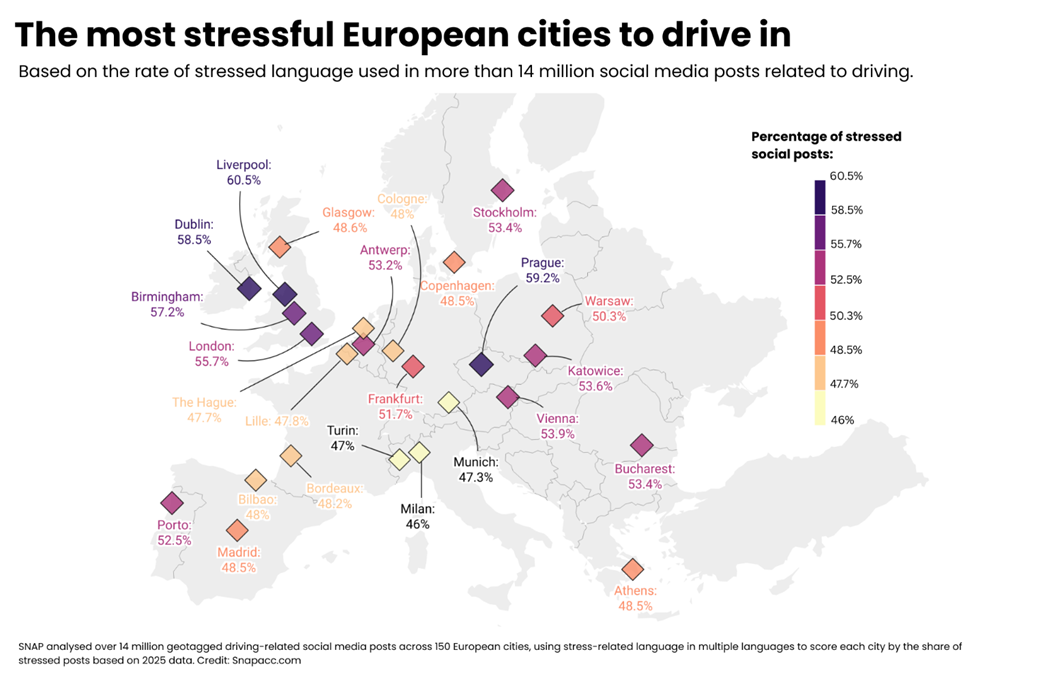
Najstresujúcejšie mestá na šoférovanie

Mestá môžu zvyšovať stres vodičov v dôsledku dopravných zápch, úzkych ulíc a zložitého usporiadania ciest.
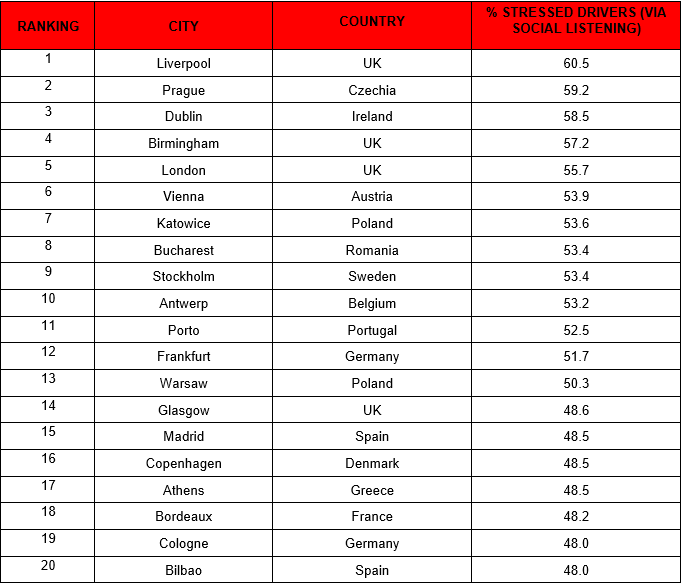
Liverpool (1. miesto), Birmingham (4. miesto) a Londýn (5. miesto) patria medzi najstresujúcejšie mestá na šoférovanie v Anglicku s hodnotami od 55,7 % do 60,5 %. K zvýšenej úrovni stresu prispievajú najmä miesta s dopravnými zápchami a úzkymi hrdlami, ako sú liverpoolske tunely Mersey a veľmi preťažené trasy, napríklad londýnska diaľnica (M25) .

Dublin je na 3. mieste a je jedným z najpreťaženejších miest v Európe, pričom vodiči sa kvôli hustej premávke zdržia v priemere 81 hodín ročne, čo poukazuje na pretrvávajúce problémy s preťažením mestských ciest.

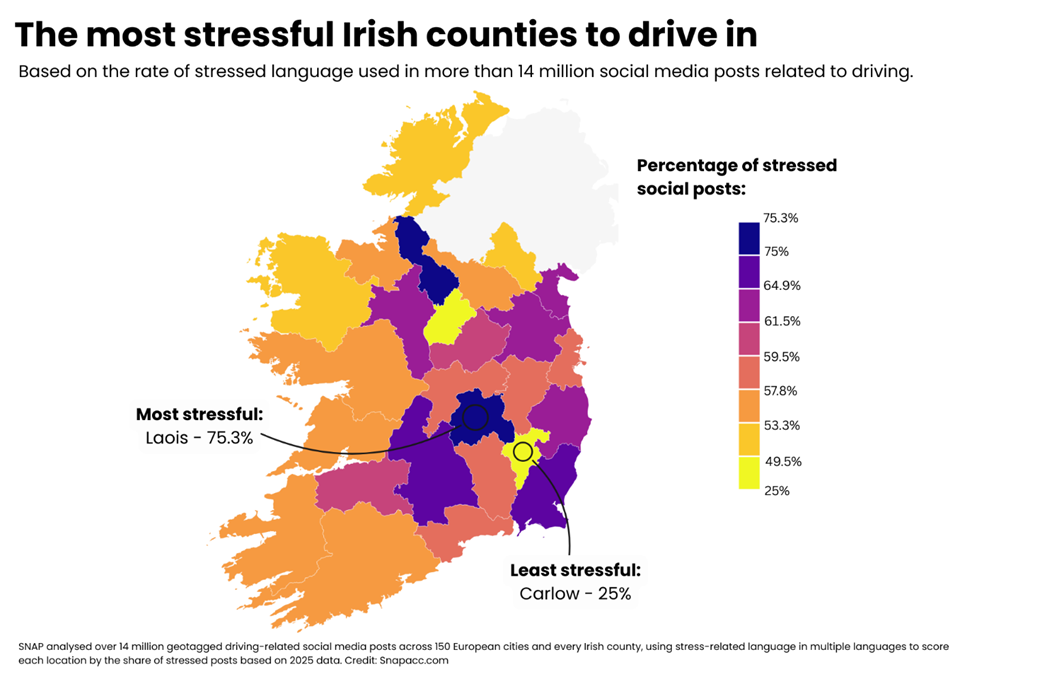
Ďalší sociálny prieskum zameraný konkrétne na írskych motoristov ukázal, že v okresoch Laois a Leitrim bola zaznamenaná mimoriadne vysoká miera stresu z parkovania, pričom skóre sa pohybovalo od 75 % do 75,3 %. Tieto vysoké čísla poukazujú na pretrvávajúce problémy vodičov v týchto oblastiach, ktoré sú do veľkej miery spôsobené veľkou závislosťou od automobilov - [73 % dochádzajúcich do práce v Laois cestuje do práce osobným autom], podľa oficiálnych štatistík (strana 118). Okrem toho sa v Leitrime vyskytujú miestne správy o riedkej cestnej infraštruktúre a konfliktoch pri dodávkach/parkovaní v mestách ako Drumshanbo, ktoré prispievajú k stresu vodičov v tomto írskom grófstve.
Katowice, Poľsko (7. miesto) - hoci Katovice nepatria medzi celkovo najzaťaženejšie poľské mestá, stále sa v nich vyskytujú meškania pri dochádzaní do práce a dopravný tlak](https://www.tomtom.com/traffic-index/katowice-traffic/), pričom vodiči trávia značný čas v dopravnej zápche a na hlavných cestách, ako sú S86 a A4, je denne veľká intenzita dopravy, čo môže prispieť k skóre stresu 53,6 %. Podobne aj v Varšave v Poľsku (13. miesto) strávia vodiči v dopravnej zápche približne 70 hodín ročne, čo prispieva k jej skóre stresu 50,3 % v roku 2025.

Bukurešť v Rumunsku (8. miesto) sa ako jedno z najpreplnenejších európskych miest potýka s notoricky známymi dopravnými zápchami, pričom vodiči trávia výrazne viac času v zápchach a kvôli pomalej premávke strácajú až 12 pracovných dní ročne.

Hlavné mesto Španielska Madrid (15. miesto) trpí veľkými dopravnými zápchami, pričom cesta 10 km trvá približne 24 minút. Úzke ulice a pretrvávajúca doprava, najmä v oblastiach ako Puente de Vallecas, spôsobujú, že každodenná jazda je pomalá a stresujúca. Podobne hlásenia o nehodách a hustej premávke v španielskom meste Bilbao (20. miesto) na kľúčových cestách, ako sú A-8 a BI-30, spôsobujú dlhé kolóny a pomalý pohyb, čo prispieva k stresujúcim podmienkam jazdy.

Najstresujúcejšie mestá na parkovanie

Parkovanie tiež prispieva k stresu vodičov a manažmentu vozového parku, pretože obmedzená dostupnosť, vysoký dopyt a reštriktívne predpisy v európskych mestách môžu spôsobiť oneskorenie ciest, zvýšiť frustráciu a skomplikovať plánovanie trasy.

Prostredníctvom sociálnych sietí sme tiež zozbierali údaje o mestách, v ktorých vodiči zažívajú najväčší stres pri parkovaní v celej Európe, konkrétne v Rumunsku, Poľsku, Španielsku a Spojenom kráľovstve. Venovať pozornosť týmto oblastiam je pre prevádzkovateľov vozových parkov dôležité, pretože obmedzená dostupnosť parkovania, vysoký dopyt a preťaženie miest môžu narušiť harmonogramy, zvýšiť meškania a ovplyvniť pohodu vodičov.

Z nášho prieskumu vyplýva, že najväčší tlak na parkovanie v Európe je v Poľsku, pričom Podlahovsko (83,3 %) a Olsztyn (80 %) čelia problémom, ako sú obmedzené parkovacie miesta v mestách a vysoká hustota vozidiel.

Podobne aj v Spojenom kráľovstve sú mestá Newcastle upon Tyne (65,3 %), Liverpool (64,4 %) a Middlesbrough (63,9 %) mestami, v ktorých majú motoristi najväčší problém s parkovaním. Tieto lokality zápasia s obmedzenými miestami v centre mesta, poplatky na ulici, zápchami a prísnymi predpismi o parkovaní, ktoré prispievajú k frustrácii vodičov.

Rumunské mestá Sibiu a Cluj-Napoca spolu so španielskymi mestami Malaga a Bilbao zaznamenali najvyššiu úroveň stresu z parkovania v rámci svojich krajín. V porovnaní so Spojeným kráľovstvom a Poľskom je však ich skóre stresu nižšie - v rozmedzí od 55,6 % do 52,4 % - čo naznačuje lepšie zvládnuteľné podmienky parkovania, menej úzkych miest a relatívne menší tlak na vodičov v týchto mestských oblastiach.

"Náš cieľ v spoločnosti SNAP je jednoduchý: znížiť stres profesionálov v oblasti nákladnej dopravy spojený s parkovaním. Poskytovaním informácií v reálnom čase a inteligentnejších možností trasy pomáhame vodičom nájsť bezpečné a dostupné parkovanie, vďaka čomu sú ich cesty menej stresujúce a efektívnejšie. "

MATTHEW BELLAMY, VÝKONNÝ RIADITEĽ, SNAP

Prečo vodiči nákladných vozidiel zažívajú v týchto mestách najväčší stres?

Vodiči nákladných vozidiel čelia iným tlakom ako bežní vodiči automobilov. Obmedzené možnosti parkovania pre veľké vozidlá, navigácia v úzkych alebo preplnených uliciach a vysoká intenzita premávky môžu spôsobiť, že jazda v meste je náročnejšia a stresujúcejšia, čím sa z bežných ciest stávajú časovo náročné a stresujúce zážitky.

Pozrime sa hlbšie na faktory spôsobujúce stres vodičov nákladných vozidiel:

  • Limited parking for large vehicles. Scarce lorry bays and high demand make it hard to find safe places to stop, especially in urban centres. The RHA’s Roadside Facilities campaign reports an estimated shortage of 11,000 lorry parking spaces in the UK, creating significant stress for HGV drivers who struggle to find safe and legal places to park., creating significant stress for HGV drivers who struggle to find safe and legal places to park.
  • Narrow streets and complex urban layouts. Tight roads and historic city centres require careful navigation, increasing stress and risk of delays in cities like Prague, Dublin, and Liverpool.
  • High traffic volumes and congestion. Heavy commuter and freight traffic slows journeys, increases travel times, and heightens frustration particularly in busier cities like London, Birmingham, Bucharest, and Madrid.
  • Low-emission or Clean Air Zones. Restrictions on vehicle access, extra charges, and rerouting requirements can complicate planning and add pressure. For example, low emission zones in Spain require some HGVs to seek alternate routes.
  • Route restrictions and delivery schedule. Height and weight limits, prohibited turns, and time-specific delivery windows force drivers onto longer or less convenient routes.
  • Isolation and limited facilities. Long urban journeys without access to rest areas, fuelling, or amenities can increase fatigue and mental strain for HGV drivers.

Čo znamenajú stresujúce mestá pre vodičov nákladných vozidiel?

Stresujúce mestá predstavujú pre vodičov nákladných vozidiel výzvu. Premávka, obmedzené možnosti parkovania a zložité mestské usporiadanie môžu viesť k časovým stratám, zmeškaným dodávkam, zvýšenej únave a vyššiemu riziku menších kolízií alebo takmer nehôd.

Vodiči môžu zvládať stres starostlivým plánovaním trás, plánovanými prestávkami a využívaním technológií na predvídanie meškaní alebo pomoc pri zostavovaní rozpočtu. SNAP podporuje vodičov pomocou nástrojov, ako je aplikácia intruck, ktorá im pomáha nájsť dostupné parkovacie miesta, plánovať efektívne trasy a byť informovaní o dopravných zápchach, čím sa znižuje stres a cesty nákladných vozidiel sú bezpečnejšie a lepšie zvládnuteľné.

Čo znamenajú stresujúce mestá pre prevádzkovateľov vozového parku nákladných vozidiel?

Stresujúce mestá neovplyvňujú len vodičov, ale aj výkonnosť vozového parku. Preťaženie a obmedzené možnosti parkovania môžu viesť k oneskoreným dodávkam, vyšším nákladom na palivo a prevádzku, zhoršenej pohode vodičov a zvýšenému riziku pokút alebo sankcií. Tieto tlaky môžu znižovať marže a komplikovať plánovanie, udržanie alebo nedostatok vodičov a spokojnosť zákazníkov.

Prevádzkovatelia vozových parkov môžu tieto výzvy prekonať prijatím inteligentnejších stratégií a podporných systémov: využívaním poznatkov o doprave a parkovaní v reálnom čase, vytváraním flexibilných harmonogramov a uprednostňovaním odpočinku a pohody vodičov.

Platobné riešenie SNAP pre vozové parky, ktoré je k dispozícii u viac ako 850 servisných partnerov v celej Európe, sa na celom kontinente používa každých 12 sekúnd na platbu za služby nákladných vozidiel - bez hotovosti alebo karty.

Zníženie stresu vodičov nákladných vozidiel v európskych mestách

Pochopenie stresových oblastí jazdy a parkovania v Európe pomáha vozovým parkom pracovať bezpečnejšie a efektívnejšie. Využitím týchto poznatkov pri plánovaní trás, školení vodičov, zavádzaní technológií a znižovaní rizík môžu prevádzkovatelia znížiť meškania, zlepšiť pohodu a chrániť svojich vodičov. SNAP podporuje toto poslanie vozových parkov tým, že ponúka bezpečné parkovanie, bezproblémové platby a nástroje, vďaka ktorým je každodenná prevádzka pokojnejšia a bezpečnejšia.
PRIHLÁSTE SA K ODBERU EŠTE DNES

Zdieľať na

Ostatní tiež čítajú...

Header Image

štvrtok 08 januára 2026 • Novinky a aktualizácie

SUTTERTON TRUCK STOP: ZVYŠOVANIE ŠTANDARDOV KOMFORTU A BEZPEČNOSTI VODIČOV

Susie Jones

Situated on the A17 and a short drive from Boston is , a haven for truck drivers transporting goods along this stretch of road. The location provides not only a truck stop with the usual amenities one would expect clean showers, toilets, shop, and refuelling options but it also presents drivers with the choice to dine at the Roadside Diner, providing visitors with an American-themed restaurant with a variety of meals. We sat down with Director James Townsend to discuss improvements to the site, driver welfare, site security, and their long-standing relationship with SNAP. explains James. The site has undergone a major refurbishment, prioritising the needs of truck drivers. Nestled inside the truck stop is the new roadside diner. James and the team have recently taken back ownership of this and refurbished it. James says. He goes on to explain that it was more than upgrading existing facilities, but providing drivers with the right facilities to make the site a home away from home. SNAP asked truck drivers parking at Sutterton what they thought of the new facilities on offer. One driver commented:When it came to the design of the truck park, the site worked closely with SNAP to maximise the site’s potential:Driver welfare still remains a huge priority for those working in the industry, with investment into truck parking lacking, something James is all too aware of after working with the DFT. he explains. While investment is valuable, directing it into the right facilities for truck drivers is also imperative. James states. James and the rest of the team work closely with SNAP’s UK Network Team as well as , providing them with a single, clear point of contact should any issues arise. explains James. Having the support in place for complaints and technical issues is a major advantage for a truck stop like Sutterton, which often manages competing demands. Working with SNAP has delivered additional benefits as well, as James goes on to say:To ensure truck drivers get a good night’s rest, ensuring the site is as safe and secure as possible was vital for Sutterton Truck Stop. Working with SNAP Access & Security from the outset has allowed James and the team to do exactly that. says James. The site is a firm believer in training its staff to deal with incidents if they occur. Inspired by what you’ve just read? Catch the full interview with

Header Image

piatok 19 decembra 2025 • Novinky a aktualizácie

JE VAŠA FLOTILA CIEĽOM? STANOVENIE PRIORÍT BEZPEČNOSTI VO SVETE, KTORÝ JE TECHNOLOGICKY VYSPELÝ

Guest

Cybersecurity readiness must be a top priority for fleet owners and managers in the United Kingdom. The rapid digital transformation in the transportation and logistics industry has made fleets attractive targets for hackers. Learn about the cybersecurity trends fleet operators must be aware of and strategies you should adopt to lower your susceptibility to attacks.The advent of connected vehicles, push for fleet electrification, integration of Internet of Things (IoT) devices and reliance on automation have expanded the attack surface opportunistic cybercriminals can exploit to infiltrate your network.Vulnerable telematics back-end systems, insecure over-the-air firmware updates and buggy APIs are common entry points for phishers, data thieves, business saboteurs and ransomware attackers. Threat actors are also increasingly leveraging artificial intelligence to launch more believable scams.Falling victim to a cyberattack can cause more than extended, unscheduled downtime. A high-profile security incident can inflict severe reputational damage on your organisation and harm your business in the long term.Although your cyber insurance coverage may compensate you millions for losses, the financial impact can lead to insolvency — as happened to KNP Logistics in June 2025. An Akira ransomware attack exacerbated this major logistics group’s preexisting financial struggles, and let go of 730 employees.Every business is at risk from cyberattacks, but these strategies can help make your fleet management software and vehicles less vulnerable.A robust threat intelligence platform strengthens cybersecurity, as it allows you to proactively defend your assets from malicious actors and minimise your losses if they target you. Here are the primary ways to use threat intel to improve your security posture:Contextualisation enables your team to identify the perpetrators behind specific attacks, understand their motives and capabilities, determine what they want from your organisation, and comprehend their methods. Context transforms raw threat data into actionable intelligence, enabling you to inform your decision-making.Attackers evolve, so learning how they operated in the past is not enough to accurately anticipate their future actions. A threat intelligence platform can help you keep pace with known malicious actors and familiarise your team with relatively unknown ones. Some organisations use deception technologies to lure cybercriminals and watch them in action in a controlled environment.A software solution that can integrate into your company’s existing tools breaks down silos and allows threat intelligence to flow freely across teams. Cross-departmental collaboration is the key to implementing an organisation-wide cybersecurity strategy effectively.A threat intelligence platform can monitor your network activity and sense attack patterns early enough to notify your Security Operations Centre or IT professionals immediately. Early detection is vital to count threats before they infiltrate deeply into your system and cause more harm.Responding to urgent incidents involves less manual work with a threat intelligence platform. This software solution can orchestrate essential tasks to mitigate breaches, enabling your in-house cybersecurity professionals to focus on activities where human input is more impactful.Regulatory frameworks and data privacy standards are becoming more stringent over time. A threat intelligence platform aids compliance by ensuring that your team handles sensitive data responsibly and generates detailed reports to document your best practices.Zero trust minimises the likelihood of unauthorised access to fleet management systems by continuously verifying every user and device and enforcing identity-centric access control.This approach acknowledges that threats can come from within the organisation. Assuming that each request may come from a malicious actor reflects the level of vigilance you must exercise to protect your operation from sophisticated attacks and help your team adapt to complex, dynamic environments involving remote users, IoT devices and cloud services.After verification, zero trust gives users and devices just enough access to perform specific tasks. The principle of least privilege enables effective threat containment if a cybercriminal gets in.According to Cybersecurity Insiders’ 2024 Insider Threat Report, insider threat attacks have spiked. In October 2024, 51% of the 413 respondents in IT and cybersecurity reportedly over the past year. 29% reported spending over $1 million on remediation.The adoption of new technologies is a primary driver behind the rise in these cyberattacks. Investing in employee training is crucial for preventing team members from becoming insider threats.Provide target users with sufficient resources to familiarise themselves with the technologies. Highlight the ways they may inadvertently leak sensitive information or compromise the system. Tell them the red flags to watch out for to identify malicious schemes and teach them safe, responsible ways to deal with cybercriminals.Tight physical security can safeguard your assets from digital hijackers. Effective physical protection often involves a layered approach, which includes perimeter fencing, strategic placement of surveillance equipment and tamper-evident vehicle electronics casings. Additionally, limiting visibility with opaque doors , thereby adding an extra layer of protection to your physical security. Blending physical safeguards with digital solutions can restrict what hackers can do, even if they manage to gain control over fleet vehicles. In 2022, a group of hacktivists attacked the Russian ride-hailing service Yandex Taxi and directed in the same place in western Moscow. The incident should serve as a wake-up call to embrace measures to immobilise your assets if criminals remotely take control of the driver’s seat.Your company is only as strong as the weakest link in your supply chain. The positive impact of impregnable internal cybersecurity diminishes when third-party vendors make it easy for lawbreakers to steal your data from elsewhere. For instance, temporarily could jeopardise your cybersecurity if your lessor has outdated software.Working with supply chain partners that are as particular about cybersecurity reduces your risk exposure. Integrating your suppliers’ systems into your threat intelligence platform ensures better coordination during data breaches. Close collaboration with critical external parties promotes cybersecurity readiness and helps everyone prepare for potential attacks.Contending with online threat actors is inevitable in modern fleet management. Prioritise proactive strategies to stay ahead of hackers. By implementing a multi-layered defence that combines technology, employee training and strategic partnerships, you can build a resilient operation. This stance protects your current assets and secures your company’s future in an increasingly connected world.Discover more from

Header Image

pondelok 08 decembra 2025 • Novinky a aktualizácie

TRENDY V NÁKLADNÝCH VOZIDLÁCH: PREDPOVEDE NA ROK 2026

Guest

Major changes are coming for the mobility sector.The next 12 months will bring some of the most significant regulatory and technological shifts European transport has seen in years. New emissions rules, driver-monitoring systems, hydrogen trials and autonomous pilots will reshape how fleets operate across the UK and EU.For operators and professional drivers, understanding these changes now will make the difference between adapting confidently and struggling to keep up. come into force in 2026, introducing new requirements for fleets. Nitrogen oxide and carbon monoxide limits will tighten further, with the permitted particle size dropping from 23 nanometres to 10. In addition, for the first time.Every new truck sold will need to comply with Euro VII. While vehicle pricing is likely to be affected, the bigger impact will fall on procurement timelines, fleet renewal cycles and long-term decarbonisation.. These monitor eye and head movement to identify early signs of fatigue or inattention, enabling safer interventions and supporting accident-reduction goals across Europe. By 2029, new cab designs must minimise blind spots through improved glass visibility rather than camera reliance. This will particularly influence urban operations, vulnerable road user safety and future vehicle specification.. After years of exemption, this change effectively brings smaller commercial vehicles under full drivers’ hours enforcement.For operators with mixed fleets, this means introducing:● new driver cards● regular data downloads● updated monitoring processes● revised routing and rest-time planningThousands of vehicles that previously operated freely will need compliance systems in place almost immediately. requires companies with more than 250 employees or €40 million revenue to collect and report verified CO₂ emissions – including Scope 3 transport activity.This will cascade through supply chains. Smaller hauliers without reliable emissions reporting risk losing access to larger contracts, accelerating the push toward better data systems and standardised reporting.Electric HGV production will rise rapidly in 2026. are all expanding manufacturing capacity.To support this, electric charging is also expanding. , as part of HyHAUL's M4 corridor project. Three refuelling stations, each supplying up to two tonnes of hydrogen daily, support the pilot. If successful, the project aims for 30 trucks on the road by the end of 2026 and 300 by 2030. Alongside this, . Five more will follow by 2027.Vehicle manufacturers are taking different approaches to developing hydrogen-fuelled trucks: ● and DAF are planning similar systems. ● will introduce its next-generation hydrogen fuel cell stack in 2026 with improved durability and lower operating costs.Hydrotreated Vegetable Oil (HVO) is emerging as a notable transitional fuel for haulage in 2026, thanks to two factors: stricter biofuel mandates in north-western Europe and its compatibility with existing diesel engines. Reports by confirm that HVO is a “drop-in” fuel: it can be used in many existing heavy-duty vehicles without engine or infrastructure changes, which gives operators a practical pathway to immediate CO₂ reductions. Meanwhile, forecast that HVO consumption could reach record highs in 2026. Germany alone may need an additional 1.5 million tonnes – almost four times 2025 levels – to meet demand. Although uptake remains modest when compared with battery-electric or hydrogen alternatives, the current regulatory push and infrastructure compatibility mean HVO is likely to gain traction in 2026.From spring 2026, in controlled zones – a full year ahead of plans. Enabled by the , this transition supports an industry expected to contribute £42 billion to the UK economy by 2035 and create an estimated 38,000 jobs. Germany is close behind. , supported by €20 million in seed funding. Across northern Europe, autonomous freight along the 1,200-km Rotterdam-Oslo corridor. The programme runs until March 2026 and examines how autonomous vehicles perform across borders, terrain types and logistics hubs.In Sweden, already move goods between warehouses, processing five million data points per second. Their controlled deployments demonstrate the potential for automation in predictable, repeatable routes.Despite this progress, humans will continue to play a central role. . So while automation will support specific functions, such as port operations, depot shuttles and fixed urban routes, long-haul and complex international transport will remain human-led.The scale and speed of change arriving in 2026 is unlike any previous year for European road transport. Multiple regulatory, technological and sustainability shifts will land simultaneously, reshaping how fleets operate across borders."The operators who succeed in 2026 won't be those who resist change but those who prepare for it systematically," says Nick Long, European Strategic Partnership and Development Manager at SNAP. "We're working with fleets across Europe to build the infrastructure that tomorrow's industry needs. Secure parking. Integrated payments for new toll structures. The building blocks of success are available now for those ready to use them."SNAP helps fleets prepare for the future with integrated solutions for parking, payments and fleet management across Europe. Visit snapacc.com to discover how we can support your transition to 2026 and beyond.