Josh Cousens
Notizie e aggiornamenti • 5 leggere

Le città europee più stressanti in cui parcheggiare e guidare

Creato: 14/01/2026

Aggiornato: 14/01/2026

Guidare e parcheggiare nelle città europee può essere un grattacapo quotidiano per gli autisti di mezzi pesanti, e gli alti livelli di stress non influiscono solo sul benessere, ma anche sull'efficienza della flotta. Per i responsabili della logistica, conoscere i luoghi in cui queste sfide sono maggiori è fondamentale per la pianificazione degli itinerari, la sicurezza dei conducenti e le prestazioni operative.

Utilizzando il social listening per analizzare milioni di post geotaggati in 150 città europee, la nostra ricerca identifica i luoghi che gli automobilisti trovano più stressanti. Liverpool è in cima alla lista (il 60,5% dei post mostra stress legato alla guida), seguita da Praga (59,2%) e Dublino (58,5%). Liverpool è anche al secondo posto tra le città più stressanti per il parcheggio nel Regno Unito. Congestione, scarsità di parcheggi e condizioni stradali difficili sono i principali punti dolenti evidenziati dagli automobilisti di tutta Europa.

Questo studio traccia una mappa dei punti nevralgici dello stress degli automezzi pesanti in Europa, utilizzando i dati reali dei conducenti e mostrando come le condizioni delle città influiscano sul benessere. Non si tratta di stilare una classifica dei Paesi, ma di fornire ai gestori di flotte e logistica informazioni chiare e attuabili per supportare i conducenti, pianificare percorsi più intelligenti e ridurre la pressione di guida in città.

Ascolto delle esperienze dei conducenti

La nostra ricerca ha analizzato oltre 14 milioni di post geotaggati sui social media di 150 città europee, riguardanti argomenti legati alla guida come il parcheggio, il traffico e le condizioni stradali. I post sono stati valutati in base allo stress, rilevando parole chiave e frasi legate a emozioni negative in inglese e nelle lingue locali. Ogni città è stata valutata in base alla percentuale di post che esprimevano stress, fornendo un quadro chiaro della pressione degli automobilisti in Europa. I dati sono stati raccolti sulla principale piattaforma di social media X (ex Twitter) per tutto il 2025.

Lo "stress" riguarda le pressioni che i conducenti di flotte devono affrontare sulla strada, tra cui il traffico, il parcheggio, le condizioni stradali, la guida in generale e i conflitti con gli altri conducenti. La comprensione di questi fattori aiuta gli operatori delle flotte a sostenere il benessere e le prestazioni dei conducenti.

"Sapere quali sono le città più stressanti per i conducenti di mezzi pesanti permette a SNAP di individuare soluzioni che migliorano sia la sicurezza che l'efficienza ".

MATTHEW BELLAMY, AMMINISTRATORE DELEGATO, SNAP

Città dell'UE in difficoltà: Risultati principali

A partire dal 2025 per le città più stressanti per la guida:

  1. Liverpool, Regno Unito. Il 60,5% dei post sui social relativi allo stress per il parcheggio - la percentuale più alta in Europa di post relativi allo stress per la guida.
  2. Praga, Cechia. 59,2% di post sui social relativi a stress da parcheggio, probabilmente a causa del traffico intenso, del design storico delle strade e dello spazio limitato per i veicoli più grandi che navigano in città.
  3. Dublino, Irlanda. 58,5% di post stressati sui social relativi al parcheggio - Lo stress degli automobilisti è fortemente legato ai ritardi dovuti alla congestione del traffico, alla carenza di parcheggi e alle strade trafficate dai pendolari che influiscono sulle condizioni di guida quotidiane.

Le 3 città britanniche più stressanti per il parcheggio nel 2025:

  1. Newcastle upon Tyne. Comunemente abbreviata in "Newcastle" e situata nella contea di Tyne and Wear, questa città ha uno sbalorditivo 65,3% di post stressanti sui social che riguardano il parcheggio, il che la rende la città del Regno Unito più stressante per il parcheggio nel 2025.
  2. Liverpool. Nel Merseyside, il 64,4% dei post sui social riguardanti il parcheggio a Liverpool esprime stress.
  3. Middlesbrough. Il 63,9% dei post sui social che parlano di parcheggio in questa città del North Yorkshire esprimono stress.

Anche la Scozia mostra un elevato stress da parcheggio, con Edimburgo (61,6% di post sui social stressati per il parcheggio) e Glasgow (61,4% di post sui social stressati per il parcheggio) che si classificano tra le città più difficili da parcheggiare nel Regno Unito. Inoltre, Londra è al 17° posto tra i luoghi più stressanti per il parcheggio (57,9 di post sociali stressati sul parcheggio). Tra i fattori che contribuiscono a questa situazione vi sono le strade strette, la densità urbana, l'elevata richiesta di spazi di parcheggio limitati e le restrizioni del centro città, che possono aumentare la pressione sugli automobilisti.

Punti di stress per gli automobilisti europei

Utilizzando milioni di post geotaggati sui social media, abbiamo assegnato un punteggio a ogni città in base alla percentuale di post legati allo stress, rivelando i principali punti critici per la guida e il parcheggio in Europa e mettendo in evidenza le condizioni urbane che mettono maggiormente alla prova gli automobilisti.

La nostra mappa infografica mostra le principali città in cui si registra una pressione di guida e di parcheggio, rivelando i principali punti caldi urbani e le sfide affrontate dagli automobilisti in ogni mercato.
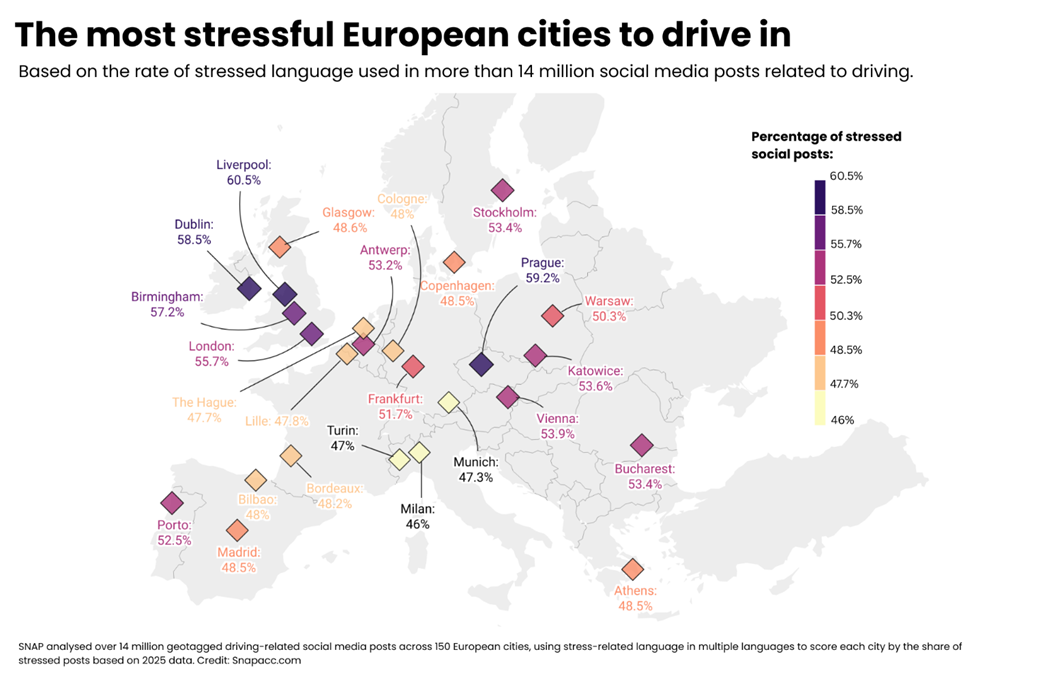
Le città più stressanti in cui guidare

Le città possono aumentare lo stress dei conducenti a causa della congestione, delle strade strette e dei complessi tracciati stradali.
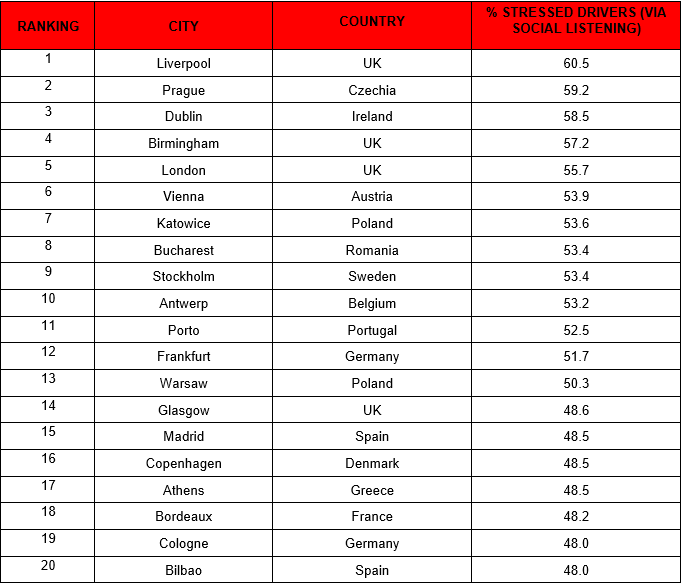
Liverpool (al 1° posto), Birmingham (4°) e Londra (5°) figurano tutte tra le città più stressanti da guidare in Inghilterra, con punteggi di stress compresi tra il 55,7% e il 60,5%. I punti di congestione e i colli di bottiglia, come i Mersey Tunnel di Liverpool e i percorsi fortemente congestionati come la London Orbital Motorway (M25), sono i principali responsabili di questi elevati livelli di stress.

Dublino è al terzo posto ed è una delle città più congestionate d'Europa, con ritardi medi di 81 ore all'anno per gli automobilisti dovuti al traffico intenso, evidenziando la persistente pressione della congestione sulle strade urbane.

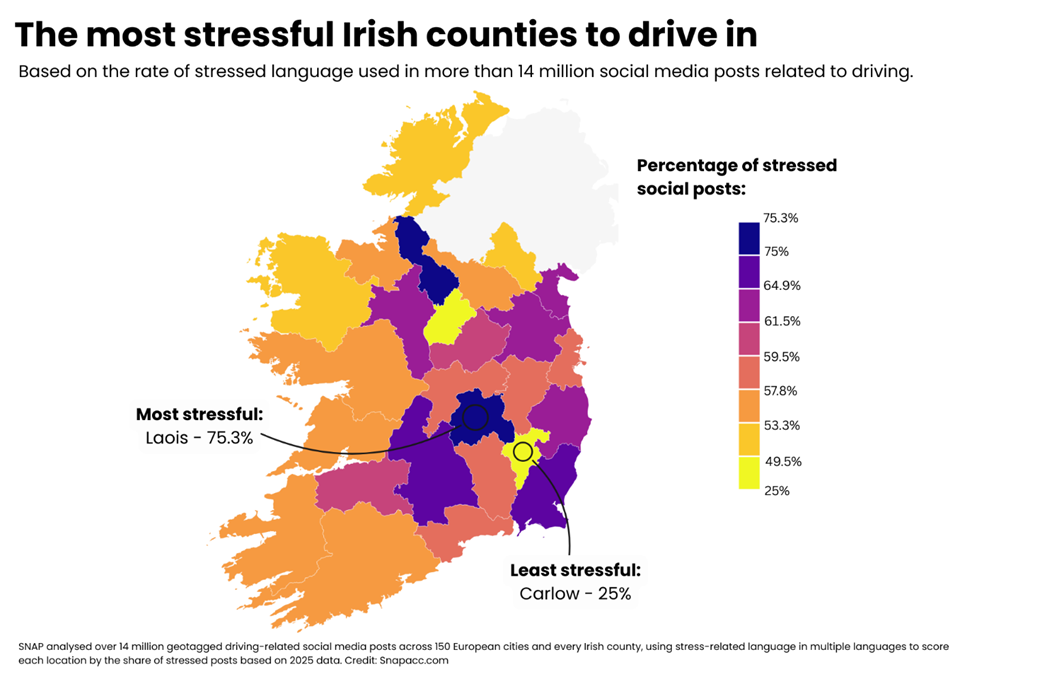
Un ulteriore social listening focalizzato specificamente sugli automobilisti irlandesi ha rivelato che le contee di Laois e Leitrim hanno registrato livelli di stress da parcheggio particolarmente elevati, con punteggi compresi tra il 75% e il 75,3%. Queste cifre elevate evidenziano le sfide persistenti per gli automobilisti di queste aree, in gran parte determinate dalla forte dipendenza dall'automobile - [il 73% dei pendolari di Laois si reca al lavoro con l'auto privata], secondo le statistiche ufficiali (pag. 118). Inoltre, nel Leitrim si segnalano a livello locale la scarsità delle infrastrutture stradali e i conflitti tra consegna e parcheggio in città come Drumshanbo che contribuiscono allo stress dei conducenti in questa contea irlandese.
Katowice, Polonia (classificata al 7° posto) - pur non essendo una delle città polacche più congestionate in assoluto, Katowice subisce comunque ritardi e pressioni del traffico da parte dei pendolari, con gli automobilisti che passano molto tempo nel traffico e le principali arterie stradali, come la S86 e la A4, che registrano volumi di traffico giornalieri elevati che possono contribuire al punteggio di stress del 53,6%. Analogamente, a Varsavia in Polonia (13° posto) gli automobilisti trascorrono circa 70 ore all'anno nel traffico, contribuendo al punteggio di stress del 50,3% nel 2025.

Bucarest, in Romania (ottava posizione), è una delle città più affollate d'Europa, con gli automobilisti che trascorrono molto più tempo in coda e perdono fino a 12 giorni lavorativi all'anno a causa della lentezza del traffico.

La capitale della Spagna, Madrid (15°), soffre di una forte congestione, con un viaggio di 10 km che richiede circa 24 minuti. Le strade strette e il traffico persistente, soprattutto in zone come Puente de Vallecas, rendono la guida quotidiana lenta e stressante. Analogamente, segnalazioni di incidenti e traffico intenso a Bilbao, in Spagna (al 20° posto), su strade chiave come la A-8 e la BI-30, causano lunghe code e movimenti lenti, che contribuiscono a creare condizioni di guida stressanti.

Le città più stressanti in cui parcheggiare

Il parcheggio contribuisce anche allo stress dei conducenti e della gestione della flotta, in quanto la disponibilità limitata, la domanda elevata e le normative restrittive nelle città europee possono ritardare i viaggi, aumentare la frustrazione e complicare la pianificazione del percorso.

Inoltre, attraverso l'ascolto sociale, abbiamo raccolto dati sulle città in cui i conducenti sperimentano il maggiore stress da parcheggio in tutta Europa, in particolare in Romania, Polonia, Spagna e Regno Unito. Prestare attenzione a queste aree è importante per gli operatori delle flotte, poiché la disponibilità limitata di parcheggi, la domanda elevata e la congestione urbana possono interrompere gli orari, aumentare i ritardi e influire sul benessere dei conducenti.

La nostra ricerca mostra che lo stress da parcheggio più elevato in Europa si registra in Polonia, con Podlachia (83,3%) e Olsztyn (80%) che devono affrontare problemi come la limitatezza degli spazi di parcheggio urbani e l'alta densità di veicoli.

Analogamente, nel Regno Unito, Newcastle upon Tyne (65,3%), Liverpool (64,4%) e Middlesbrough (63,9%) sono le città con il maggior stress da parcheggio per gli automobilisti. Queste città devono fare i conti con spazi ristretti nel centro città, tariffe su strada, congestione e norme di parcheggio severe che contribuiscono alla frustrazione degli automobilisti.

Le città rumene Sibiu e Cluj-Napoca, insieme alle città spagnole di Malaga e Bilbao, hanno registrato i più alti livelli di stress da parcheggio nei rispettivi Paesi. Tuttavia, rispetto al Regno Unito e alla Polonia, i punteggi di stress sono più bassi (da 55,6% a 52,4%), il che suggerisce condizioni di parcheggio più gestibili, meno colli di bottiglia e una pressione relativamente minore sugli automobilisti in queste aree urbane.

L'obiettivo di SNAP è semplice: ridurre lo stress da parcheggio per i professionisti del trasporto. Fornendo informazioni in tempo reale e opzioni di percorso più intelligenti, aiutiamo gli autisti a trovare parcheggi sicuri e accessibili, rendendo i loro viaggi meno stressanti e più efficienti ".

MATTHEW BELLAMY, AMMINISTRATORE DELEGATO, SNAP

Perché gli autisti di mezzi pesanti subiscono lo stress più elevato in queste città?

Gli autisti di mezzi pesanti devono affrontare pressioni diverse da quelle dei normali automobilisti. I parcheggi limitati per i veicoli di grandi dimensioni, la navigazione in strade strette o congestionate e gli elevati volumi di traffico possono rendere la guida urbana più impegnativa e stressante, trasformando i viaggi di routine in esperienze ad alta pressione temporale.

Approfondiamo i fattori di stress per gli autisti di mezzi pesanti:

  • Limited parking for large vehicles. Scarce lorry bays and high demand make it hard to find safe places to stop, especially in urban centres. The RHA’s Roadside Facilities campaign reports an estimated shortage of 11,000 lorry parking spaces in the UK, creating significant stress for HGV drivers who struggle to find safe and legal places to park., creating significant stress for HGV drivers who struggle to find safe and legal places to park.
  • Narrow streets and complex urban layouts. Tight roads and historic city centres require careful navigation, increasing stress and risk of delays in cities like Prague, Dublin, and Liverpool.
  • High traffic volumes and congestion. Heavy commuter and freight traffic slows journeys, increases travel times, and heightens frustration particularly in busier cities like London, Birmingham, Bucharest, and Madrid.
  • Low-emission or Clean Air Zones. Restrictions on vehicle access, extra charges, and rerouting requirements can complicate planning and add pressure. For example, low emission zones in Spain require some HGVs to seek alternate routes.
  • Route restrictions and delivery schedule. Height and weight limits, prohibited turns, and time-specific delivery windows force drivers onto longer or less convenient routes.
  • Isolation and limited facilities. Long urban journeys without access to rest areas, fuelling, or amenities can increase fatigue and mental strain for HGV drivers.

Cosa significa città stressante per gli autisti di mezzi pesanti?

Le città stressanti creano problemi agli autisti di mezzi pesanti. La congestione, i parcheggi limitati e le complesse disposizioni urbane possono causare perdite di tempo, mancate consegne, maggiore stanchezza e un rischio più elevato di collisioni minori o di quasi incidenti.

I conducenti possono gestire lo stress pianificando attentamente i percorsi, facendo pause programmate e utilizzando la tecnologia per anticipare i ritardi o per aiutarsi con il budgeting. SNAP supporta gli autisti con strumenti come l'app intruck, aiutandoli a localizzare i parcheggi disponibili, a pianificare percorsi efficienti e a rimanere informati sulla congestione del traffico, riducendo lo stress e rendendo i viaggi dei mezzi pesanti più sicuri e più gestibili.

Cosa significano le città stressanti per gli operatori delle flotte di mezzi pesanti?

Le città stressanti non si ripercuotono solo sui conducenti, ma anche sulle prestazioni delle flotte. La congestione e i parcheggi limitati possono causare ritardi nelle consegne, un aumento dei costi di carburante e di esercizio, una riduzione del benessere dei conducenti e un aumento del rischio di multe o sanzioni. Queste pressioni possono intaccare i margini e complicare la programmazione, [la fidelizzazione o la carenza di conducenti] (https://snapacc.com/newsroom/uk-driver-shortage-are-numbers-improving/) e la soddisfazione dei clienti.

Gli operatori delle flotte possono superare queste sfide adottando strategie più intelligenti e sistemi di supporto: utilizzando informazioni in tempo reale sul traffico e sui parcheggi, creando orari flessibili e dando priorità al riposo e al benessere dei conducenti.

Disponibile presso oltre 850 partner di servizio in tutta Europa, la soluzione di pagamento per flotte SNAP viene utilizzata ogni 12 secondi in tutto il continente per pagare i servizi dei camion, senza contanti o carta.

Rendere le città europee meno stressanti per gli autisti di mezzi pesanti

La comprensione dei punti critici di guida e parcheggio in Europa aiuta le flotte a operare in modo più sicuro ed efficiente. Utilizzando queste informazioni per la pianificazione degli itinerari, la formazione dei conducenti, l'adozione di tecnologie e la riduzione dei rischi, gli operatori possono ridurre i ritardi, migliorare il benessere e proteggere i loro conducenti. SNAP sostiene questa missione per le flotte di autotrasporto, offrendo parcheggi sicuri, pagamenti senza interruzioni e strumenti che rendono le operazioni quotidiane più tranquille e sicure.
ISCRIVITI ALLO SNAP OGGI

Condividi con

Anche altri leggono...

Header Image

giovedì 08 gennaio 2026 • Notizie e aggiornamenti

SUTTERTON TRUCK STOP: INNALZARE GLI STANDARD DI COMFORT E SICUREZZA PER I CONDUCENTI

Susie Jones

Situated on the A17 and a short drive from Boston is , a haven for truck drivers transporting goods along this stretch of road. The location provides not only a truck stop with the usual amenities one would expect clean showers, toilets, shop, and refuelling options but it also presents drivers with the choice to dine at the Roadside Diner, providing visitors with an American-themed restaurant with a variety of meals. We sat down with Director James Townsend to discuss improvements to the site, driver welfare, site security, and their long-standing relationship with SNAP. explains James. The site has undergone a major refurbishment, prioritising the needs of truck drivers. Nestled inside the truck stop is the new roadside diner. James and the team have recently taken back ownership of this and refurbished it. James says. He goes on to explain that it was more than upgrading existing facilities, but providing drivers with the right facilities to make the site a home away from home. SNAP asked truck drivers parking at Sutterton what they thought of the new facilities on offer. One driver commented:When it came to the design of the truck park, the site worked closely with SNAP to maximise the site’s potential:Driver welfare still remains a huge priority for those working in the industry, with investment into truck parking lacking, something James is all too aware of after working with the DFT. he explains. While investment is valuable, directing it into the right facilities for truck drivers is also imperative. James states. James and the rest of the team work closely with SNAP’s UK Network Team as well as , providing them with a single, clear point of contact should any issues arise. explains James. Having the support in place for complaints and technical issues is a major advantage for a truck stop like Sutterton, which often manages competing demands. Working with SNAP has delivered additional benefits as well, as James goes on to say:To ensure truck drivers get a good night’s rest, ensuring the site is as safe and secure as possible was vital for Sutterton Truck Stop. Working with SNAP Access & Security from the outset has allowed James and the team to do exactly that. says James. The site is a firm believer in training its staff to deal with incidents if they occur. Inspired by what you’ve just read? Catch the full interview with

Header Image

venerdì 19 dicembre 2025 • Notizie e aggiornamenti

LA VOSTRA FLOTTA È UN BERSAGLIO? DARE PRIORITÀ ALLA SICUREZZA IN UN MONDO TECNOLOGICAMENTE EVOLUTO

Guest

Cybersecurity readiness must be a top priority for fleet owners and managers in the United Kingdom. The rapid digital transformation in the transportation and logistics industry has made fleets attractive targets for hackers. Learn about the cybersecurity trends fleet operators must be aware of and strategies you should adopt to lower your susceptibility to attacks.The advent of connected vehicles, push for fleet electrification, integration of Internet of Things (IoT) devices and reliance on automation have expanded the attack surface opportunistic cybercriminals can exploit to infiltrate your network.Vulnerable telematics back-end systems, insecure over-the-air firmware updates and buggy APIs are common entry points for phishers, data thieves, business saboteurs and ransomware attackers. Threat actors are also increasingly leveraging artificial intelligence to launch more believable scams.Falling victim to a cyberattack can cause more than extended, unscheduled downtime. A high-profile security incident can inflict severe reputational damage on your organisation and harm your business in the long term.Although your cyber insurance coverage may compensate you millions for losses, the financial impact can lead to insolvency — as happened to KNP Logistics in June 2025. An Akira ransomware attack exacerbated this major logistics group’s preexisting financial struggles, and let go of 730 employees.Every business is at risk from cyberattacks, but these strategies can help make your fleet management software and vehicles less vulnerable.A robust threat intelligence platform strengthens cybersecurity, as it allows you to proactively defend your assets from malicious actors and minimise your losses if they target you. Here are the primary ways to use threat intel to improve your security posture:Contextualisation enables your team to identify the perpetrators behind specific attacks, understand their motives and capabilities, determine what they want from your organisation, and comprehend their methods. Context transforms raw threat data into actionable intelligence, enabling you to inform your decision-making.Attackers evolve, so learning how they operated in the past is not enough to accurately anticipate their future actions. A threat intelligence platform can help you keep pace with known malicious actors and familiarise your team with relatively unknown ones. Some organisations use deception technologies to lure cybercriminals and watch them in action in a controlled environment.A software solution that can integrate into your company’s existing tools breaks down silos and allows threat intelligence to flow freely across teams. Cross-departmental collaboration is the key to implementing an organisation-wide cybersecurity strategy effectively.A threat intelligence platform can monitor your network activity and sense attack patterns early enough to notify your Security Operations Centre or IT professionals immediately. Early detection is vital to count threats before they infiltrate deeply into your system and cause more harm.Responding to urgent incidents involves less manual work with a threat intelligence platform. This software solution can orchestrate essential tasks to mitigate breaches, enabling your in-house cybersecurity professionals to focus on activities where human input is more impactful.Regulatory frameworks and data privacy standards are becoming more stringent over time. A threat intelligence platform aids compliance by ensuring that your team handles sensitive data responsibly and generates detailed reports to document your best practices.Zero trust minimises the likelihood of unauthorised access to fleet management systems by continuously verifying every user and device and enforcing identity-centric access control.This approach acknowledges that threats can come from within the organisation. Assuming that each request may come from a malicious actor reflects the level of vigilance you must exercise to protect your operation from sophisticated attacks and help your team adapt to complex, dynamic environments involving remote users, IoT devices and cloud services.After verification, zero trust gives users and devices just enough access to perform specific tasks. The principle of least privilege enables effective threat containment if a cybercriminal gets in.According to Cybersecurity Insiders’ 2024 Insider Threat Report, insider threat attacks have spiked. In October 2024, 51% of the 413 respondents in IT and cybersecurity reportedly over the past year. 29% reported spending over $1 million on remediation.The adoption of new technologies is a primary driver behind the rise in these cyberattacks. Investing in employee training is crucial for preventing team members from becoming insider threats.Provide target users with sufficient resources to familiarise themselves with the technologies. Highlight the ways they may inadvertently leak sensitive information or compromise the system. Tell them the red flags to watch out for to identify malicious schemes and teach them safe, responsible ways to deal with cybercriminals.Tight physical security can safeguard your assets from digital hijackers. Effective physical protection often involves a layered approach, which includes perimeter fencing, strategic placement of surveillance equipment and tamper-evident vehicle electronics casings. Additionally, limiting visibility with opaque doors , thereby adding an extra layer of protection to your physical security. Blending physical safeguards with digital solutions can restrict what hackers can do, even if they manage to gain control over fleet vehicles. In 2022, a group of hacktivists attacked the Russian ride-hailing service Yandex Taxi and directed in the same place in western Moscow. The incident should serve as a wake-up call to embrace measures to immobilise your assets if criminals remotely take control of the driver’s seat.Your company is only as strong as the weakest link in your supply chain. The positive impact of impregnable internal cybersecurity diminishes when third-party vendors make it easy for lawbreakers to steal your data from elsewhere. For instance, temporarily could jeopardise your cybersecurity if your lessor has outdated software.Working with supply chain partners that are as particular about cybersecurity reduces your risk exposure. Integrating your suppliers’ systems into your threat intelligence platform ensures better coordination during data breaches. Close collaboration with critical external parties promotes cybersecurity readiness and helps everyone prepare for potential attacks.Contending with online threat actors is inevitable in modern fleet management. Prioritise proactive strategies to stay ahead of hackers. By implementing a multi-layered defence that combines technology, employee training and strategic partnerships, you can build a resilient operation. This stance protects your current assets and secures your company’s future in an increasingly connected world.Discover more from

Header Image

lunedì 08 dicembre 2025 • Notizie e aggiornamenti

TENDENZE DEI CAMION: PREVISIONI PER IL 2026

Guest

Major changes are coming for the mobility sector.The next 12 months will bring some of the most significant regulatory and technological shifts European transport has seen in years. New emissions rules, driver-monitoring systems, hydrogen trials and autonomous pilots will reshape how fleets operate across the UK and EU.For operators and professional drivers, understanding these changes now will make the difference between adapting confidently and struggling to keep up. come into force in 2026, introducing new requirements for fleets. Nitrogen oxide and carbon monoxide limits will tighten further, with the permitted particle size dropping from 23 nanometres to 10. In addition, for the first time.Every new truck sold will need to comply with Euro VII. While vehicle pricing is likely to be affected, the bigger impact will fall on procurement timelines, fleet renewal cycles and long-term decarbonisation.. These monitor eye and head movement to identify early signs of fatigue or inattention, enabling safer interventions and supporting accident-reduction goals across Europe. By 2029, new cab designs must minimise blind spots through improved glass visibility rather than camera reliance. This will particularly influence urban operations, vulnerable road user safety and future vehicle specification.. After years of exemption, this change effectively brings smaller commercial vehicles under full drivers’ hours enforcement.For operators with mixed fleets, this means introducing:● new driver cards● regular data downloads● updated monitoring processes● revised routing and rest-time planningThousands of vehicles that previously operated freely will need compliance systems in place almost immediately. requires companies with more than 250 employees or €40 million revenue to collect and report verified CO₂ emissions – including Scope 3 transport activity.This will cascade through supply chains. Smaller hauliers without reliable emissions reporting risk losing access to larger contracts, accelerating the push toward better data systems and standardised reporting.Electric HGV production will rise rapidly in 2026. are all expanding manufacturing capacity.To support this, electric charging is also expanding. , as part of HyHAUL's M4 corridor project. Three refuelling stations, each supplying up to two tonnes of hydrogen daily, support the pilot. If successful, the project aims for 30 trucks on the road by the end of 2026 and 300 by 2030. Alongside this, . Five more will follow by 2027.Vehicle manufacturers are taking different approaches to developing hydrogen-fuelled trucks: ● and DAF are planning similar systems. ● will introduce its next-generation hydrogen fuel cell stack in 2026 with improved durability and lower operating costs.Hydrotreated Vegetable Oil (HVO) is emerging as a notable transitional fuel for haulage in 2026, thanks to two factors: stricter biofuel mandates in north-western Europe and its compatibility with existing diesel engines. Reports by confirm that HVO is a “drop-in” fuel: it can be used in many existing heavy-duty vehicles without engine or infrastructure changes, which gives operators a practical pathway to immediate CO₂ reductions. Meanwhile, forecast that HVO consumption could reach record highs in 2026. Germany alone may need an additional 1.5 million tonnes – almost four times 2025 levels – to meet demand. Although uptake remains modest when compared with battery-electric or hydrogen alternatives, the current regulatory push and infrastructure compatibility mean HVO is likely to gain traction in 2026.From spring 2026, in controlled zones – a full year ahead of plans. Enabled by the , this transition supports an industry expected to contribute £42 billion to the UK economy by 2035 and create an estimated 38,000 jobs. Germany is close behind. , supported by €20 million in seed funding. Across northern Europe, autonomous freight along the 1,200-km Rotterdam-Oslo corridor. The programme runs until March 2026 and examines how autonomous vehicles perform across borders, terrain types and logistics hubs.In Sweden, already move goods between warehouses, processing five million data points per second. Their controlled deployments demonstrate the potential for automation in predictable, repeatable routes.Despite this progress, humans will continue to play a central role. . So while automation will support specific functions, such as port operations, depot shuttles and fixed urban routes, long-haul and complex international transport will remain human-led.The scale and speed of change arriving in 2026 is unlike any previous year for European road transport. Multiple regulatory, technological and sustainability shifts will land simultaneously, reshaping how fleets operate across borders."The operators who succeed in 2026 won't be those who resist change but those who prepare for it systematically," says Nick Long, European Strategic Partnership and Development Manager at SNAP. "We're working with fleets across Europe to build the infrastructure that tomorrow's industry needs. Secure parking. Integrated payments for new toll structures. The building blocks of success are available now for those ready to use them."SNAP helps fleets prepare for the future with integrated solutions for parking, payments and fleet management across Europe. Visit snapacc.com to discover how we can support your transition to 2026 and beyond.