Josh Cousens
Europe's most stressful cities to park and drive in
Created: 14/01/2026
•
Updated: 15/01/2026
Driving and parking in Europe’s cities can be a daily headache for HGV drivers — and high stress levels don’t just affect wellbeing; they impact fleet efficiency too. For logistics managers, knowing where these challenges are greatest is crucial for route planning, driver safety, and operational performance.
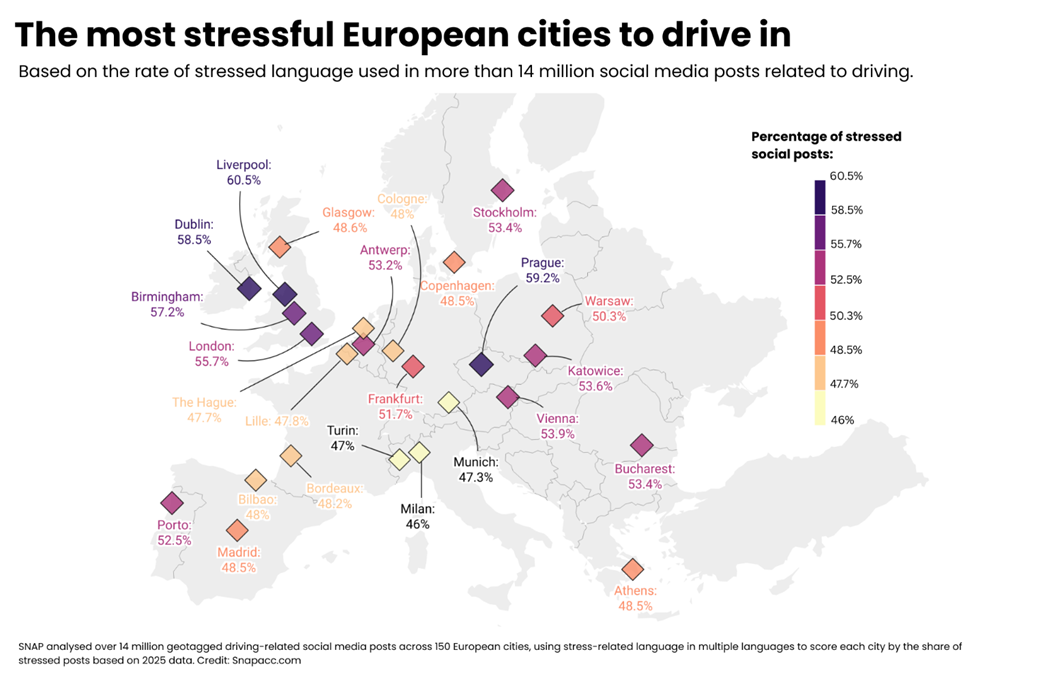
Using social listening to analyse millions of geotagged posts across 150 European cities, our research identifies the places drivers find most stressful. Liverpool tops the list (60.5% of posts show driving-related stress), followed by Prague (59.2%) and Dublin (58.5%). Liverpool also ranks 2nd for most stressful city for parking in the UK. Congestion, scarce parking, and tricky road conditions are the main pain points highlighted by drivers across Europe.
This study maps Europe’s HGV stress hotspots using real-world driver sentiment, showing how city conditions affect wellbeing. It is not about ranking countries, but giving fleet and logistics managers clear, actionable insights to support drivers, plan smarter routes, and reduce urban driving pressures.
Listening to driver experiences
Our research analysed over 14 million geotagged social media posts from 150 European cities, covering driving-related topics such as parking, traffic, and road conditions. Posts were assessed for stress by tracking keywords and phrases linked to negative emotions in English and local languages. Each city was scored based on the percentage of posts expressing stress, providing a clear picture of driver pressure across Europe. Data was collected across major social media platform X (formerly Twitter) throughout 2025.
“Stress” covers the pressures fleet drivers face on the road, including traffic, parking, road conditions, general driving, and conflicts with other drivers. Understanding these factors helps fleet operators support driver wellbeing and performance.
"Knowing which cities are most stressful for HGV drivers allows SNAP to target solutions that improve both safety and efficiency."
MATTHEW BELLAMY, MANAGING DIRECTOR, SNAP
Stressful EU cities: Key findings
As of 2025 for most stressful cities for driving:
- Liverpool, UK. 60.5% of stressed social posts about parking - the highest proportion of stress-related driving posts in Europe.
- Prague, Czechia. 59.2% of stressed social posts about parking likely due to dense traffic, historic street design, and limited space for larger vehicles navigating the city.
- Dublin, Ireland. 58.5% of stressed social posts about parking – Driver stress is strongly linked to congestion delays, parking shortages, and busy commuter routes impacting daily driving conditions.
The top 3 most stressful UK cities for parking in 2025:
- Newcastle upon Tyne. Commonly shortened to as “Newcastle” and located in the county, Tyne and Wear, this city has a staggering 65.3% of stressed social posts about parking, making it the most stressful UK city for parking in 2025.
- Liverpool. In Merseyside, 64.4% of social posts about parking in Liverpool express stress.
- Middlesbrough. 63.9% of stressed social posts about parking in this city of North Yorkshire.
Scotland also shows elevated parking stress, with Edinburgh (61.6% of stressed social posts about parking) and Glasgow (61.4% of stressed social posts about parking) ranking among the UK’s most challenging cities to park in. Additionally, London is ranked 17th most stressful place for parking (57.9 of stressed social posts about parking. Contributing factors could include narrow streets, dense urban layouts, high demand for limited parking space, and city-centre restrictions, which may increase pressure on drivers.
Stress hotspots for European drivers
Using millions of geotagged social media posts, we scored each city was by the share of stress-related posts, revealing Europe’s top driving, parking hotspots, and highlighting the urban conditions that challenge drivers most.
Our infographic map shows the top cities for driving and parking pressure, revealing key urban hotspots and the challenges faced by drivers in each market.
The most stressful cities to drive in
Cities can increase driver stress due to congestion, narrow streets, and complex road layouts.
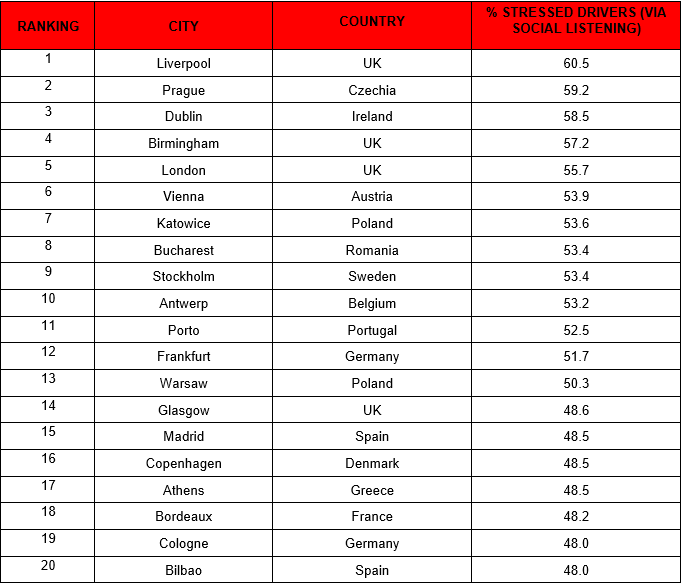
Liverpool (ranked 1st), Birmingham (4th), and London (5th) all feature among the most stressful cities to drive in England, with between 55.7% and 60.5% stress scores. Congestion hotspots and bottlenecks — such as Liverpool’s Mersey Tunnels and heavily congested routes like London Orbital Motorway (M25) .— are key contributors to these elevated stress levels.
Dublin ranks 3rd and is one of Europe’s most congested cities, with drivers delayed by an average of 81 hours annually due to heavy traffic, highlighting persistent congestion pressures on urban roads.
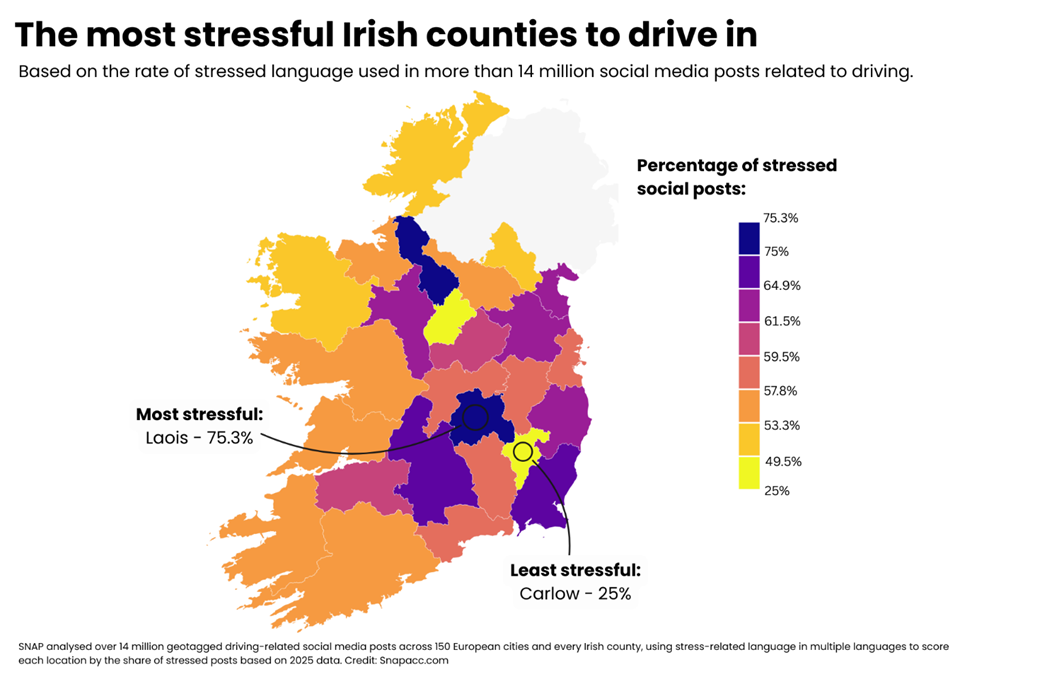
Further social listening focused specifically on Irish motorists revealed that the counties of Laois and Leitrim recorded notably high parking stress levels, with scores ranging from 75% to 75.3%. These high figures highlight persistent challenges for drivers in these areas, largely driven by heavy car dependency — [73% of commuters in Laois travel to work by private car], according to official statistics (Page. 118). Additionally, Leitrim has local reports of sparse road infrastructure and delivery/parking conflicts in towns like Drumshanbo that contributes driver stress in this Irish county.
Katowice, Poland (ranked 7th) – while not one of the most congested Polish cities overall, Katowice still experiences commuter delays and traffic pressure, with drivers spending notable time in traffic and major roadways such as the S86 and A4 seeing heavy daily traffic volumes that can contribute to the stress score of 53.6%. Similarly, Warsaw in Poland (ranked 13th) has drivers spending approximately 70 hours a year in traffic, contributing to its stress score of 50.3% in 2025.
Bucharest in Romania (ranked 8th) faces notorious congestion as one of Europe’s most crowded cities, with drivers spending significantly more time in gridlock and losing up to 12 working days a year due to slow traffic.
Spain’s capital; Madrid (15th) suffers from heavy congestion, with a 10 km trip taking around 24 minutes. Narrow streets and persistent traffic, especially in areas like Puente de Vallecas, make every day driving slow and stressful. Similarly, reports of accidents and heavy traffic in Bilbao, in Spain (ranked 20th) on key routes like the A‑8 and BI‑30, causing extended queues and slow movement, which contributes to stressful driving conditions.
The most stressful cities to park in
Parking also contributes to driver and fleet management stress, as limited availability, high demand, and restrictive regulations across Europe’s cities which can delay journeys, increase frustration, and complicate route planning.
Also, through social listening, we have collected data on the cities where drivers experience the most stress when parking across Europe, specifically in Romania, Poland, Spain, and the UK. Paying attention to these areas is important for fleet operators, as limited parking availability, high demand, and urban congestion can disrupt schedules, increase delays, and affect driver wellbeing.
Our research shows the highest parking stress in Europe is in Poland, with Podlachia (83.3%) and Olsztyn (80%) facing issues like limited urban parking spaces and high vehicle density.
Similarly, in the UK, Newcastle upon Tyne (65.3%), Liverpool (64.4%), and Middlesbrough (63.9%) are the cities with the most parking stress for motorists. These located struggle with restricted city‑centre spaces, on‑street charges, congestion and strict parking regulations contribute to driver frustration.
Romanian cities Sibiu and Cluj-Napoca, along with the Spanish cities of Malaga and Bilbao, recorded the highest parking stress levels within their respective countries. However, compared with the UK and Poland, their stress scores are lower — ranging from 55.6% to 52.4% — suggesting more manageable parking conditions, fewer bottlenecks, and relatively less pressure on drivers in these urban areas.
“At SNAP, our goal is simple: to reduce parking-related stress for haulage professionals. By providing real-time information and smarter route options, we help drivers find safe, accessible parking, making their journeys less stressful and more efficient.”
MATTHEW BELLAMY, MANAGING DIRECTOR, SNAP
Why do HGV drivers experience the highest stress in these cities?
HGV drivers face pressures that differ from regular car drivers. Limited parking for large vehicles, navigating narrow or congested streets, and high traffic volumes can make urban driving more challenging and stressful, turning routine journeys into time‑pressured, high‑stress experiences.
Let us dive deeper into the factors causing stress for HGV drivers:
- Limited parking for large vehicles. Scarce lorry bays and high demand make it hard to find safe places to stop, especially in urban centres. The RHA’s Roadside Facilities campaign reports an estimated shortage of 11,000 lorry parking spaces in the UK, creating significant stress for HGV drivers who struggle to find safe and legal places to park., creating significant stress for HGV drivers who struggle to find safe and legal places to park.
- Narrow streets and complex urban layouts. Tight roads and historic city centres require careful navigation, increasing stress and risk of delays in cities like Prague, Dublin, and Liverpool.
- High traffic volumes and congestion. Heavy commuter and freight traffic slows journeys, increases travel times, and heightens frustration particularly in busier cities like London, Birmingham, Bucharest, and Madrid.
- Low-emission or Clean Air Zones. Restrictions on vehicle access, extra charges, and rerouting requirements can complicate planning and add pressure. For example, low emission zones in Spain require some HGVs to seek alternate routes.
- Route restrictions and delivery schedule. Height and weight limits, prohibited turns, and time-specific delivery windows force drivers onto longer or less convenient routes.
- Isolation and limited facilities. Long urban journeys without access to rest areas, fuelling, or amenities can increase fatigue and mental strain for HGV drivers.
What does stressful cities mean for HGV drivers?
Stressful cities create challenges for HGV drivers. Congestion, limited parking, and complex urban layouts can lead to lost time, missed deliveries, increased fatigue, and a higher risk of minor collisions or near-misses.
Drivers can manage stress by planning routes carefully, taking scheduled breaks, and using technology to anticipate delays or help with budgeting. SNAP supports drivers with tools like the intruck app, helping them locate available parking, plan efficient routes, and stay informed about congestion, reducing stress and making HGV journeys safer and more manageable.
What do stressful cities mean for HGV fleet operators?
Stressful cities do not just affect drivers — they impact fleet performance too. Congestion and limited parking can lead to delayed deliveries, higher fuel and operating costs, reduced driver wellbeing, and increased risk of fines or penalties. These pressures can eat into margins and complicate scheduling, driver retention or shortage, and customer satisfaction.
Fleet operators can overcome these challenges by adopting smarter strategies and support systems: using real‑time traffic and parking insights, building flexible schedules, and prioritising driver rest and wellbeing.
Available at over 850 service partners across Europe, SNAP’s fleet payment solution is used every 12 seconds across the continent to pay for truck services — without cash or a card.
Making Europe’s cities less stressful for HGV drivers
Understanding driving and parking stress hotspots across Europe helps fleets operate more safely and efficiently. By using these insights for route planning, driver training, tech adoption, and risk reduction, operators can reduce delays, improve wellbeing, and protect their drivers. SNAP supports this mission for the haulage fleets, offering secure parking, seamless payments, and tools that make daily operations calmer and safer.