Josh Cousens
Nieuws en updates • 5 min lezen

De meest stressvolle steden van Europa om in te parkeren en rijden

Gemaakt: 14-01-2026

Bijgewerkt: 14-01-2026

Rijden en parkeren in Europese steden kan een dagelijkse kopzorg zijn voor vrachtwagenchauffeurs - en hoge stressniveaus hebben niet alleen invloed op het welzijn, maar ook op de efficiëntie van het wagenpark. Voor logistiek managers is het van cruciaal belang om te weten waar deze uitdagingen het grootst zijn voor de routeplanning, de veiligheid van de chauffeurs en de operationele prestaties.

Ons onderzoek maakt gebruik van social listening om miljoenen geotagged posts in 150 Europese steden te analyseren en identificeert de plaatsen die chauffeurs het meest stressvol vinden. Liverpool staat bovenaan de lijst (60,5% van de posts tonen rijgerelateerde stress), gevolgd door Praag (59,2%) en Dublin (58,5%). Liverpool staat ook op de 2e plaats van meest stressvolle steden voor parkeren in het Verenigd Koninkrijk. Congestie, schaarse parkeergelegenheid en lastige wegomstandigheden zijn de belangrijkste pijnpunten die door bestuurders in heel Europa naar voren worden gebracht.

Dit onderzoek brengt de stresshaarden voor vrachtwagens in Europa in kaart aan de hand van het sentiment onder chauffeurs uit de praktijk en laat zien hoe de omstandigheden in de stad van invloed zijn op het welzijn. Het gaat niet om het rangschikken van landen, maar om het geven van duidelijke, bruikbare inzichten aan wagenpark- en logistiekmanagers om chauffeurs te ondersteunen, slimmere routes te plannen en de rijdruk in de stad te verminderen.

Luisteren naar ervaringen van bestuurders

Ons onderzoek analyseerde meer dan 14 miljoen geotagged social media posts uit 150 Europese steden, over rij-gerelateerde onderwerpen zoals parkeren, verkeer en wegomstandigheden. Berichten werden beoordeeld op stress door het bijhouden van trefwoorden en zinnen gekoppeld aan negatieve emoties in het Engels en de lokale talen. Elke stad kreeg een score op basis van het percentage berichten waarin stress werd geuit, zodat er een duidelijk beeld ontstond van de druk op chauffeurs in heel Europa. De gegevens werden verzameld op het belangrijkste sociale mediaplatform X (voorheen Twitter) in 2025.

"Stress" heeft betrekking op de druk waaraan bestuurders van wagenparken onderweg worden blootgesteld, zoals verkeer, parkeren, wegomstandigheden, algemeen rijgedrag en conflicten met andere bestuurders. Inzicht in deze factoren helpt wagenparkbeheerders het welzijn en de prestaties van bestuurders te ondersteunen.

*"Als we weten welke steden het meest stressvol zijn voor vrachtwagenchauffeurs, kan SNAP zich richten op oplossingen die zowel de veiligheid als de efficiëntie verbeteren.

MATTHEW BELLAMY, ALGEMEEN DIRECTEUR, SNAP

Stressvolle EU-steden: Belangrijkste bevindingen

Vanaf 2025 voor de meest stressvolle steden om te rijden:

  1. Liverpool, VK. 60,5% van de gestreste sociale berichten over parkeren - het hoogste percentage stressgerelateerde berichten over autorijden in Europa.
  2. Praag, Tsjechië. 59,2% van gestreste sociale berichten over parkeren, waarschijnlijk als gevolg van druk verkeer, historisch straatontwerp en beperkte ruimte voor grotere voertuigen die door de stad navigeren.
  3. Dublin, Ierland. 58,5% van de gestreste sociale berichten over parkeren - stress bij chauffeurs is sterk gekoppeld aan vertragingen door files, parkeertekorten en drukke forenzenroutes die van invloed zijn op de dagelijkse rijomstandigheden.

De top 3 van meest stressvolle Britse steden voor parkeren in 2025:

  1. Newcastle upon Tyne. Gewoonlijk afgekort als "Newcastle" en gelegen in Tyne and Wear, heeft deze stad maar liefst 65,3% van de gestreste sociale berichten over parkeren, waardoor het de meest stressvolle Britse stad is voor parkeren in 2025.
  2. Liverpool. In Merseyside geeft 64,4% van de sociale berichten over parkeren in Liverpool blijk van stress.
  3. Middlesbrough. 63,9% van de sociale berichten over parkeren in deze stad in North Yorkshire geeft blijk van stress.

Schotland laat ook een verhoogde parkeerstress zien, met Edinburgh (61,6% van de gestreste sociale berichten over parkeren) en Glasgow (61,4% van de gestreste sociale berichten over parkeren) op de ranglijst van meest uitdagende steden in het Verenigd Koninkrijk om te parkeren. Daarnaast staat Londen op de 17e plaats van meest stressvolle plaatsen om te parkeren (57,9 van de gestreste sociale berichten over parkeren. Factoren die kunnen bijdragen zijn onder andere smalle straten, dichte stedelijke lay-outs, een grote vraag naar beperkte parkeerruimte en beperkingen in het stadscentrum die de druk op bestuurders kunnen verhogen.

Stress-hotspots voor Europese bestuurders

Met behulp van miljoenen geotagged social media posts hebben we elke stad beoordeeld op het aandeel stressgerelateerde posts, waardoor we de beste rij- en parkeerhotspots van Europa hebben ontdekt en de stedelijke omstandigheden hebben belicht die bestuurders het meest uitdagen.

Onze infografische kaart toont de topsteden voor rij- en parkeerdruk, met de belangrijkste stedelijke hotspots en de uitdagingen waar bestuurders in elke markt mee te maken krijgen.

(https://prodsnapstorage.blob.core.windows.net/public-news/2b1309d2-d01b-4909-9eac-9f3c7bfe6273-image.png)

De meest stressvolle steden om in te rijden

Steden kunnen de stress bij bestuurders verhogen door files, smalle straten en complexe wegindelingen.

(https://prodsnapstorage.blob.core.windows.net/public-news/7b485a8f-90e0-4ec0-922c-d1b12e41f781-image.png)

Liverpool (1e plaats), Birmingham (4e) en Londen (5e) behoren allemaal tot de meest stressvolle steden om te rijden in Engeland, met 55,7% en 60,5% stressscores. Congestie hotspots en knelpunten - zoals Liverpool's Mersey Tunnels en zwaar overbelaste routes zoals London Orbital Motorway (M25) .- dragen in belangrijke mate bij aan deze verhoogde stressniveaus.

Dublin staat op de 3e plaats en is een van de meest overvolle steden van Europa, met automobilisten die jaarlijks gemiddeld 81 uur vertraging oplopen door druk verkeer, wat de aanhoudende congestiedruk op stedelijke wegen benadrukt.

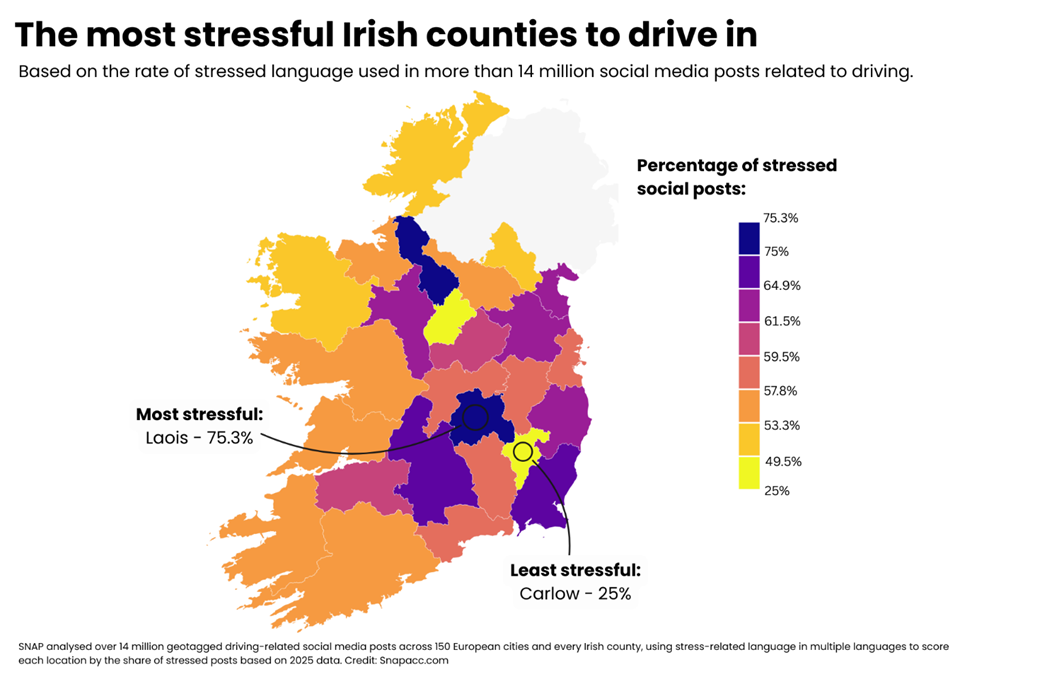
Verder social listening, specifiek gericht op Ierse automobilisten, onthulde dat de graafschappen Laois en Leitrim opmerkelijk hoge parkeerstressniveaus lieten zien, met scores variërend van 75% tot 75,3%. Deze hoge cijfers benadrukken de hardnekkige uitdagingen voor automobilisten in deze gebieden, die grotendeels worden veroorzaakt door de grote afhankelijkheid van de auto - [73% van de forenzen in Laois reist met de eigen auto naar het werk], volgens officiële statistieken (Blz. 118). Daarnaast zijn er in Leitrim lokale rapporten over de schaarse wegeninfrastructuur en conflicten over bezorging/parkeren in steden als Drumshanbo die bijdragen aan de stress bij bestuurders in deze Ierse county.
Katowice, Polen (7e plaats) - hoewel het niet een van de meest overbelaste Poolse steden in het algemeen is, heeft Katowice nog steeds te maken met vertragingen voor forenzen en verkeersdrukte, met bestuurders die veel tijd in het verkeer doorbrengen en belangrijke wegen zoals de S86 en A4 waar dagelijks veel verkeer is dat kan bijdragen aan de stressscore van 53,6%. Ook in Warsaw in Polen (13e plaats) besteden bestuurders ongeveer 70 uur per jaar in het verkeer, wat bijdraagt aan de stressscore van 50,3% in 2025.

Boekarest in Roemenië (8e plaats) heeft te kampen met beruchte files als een van de drukste steden van Europa. Automobilisten brengen aanzienlijk meer tijd door in files en verliezen tot 12 werkdagen per jaar door traag verkeer.

De hoofdstad van Spanje, Madrid (15e), heeft last van verkeersopstoppingen. Een rit van 10 km duurt ongeveer 24 minuten. Smalle straten en aanhoudend verkeer, vooral in gebieden zoals Puente de Vallecas, maken elke dag rijden langzaam en stressvol. Ook meldingen van ongevallen en druk verkeer in Bilbao, in Spanje (20e plaats) op belangrijke routes zoals de A-8 en BI-30, veroorzaken lange wachtrijen en traag verkeer, wat bijdraagt aan stressvolle rijomstandigheden.

De meest stressvolle steden om te parkeren

Parkeren draagt ook bij aan de stress bij bestuurders en wagenparkbeheerders, omdat de beperkte beschikbaarheid, de grote vraag en de beperkende regels in de Europese steden de ritten kunnen vertragen, de frustratie kunnen verhogen en de routeplanning kunnen bemoeilijken.

Via social listening hebben we ook gegevens verzameld over de steden in Europa waar bestuurders de meeste stress ervaren bij het parkeren, met name in Roemenië, Polen, Spanje en het Verenigd Koninkrijk. Aandacht besteden aan deze gebieden is belangrijk voor wagenparkbeheerders, omdat beperkte beschikbaarheid van parkeergelegenheid, grote vraag en stedelijke congestie schema's kunnen verstoren, vertragingen kunnen vergroten en het welzijn van bestuurders kunnen beïnvloeden.

Uit ons onderzoek blijkt dat de hoogste parkeerdruk in Europa te vinden is in Polen, met Podlachia (83,3%) en Olsztyn (80%) die te kampen hebben met problemen zoals beperkte parkeerplaatsen in de stad en een hoge voertuigdichtheid.

In het Verenigd Koninkrijk zijn Newcastle upon Tyne (65,3%), Liverpool (64,4%) en Middlesbrough (63,9%) de steden met de meeste parkeerstress voor automobilisten. Deze steden hebben te kampen met beperkte parkeerplaatsen in het stadscentrum, parkeertarieven, files en strenge parkeerregels die bijdragen aan de frustratie van automobilisten.

De Roemeense steden Sibiu en Cluj-Napoca, samen met de Spaanse steden Malaga en Bilbao, noteerden de hoogste parkeerstressniveaus binnen hun respectievelijke landen. Vergeleken met het Verenigd Koninkrijk en Polen zijn hun stressscores echter lager - variërend van 55,6% tot 52,4% - wat duidt op beter beheersbare parkeeromstandigheden, minder knelpunten en relatief minder druk op bestuurders in deze stedelijke gebieden.

Bij SNAP is ons doel eenvoudig: parkeergerelateerde stress voor transportprofessionals verminderen. Door realtime informatie en slimmere routeopties te bieden, helpen we chauffeurs bij het vinden van veilige, toegankelijke parkeerplekken, waardoor hun reizen minder stressvol en efficiënter worden."

MATTHEW BELLAMY, ALGEMEEN DIRECTEUR, SNAP

Waarom ervaren vrachtwagenchauffeurs de meeste stress in deze steden?

Vrachtwagenchauffeurs hebben te maken met andere problemen dan gewone automobilisten. Beperkte parkeergelegenheid voor grote voertuigen, navigeren door smalle of drukke straten en grote verkeersvolumes kunnen het rijden in de stad uitdagender en stressvoller maken, waardoor routinekilometers veranderen in tijdsdruk en stressvolle ervaringen.

Laten we eens dieper ingaan op de factoren die stress veroorzaken bij vrachtwagenchauffeurs:

  • Limited parking for large vehicles. Scarce lorry bays and high demand make it hard to find safe places to stop, especially in urban centres. The RHA’s Roadside Facilities campaign reports an estimated shortage of 11,000 lorry parking spaces in the UK, creating significant stress for HGV drivers who struggle to find safe and legal places to park., creating significant stress for HGV drivers who struggle to find safe and legal places to park.
  • Narrow streets and complex urban layouts. Tight roads and historic city centres require careful navigation, increasing stress and risk of delays in cities like Prague, Dublin, and Liverpool.
  • High traffic volumes and congestion. Heavy commuter and freight traffic slows journeys, increases travel times, and heightens frustration particularly in busier cities like London, Birmingham, Bucharest, and Madrid.
  • Low-emission or Clean Air Zones. Restrictions on vehicle access, extra charges, and rerouting requirements can complicate planning and add pressure. For example, low emission zones in Spain require some HGVs to seek alternate routes.
  • Route restrictions and delivery schedule. Height and weight limits, prohibited turns, and time-specific delivery windows force drivers onto longer or less convenient routes.
  • Isolation and limited facilities. Long urban journeys without access to rest areas, fuelling, or amenities can increase fatigue and mental strain for HGV drivers.

Wat betekenen stressvolle steden voor vrachtwagenchauffeurs?

Stressvolle steden creëren uitdagingen voor vrachtwagenchauffeurs. Congestie, beperkte parkeergelegenheid en complexe stedelijke lay-outs kunnen leiden tot tijdverlies, gemiste leveringen, verhoogde vermoeidheid en een hoger risico op kleine botsingen of bijna-ongevallen.

Chauffeurs kunnen stress beheersen door routes zorgvuldig te plannen, geplande pauzes te nemen en technologie te gebruiken om te anticiperen op vertragingen of te helpen met budgettering. SNAP ondersteunt chauffeurs met tools zoals de intruck app, waarmee ze beschikbare parkeerplekken kunnen vinden, efficiënte routes kunnen plannen en op de hoogte kunnen blijven van files, wat stress vermindert en vrachtwagenritten veiliger en beter beheersbaar maakt.

Wat betekenen stressvolle steden voor vrachtwagenparkbeheerders?

Stressvolle steden hebben niet alleen gevolgen voor chauffeurs, maar ook voor de prestaties van het wagenpark. Congestie en beperkte parkeergelegenheid kunnen leiden tot vertraagde leveringen, hogere brandstof- en bedrijfskosten, een verminderd welzijn van de chauffeurs en een verhoogd risico op boetes of sancties. Deze druk kan ten koste gaan van de marges en de planning, het behoud of tekort van bestuurders en de klanttevredenheid bemoeilijken.

Wagenparkbeheerders kunnen deze uitdagingen het hoofd bieden door slimmere strategieën en ondersteunende systemen te gebruiken: gebruikmaken van realtime verkeers- en parkeerinzichten, flexibele roosters opstellen en prioriteit geven aan rust en welzijn van de bestuurder.

De SNAP-betaaloplossing voor wagenparken, die beschikbaar is bij meer dan 850 servicepartners in heel Europa, wordt elke 12 seconden in heel Europa gebruikt om te betalen voor diensten van vrachtwagens - zonder contant geld of een kaart.

Europese steden minder stressvol maken voor vrachtwagenchauffeurs

Inzicht in rij- en parkeerstress hotspots in heel Europa helpt wagenparken om veiliger en efficiënter te werken. Door deze inzichten te gebruiken voor routeplanning, chauffeurstraining, het gebruik van technologie en risicovermindering, kunnen transportbedrijven vertragingen verminderen, het welzijn verbeteren en hun chauffeurs beschermen. SNAP ondersteunt deze missie voor transportvloten en biedt veilig parkeren, naadloze betalingen en tools die de dagelijkse werkzaamheden rustiger en veiliger maken.
INSCHRIJVEN OM VANDAAG TE KLIKKEN

Deel naar

Anderen lezen ook...

Header Image

donderdag 08 januari 2026 • Nieuws en updates

SUTTERTON TRUCK STOP: DE NORM VERHOGEN VOOR CHAUFFEURSCOMFORT EN VEILIGHEID

Susie Jones

Situated on the A17 and a short drive from Boston is , a haven for truck drivers transporting goods along this stretch of road. The location provides not only a truck stop with the usual amenities one would expect clean showers, toilets, shop, and refuelling options but it also presents drivers with the choice to dine at the Roadside Diner, providing visitors with an American-themed restaurant with a variety of meals. We sat down with Director James Townsend to discuss improvements to the site, driver welfare, site security, and their long-standing relationship with SNAP. explains James. The site has undergone a major refurbishment, prioritising the needs of truck drivers. Nestled inside the truck stop is the new roadside diner. James and the team have recently taken back ownership of this and refurbished it. James says. He goes on to explain that it was more than upgrading existing facilities, but providing drivers with the right facilities to make the site a home away from home. SNAP asked truck drivers parking at Sutterton what they thought of the new facilities on offer. One driver commented:When it came to the design of the truck park, the site worked closely with SNAP to maximise the site’s potential:Driver welfare still remains a huge priority for those working in the industry, with investment into truck parking lacking, something James is all too aware of after working with the DFT. he explains. While investment is valuable, directing it into the right facilities for truck drivers is also imperative. James states. James and the rest of the team work closely with SNAP’s UK Network Team as well as , providing them with a single, clear point of contact should any issues arise. explains James. Having the support in place for complaints and technical issues is a major advantage for a truck stop like Sutterton, which often manages competing demands. Working with SNAP has delivered additional benefits as well, as James goes on to say:To ensure truck drivers get a good night’s rest, ensuring the site is as safe and secure as possible was vital for Sutterton Truck Stop. Working with SNAP Access & Security from the outset has allowed James and the team to do exactly that. says James. The site is a firm believer in training its staff to deal with incidents if they occur. Inspired by what you’ve just read? Catch the full interview with

Header Image

vrijdag 19 december 2025 • Nieuws en updates

IS UW WAGENPARK EEN DOELWIT? PRIORITEIT GEVEN AAN BEVEILIGING IN EEN WERELD VOL TECHNOLOGIE

Guest

Cybersecurity readiness must be a top priority for fleet owners and managers in the United Kingdom. The rapid digital transformation in the transportation and logistics industry has made fleets attractive targets for hackers. Learn about the cybersecurity trends fleet operators must be aware of and strategies you should adopt to lower your susceptibility to attacks.The advent of connected vehicles, push for fleet electrification, integration of Internet of Things (IoT) devices and reliance on automation have expanded the attack surface opportunistic cybercriminals can exploit to infiltrate your network.Vulnerable telematics back-end systems, insecure over-the-air firmware updates and buggy APIs are common entry points for phishers, data thieves, business saboteurs and ransomware attackers. Threat actors are also increasingly leveraging artificial intelligence to launch more believable scams.Falling victim to a cyberattack can cause more than extended, unscheduled downtime. A high-profile security incident can inflict severe reputational damage on your organisation and harm your business in the long term.Although your cyber insurance coverage may compensate you millions for losses, the financial impact can lead to insolvency — as happened to KNP Logistics in June 2025. An Akira ransomware attack exacerbated this major logistics group’s preexisting financial struggles, and let go of 730 employees.Every business is at risk from cyberattacks, but these strategies can help make your fleet management software and vehicles less vulnerable.A robust threat intelligence platform strengthens cybersecurity, as it allows you to proactively defend your assets from malicious actors and minimise your losses if they target you. Here are the primary ways to use threat intel to improve your security posture:Contextualisation enables your team to identify the perpetrators behind specific attacks, understand their motives and capabilities, determine what they want from your organisation, and comprehend their methods. Context transforms raw threat data into actionable intelligence, enabling you to inform your decision-making.Attackers evolve, so learning how they operated in the past is not enough to accurately anticipate their future actions. A threat intelligence platform can help you keep pace with known malicious actors and familiarise your team with relatively unknown ones. Some organisations use deception technologies to lure cybercriminals and watch them in action in a controlled environment.A software solution that can integrate into your company’s existing tools breaks down silos and allows threat intelligence to flow freely across teams. Cross-departmental collaboration is the key to implementing an organisation-wide cybersecurity strategy effectively.A threat intelligence platform can monitor your network activity and sense attack patterns early enough to notify your Security Operations Centre or IT professionals immediately. Early detection is vital to count threats before they infiltrate deeply into your system and cause more harm.Responding to urgent incidents involves less manual work with a threat intelligence platform. This software solution can orchestrate essential tasks to mitigate breaches, enabling your in-house cybersecurity professionals to focus on activities where human input is more impactful.Regulatory frameworks and data privacy standards are becoming more stringent over time. A threat intelligence platform aids compliance by ensuring that your team handles sensitive data responsibly and generates detailed reports to document your best practices.Zero trust minimises the likelihood of unauthorised access to fleet management systems by continuously verifying every user and device and enforcing identity-centric access control.This approach acknowledges that threats can come from within the organisation. Assuming that each request may come from a malicious actor reflects the level of vigilance you must exercise to protect your operation from sophisticated attacks and help your team adapt to complex, dynamic environments involving remote users, IoT devices and cloud services.After verification, zero trust gives users and devices just enough access to perform specific tasks. The principle of least privilege enables effective threat containment if a cybercriminal gets in.According to Cybersecurity Insiders’ 2024 Insider Threat Report, insider threat attacks have spiked. In October 2024, 51% of the 413 respondents in IT and cybersecurity reportedly over the past year. 29% reported spending over $1 million on remediation.The adoption of new technologies is a primary driver behind the rise in these cyberattacks. Investing in employee training is crucial for preventing team members from becoming insider threats.Provide target users with sufficient resources to familiarise themselves with the technologies. Highlight the ways they may inadvertently leak sensitive information or compromise the system. Tell them the red flags to watch out for to identify malicious schemes and teach them safe, responsible ways to deal with cybercriminals.Tight physical security can safeguard your assets from digital hijackers. Effective physical protection often involves a layered approach, which includes perimeter fencing, strategic placement of surveillance equipment and tamper-evident vehicle electronics casings. Additionally, limiting visibility with opaque doors , thereby adding an extra layer of protection to your physical security. Blending physical safeguards with digital solutions can restrict what hackers can do, even if they manage to gain control over fleet vehicles. In 2022, a group of hacktivists attacked the Russian ride-hailing service Yandex Taxi and directed in the same place in western Moscow. The incident should serve as a wake-up call to embrace measures to immobilise your assets if criminals remotely take control of the driver’s seat.Your company is only as strong as the weakest link in your supply chain. The positive impact of impregnable internal cybersecurity diminishes when third-party vendors make it easy for lawbreakers to steal your data from elsewhere. For instance, temporarily could jeopardise your cybersecurity if your lessor has outdated software.Working with supply chain partners that are as particular about cybersecurity reduces your risk exposure. Integrating your suppliers’ systems into your threat intelligence platform ensures better coordination during data breaches. Close collaboration with critical external parties promotes cybersecurity readiness and helps everyone prepare for potential attacks.Contending with online threat actors is inevitable in modern fleet management. Prioritise proactive strategies to stay ahead of hackers. By implementing a multi-layered defence that combines technology, employee training and strategic partnerships, you can build a resilient operation. This stance protects your current assets and secures your company’s future in an increasingly connected world.Discover more from

Header Image

maandag 08 december 2025 • Nieuws en updates

VRACHTWAGEN TRENDS: VOORSPELLINGEN VOOR 2026

Guest

Major changes are coming for the mobility sector.The next 12 months will bring some of the most significant regulatory and technological shifts European transport has seen in years. New emissions rules, driver-monitoring systems, hydrogen trials and autonomous pilots will reshape how fleets operate across the UK and EU.For operators and professional drivers, understanding these changes now will make the difference between adapting confidently and struggling to keep up. come into force in 2026, introducing new requirements for fleets. Nitrogen oxide and carbon monoxide limits will tighten further, with the permitted particle size dropping from 23 nanometres to 10. In addition, for the first time.Every new truck sold will need to comply with Euro VII. While vehicle pricing is likely to be affected, the bigger impact will fall on procurement timelines, fleet renewal cycles and long-term decarbonisation.. These monitor eye and head movement to identify early signs of fatigue or inattention, enabling safer interventions and supporting accident-reduction goals across Europe. By 2029, new cab designs must minimise blind spots through improved glass visibility rather than camera reliance. This will particularly influence urban operations, vulnerable road user safety and future vehicle specification.. After years of exemption, this change effectively brings smaller commercial vehicles under full drivers’ hours enforcement.For operators with mixed fleets, this means introducing:● new driver cards● regular data downloads● updated monitoring processes● revised routing and rest-time planningThousands of vehicles that previously operated freely will need compliance systems in place almost immediately. requires companies with more than 250 employees or €40 million revenue to collect and report verified CO₂ emissions – including Scope 3 transport activity.This will cascade through supply chains. Smaller hauliers without reliable emissions reporting risk losing access to larger contracts, accelerating the push toward better data systems and standardised reporting.Electric HGV production will rise rapidly in 2026. are all expanding manufacturing capacity.To support this, electric charging is also expanding. , as part of HyHAUL's M4 corridor project. Three refuelling stations, each supplying up to two tonnes of hydrogen daily, support the pilot. If successful, the project aims for 30 trucks on the road by the end of 2026 and 300 by 2030. Alongside this, . Five more will follow by 2027.Vehicle manufacturers are taking different approaches to developing hydrogen-fuelled trucks: ● and DAF are planning similar systems. ● will introduce its next-generation hydrogen fuel cell stack in 2026 with improved durability and lower operating costs.Hydrotreated Vegetable Oil (HVO) is emerging as a notable transitional fuel for haulage in 2026, thanks to two factors: stricter biofuel mandates in north-western Europe and its compatibility with existing diesel engines. Reports by confirm that HVO is a “drop-in” fuel: it can be used in many existing heavy-duty vehicles without engine or infrastructure changes, which gives operators a practical pathway to immediate CO₂ reductions. Meanwhile, forecast that HVO consumption could reach record highs in 2026. Germany alone may need an additional 1.5 million tonnes – almost four times 2025 levels – to meet demand. Although uptake remains modest when compared with battery-electric or hydrogen alternatives, the current regulatory push and infrastructure compatibility mean HVO is likely to gain traction in 2026.From spring 2026, in controlled zones – a full year ahead of plans. Enabled by the , this transition supports an industry expected to contribute £42 billion to the UK economy by 2035 and create an estimated 38,000 jobs. Germany is close behind. , supported by €20 million in seed funding. Across northern Europe, autonomous freight along the 1,200-km Rotterdam-Oslo corridor. The programme runs until March 2026 and examines how autonomous vehicles perform across borders, terrain types and logistics hubs.In Sweden, already move goods between warehouses, processing five million data points per second. Their controlled deployments demonstrate the potential for automation in predictable, repeatable routes.Despite this progress, humans will continue to play a central role. . So while automation will support specific functions, such as port operations, depot shuttles and fixed urban routes, long-haul and complex international transport will remain human-led.The scale and speed of change arriving in 2026 is unlike any previous year for European road transport. Multiple regulatory, technological and sustainability shifts will land simultaneously, reshaping how fleets operate across borders."The operators who succeed in 2026 won't be those who resist change but those who prepare for it systematically," says Nick Long, European Strategic Partnership and Development Manager at SNAP. "We're working with fleets across Europe to build the infrastructure that tomorrow's industry needs. Secure parking. Integrated payments for new toll structures. The building blocks of success are available now for those ready to use them."SNAP helps fleets prepare for the future with integrated solutions for parking, payments and fleet management across Europe. Visit snapacc.com to discover how we can support your transition to 2026 and beyond.