Josh Cousens
Naujienos ir atnaujinimai • 5 min perskaityti

Europos miestai, kuriuose vairuoti ir parkuoti automobilį kelia daugiausia streso

Sukurta: 14-01-2026

Atnaujinta: 15-01-2026

Vairavimas ir parkavimas Europos miestuose sunkiasvorių sunkvežimių vairuotojams gali tapti kasdieniu galvos skausmu, o didelis streso lygis turi įtakos ne tik savijautai, bet ir automobilių parko efektyvumui. Logistikos vadybininkams žinoti, kur šios problemos didžiausios, labai svarbu planuojant maršrutus, užtikrinant vairuotojų saugą ir veiklos efektyvumą.

Naudodami socialinio klausymosi metodą ir analizuodami milijonus geografiniais ženklais pažymėtų pranešimų 150 Europos miestų, nustatėme vietas, kurios vairuotojams kelia didžiausią stresą. Sąrašo viršūnėje atsidūrė Liverpulis (60,5 % pranešimų rodo su vairavimu susijusį stresą), toliau rikiuojasi Praha (59,2 %) ir Dublinas (58,5 %). Liverpulis taip pat užima 2-ąją vietą tarp labiausiai stresą keliančių miestų Jungtinėje Karalystėje, kuriuose tenka stovėti automobiliuose. Spūstys, automobilių stovėjimo aikštelių trūkumas ir sudėtingos kelių sąlygos - tai pagrindiniai skauduliai, į kuriuos atkreipia dėmesį vairuotojai visoje Europoje.

Šiame tyrime, remiantis realiomis vairuotojų nuotaikomis, nustatomi Europos sunkiasvorių sunkvežimių streso taškai ir parodoma, kaip miesto sąlygos veikia savijautą. Jame ne reitinguojamos šalys, o pateikiamos aiškios, praktiškai pritaikomos įžvalgos automobilių parkų ir logistikos vadovams, kad jie galėtų padėti vairuotojams, planuoti pažangesnius maršrutus ir mažinti mieste patiriamą vairavimo spaudimą.

Vairuotojų patirties klausymasis

Mūsų tyrime išanalizuota daugiau kaip 14 milijonų geografiniais ženklais pažymėtų socialinės žiniasklaidos įrašų iš 150 Europos miestų, kuriuose aptariamos su vairavimu susijusios temos, pavyzdžiui, automobilių statymas, eismas ir kelių būklė. Įrašai buvo vertinami dėl streso, stebint raktinius žodžius ir frazes, susijusias su neigiamomis emocijomis anglų ir vietos kalbomis. Kiekvienas miestas buvo įvertintas pagal stresą keliančių pranešimų procentinę dalį, todėl buvo galima susidaryti aiškų vaizdą apie vairuotojų spaudimą visoje Europoje. Duomenys buvo renkami pagrindinėje socialinės žiniasklaidos platformoje "X" (buvusi "Twitter") per 2025 m.

"Stresas" apima sunkumus, su kuriais parko vairuotojai susiduria kelyje, įskaitant eismą, automobilių stovėjimą, kelio sąlygas, bendrą vairavimą ir konfliktus su kitais vairuotojais. Šių veiksnių supratimas padeda transporto priemonių parko operatoriams palaikyti vairuotojų gerovę ir našumą.

"Žinant, kuriuose miestuose sunkiasvorių sunkvežimių vairuotojai patiria daugiausiai streso, SNAP gali priimti sprendimus, kurie pagerintų ir saugumą, ir efektyvumą. "

MATTHEW BELLAMY, SNAP GENERALINIS DIREKTORIUS

ES miestai, kuriuose patiriama įtampa: Pagrindinės išvados

Nuo 2025 m. labiausiai stresą keliančiuose miestuose vairuojant:

  1. Liverpulas, Jungtinė Karalystė. 60,5 proc. stresą keliančių socialinių pranešimų apie automobilių stovėjimą - tai didžiausia su stresu susijusių vairavimo pranešimų dalis Europoje.
  2. Praha, Čekija. 59,2 % socialiniuose tinkluose paskelbtų pranešimų, susijusių su automobilių stovėjimo aikštele, greičiausiai dėl intensyvaus eismo, istorinio gatvių dizaino ir ribotos vietos didesnėms transporto priemonėms, kuriomis galima judėti mieste.
  3. Dublinas, Airija. 58,5 % socialiniuose tinkluose paskelbtų pranešimų apie automobilių stovėjimą - vairuotojų patiriamas stresas yra glaudžiai susijęs su vėlavimais spūstyse, automobilių stovėjimo aikštelių trūkumu ir įtemptais maršrutais, turinčiais įtakos kasdienėms vairavimo sąlygoms.

3 didžiausio streso keliantys JK miestai, kuriuose 2025 m. teks statyti automobilį:

  1. Newcastle upon Tyne. Šiame mieste, kuris paprastai sutrumpintai vadinamas "Niukaslu" ir yra Tyne and Wear grafystėje, net 65,3 proc. socialinių pranešimų apie automobilių stovėjimą yra susiję su stresu, todėl 2025 m. šis miestas yra daugiausiai streso keliantis Jungtinės Karalystės miestas dėl automobilių stovėjimo.
  2. Liverpulis. Mersisaido grafystėje esančiame Liverpulyje 64,4 % socialinių pranešimų apie automobilių statymą išreiškia stresą.
  3. Midlsbrougas. Šiame Šiaurės Jorkšyro mieste 63,9 % socialinių pranešimų apie automobilių statymą kelia stresą.

Škotijoje taip pat pastebimas padidėjęs automobilių statymo stresas: Edinburgas (61,6 proc. socialinių pranešimų apie automobilių statymą) ir Glazgas (61,4 proc. socialinių pranešimų apie automobilių statymą) patenka tarp JK miestų, kuriuose statyti automobilį yra sudėtingiausia. Be to, Londonas užima 17 vietą tarp miestų, kuriuose automobilių statymas kelia didžiausią stresą (57,9 stresą keliančių socialinių pranešimų apie automobilių statymą. Prie to gali prisidėti siauros gatvės, tankus miestų išplanavimas, didelė paklausa ribotai automobilių stovėjimo vietai ir miesto centre taikomi apribojimai, kurie gali padidinti vairuotojų spaudimą.

Europos vairuotojų streso židiniai

Naudodamiesi milijonais socialinės žiniasklaidos įrašų su geografinėmis žymėmis, įvertinome kiekvieną miestą pagal su stresu susijusių įrašų dalį, taip atskleidėme, kur Europoje yra didžiausi vairavimo ir automobilių statymo sunkumai, ir išryškinome miestų sąlygas, kurios vairuotojams kelia daugiausia problemų.

Mūsų infografiniame žemėlapyje parodyti miestai, kuriuose vairuotojai patiria didžiausią spaudimą vairuojant ir parkuojant automobilius, atskleidžiant pagrindinius miestų taškus ir iššūkius, su kuriais susiduria vairuotojai kiekvienoje rinkoje.
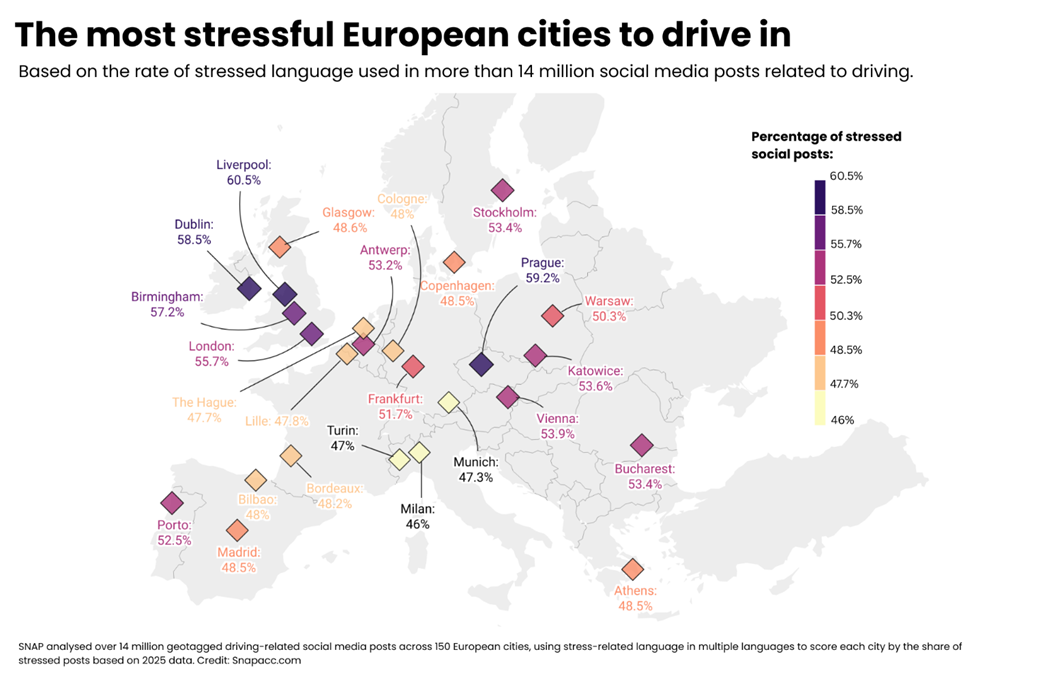
Didžiausią stresą keliantys miestai, kuriuose tenka vairuoti

Miestuose vairuotojams gali kilti daugiau streso dėl spūsčių, siaurų gatvių ir sudėtingo kelių išplanavimo.
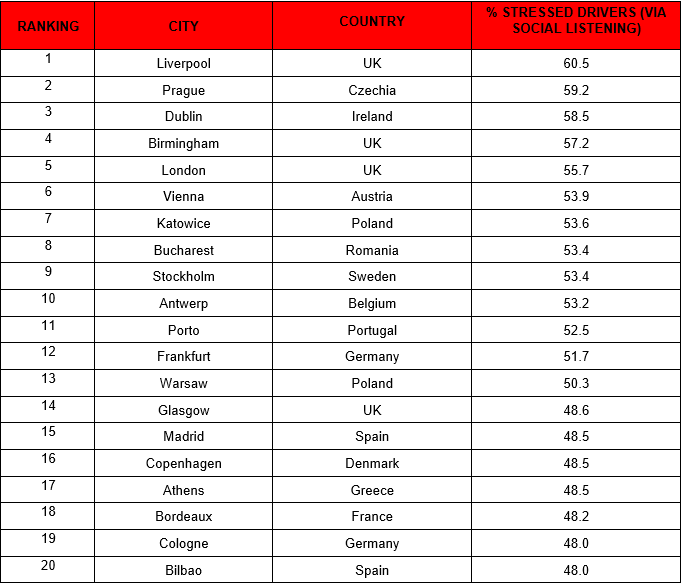
Liverpulis (1 vieta), Birmingamas (4 vieta) ir Londonas (5 vieta) - visi šie miestai patenka tarp labiausiai stresą keliančių Anglijos miestų, kuriuose streso lygis svyruoja nuo 55,7 % iki 60,5 %. Spūstys ir kamščiai, tokie kaip Liverpulio Mersio tuneliai ir labai apkrauti keliai, pavyzdžiui, Londono orbitinis greitkelis (M25) .- yra pagrindiniai veiksniai, lemiantys padidėjusį streso lygį.

Dublinas užima 3-iąją vietą ir yra vienas iš labiausiai apkrautų Europos miestų, kuriame vairuotojai dėl intensyvaus eismo vidutiniškai vėluoja 81 valandą per metus, o tai rodo, kad miestų keliuose nuolat susidaro spūstys.

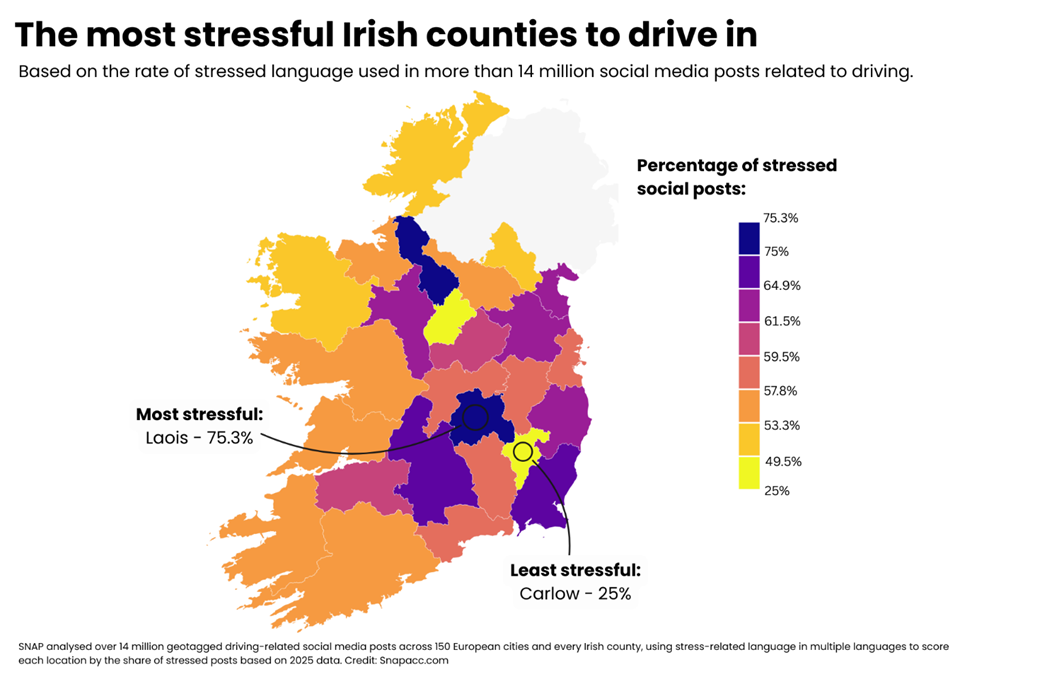
Tolesnė socialinė apklausa, skirta konkrečiai Airijos vairuotojams, parodė, kad Laois ir Leitrim apskrityse užfiksuotas ypač aukštas streso dėl automobilių stovėjimo lygis - nuo 75 % iki 75,3 %.** Šie aukšti rodikliai rodo, kad šiose vietovėse vairuotojai susiduria su nuolatinėmis problemomis, kurias daugiausia lemia didelė priklausomybė nuo automobilių - [73 % Laois gyventojų į darbą važiuoja asmeniniu automobiliu] pagal oficialią statistiką (118 psl.). Be to, Leitrimo grafystėje vietos gyventojai praneša apie prastą kelių infrastruktūrą ir pristatymo ir automobilių stovėjimo vietų konfliktus tokiuose miestuose kaip Drumshanbo, dėl kurių šioje Airijos grafystėje vairuotojams kyla stresas.
Katovicai, Lenkija (7 vieta) - nors Katovicai nėra vienas iš labiausiai perpildytų Lenkijos miestų apskritai, Katovicuose vis dar susiduriama su vėlavimais ir eismo spūstimis, vairuotojai praleidžia daug laiko spūstyse, o pagrindiniuose keliuose, tokiuose kaip S86 ir A4, kasdien būna didelis eismo intensyvumas, kuris gali lemti 53,6 proc. streso rodiklį. Panašiai ir Varšuvoje Lenkijoje (13 vieta) vairuotojai praleidžia apie 70 valandų per metus spūstyse, o tai prisideda prie to, kad 2025 m. streso rodiklis yra 50,3 %.

Bukareštas Rumunijoje (8 vieta), vienas iš labiausiai perpildytų Europos miestų, susiduria su liūdnai pagarsėjusiomis spūstimis: vairuotojai daug daugiau laiko praleidžia spūstyse ir dėl lėto eismo praranda iki 12 darbo dienų per metus.

Ispanijos sostinėje Madride (15 vieta) susidaro didelės spūstys, o 10 km kelionė trunka apie 24 minutes. Dėl siaurų gatvių ir nuolatinio eismo, ypač tokiuose rajonuose kaip Puente de Vallecas,, kasdienis vairavimas tampa lėtas ir kelia stresą. Panašiai pranešama apie avarijas ir intensyvų eismą Ispanijos Bilbao mieste (20 vieta) pagrindiniuose keliuose, pavyzdžiui, A-8 ir BI-30, dėl to susidaro ilgos eilės ir lėtas judėjimas, o tai prisideda prie stresą keliančių vairavimo sąlygų.

Didžiausią stresą keliantys miestai, kuriuose tenka stovėti

Automobilių stovėjimo aikštelės taip pat kelia stresą vairuotojams ir transporto priemonių parko vadovams, nes ribotos galimybės, didelė paklausa ir ribojančios taisyklės Europos miestuose gali atidėti keliones, padidinti nusivylimą ir apsunkinti maršruto planavimą.

Be to, naudodamiesi socialiniais tinklais surinkome duomenis apie miestus, kuriuose vairuotojai patiria daugiausiai streso parkuodami automobilį visoje Europoje, ypač Rumunijoje, Lenkijoje, Ispanijoje ir Jungtinėje Karalystėje. Automobilių parkų operatoriams svarbu atkreipti dėmesį į šias sritis, nes ribotos automobilių stovėjimo aikštelės galimybės, didelė paklausa ir spūstys miestuose gali sutrikdyti tvarkaraščius, padidinti vėlavimus ir paveikti vairuotojų savijautą.

Mūsų tyrimai rodo, kad didžiausia automobilių stovėjimo vietų problema Europoje yra Lenkijoje: Podlachia (83,3 %) ir Olštynas (80 %) susiduria su tokiomis problemomis kaip ribotos automobilių stovėjimo vietos miestuose ir didelis transporto priemonių tankis.

Jungtinėje Karalystėje daugiausiai streso dėl automobilių statymo patiria Newcastle upon Tyne (65,3 %), Liverpool (64,4 %) ir Middlesbrough (63,9 %) miestai. Šiuose miestuose kovojama su ribotomis vietomis miesto centre, mokesčiai gatvėse, spūstys ir griežtos automobilių statymo taisyklės prisideda prie vairuotojų nusivylimo.

Rumunijos miestuose Sibiu ir Cluj-Napoka, taip pat Ispanijos miestuose Malaga ir Bilbao užfiksuotas didžiausias automobilių stovėjimo aikštelėse patiriamo streso lygis atitinkamose šalyse. Tačiau, palyginti su Jungtine Karalyste ir Lenkija, jų streso rodikliai yra mažesni - nuo 55,6 % iki 52,4 %, o tai rodo, kad šiuose miestuose automobilių stovėjimo sąlygos yra tinkamesnės, mažiau kamščių ir vairuotojai patiria santykinai mažesnį spaudimą.

"SNAP tikslas yra paprastas: sumažinti su automobilių stovėjimo aikštelėmis susijusį krovinių vežimo specialistų stresą. Teikdami informaciją realiuoju laiku ir išmanesnes maršruto parinktis, padedame vairuotojams rasti saugias ir prieinamas automobilių stovėjimo aikšteles, todėl jų kelionės tampa mažiau įtemptos ir efektyvesnės. ".

MATTHEW BELLAMY, SNAP GENERALINIS DIREKTORIUS

Kodėl sunkiasvorių sunkvežimių vairuotojai šiuose miestuose patiria didžiausią stresą?

Sunkvežimių vairuotojai patiria kitokį spaudimą nei įprastų automobilių vairuotojai. Dėl riboto didelių transporto priemonių stovėjimo vietų skaičiaus, važiavimo siauromis ar perpildytomis gatvėmis ir didelio eismo intensyvumo vairavimas mieste gali tapti sudėtingesnis ir keliantis stresą, todėl įprastos kelionės gali virsti laiko trūkumu ir dideliu stresu.

Giliau panagrinėkime sunkiasvorių sunkvežimių vairuotojų stresą sukeliančius veiksnius:

  • Limited parking for large vehicles. Scarce lorry bays and high demand make it hard to find safe places to stop, especially in urban centres. The RHA’s Roadside Facilities campaign reports an estimated shortage of 11,000 lorry parking spaces in the UK, creating significant stress for HGV drivers who struggle to find safe and legal places to park., creating significant stress for HGV drivers who struggle to find safe and legal places to park.
  • Narrow streets and complex urban layouts. Tight roads and historic city centres require careful navigation, increasing stress and risk of delays in cities like Prague, Dublin, and Liverpool.
  • High traffic volumes and congestion. Heavy commuter and freight traffic slows journeys, increases travel times, and heightens frustration particularly in busier cities like London, Birmingham, Bucharest, and Madrid.
  • Low-emission or Clean Air Zones. Restrictions on vehicle access, extra charges, and rerouting requirements can complicate planning and add pressure. For example, low emission zones in Spain require some HGVs to seek alternate routes.
  • Route restrictions and delivery schedule. Height and weight limits, prohibited turns, and time-specific delivery windows force drivers onto longer or less convenient routes.
  • Isolation and limited facilities. Long urban journeys without access to rest areas, fuelling, or amenities can increase fatigue and mental strain for HGV drivers.

Ką sunkiasvorių sunkvežimių vairuotojams reiškia stresą keliantys miestai?

Stresą keliantys miestai kelia iššūkių sunkiasvorių sunkvežimių vairuotojams. Spūstys, ribotos automobilių stovėjimo aikštelės ir sudėtingas miestų išplanavimas gali lemti laiko praradimą, praleistus pristatymus, didesnį nuovargį ir didesnę smulkių susidūrimų ar vos neįvykusių avarijų riziką.

Vairuotojai gali valdyti stresą kruopščiai planuodami maršrutus, darydami suplanuotas pertraukas ir naudodamiesi technologijomis, kad galėtų numatyti vėlavimus arba padėti sudaryti biudžetą. SNAP padeda vairuotojams naudodama tokias priemones, kaip intruck programėlė, padedančias rasti laisvas automobilių stovėjimo aikšteles, planuoti efektyvius maršrutus ir būti informuotiems apie spūstis, taip sumažinant stresą ir padarant sunkiasvorių sunkvežimių keliones saugesnes bei lengviau valdomas.

Ką sunkvežimių parko operatoriams reiškia miestai, kuriuose patiriamas stresas?

Stresą keliantys miestai veikia ne tik vairuotojus, bet ir automobilių parko našumą. Dėl spūsčių ir riboto automobilių stovėjimo vietų skaičiaus gali vėluoti krovinių pristatymas, padidėti degalų ir eksploatacinės išlaidos, pablogėti vairuotojų savijauta ir padidėti baudų ar nuobaudų rizika. Šis spaudimas gali sumažinti maržas ir apsunkinti planavimą, vairuotojų išlaikymą ar trūkumą ir klientų pasitenkinimą.

Transporto priemonių parko operatoriai gali įveikti šiuos iššūkius taikydami pažangesnes strategijas ir pagalbines sistemas: naudodami realaus laiko eismo ir automobilių stovėjimo įžvalgas, sudarydami lanksčius tvarkaraščius ir teikdami pirmenybę vairuotojų poilsiui ir gerovei.

Daugiau nei 850 paslaugų partnerių visoje Europoje gali naudotis SNAP automobilių parko mokėjimo sprendimu, kuris kas 12 sekundžių visame žemyne naudojamas atsiskaityti už sunkvežimių paslaugas be grynųjų pinigų ar kortelės.

Europos miestai sunkvežimių vairuotojams kelia mažiau streso

Supratimas apie vairavimo ir stovėjimo aikštelėse patiriamo streso taškus Europoje padeda automobilių parkams dirbti saugiau ir efektyviau. Naudodamiesi šiomis įžvalgomis maršrutų planavimui, vairuotojų mokymui, technologijų diegimui ir rizikos mažinimui, operatoriai gali sumažinti vėlavimus, pagerinti savijautą ir apsaugoti savo vairuotojus. SNAP padeda vykdyti šią krovinių vežimo parkų misiją, siūlydama saugias automobilių stovėjimo aikšteles, sklandžius mokėjimus ir įrankius, kurie kasdienę veiklą padaro ramesnę ir saugesnę.
SIGN UP TO SNAP TODAY

Dalytis su

Kiti taip pat skaito...

Header Image

trečiadienis 25 kovo 2026 • Naujienos ir atnaujinimai

KAIP PROGNOZAVIMO SISTEMOS SUVALDO PRISTATYMO NEAPIBRĖŽTUMĄ

Evelyn Long

Delivery operations rarely unfold exactly as planned. Even the most carefully designed logistics schedules must contend with an unpredictable world. Travel congestion can add hours to a route, severe weather can delay entire regions and a single vehicle breakdown can disrupt dozens of deliveries scheduled throughout the day. When these disruptions occur, they often create a chain reaction that affects drivers, warehouses, customers and operational costs. For companies that operate fleets, whether they deliver packages, medical supplies, food or construction materials, this uncertainty can significantly impact business performance. Missed delivery windows frustrate customers and can damage brand reputation. Delays can also increase fuel costs, overtime pay and operational inefficiencies. In industries where margins are tight, even small disruptions can add up quickly.What makes delivery uncertainty especially challenging is how interconnected modern logistics networks have become. A delay at one point in the system can ripple outward, affecting multiple routes and schedules. Without the right tools to anticipate and manage these disruptions, businesses are often forced to react in real time, which can lead to rushed decisions and inefficient solutions.One of the key technologies helping organisations manage delivery uncertainty is the Internet of Things (IoT). IoT refers to networks of connected devices, such as sensors, GPS trackers and telematics systems, that connect and transmit real-time data from vehicles, equipment and infrastructure. In fleet operations, IoT devices can monitor a wide range of conditions. GPS tracking for vehicles on the road. Engine sensors can track vehicle performance and detect early signs of mechanical issues. Temperature sensors can ensure that sensitive cargo remains within required conditions during transit. Together, these data streams create a detailed picture of what’s happening across an entire delivery network. This level of visibility is essential for managing uncertainty. When managers can see where vehicles are, how they’re performing and whether any issues are developing, they can respond much faster. Instead of discovering a problem hours later, they can address it as soon as the warning signs appear. In many cases, this visibility also feeds into predictive systems that analyse the data and forecast potential disruptions before they occur. While IoT provides the data, AI offers the intelligence needed to interpret it. AI systems analyse large volumes of operational information, including traffic patterns, weather forecasts, vehicle performance metrics, delivery history and route efficiency. By identifying patterns in this data, to occur and recommend adjustments. For example, predictive algorithms can analyse historical traffic conditions along a delivery route and estimate when congestion is likely to occur during certain times of day. If the system detects that a particular route will likely experience delays, it can suggest an alternative path before the driver even leaves the depot. Similarly, AI-driven maintenance systems can analyse engine data and identify early warning signs of mechanical problems, allowing repairs to be scheduled before a breakdown occurs on the road. Predictive systems work best when they combine data from multiple sources and translate that information into actionable insights. In a fleet environment, this often means integrating vehicle telematics, weather data, delivery schedules and live traffic information into a single predictive platform. When all of this data is analysed together, the system early. For example, if a severe storm is forecasted along a delivery route, the network can recommend adjusting departure times or rerouting drivers to avoid affected areas. If sensors detect that a vehicle component is likely to fail soon, it can schedule maintenance during planned downtime rather than allowing a breakdown to disrupt deliveries. Over time, these predictive adjustments make delivery operations smoother and more efficient. Routes become more optimised because the system continually learns from previous trips. Maintenance becomes strategic because vehicles are rather than fixed schedules. Even warehouse operations can improve, since more accurate delivery predictions allow teams to better coordinate loading and unloading processes. Beyond preventing disruptions, predictive systems also help fleets operate more efficiently. Businesses that have access to reliable forecasts and operational insights can plan routes, staffing and vehicle usage with greater precision.For instance, predictive analytics can identify patterns in delivery demand, allowing companies to allocate resources where they’re most needed. If certain routes consistently experience delays during specific hours, schedules can be adjusted to avoid those peak periods. Fuel usage can also be optimised by identifying more efficient routes or driving patterns. Over time, these incremental improvements add up. Vehicles spend less time idling in traffic, drivers spend more time completing deliveries rather than waiting or rerouting, and customers receive more accurate delivery estimates, and satisfaction. Another key benefit of predictive technology is the ability to monitor and control systems remotely. As connected devices become more common, consumers and businesses expect this level of oversight and convenience. A survey found that smart garage door openers consider remote monitoring and control to be a crucial feature. While this statistic relates to residential technology, it highlights a broader shift in expectations. People increasingly value the ability to check on systems, receive alerts and manage operations from anywhere. The same mindset is becoming more important in professional logistics environments. Fleet managers want to see vehicle locations in real time, receive notifications about potential issues and make adjustments without needing to be physically present. Predictive systems support this capability by turning complex operational data into clear, actionable insights that can be assessed remotely. While predictive systems provide clear advantages, they also introduce new considerations that businesses must address. In 2024, the of suspected internet crime. As fleets become more connected and reliant on digital platforms, cybersecurity becomes increasingly important. IoT devices, cloud platforms and AI-driven systems all rely on network connectivity and data exchange. Systems that aren’t properly secured could become targets for cyberattacks. A compromised system could disrupt operations, expose sensitive data or interfere with fleet management tools.Delivery uncertainty may never disappear entirely, but predictive systems are making it far more manageable. By combining IoT connectivity with AI-driven analytics, fleet operators can gain deeper visibility into their operations and anticipate problems before they disrupt schedules. As these technologies continue to evolve, they will play an important role in helping fleet-based businesses reduce uncertainty, streamline operations and deliver a more consistent experience for their customers.Discover more from

Header Image

trečiadienis 11 kovo 2026 • Naujienos ir atnaujinimai

AKTYVŪS PATARIMAI, KAIP UŽTIKRINTI AUTOMOBILIŲ PARKO SAUGUMĄ IR NAŠUMĄ VISAIS METŲ LAIKAIS

Guest

Fleet performance rarely unravels overnight. It slips through small oversights — a missed service interval, worn tread or a delayed depot repair. As a UK fleet manager, the cost of reacting late shows up in downtime, higher insurance premiums and risk to your reputation.Your proactive, seasonal strategy protects the vehicles, drivers and infrastructure before temperature-triggered issues escalate. Align maintenance cycles with weather patterns, operational peaks and compliance demands. Your fleet will be steadier, safer on the road and reduce unwelcome surprises.Reactive fleet management costs you more. Emergency repairs can disrupt tight schedules, strain budgets and frustrate even the best drivers. In contrast, effective forward planning can reduce unplanned downtime and extend vehicle life cycles.Predictive maintenance and seasonal checks are strategic in supporting compliance. The Driver and Vehicle Standards Agency can for roadworthiness at any time, not just during the annual inspection. A prevention-first culture demonstrates your team’s due diligence and strengthens your Operator Compliance Risk Score, without warning.Driver retention links closely to this mindset. Vehicles that are reliable in winter, maintain cabin comfort in summer and feel safe in poor weather send a clear message that your organisation values professionalism and safety.Longer daylight hours and increased road activity shift risk profiles. Construction zones expand, cyclists and pedestrians increase and higher temperatures stress mechanical systems.Introduce quarterly automobile network checks before weather changes set in.: Ensure all vehicles’ air conditioning systems operate efficiently. Comfortable drivers remain more alert and calm on long routes and in heavy traffic, while being hot and bothered behind the wheel fosters reckless driving. : Check radiators, coolant levels and hoses. Heat accelerates wear and can trigger overheating if systems run hot due to environmental factors. : Rising temperatures can affect tyre pressure. Confirm correct inflation and inspect for sidewall damage to reduce the risk of blowouts. Hot road surfaces also wear tyre tread more easily, affecting braking capacity. Reinforce safe driving techniques that consider sun glare, roadworks and higher traffic density. Consider installing tinted windshields when drivers face extreme light conditions.Heat amplifies even minor engine weaknesses. Address mechanical safety early, and you'll prevent mid-season breakdowns or disrupted delivery windows.Shorter days, heavy rain and icy surfaces demand that your team is on top of their game. Autumn brings leaves and debris that litter already-slick roadways, and winter compounds the challenge with frost and failing batteries. Prepare before these conditions set in to keep your mobile assets from deteriorating:: Inspect all headlights, brake lights and indicators. Replace worn wipers, top up the windshield washer reservoirs with de-icing chemicals rated for low-temperature use and add anti-freeze to radiators. : Confirm adequate grip depth on all wheels for additional safety on wet and icy roads and consider swapping to winter sets where routes justify the investment. This is also an ideal time to check your fleet’s tyre ages, as no commercial vehicle may be on the road in the UK with ago, which are considered unroadworthy. : Cold weather reduces battery efficiency. Test older units and replace those nearing the end of life. Trickle chargers help maintain truck batteries' charge when drivers must stop to meet their rest requirements. : Low light and adverse weather can trigger anyone's natural sleep instinct, so manage drivers' alertness levels. Review route planning and rest policies to reduce strain or assign two drivers on longer routes.Vehicle readiness supports road safety, yet infrastructure also plays a role. Poor depot lighting, icy yard surfaces or malfunctioning entry points can delay departures and create hazards before trucks even reach public roads.Mobile asset safety starts at the depot. Vehicles often sit for hours in storage yards or warehouses. A compromised facility exposes high-value assets to theft, weather damage and operational delay. Commercial lots or warehouses are vulnerable matter.Rolling doors and access points demand particular attention in the UK’s damp climate. Corrosion frequently begins at exterior door components, affecting guides and structural elements. Over time, degradation can trigger failures that halt departures or compromise security. Noncorrosive rolling doors made with , like stainless steel, provide safety for the fleet’s vehicles and secure valuable manifests at depots.Businesses operating in high-moisture or coastal environments should invest in corrosion-resistant products. Use cleaning agents and lubricants to prevent hinges and mechanisms from seizing up. Functional doors safeguard operations because a primary access door that fails during peak dispatch hours can result in vehicles missing slots and customer confidence slipping. Proactive facility maintenance reduces that risk.Broader property readiness matters, too. Seasonal inspections of drainage, roofing and external lighting strengthen operational continuity at all hours of the day. Thorough winter preparation should prevent structural and water-related damage. Treat your depot as part of the company's mobility ecosystem by securing doors and maintaining clean yard surfaces. Resilient infrastructure protects vehicles before they reach the road.Technology strengthens your seasonal planning. Telematics platforms provide a wealth of information, including identifying braking patterns, fuel efficiency shifts and early warning codes before faults escalate. Advanced driver-assistance systems add further safeguards, particularly in low-visibility conditions.Use AI to help you analyse data and create workflows that meet each season’s changing needs. Data-driven insights inform scheduling. Use analytics to identify recurring battery failures in cold-region trucks or cooling issues during summer peaks. Adjust the fleet's scheduled maintenance according to telematics guidance.Modern trucks with telematics can of data per minute from hundreds of sensors, which is only useful if you have the computing systems to extrapolate findings and trends that inform maintenance and performance schedules.Proactive company asset management evolves beyond checklists. It becomes a continuous improvement process informed by data, temperatures and infrastructure integrity.Seasonal transitions present predictable challenges from heat-stressing engines, cold-draining batteries and moisture corroding structural components. Increased traffic and vehicle use alter risk patterns.Address these variables before they disrupt your team’s operations. Align maintenance cycles with weather trends, reinforce driver training ahead of weather shifts and invest in resilient depot infrastructure.A fleet that anticipates change operates with confidence and performs consistently with improved safety metrics and decreased downtime. Those incremental advantages compound into measurable operational strength.

Header Image

pirmadienis 26 sausio 2026 • Naujienos ir atnaujinimai

2026 M. LAIVYNO BIUDŽETO RENGIMAS ATSIŽVELGIANT Į (NE)TIKĖTINĄ

Guest

Preparing your fleet budget goes beyond simple financial exercises. As a manager, you need strategic oversight to navigate economic headwinds and an evolving regulatory framework. It is essential to prepare your company for unexpected events, as these instances define operational stability and success. Here’s how to build a responsive budget and get ready for future challenges. Being a fleet manager means foreseeing both the predictable trends and significant uncertainties. The following seven strategies are designed to absorb shocks, adapt to change and build resilience. Your budget may have a fixed monetary amount each year. While simple, it could be too static when anticipating unexpected events. Make your financial planning more dynamic by allocating a specific percentage rather than a fixed amount. For instance, your emergency fund could be 5% of the total budget instead of $100,000 annually. Using a percentage is wise because it hedges against inflation. A fixed amount loses purchasing power over the years, whereas a percentage-based fund grows with the budget. You get automatic protection from marketwide surges. Consumer prices in the U.K. , though they can quickly fluctuate due to market conditions. Fleet managers used to determine their budgets based on acquisition prices. Now, they are focusing on budget stability and long-term strategies. Make your process more holistic by managing the total cost of ownership (TCO) and the cost per vehicle over their lifetimes. This approach makes you more meticulous and your budget more dynamic. Mastering TCO involves centralising your data and using dedicated fleet management software. This technology helps your business by and recommending conservation strategies. TCO also enables you to forecast the year for each vehicle based on historical information. Use this to make more informed acquisitions and save money. A volatile economic climate means you need to contain costs. Leverage your company’s position by reviewing supplier contracts and considering renegotiations before renewal. This strategy converts unpredictable expenses into more manageable line items. Your business partner may raise prices on essential goods, so your meetings should lock in prices for tyres and oil. Narrow your negotiation to key areas, such as pricing structure. Your primary focus should be fixed-price agreements for high-volume items and standard labour rates. Savvy fleet managers leverage their spending from the previous year to earn volume discounts and capped increases. These properly managed contracts insulate your business and transfer risk to suppliers. Risk management for your fleet budget also includes insurance optimisation. Managers should turn this annual exercise into an opportunity to protect their business from financial debilitation. The right policy is crucial because it protects against shocks that can result in third-party damage or injury. It also increases predictability by turning repair bills into known variables. Insurance optimisation requires a thoughtful, data-driven process. Give your broker a risk management portfolio to showcase positive trends, such as fewer speeding incidents or less harsh braking. If you have policy excess, ask your insurer to model the premium savings for a higher deductible. Therefore, you can save money on your monthly payment. Maintenance and repairs can be unpredictable and expensive. One breakdown on the M6 could require costly engine work or a transmission replacement. Be proactive by implementing structured service schedules. Beyond the manufacturer's guidelines, you should create detailed plans for each vehicle based on its usage and age. You can dive deeper by including motorway driving and city travel. Your maintenance schedule should also include daily tasks. For example, experts to prevent condensation formation. If the tank is close to empty, sediment buildup and pump damage may occur. Cleaning is another nonnegotiable daily chore, especially when driving over road salts and chemicals. Rinse off dirt and other contaminants before storing vehicles. Accidents are among the most unexpected parts of your fleet budget. Besides the crash, managers must also and solicitor fees. However, proper driver training can mitigate this cost by reducing its frequency. Targeted coaching helps operators understand defensive driving, hazard perception and the specific dynamics of their jobs. Investing in driver training is one element of risk control. Human driving can be unpredictable, but education transforms it into a more consistent variable. By improving your drivers, you also help your insurance premiums. An accident can raise rates, so proper training is one way to control costs. A decrease in incidents can be used as leverage in insurance negotiations. Fleets are becoming more connected as they transform into data hubs. Your vehicles can generate and store vast amounts of information, which is essential for management. However, the connectivity exposes the modern automobile to liabilities. Budget for cybersecurity to protect your assets from digital threats and prepare for the unexpected. Managing this part of your fleet budget involves protecting vehicle systems. You could invest in hardware and software solutions to create firewalls around your GPS and V2X communications. This strategy helps keep your software up to date and protected from external threats. Secure data transmission is another part of preparing for the unexpected. Forward-thinking managers invest in fleet management systems with end-to-end encryption. Before building a resilient operation, it is essential to understand why. You should budget for unexpected events to ensure continuity. If a vehicle breaks down, it could halt operations and delay services. However, planning for these incidents provides a buffer and safeguards your bottom line. All vehicles are subject to failure, so you are preparing for the physical reality. This strategy is also essential for the bigger picture. For instance, economic volatility is a factor outside your control. Sudden inflation, interest rate hikes and price increases are detrimental to static budgets. However, planning for unexpected costs helps absorb them. By accurately forecasting expenses, you build financial discipline and credibility with stakeholders.Building a dynamic budget demonstrates strategic leadership more than defensive measures. As you incorporate wise approaches, you fundamentally shift your organisation’s mindset and promote proactive control. The modern economic climate requires fleet managers to absorb shocks and mitigate asset failure. A strong budgetary framework lets you protect profit margins and guarantee continuity.Discover more from