Evelyn Long
Nasveti za voznike • 4 min branja

Varni postopki nakladanja in razkladanja za preprečevanje kostno-mišičnih poškodb

Ustvarjeno: 26. 05. 2026

Posodobljeno: 26. 05. 2026

Poškodbe mišično-skeletnega sistema so eden od najbolj perečih izzivov, s katerimi se danes sooča industrija voznih parkov. Vozniki in skladiščno osebje se med nakladanjem in razkladanjem stalno soočajo s fizičnimi zahtevami.

Z izvajanjem ustreznih postopkov zaščitite svoje delavce pred kroničnimi bolečinami in poškodbami, ki bi lahko ogrozile njihovo poklicno pot, hkrati pa ohranite učinkovitost, ki ohranja konkurenčnost vašega podjetja na zahtevnih trgih.

Visoki stroški kostno-mišičnih poškodb

Poškodbe kostno-mišičnega sistema prizadenejo posamezne delavce, hkrati pa zaradi izgube produktivnosti in povečanih zavarovalnih premij izčrpavajo poslovna sredstva.

Vpliv na poslovanje in finance

Ko se delavec poškoduje, finančne posledice presegajo neposredne stroške zdravljenja. Upravljavci voznega parka morajo upoštevati stroške bolniškega dopusta, stroške začasnih delavcev in morebitne odškodninske zahtevke.

V letih od 2023 do 2024 bodo skupni stroški slabega zdravja in poškodb na delovnem mestu [v Združenem kraljestvu] dosegli 22,9 milijarde funtov](https://www.hse.gov.uk/statistics/cost.htm), pri čemer bodo poškodbe predstavljale 28 % ali 6,5 milijarde funtov. Te številke kažejo, kako se poškodbe kažejo v gospodarskih bremenih, ki vplivajo na stopnje dobička.

Izgubljena produktivnost še povečuje te neposredne stroške. Ko izkušeni vozniki ali skladiščno osebje vzamejo daljši dopust, se delovanje upočasni, preostali člani ekipe pa se soočajo s povečano delovno obremenitvijo. Posledice se dotaknejo vseh vidikov delovanja voznega parka, od zamud pri dostavah do napetih odnosov s strankami.

Posledice za poklicne voznike

Vozniki, pri katerih se pojavijo kostno-mišična obolenja, se soočajo s težko realnostjo. Kronične bolečine v hrbtu, poškodbe ramen in ponavljajoči se napori lahko povzročijo, da je opravljanje osnovnih delovnih opravil neznosno. Številni vozniki poročajo, da vztrajne bolečine vplivajo na njihovo sposobnost osredotočanja na dolgih poteh, kar povzroča dodatne varnostne težave.

Kostno-mišična obolenja so v Veliki Britaniji med vodilnimi vzroki z delom povezanega slabega zdravja. Zaradi teh bolezni izkušeni strokovnjaki zapuščajo panogo, v kateri so si ustvarili dolgoletno strokovno znanje.

Varnostni predpisi in ocene tveganja v Združenem kraljestvu

Zakonodaja Združenega kraljestva od delodajalcev zahteva, da sprejmejo posebne ukrepe za preprečevanje poškodb pri ročnem premeščanju. Ocena tveganja je temelj skladnosti in služi kot prva obrambna linija proti obremenitvam na delovnem mestu.

Ključni predpisi za ročno rokovanje

Delodajalci morajo upoštevati predpise o ročnem premeščanju, ki jih je izdal Izvršilni organ za zdravje in varnost (Health and Safety Executive) in ki določajo jasno hierarhijo.

Prvič, izogibajte se nevarnim ročnim manipulacijam, če je to razumno izvedljivo. Drugič, ocenite vse nevarne postopke, ki se jim ni mogoče izogniti. Tretjič, zmanjšajte tveganje za poškodbe zaradi teh postopkov na najnižjo razumno izvedljivo raven.

Ta okvir spodbuja podjetja, da v celoti odpravijo tveganja pri ročnem delu. Kadar koli je to mogoče, je treba za premikanje tovora uporabljati mehansko opremo. Vsako neizogibno ročno rokovanje zahteva ustrezno oceno in obvezne nadzorne ukrepe.

Postopek ocene tveganja

Ustrezna in zadostna ocena tveganja preuči štiri ključne dejavnike logističnih dejavnosti:

  1. Naloga: Pomembna je sama naloga, vključno s tem, ali vključuje zvijanje, sklanjanje ali ponavljajoče se gibe.
  2. Obremenitev: Pomembne so značilnosti bremena, kot so teža, velikost in stabilnost.
  3. Okolje: Okoljski pogoji, vključno s prostorskimi omejitvami, talnimi površinami in ekstremnimi temperaturami, vplivajo na varnostne rezultate.
  4. Posameznik: Individualne sposobnosti se razlikujejo med delavci, ki pri vsakem delu prinašajo različne prednosti in fizične omejitve.

Učinkovite ocene tveganja v zvezi z varnostjo v logistiki bi morale voditi do konkretnih izboljšav. Dokumentirajte svoje ugotovitve in jih delite s svojo ekipo.

Tehnike varnega ročnega upravljanja

Kadar je ročno delo neizogibno, lahko s pravilno tehniko zmanjšate tveganje za poškodbe. Usposabljanje zaposlenih za pravilne metode dvigovanja jih varuje pri vsakodnevnem delu.

Posamezne metode dvigovanja in prenašanja

Stopala morajo biti zaradi stabilnosti v širini ramen, nameščena blizu bremena. Upogibanje v kolenih ob ohranjanju ravnega hrbta vam omogoča, da breme trdno primete z obema rokama. Mišice nog morajo pri gladkem dvigu pognati dvigovanje. Če med celotnim gibanjem breme držite blizu telesa, preprečite obremenitve, prav tako se izogibajte vsakršnemu zasuku med dvigovanjem ali prenašanjem.

Če se morate pri premikanju predmeta naprezati ali drgniti, je potrebna mehanska pomoč ali skupinsko dvigovanje. Nikoli ne hitite z dvigovanjem, da bi prihranili čas. Če si vzamete nekaj dodatnih sekund za pravilen položaj, preprečite poškodbe, ki vas lahko izločijo za več tednov.

Usklajeni postopki za dvigovanje ekipe

Za skupinsko dvigovanje je potrebna jasna komunikacija in načrtovanje, preden se kdo dotakne tovora. Določite eno osebo za koordinatorja dvigovanja, ki bo dajala navodila. Vsi člani ekipe morajo razumeti načrt dviga, vključno s točkami prijema, potjo gibanja in mestom, kamor bo tovor postavljen.

Koordinator naj pred začetkom dviga odšteva, da se vsi gibljejo istočasno. Člani ekipe morajo ves čas vzdrževati komunikacijo in se oglasiti, če je treba prekiniti ali prilagoditi.
Tehnologija in oprema za preprečevanje poškodb

Tehnologija ponuja učinkovita orodja za zmanjšanje ali odpravo tveganj pri ročnem delu z voznim parkom, naložbe v opremo pa varujejo delavce ter pogosto izboljšajo učinkovitost in prepustnost.

Mehanski pripomočki za dvigovanje

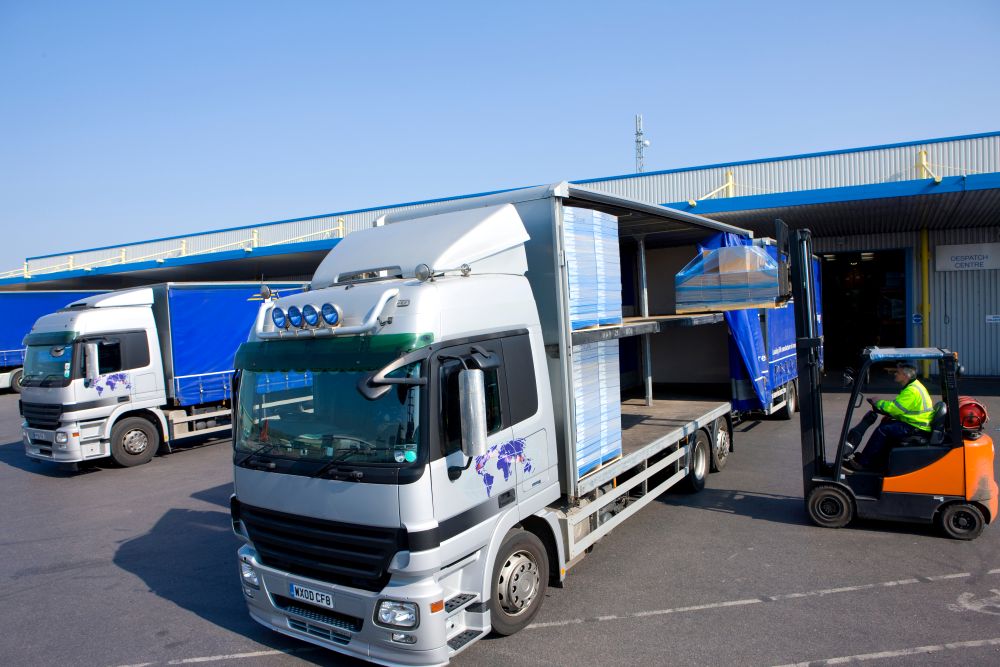
Mehanska oprema, kot so paletni viličarji, viličarji in transporterji, odpravlja številne poškodbe pri ročnem premeščanju. Hrbti in sklepi delavcev niso več fizično obremenjeni, ko tovor prenašajo stroji.

Baterijski električni paletni viličarji zmanjšajo utrujenost upravljavca in tveganje poškodb. Ti stroji lahko prenesejo precej večjo težo kot ročne različice, hkrati pa od upravljavcev zahtevajo minimalen fizični napor.

Viličarji so odlični za prevoz in dvigovanje materialov v skladiščih in nakladalnih dokih. Upravljavci nadzorujejo težka bremena iz zaščitenega položaja, kar preprečuje obremenitve hrbta in poškodbe zaradi ponavljajočih se gibov, ki so povezane z ročnim rokovanjem.

Prediktivna analitika

Na podatkih temelječe načrtovanje s pomočjo napovednih sistemov lahko prepozna vzorce povpraševanja po dostavi in potencialne točke zamud na vaših poteh. Upravitelji voznega parka lahko ta spoznanja uporabijo za prilagoditev urnikov, dodelitev dodatnih virov v obdobjih največje obremenitve in zagotavljanje realnih časovnih okvirov voznikom.

Če se vozniki počutijo prehitro, so bolj nagnjeni k temu, da se izogibajo varnostnim postopkom. Pravilno načrtovanje odpravlja ta pritisk. Delavci imajo čas za pravilno uporabo mehanske opreme, po potrebi izvajajo skupinska dvigala in upoštevajo pravilne tehnike ročnega upravljanja.

Nosljiva tehnologija

Nove nosljive naprave spremljajo gibanje in držo delavcev med izmeno. Te naprave uporabljajo AI-powered wearables for workplace safety za analizo tehnik dvigovanja in zagotavljajo povratne informacije v realnem času, ko delavci zavzamejo nevarno držo.

Podobna tehnologija se pojavlja v aplikacijah za varnost voznikov. Program telematske aplikacije je pomagal zmanjšati število nesreč za 42 % med mladimi vozniki z zagotavljanjem povratnih informacij v realnem času. Enako načelo velja za fizično delo, kjer lahko takojšnje opozorilo o nepravilni obliki dvigovanja prepreči poškodbe zaradi kumulativnih obremenitev.

Preprečevanje z načrtovanjem pri delovanju voznega parka

Pri načrtovanju dejavnosti voznega parka lahko za odpravo nevarnosti uporabite preprečevanje z načrtovanjem (PtD). V ta proaktivni pristop spadajo specifikacije vozil, ki zmanjšujejo zahteve po ročnem rokovanju, postavitve skladišč, ki omogočajo varno gibanje, in odločitve o nabavi, ki dajejo prednost ergonomiji.

Izbira zasnove vozila neposredno vpliva na tveganje vsakodnevnih poškodb. Nižja višina tovorne postelje zmanjša razdaljo, na katero morajo delavci dvigovati težke predmete, konfiguracije s stranskim nalaganjem pa v primerjavi s konfiguracijami z zadnjim nalaganjem zmanjšajo obremenitev hrbta delavcev. Pomembne so tudi odločitve o razporeditvi skladišča, saj mora biti okoli nakladalnih oken dovolj prostora, da se lahko delavci pravilno namestijo in uporabljajo opremo brez nerodnega manevriranja.

Samo zagotavljanje opreme ne zagotavlja varnosti. Raziskave kažejo, da 62,2 % gradbenih delavcev morda dela na višini, ki zahteva zaščito, vendar jih le 31 % dosledno uporablja razpoložljivo varnostno](https://renovated.com/prevention-through-design-in-construction-safety/) opremo. Ta vrzel poudarja, zakaj je PtD pomemben. Če dejavnosti načrtujete tako, da je varna metoda tudi najlažja, postane skladnost s predpisi samoumevna.

Dolgoročna zavezanost varnosti

Preprečevanje kostno-mišičnih poškodb zahteva stalno pozornost. Vlaganje v ustrezno opremo, usposabljanje in operativno zasnovo varuje vašo delovno silo, hkrati pa krepi ugled vašega podjetja in njegove prihodnje možnosti.

Odkrijte več iz Renovated Magazine.

Delite z

Tudi drugi berejo...

Header Image

četrtek 03 april 2025 • Nasveti za voznike

PARKIRNI PREDPISI ZA VOZILA HGV V ZDRUŽENEM KRALJESTVU: KAJ BI MORAL VEDETI VSAK VOZNIK

Susie Jones

For many truck drivers, it can be challenging trying to navigate the number of regulations surrounding overnight truck parking in the UK. After a long day behind the wheel, they must adhere to several rules before they can even think about parking up for the night. We'll delve into these regulations and provide you with everything you need to know. Before we look at parking regulations, it's vital to understand UK and EU laws regarding rest periods. We've collated all you need to know about . However, in a nutshell, if your vehicle exceeds three and a half tonnes, you must have a tachograph fitted. A tachograph will record the number of breaks a driver takes. Truck drivers must adhere to the following:• Drivers must take 11 continuous hours of rest. This can be reduced to nine. • Truck drivers are required to take at least 45 hours of rest. • Driving time can be no longer than four-and-a-half hours before a break. A break must be at least 45 minutes.To comply with parking laws and ensure safety, truck drivers must follow strict regulations regarding where and when they can park overnight:• Many local authorities do not allow truck drivers to park in residential areas doing so may result in a fine or penalty.• If the maximum loaded weight of the vehicle is more than 7.5 tonnes (including any trailer), you must not park on a verge, pavement, or any land between carriageways unless there is police permission. • Truck drivers can use these for overnight parking. However, they provide less security and no amenities. Parking overnight in a lay-by is often the most straightforward and economical option but can pose a greater security risk.Failure to follow HGV parking regulations can result in fines, vehicle clamping, or impounding. These penalties are in place to encourage drivers to comply with the law and ensure road safety.Suitable parking locations include: Specifically designed for HGVs and include facilities such as fuel, food, showers, toilets, and security options. Many motorway service areas (MSAs) will provide areas for HGV parking. Most offer similar facilities as truck stops. SNAP provides drivers with a network of over across Europe. • Downloading a truck parking app can help drivers find locations near them to park up for the night. enables truck drivers to find parking & washing spots across Europe, allowing drivers to book SNAP sites through the app.• Search for a spot that offers essential amenities like food, toilets, and showers for a more comfortable stay. • Most truck stops and MSAs will have security features. Using the or, drivers can check a site's security features, including fencing, CCTV, night watchmen, and TAPA accreditations. Truck drivers can park on verges or pavements if the parking is for essential loading and unloading. There are a few exceptions they must consider before loading and unloading:• Drivers must not park where yellow markings are on the curb, and upright signs advise restrictions. • The vehicle must not be left unattended.• On red routes, drivers should look out for specially marked and signposted bays showing when and where loading and unloading is permitted. • Councils and private estates may have different regulations. Truck drivers are restricted to using lanes one and two. On a four-lane motorway, drivers can use lane three. However, HGVs are not permitted to use the furthest right lane.A road may be marked unsuitable for heavy goods vehicles for the following reasons: These pose a challenge for many HGVs, especially long or articulated trucks. Ascending a steep incline for an HGV is a difficult task due to its heavy load, leading to reduced traction and wheel spin. Roads with limited width can feature sharp bends or walls on either side and are unsuitable for trucks. Due to their turning radius of HGVs, they require more space to maneuver. Roads with walls on either side leave little room for error and increase the risk of an HGV becoming stuck or causing damage.

Header Image

ponedeljek 02 december 2024 • Nasveti za voznike

VSE, KAR MORATE VEDETI O SPREMEMBAH SISTEMA CPC ZA VOZNIKE

Susie Jones

On the 3rd of December 2024, changes to the Driver Certificate of Professional Competence (CPC) will come into full effect. The new CPC aims to offer better flexibility to drivers returning to the profession and those undertaking mandatory training. We delve into the upcoming changes and how they will impact drivers. Introduced in 2007, the CPC is a mandatory qualification for professional drivers in the UK and EU wanting to drive a range of heavy vehicles, such as HGVs, LGVs, buses, and coaches. Drivers must pass four tests: • Theory• Case study• Practical• Vehicle safety demonstration. Once passed, the CPC lasts for five years and must be renewed by taking 35 hours of periodic training within the five years.The UK government wanted to understand the effectiveness of the Driver CPC. They did this by asking drivers, trainers, and other parties to take a poll. The government focused on two main areas: improving driver choice and attracting more drivers into the industry for example, making it easier for drivers with foreign qualifications to obtain a licence in the UK. The changes to the Driver CPC are categorised into the following:The international Driver CPC is the new name for how the previous Driver CPC worked. The following applies:• Drivers must take 35 hours of CPC training every five years.• The courses must be at least seven hours long. • If splitting a course over a day, a driver must complete it on two consecutive days.• Drivers are allowed to do a total of 12 hours of e-learning.The National Driver CPC provides more flexibility for those wanting to drive in the UK. Drivers can take either:• 35 hours of training every five years.• A combination of 35 hours of National Driver CPC and International Driver CPC training every five years.The flexibility means that:• Training must be at least 3 hours 30 minutes long training providers can offer longer courses. • It does not need to be completed on two consecutive days if it's a split course course providers can set their time limits.• Training can be e-learning.• Drivers can do 12 hours of e-learning towards their overall 35 hours.From the 3rd of December, 2024, drivers will be able to stay qualified by choosing either:1. International Driver CPC National Driver CPCDrivers wanting to return to the profession must take 35 hours of training before returning. However, this will change from the 1st of February, 2025.Drivers with an expired CPC will have new pathways to make returning to driving easier.Drivers have four options:• Undertake 35 hours of International Driver CPC training.• Regain qualification to drive in the UK and EU.• Complete 35 hours of National Driver CPC training.• Regain qualification to drive in the UK only.• Take a seven-hour "return to driving" module.• Regain UK driving qualification instantly.• To drive in the EU, complete 28 additional hours of training within 12 months.• As part of the National Driver CPC training, complete a seven-hour "return to driving" module.• Regain UK driving qualification instantly.• Take 28 additional hours of training (National or International Driver CPC) within 12 months.Drivers must take 35 hours of training (International or National).The rules surrounding Driver CPC cards remain the same drivers must carry their cards when operating vehicles professionally. However, the type of card differs based on qualification:• Identical to the current design.• The design will include "Domestic UK use only."If a driver is qualified for both categories, they may hold two cards.Fleet managers can prepare for the changes by ensuring the following:• Find out whether their drivers need an International or National CPC.• Training deadlines aren't missed to avoid fines.You are exempt from needing a Driver CPC if you're using the vehicle for:• Non-commercial carriage• Carrying materials you use for your job driving must be less than 30% of your rolling monthly work.• Driving for someone you work for or your own agriculture, horticulture, forestry, farming, or fisheries business driving must be less than 30% of your rolling monthly work. • Driving within 62 miles of your base driving a HGV, bus, or coach must not be your main job.• Driving to or from pre-booked appointments to test centres.• Lessons for anyone wanting to get a driving licence or a Driver CPC.• Maintain public order.Full guidance is on the website.Drivers with grandfather rights don't need to hold the actual qualification as part of their licence. However, they must complete 35 hours of training every five years.

Header Image

sreda 18 september 2024 • Nasveti za voznike

JASEN POGLED NAPREJ: POMEN NEGE OČI ZA VOZNIKE TOVORNJAKOV

Susie Jones

takes place from the 23rd to the 29th of September, and as a truck driver, maintaining good vision is crucial to your job. Optical Express reported that road crashes involving drivers with poor vision accounted for roughly yearly casualties.Truck driving is a physically demanding role, but it is just as demanding visually requiring constant vigilance and the ability to quickly identify or react to changing road conditions. Poor vision can affect a driver's ability to judge distances, read signs, and detect other vehicles, reducing safety for the driver and other road users.Drivers must complete a t when applying for an HGV licence this occurs every five years after 45 and every year after the age of 65. As part of the medical, truck drivers must have a vision examination by a doctor, optician, or optometrist.To pass the examination, drivers require visual acuity of at least 0.8 (6/7.5) on the Snellen scale in their best eye and at least 0.1 (6/60) in the other.Group 2 HGV drivers need a horizontal visual field of at least 160 degrees with an extension of at least 70 degrees left and right and 30 degrees up and down. No defects should be present within a radius of the central 30 degrees.After 45 years old, drivers must complete their D4 Medical Assessment every five years and every year after 65. However, opticians recommend that every road user has an eye test at least every two years.If a driver experiences the following, they should get their eyes tested immediately:• Headaches• Eyestrain• Pressure behind the eyes• Double vision• Difficulty seeing during the night• Halos around lights.Under the law, employers must ensure their employees are fit to drive this could cover several things, but eyesight is one of them. Employers should test their driver's eyesight every six months by carrying out a number plate sight check 20 metres away.If an HGV driver requires glasses or contact lenses to reach the minimum vision requirement, they can't have a spectacle power greater than eightdioptres. For contact lenses, there is no restriction on contact lens power.The recommends the following to maintain good eye health:• Eat a well-balanced diet with foods that help your vision.• Exercise regularly to prevent diabetes and other conditions that can lead to vision problems.• Inform an optician if you notice any changes.• Wash your hands before putting them near your eyes or if you're handling contact lenses.• Protect your eyes when performing tasks that could damage them.• Wear sunglasses that block 99% or 100% of UVA and UVB radiation.• Follow the 20-20-20 rule every 20 minutes, look 20 feet away for 20 seconds.• Try not to smoke smoking is just as harmful to your eyes as it is to your body.The visual standards HGV drivers must meet are higher than those of other road users. In the UK, drivers must have a visual acuity of at least 0.5 (6/12) on the Snellen scale. In addition, drivers must be able to read a car number plate made after the 1st of September 2001 from 20 metres.The UK law on vision and driving falls below many European countries.By a number plate self-test from 20 metres. A visual acuity/visual field test is mandatory in other European countries.A driving test examiner performs the test in the UK, Cyprus, The Netherlands, and Norway. Several European countries require an Optometrist/Ophthalmologist/Doctor to carry out the test.• The UK, Austria, Belgium, Czech Republic, France, Germany, and Sweden require no further visual tests.• Algeria, Estonia, Hungary, Italy, Latvia, Spain, and Turkey require a visual assessment every ten years.• Algeria, Estonia, Finland, Greece, Hungary, Italy, Latvia, Portugal, Serbia, Spain, and Turkey require visual tests from 65 or younger.It's vital to inform the DVLA if you have any of the following eye conditions:• Blepharospasm• Cataracts• Diabetic retinopathy• Glaucoma• Eye loss• Macular degeneration• Monocular vision• Nyctalopia• Retinitis pigmentosa• Visual field defect.Drivers need to meet the following standards:• Can read a number plate 20 metres away• No double vision• Have a regular field of vision in at least one eye.If a driver is unsure whether they meet the visual standards for driving, they must get advice from a GP, optician, or eye specialist. of the information a driver receives comes from vision with most maneuvers made based on a sense of sight. Vision cannot be substituted or supplemented and is the most important physical factor behind the wheel.