Evelyn Long
Conselhos ao condutor • 4 min ler

Procedimentos seguros de carga e descarga para evitar lesões músculo-esqueléticas

Criado: 26/05/2026

Atualizado: 26/05/2026

As lesões músculo-esqueléticas são um dos desafios mais persistentes que o sector das frotas enfrenta atualmente. Os condutores e o pessoal do armazém enfrentam exigências físicas constantes durante as operações de carga e descarga.

A implementação de procedimentos adequados protege a sua força de trabalho de dores crónicas e lesões que põem fim à sua carreira, mantendo a eficiência que mantém a sua empresa competitiva em mercados exigentes.

O elevado custo das lesões músculo-esqueléticas

As lesões músculo-esqueléticas afectam os trabalhadores individualmente, ao mesmo tempo que esgotam os recursos da empresa através da perda de produtividade e do aumento dos prémios de seguro.

Impacto nas operações e finanças da empresa

Quando um empregado sofre uma lesão, as consequências financeiras vão para além das despesas médicas imediatas. Os gestores de frotas têm de ter em conta os custos das baixas por doença, as despesas com trabalhadores temporários e potenciais pedidos de indemnização.

Em 2023 e 2024, os custos totais dos problemas de saúde e lesões no local de trabalho [atingiram 22,9 mil milhões de libras no Reino Unido] (https://www.hse.gov.uk/statistics/cost.htm), sendo as lesões responsáveis por 28% ou 6,5 mil milhões de libras. Estes números demonstram como as lesões se traduzem em encargos económicos que afectam as margens de lucro.

A perda de produtividade agrava estes custos diretos. Quando os condutores experientes ou o pessoal do armazém se ausentam durante um período prolongado, as operações abrandam e os restantes membros da equipa enfrentam cargas de trabalho acrescidas. Os efeitos em cascata afectam todos os aspectos das operações da frota, desde entregas atrasadas a relações tensas com os clientes.

Consequências para os condutores profissionais

Os condutores que desenvolvem perturbações músculo-esqueléticas enfrentam uma realidade difícil. As dores crónicas nas costas, as lesões nos ombros e o esforço repetitivo podem tornar as funções básicas do trabalho excruciantes. Muitos condutores referem que a dor persistente afecta a sua capacidade de concentração durante percursos longos, criando preocupações adicionais de segurança.

As perturbações músculo-esqueléticas estão entre as [principais causas de doença relacionada com o trabalho] (https://www.hse.gov.uk/statistics/causdis/index.htm) na Grã-Bretanha. Estas doenças obrigam os profissionais experientes a abandonar um sector onde adquiriram anos de experiência.

Regulamentos de segurança e avaliações de risco no Reino Unido

A legislação do Reino Unido exige que os empregadores tomem medidas específicas para evitar lesões causadas por manuseamento manual. A avaliação de riscos constitui a base da conformidade e serve como a primeira linha de defesa contra o desgaste no local de trabalho.

Principais regulamentos sobre operações de movimentação manual

Os empregadores devem seguir os Regulamentos de Operações de Manuseamento Manual do Executivo de Saúde e Segurança, que estabelecem uma hierarquia clara.

Em primeiro lugar, [evitar operações perigosas de movimentação manual] (https://www.hse.gov.uk/msd/) sempre que for razoavelmente possível. Em segundo lugar, avaliar as operações perigosas que não podem ser evitadas. Em terceiro lugar, reduzir o risco de lesões resultantes dessas operações ao nível mais baixo razoavelmente praticável.

Este quadro obriga as empresas a eliminar totalmente os riscos de movimentação manual. Sempre que possível, deve ser utilizado equipamento mecânico para movimentar cargas. Qualquer movimentação manual inevitável requer uma avaliação adequada e medidas de controlo obrigatórias.

O processo de avaliação dos riscos

Uma avaliação de risco adequada e suficiente examina quatro factores-chave nas operações logísticas:

  1. tarefa: A tarefa em si é importante, incluindo se envolve torção, inclinação ou movimentos repetitivos. 2) Carga: As caraterísticas da carga, como o peso, o tamanho e a estabilidade, desempenham um papel importante.
  2. ambiente: As condições ambientais, incluindo as limitações de espaço, as superfícies do pavimento e as temperaturas extremas, afectam os resultados de segurança.
  3. indivíduo: As capacidades individuais variam entre os trabalhadores, que trazem diferentes pontos fortes e limitações físicas para cada trabalho.

As [avaliações de risco relativas à segurança na logística] (https://www.hse.gov.uk/logistics/) eficazes devem conduzir a melhorias concretas. Documente as suas conclusões e partilhe-as com a sua equipa.

Técnicas seguras de manuseamento manual

Quando o manuseamento manual se torna inevitável, uma técnica adequada pode reduzir o risco de lesões. A formação dos trabalhadores em métodos de elevação corretos protege-os durante as operações diárias.

Métodos individuais de elevação e transporte

Os pés devem estar [afastados à largura dos ombros para maior estabilidade] (https://www.hse.gov.uk/msd/manual-handling/good-handling-technique.htm), posicionados perto da carga. Dobrar os joelhos, mantendo as costas direitas, permite-lhe agarrar a carga firmemente com ambas as mãos. Os músculos das pernas devem dar força à elevação à medida que se eleva suavemente. Manter a carga junto ao corpo durante todo o movimento evita a tensão, assim como evitar qualquer movimento de torção durante a elevação ou transporte.

Se precisar de se esforçar ou sacudir para mover um objeto, é necessária assistência mecânica ou uma equipa de elevação. Nunca apresse uma elevação para ganhar tempo. Se demorar alguns segundos a mais para se posicionar corretamente, evita lesões que o podem deixar de fora durante semanas.

Procedimentos de elevação de equipas coordenados

As elevações em equipa requerem uma comunicação clara e planeamento antes de alguém tocar na carga. Designar uma pessoa como coordenador da elevação que irá dar instruções. Todos os membros da equipa devem compreender o plano de elevação, incluindo os pontos de preensão, o percurso do movimento e o local onde a carga será colocada.

O coordenador deve fazer uma contagem decrescente antes do início da elevação para que todos se movam ao mesmo tempo. Os membros da equipa devem manter a comunicação durante todo o processo, chamando se for necessário fazer uma pausa ou ajustar.
Tecnologia e equipamento para a prevenção de lesões

A tecnologia oferece ferramentas poderosas para reduzir ou eliminar os riscos de manuseamento manual nas operações de frota, enquanto os investimentos em equipamento protegem os trabalhadores, melhorando frequentemente a eficiência e o rendimento.

Auxiliares de elevação mecânicos

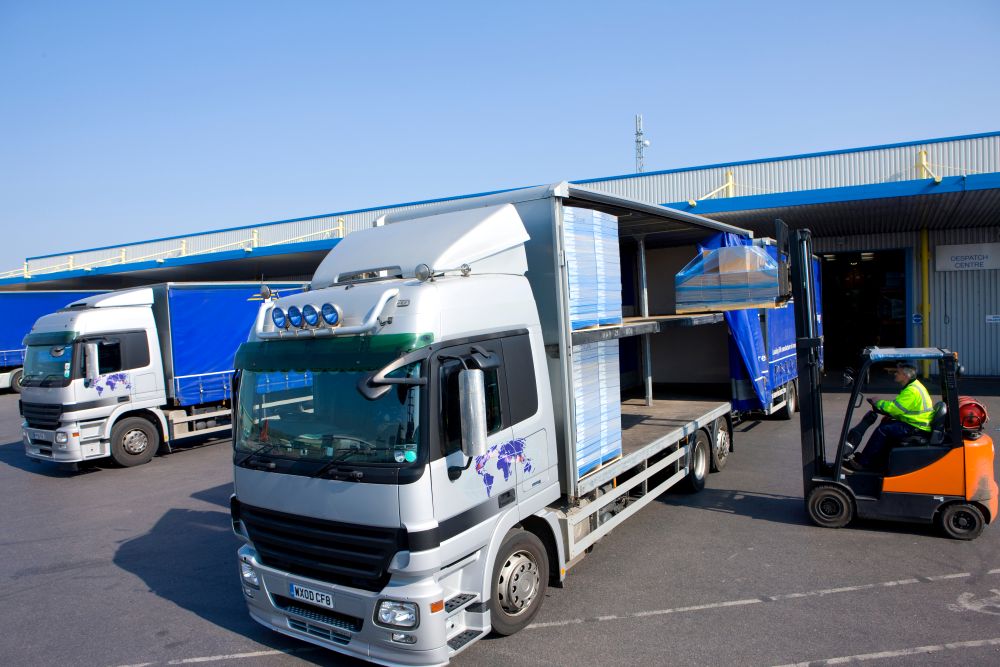
O equipamento mecânico, como porta-paletes, empilhadores e transportadores, elimina muitas lesões causadas pela movimentação manual. As costas e as articulações dos trabalhadores já não suportam o esforço físico quando as máquinas tratam da carga.

Motorizando o esforço necessário para mover cargas pesadas, os porta-paletes eléctricos a bateria [reduzem a fadiga do operador e o risco de lesões] (https://www.chicagoindustrial.com/blog/forklifts/). Estas máquinas podem suportar muito mais peso do que as versões manuais, exigindo um esforço físico mínimo por parte dos operadores.

Os empilhadores são excelentes no transporte e elevação de materiais em ambientes de armazém e cais de carga. Os operadores controlam cargas pesadas a partir de uma posição protegida, eliminando a tensão nas costas e as lesões por movimentos repetitivos associadas ao manuseamento manual.

Análise preditiva

O planeamento orientado por dados através de sistemas preditivos pode identificar padrões na procura de entregas e potenciais pontos de atraso nos seus itinerários. Os gestores de frotas podem utilizar estas informações para ajustar os horários, afetar recursos adicionais durante os períodos de pico e dar aos condutores prazos realistas.

Quando os condutores se sentem apressados, é mais provável que não respeitem os procedimentos de segurança. Uma programação correta elimina esta pressão. Os trabalhadores têm tempo para utilizar corretamente o equipamento mecânico, efetuar elevações em equipa quando necessário e seguir técnicas corretas de manuseamento manual.

Tecnologia vestível

Os dispositivos portáteis emergentes monitorizam os movimentos e a postura dos trabalhadores ao longo dos seus turnos. Estes dispositivos utilizam [dispositivos portáteis alimentados por IA para segurança no local de trabalho] (https://www.britsafe.org/safety-management/2025/ai-powered-wearables-transforming-workplace-health-and-safety) para analisar técnicas de elevação e fornecer feedback em tempo real quando os trabalhadores adoptam posturas inseguras.

Uma tecnologia semelhante aparece nas aplicações de segurança dos condutores. Um programa de aplicações telemáticas ajudou [a reduzir os acidentes em 42%] (https://hrnews.co.uk/appy-fleet-trak-global-group-set-revolutionise-worlds-businesses-manage-driver-safety/) entre os jovens condutores, fornecendo feedback em tempo real. O mesmo princípio aplica-se ao trabalho físico, em que os alertas imediatos sobre a forma incorrecta de elevação podem evitar lesões por esforço acumulado.

Prevenção através da conceção em operações de frota

As operações de frota podem utilizar a prevenção através da conceção (PtD) para eliminar os perigos durante o planeamento. As especificações dos veículos que minimizam os requisitos de manuseamento manual, as disposições do armazém que facilitam a circulação segura e as decisões de aquisição que dão prioridade à ergonomia enquadram-se nesta abordagem proactiva.

As opções de conceção dos veículos têm um impacto direto no risco de lesões diárias. As alturas mais baixas das plataformas de carga reduzem a distância a que os trabalhadores têm de levantar objectos pesados, enquanto as configurações de carregamento lateral aliviam a tensão nas costas dos trabalhadores em comparação com os modelos de carregamento traseiro. As decisões relativas à disposição dos armazéns também são importantes, sendo que o espaço adequado em torno dos cais de carga permite que os trabalhadores se posicionem corretamente e utilizem o equipamento sem manobras incómodas.

O fornecimento de equipamento, por si só, não garante a segurança. A investigação mostra que, embora 62,2% dos trabalhadores da construção possam trabalhar em alturas que exijam proteção, apenas 31% utilizam sistematicamente o equipamento de segurança disponível. Esta lacuna evidencia a importância do DTD. Quando se concebem as operações de modo a que o método seguro seja também o mais fácil, o cumprimento torna-se natural.

Um compromisso de segurança a longo prazo

A prevenção de lesões músculo-esqueléticas requer uma atenção constante. O investimento em equipamento adequado, formação e conceção operacional protege a sua força de trabalho, reforçando simultaneamente a reputação da sua empresa e as suas perspectivas futuras.

Descubra mais em [Renovated Magazine] (https://renovated.com/)
Partilhar para

Outros também lêem...

Header Image

quinta-feira 03 abril 2025 • Conselhos ao condutor

REGULAMENTOS DE ESTACIONAMENTO PARA VEÍCULOS PESADOS NO REINO UNIDO: O QUE TODOS OS CONDUTORES DEVEM SABER

Susie Jones

For many truck drivers, it can be challenging trying to navigate the number of regulations surrounding overnight truck parking in the UK. After a long day behind the wheel, they must adhere to several rules before they can even think about parking up for the night. We'll delve into these regulations and provide you with everything you need to know. Before we look at parking regulations, it's vital to understand UK and EU laws regarding rest periods. We've collated all you need to know about . However, in a nutshell, if your vehicle exceeds three and a half tonnes, you must have a tachograph fitted. A tachograph will record the number of breaks a driver takes. Truck drivers must adhere to the following:• Drivers must take 11 continuous hours of rest. This can be reduced to nine. • Truck drivers are required to take at least 45 hours of rest. • Driving time can be no longer than four-and-a-half hours before a break. A break must be at least 45 minutes.To comply with parking laws and ensure safety, truck drivers must follow strict regulations regarding where and when they can park overnight:• Many local authorities do not allow truck drivers to park in residential areas doing so may result in a fine or penalty.• If the maximum loaded weight of the vehicle is more than 7.5 tonnes (including any trailer), you must not park on a verge, pavement, or any land between carriageways unless there is police permission. • Truck drivers can use these for overnight parking. However, they provide less security and no amenities. Parking overnight in a lay-by is often the most straightforward and economical option but can pose a greater security risk.Failure to follow HGV parking regulations can result in fines, vehicle clamping, or impounding. These penalties are in place to encourage drivers to comply with the law and ensure road safety.Suitable parking locations include: Specifically designed for HGVs and include facilities such as fuel, food, showers, toilets, and security options. Many motorway service areas (MSAs) will provide areas for HGV parking. Most offer similar facilities as truck stops. SNAP provides drivers with a network of over across Europe. • Downloading a truck parking app can help drivers find locations near them to park up for the night. enables truck drivers to find parking & washing spots across Europe, allowing drivers to book SNAP sites through the app.• Search for a spot that offers essential amenities like food, toilets, and showers for a more comfortable stay. • Most truck stops and MSAs will have security features. Using the or, drivers can check a site's security features, including fencing, CCTV, night watchmen, and TAPA accreditations. Truck drivers can park on verges or pavements if the parking is for essential loading and unloading. There are a few exceptions they must consider before loading and unloading:• Drivers must not park where yellow markings are on the curb, and upright signs advise restrictions. • The vehicle must not be left unattended.• On red routes, drivers should look out for specially marked and signposted bays showing when and where loading and unloading is permitted. • Councils and private estates may have different regulations. Truck drivers are restricted to using lanes one and two. On a four-lane motorway, drivers can use lane three. However, HGVs are not permitted to use the furthest right lane.A road may be marked unsuitable for heavy goods vehicles for the following reasons: These pose a challenge for many HGVs, especially long or articulated trucks. Ascending a steep incline for an HGV is a difficult task due to its heavy load, leading to reduced traction and wheel spin. Roads with limited width can feature sharp bends or walls on either side and are unsuitable for trucks. Due to their turning radius of HGVs, they require more space to maneuver. Roads with walls on either side leave little room for error and increase the risk of an HGV becoming stuck or causing damage.

Header Image

segunda-feira 02 dezembro 2024 • Conselhos ao condutor

TUDO O QUE PRECISA DE SABER SOBRE AS ALTERAÇÕES DO CPC PARA CONDUTORES

Susie Jones

On the 3rd of December 2024, changes to the Driver Certificate of Professional Competence (CPC) will come into full effect. The new CPC aims to offer better flexibility to drivers returning to the profession and those undertaking mandatory training. We delve into the upcoming changes and how they will impact drivers. Introduced in 2007, the CPC is a mandatory qualification for professional drivers in the UK and EU wanting to drive a range of heavy vehicles, such as HGVs, LGVs, buses, and coaches. Drivers must pass four tests: • Theory• Case study• Practical• Vehicle safety demonstration. Once passed, the CPC lasts for five years and must be renewed by taking 35 hours of periodic training within the five years.The UK government wanted to understand the effectiveness of the Driver CPC. They did this by asking drivers, trainers, and other parties to take a poll. The government focused on two main areas: improving driver choice and attracting more drivers into the industry for example, making it easier for drivers with foreign qualifications to obtain a licence in the UK. The changes to the Driver CPC are categorised into the following:The international Driver CPC is the new name for how the previous Driver CPC worked. The following applies:• Drivers must take 35 hours of CPC training every five years.• The courses must be at least seven hours long. • If splitting a course over a day, a driver must complete it on two consecutive days.• Drivers are allowed to do a total of 12 hours of e-learning.The National Driver CPC provides more flexibility for those wanting to drive in the UK. Drivers can take either:• 35 hours of training every five years.• A combination of 35 hours of National Driver CPC and International Driver CPC training every five years.The flexibility means that:• Training must be at least 3 hours 30 minutes long training providers can offer longer courses. • It does not need to be completed on two consecutive days if it's a split course course providers can set their time limits.• Training can be e-learning.• Drivers can do 12 hours of e-learning towards their overall 35 hours.From the 3rd of December, 2024, drivers will be able to stay qualified by choosing either:1. International Driver CPC National Driver CPCDrivers wanting to return to the profession must take 35 hours of training before returning. However, this will change from the 1st of February, 2025.Drivers with an expired CPC will have new pathways to make returning to driving easier.Drivers have four options:• Undertake 35 hours of International Driver CPC training.• Regain qualification to drive in the UK and EU.• Complete 35 hours of National Driver CPC training.• Regain qualification to drive in the UK only.• Take a seven-hour "return to driving" module.• Regain UK driving qualification instantly.• To drive in the EU, complete 28 additional hours of training within 12 months.• As part of the National Driver CPC training, complete a seven-hour "return to driving" module.• Regain UK driving qualification instantly.• Take 28 additional hours of training (National or International Driver CPC) within 12 months.Drivers must take 35 hours of training (International or National).The rules surrounding Driver CPC cards remain the same drivers must carry their cards when operating vehicles professionally. However, the type of card differs based on qualification:• Identical to the current design.• The design will include "Domestic UK use only."If a driver is qualified for both categories, they may hold two cards.Fleet managers can prepare for the changes by ensuring the following:• Find out whether their drivers need an International or National CPC.• Training deadlines aren't missed to avoid fines.You are exempt from needing a Driver CPC if you're using the vehicle for:• Non-commercial carriage• Carrying materials you use for your job driving must be less than 30% of your rolling monthly work.• Driving for someone you work for or your own agriculture, horticulture, forestry, farming, or fisheries business driving must be less than 30% of your rolling monthly work. • Driving within 62 miles of your base driving a HGV, bus, or coach must not be your main job.• Driving to or from pre-booked appointments to test centres.• Lessons for anyone wanting to get a driving licence or a Driver CPC.• Maintain public order.Full guidance is on the website.Drivers with grandfather rights don't need to hold the actual qualification as part of their licence. However, they must complete 35 hours of training every five years.

Header Image

quarta-feira 18 setembro 2024 • Conselhos ao condutor

VISÃO CLARA À FRENTE: A IMPORTÂNCIA DOS CUIDADOS OFTALMOLÓGICOS PARA OS CONDUTORES DE CAMIÕES

Susie Jones

takes place from the 23rd to the 29th of September, and as a truck driver, maintaining good vision is crucial to your job. Optical Express reported that road crashes involving drivers with poor vision accounted for roughly yearly casualties.Truck driving is a physically demanding role, but it is just as demanding visually requiring constant vigilance and the ability to quickly identify or react to changing road conditions. Poor vision can affect a driver's ability to judge distances, read signs, and detect other vehicles, reducing safety for the driver and other road users.Drivers must complete a t when applying for an HGV licence this occurs every five years after 45 and every year after the age of 65. As part of the medical, truck drivers must have a vision examination by a doctor, optician, or optometrist.To pass the examination, drivers require visual acuity of at least 0.8 (6/7.5) on the Snellen scale in their best eye and at least 0.1 (6/60) in the other.Group 2 HGV drivers need a horizontal visual field of at least 160 degrees with an extension of at least 70 degrees left and right and 30 degrees up and down. No defects should be present within a radius of the central 30 degrees.After 45 years old, drivers must complete their D4 Medical Assessment every five years and every year after 65. However, opticians recommend that every road user has an eye test at least every two years.If a driver experiences the following, they should get their eyes tested immediately:• Headaches• Eyestrain• Pressure behind the eyes• Double vision• Difficulty seeing during the night• Halos around lights.Under the law, employers must ensure their employees are fit to drive this could cover several things, but eyesight is one of them. Employers should test their driver's eyesight every six months by carrying out a number plate sight check 20 metres away.If an HGV driver requires glasses or contact lenses to reach the minimum vision requirement, they can't have a spectacle power greater than eightdioptres. For contact lenses, there is no restriction on contact lens power.The recommends the following to maintain good eye health:• Eat a well-balanced diet with foods that help your vision.• Exercise regularly to prevent diabetes and other conditions that can lead to vision problems.• Inform an optician if you notice any changes.• Wash your hands before putting them near your eyes or if you're handling contact lenses.• Protect your eyes when performing tasks that could damage them.• Wear sunglasses that block 99% or 100% of UVA and UVB radiation.• Follow the 20-20-20 rule every 20 minutes, look 20 feet away for 20 seconds.• Try not to smoke smoking is just as harmful to your eyes as it is to your body.The visual standards HGV drivers must meet are higher than those of other road users. In the UK, drivers must have a visual acuity of at least 0.5 (6/12) on the Snellen scale. In addition, drivers must be able to read a car number plate made after the 1st of September 2001 from 20 metres.The UK law on vision and driving falls below many European countries.By a number plate self-test from 20 metres. A visual acuity/visual field test is mandatory in other European countries.A driving test examiner performs the test in the UK, Cyprus, The Netherlands, and Norway. Several European countries require an Optometrist/Ophthalmologist/Doctor to carry out the test.• The UK, Austria, Belgium, Czech Republic, France, Germany, and Sweden require no further visual tests.• Algeria, Estonia, Hungary, Italy, Latvia, Spain, and Turkey require a visual assessment every ten years.• Algeria, Estonia, Finland, Greece, Hungary, Italy, Latvia, Portugal, Serbia, Spain, and Turkey require visual tests from 65 or younger.It's vital to inform the DVLA if you have any of the following eye conditions:• Blepharospasm• Cataracts• Diabetic retinopathy• Glaucoma• Eye loss• Macular degeneration• Monocular vision• Nyctalopia• Retinitis pigmentosa• Visual field defect.Drivers need to meet the following standards:• Can read a number plate 20 metres away• No double vision• Have a regular field of vision in at least one eye.If a driver is unsure whether they meet the visual standards for driving, they must get advice from a GP, optician, or eye specialist. of the information a driver receives comes from vision with most maneuvers made based on a sense of sight. Vision cannot be substituted or supplemented and is the most important physical factor behind the wheel.