Evelyn Long
Consejos para conductores • 4 min leer

Procedimientos seguros de carga y descarga para evitar lesiones musculoesqueléticas

Creado: 26/05/2026

Actualizado: 26/05/2026

Las lesiones musculoesqueléticas son uno de los retos más persistentes a los que se enfrenta el sector de las flotas en la actualidad. Los conductores y el personal de almacén se enfrentan a constantes exigencias físicas durante las operaciones de carga y descarga.

La aplicación de los procedimientos adecuados protege a su plantilla de dolores crónicos y lesiones que pueden poner fin a su carrera profesional, al tiempo que mantiene la eficacia que permite a su empresa seguir siendo competitiva en mercados exigentes.

El elevado coste de las lesiones musculoesqueléticas

Las lesiones musculoesqueléticas afectan a los trabajadores individualmente, al tiempo que agotan los recursos de las empresas por la pérdida de productividad y el aumento de las primas de seguros.

Impacto en las operaciones y finanzas de la empresa

Cuando un empleado sufre una lesión, las consecuencias financieras van más allá de los gastos médicos inmediatos. Los gestores de flotas deben tener en cuenta los costes de las bajas por enfermedad, los gastos de los trabajadores temporales y las posibles reclamaciones de indemnización.

Entre 2023 y 2024, los costes totales de la mala salud y las lesiones en el lugar de trabajo alcanzaron los 22 900 millones de libras en el Reino Unido, representando las lesiones el 28% o 6 500 millones de libras. Estas cifras demuestran cómo las lesiones se traducen en cargas económicas que afectan a los márgenes de beneficio.

La pérdida de productividad agrava estos costes directos. Cuando los conductores experimentados o el personal de almacén se toman una baja prolongada, las operaciones se ralentizan y los miembros restantes del equipo se enfrentan a una mayor carga de trabajo. El efecto dominó afecta a todos los aspectos de las operaciones de la flota, desde retrasos en las entregas hasta tensiones en las relaciones con los clientes.

Consecuencias para los conductores profesionales

Los conductores que desarrollan trastornos musculoesqueléticos se enfrentan a una difícil realidad. El dolor de espalda crónico, las lesiones de hombro y los esfuerzos repetitivos pueden hacer que las funciones laborales básicas resulten insoportables. Muchos conductores afirman que el dolor persistente afecta a su capacidad de concentración durante los trayectos largos, creando problemas de seguridad adicionales.

Los trastornos musculoesqueléticos figuran entre las principales causas de mala salud relacionada con el trabajo en Gran Bretaña. Estas afecciones obligan a profesionales experimentados a abandonar un sector en el que han acumulado años de experiencia.

Normativa de seguridad y evaluación de riesgos en el Reino Unido

La legislación británica exige a los empresarios que adopten medidas específicas para prevenir las lesiones por manipulación manual. La evaluación de riesgos constituye la base del cumplimiento de la normativa y sirve como primera línea de defensa contra las tensiones en el lugar de trabajo.

Normativa clave sobre operaciones de manipulación manual

Los empresarios deben seguir la Normativa de Operaciones de Manipulación Manual del Ejecutivo de Salud y Seguridad, que establece una jerarquía clara.

En primer lugar, evite las operaciones peligrosas de manipulación manual siempre que sea razonablemente factible. En segundo lugar, evalúe las operaciones peligrosas que no puedan evitarse. En tercer lugar, reduzca el riesgo de lesiones derivado de dichas operaciones al nivel más bajo razonablemente practicable.

Este marco empuja a las empresas a eliminar por completo los riesgos de manipulación manual. Siempre que sea posible, deben utilizarse equipos mecánicos para mover las cargas. Cualquier manipulación manual inevitable requiere una evaluación adecuada y medidas de control obligatorias.

El proceso de evaluación de riesgos

Una evaluación de riesgos adecuada y suficiente examina cuatro factores clave en las operaciones logísticas:

  1. Tarea: La tarea en sí importa, incluyendo si implica giros, agacharse o movimientos repetitivos.
  2. Carga: Las características de la carga, como el peso, el tamaño y la estabilidad, desempeñan un papel importante.
  3. Entorno: Las condiciones ambientales, incluidas las limitaciones de espacio, las superficies del suelo y las temperaturas extremas, afectan a los resultados de seguridad.
  4. Individuo: Las capacidades individuales varían entre los trabajadores, que aportan diferentes puntos fuertes y limitaciones físicas a cada trabajo.

Una [evaluación de riesgos relativa a la seguridad en logística] eficaz (https://www.hse.gov.uk/logistics/) debe conducir a mejoras concretas. Documente sus conclusiones y compártalas con su equipo.

Técnicas seguras de manipulación manual

Cuando la manipulación manual se hace ineludible, una técnica adecuada puede reducir el riesgo de lesiones. Formar a los trabajadores en métodos correctos de elevación les protege durante las operaciones diarias.

Métodos individuales de elevación y transporte

Los pies deben estar separados a la anchura de los hombros para mayor estabilidad, colocados cerca de la carga. Doblar las rodillas manteniendo la espalda recta permite agarrar firmemente la carga con ambas manos. Los músculos de las piernas deben dar fuerza a la elevación mientras te levantas suavemente. Mantener la carga cerca del cuerpo durante todo el movimiento previene la tensión, al igual que evitar cualquier movimiento de torsión durante el levantamiento o el transporte.

Si tiene que hacer un esfuerzo o dar un tirón para mover un objeto, requiere asistencia mecánica o elevación en equipo. No se precipite nunca para ganar tiempo. Tomarse unos segundos de más para colocarse correctamente evita lesiones que podrían dejarle fuera de juego durante semanas.

Procedimientos coordinados de elevación en equipo

Las elevaciones en equipo requieren una comunicación y una planificación claras antes de que nadie toque la carga. Designe a una persona como coordinador de la elevación que dará las instrucciones. Todos los miembros del equipo deben comprender el plan de elevación, incluidos los puntos de agarre, la trayectoria del movimiento y dónde se colocará la carga.

El coordinador debe realizar una cuenta atrás antes de que comience la elevación para que todos se muevan al mismo tiempo. Los miembros del equipo deben mantener la comunicación en todo momento, avisando si necesitan hacer una pausa o un ajuste.
Tecnología y equipos para la prevención de lesiones

La tecnología ofrece potentes herramientas para reducir o eliminar los riesgos de manipulación manual en las operaciones de flota, mientras que las inversiones en equipos protegen a los trabajadores, mejorando a menudo la eficiencia y el rendimiento.

Ayudas mecánicas a la elevación

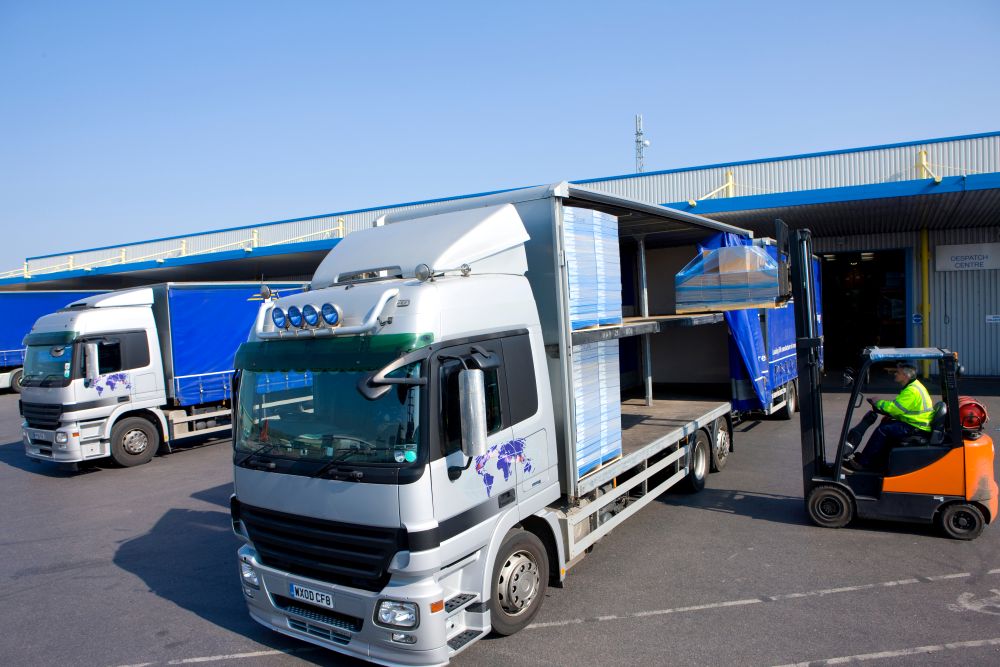
Los equipos mecánicos, como transpaletas, carretillas elevadoras y cintas transportadoras, eliminan muchas lesiones por manipulación manual. La espalda y las articulaciones de los trabajadores ya no soportan el esfuerzo físico cuando las máquinas manejan la carga.

Al motorizar el esfuerzo necesario para mover cargas pesadas, las transpaletas eléctricas de batería reducen la fatiga del operario y el riesgo de lesiones. Estas máquinas pueden manipular mucho más peso que las versiones manuales y requieren un esfuerzo físico mínimo por parte de los operarios.

Las carretillas elevadoras destacan en el transporte y elevación de materiales en almacenes y muelles de carga. Los operarios controlan cargas pesadas desde una posición protegida, lo que elimina la tensión en la espalda y las lesiones por movimientos repetitivos asociadas a la manipulación manual.

Análisis predictivo

La programación basada en datos mediante sistemas predictivos puede identificar patrones en la demanda de entregas y posibles puntos de retraso en sus rutas. Los gestores de flotas pueden utilizar esta información para ajustar los horarios, asignar recursos adicionales durante los periodos punta y dar a los conductores plazos realistas.

Cuando los conductores se sienten apurados, es más probable que tomen atajos en los procedimientos de seguridad. Una programación adecuada elimina esta presión. Los trabajadores tienen tiempo para utilizar correctamente los equipos mecánicos, realizar elevaciones en equipo cuando sea necesario y seguir técnicas correctas de manipulación manual.

Tecnología vestible

Los nuevos dispositivos vestibles supervisan los movimientos y posturas de los trabajadores durante sus turnos. Estos dispositivos utilizan AI-powered wearables for workplace safety para analizar las técnicas de elevación y proporcionar información en tiempo real cuando los trabajadores adoptan posturas poco seguras.

Una tecnología similar aparece en las aplicaciones de seguridad del conductor. Un programa de aplicación telemática ayudó a reducir los accidentes en un 42% entre los conductores jóvenes al proporcionar información en tiempo real. El mismo principio se aplica al trabajo físico, donde las alertas inmediatas sobre la forma incorrecta de levantar objetos pueden evitar lesiones por esfuerzo acumulativo.

La prevención a través del diseño en las operaciones de flota

Las operaciones de flota pueden utilizar la prevención a través del diseño (PtD) para eliminar riesgos durante la planificación. Las especificaciones de los vehículos que reducen al mínimo las necesidades de manipulación manual, la distribución de los almacenes que facilita los desplazamientos seguros y las decisiones de compra que dan prioridad a la ergonomía entran dentro de este enfoque proactivo.

Las opciones de diseño de los vehículos influyen directamente en el riesgo diario de lesiones. Las alturas más bajas de la plataforma de carga reducen la distancia a la que los trabajadores deben levantar objetos pesados, mientras que las configuraciones de carga lateral alivian la tensión en la espalda de los trabajadores en comparación con los diseños de carga trasera. Las decisiones sobre la distribución de los almacenes también son importantes, ya que un espacio adecuado alrededor de los muelles de carga permite a los trabajadores colocarse correctamente y utilizar los equipos sin maniobras incómodas.

La provisión de equipos por sí sola no garantiza la seguridad. Las investigaciones muestran que, aunque el 62,2% de los trabajadores de la construcción pueden trabajar en alturas que requieren protección, sólo el 31% utiliza sistemáticamente los equipos de seguridad disponibles. Esta brecha pone de manifiesto por qué es importante la PtD. Cuando se diseñan las operaciones de modo que el método seguro sea también el más sencillo, el cumplimiento se convierte en algo natural.

Un compromiso a largo plazo con la seguridad

La prevención de lesiones musculoesqueléticas requiere una atención constante. Invertir en equipos, formación y diseño operativo adecuados protege a su plantilla al tiempo que refuerza la reputación y las perspectivas de futuro de su empresa.

Descubra más en Renovated Magazine.
Compartir con

Otros también leen...

Header Image

jueves 03 abril 2025 • Consejos para conductores

NORMAS DE APARCAMIENTO PARA VEHÍCULOS PESADOS EN EL REINO UNIDO: LO QUE TODO CONDUCTOR DEBE SABER

Susie Jones

For many truck drivers, it can be challenging trying to navigate the number of regulations surrounding overnight truck parking in the UK. After a long day behind the wheel, they must adhere to several rules before they can even think about parking up for the night. We'll delve into these regulations and provide you with everything you need to know. Before we look at parking regulations, it's vital to understand UK and EU laws regarding rest periods. We've collated all you need to know about . However, in a nutshell, if your vehicle exceeds three and a half tonnes, you must have a tachograph fitted. A tachograph will record the number of breaks a driver takes. Truck drivers must adhere to the following:• Drivers must take 11 continuous hours of rest. This can be reduced to nine. • Truck drivers are required to take at least 45 hours of rest. • Driving time can be no longer than four-and-a-half hours before a break. A break must be at least 45 minutes.To comply with parking laws and ensure safety, truck drivers must follow strict regulations regarding where and when they can park overnight:• Many local authorities do not allow truck drivers to park in residential areas doing so may result in a fine or penalty.• If the maximum loaded weight of the vehicle is more than 7.5 tonnes (including any trailer), you must not park on a verge, pavement, or any land between carriageways unless there is police permission. • Truck drivers can use these for overnight parking. However, they provide less security and no amenities. Parking overnight in a lay-by is often the most straightforward and economical option but can pose a greater security risk.Failure to follow HGV parking regulations can result in fines, vehicle clamping, or impounding. These penalties are in place to encourage drivers to comply with the law and ensure road safety.Suitable parking locations include: Specifically designed for HGVs and include facilities such as fuel, food, showers, toilets, and security options. Many motorway service areas (MSAs) will provide areas for HGV parking. Most offer similar facilities as truck stops. SNAP provides drivers with a network of over across Europe. • Downloading a truck parking app can help drivers find locations near them to park up for the night. enables truck drivers to find parking & washing spots across Europe, allowing drivers to book SNAP sites through the app.• Search for a spot that offers essential amenities like food, toilets, and showers for a more comfortable stay. • Most truck stops and MSAs will have security features. Using the or, drivers can check a site's security features, including fencing, CCTV, night watchmen, and TAPA accreditations. Truck drivers can park on verges or pavements if the parking is for essential loading and unloading. There are a few exceptions they must consider before loading and unloading:• Drivers must not park where yellow markings are on the curb, and upright signs advise restrictions. • The vehicle must not be left unattended.• On red routes, drivers should look out for specially marked and signposted bays showing when and where loading and unloading is permitted. • Councils and private estates may have different regulations. Truck drivers are restricted to using lanes one and two. On a four-lane motorway, drivers can use lane three. However, HGVs are not permitted to use the furthest right lane.A road may be marked unsuitable for heavy goods vehicles for the following reasons: These pose a challenge for many HGVs, especially long or articulated trucks. Ascending a steep incline for an HGV is a difficult task due to its heavy load, leading to reduced traction and wheel spin. Roads with limited width can feature sharp bends or walls on either side and are unsuitable for trucks. Due to their turning radius of HGVs, they require more space to maneuver. Roads with walls on either side leave little room for error and increase the risk of an HGV becoming stuck or causing damage.

Header Image

lunes 02 diciembre 2024 • Consejos para conductores

TODO LO QUE DEBE SABER SOBRE LOS CAMBIOS EN EL CPC DE CONDUCTORES

Susie Jones

On the 3rd of December 2024, changes to the Driver Certificate of Professional Competence (CPC) will come into full effect. The new CPC aims to offer better flexibility to drivers returning to the profession and those undertaking mandatory training. We delve into the upcoming changes and how they will impact drivers. Introduced in 2007, the CPC is a mandatory qualification for professional drivers in the UK and EU wanting to drive a range of heavy vehicles, such as HGVs, LGVs, buses, and coaches. Drivers must pass four tests: • Theory• Case study• Practical• Vehicle safety demonstration. Once passed, the CPC lasts for five years and must be renewed by taking 35 hours of periodic training within the five years.The UK government wanted to understand the effectiveness of the Driver CPC. They did this by asking drivers, trainers, and other parties to take a poll. The government focused on two main areas: improving driver choice and attracting more drivers into the industry for example, making it easier for drivers with foreign qualifications to obtain a licence in the UK. The changes to the Driver CPC are categorised into the following:The international Driver CPC is the new name for how the previous Driver CPC worked. The following applies:• Drivers must take 35 hours of CPC training every five years.• The courses must be at least seven hours long. • If splitting a course over a day, a driver must complete it on two consecutive days.• Drivers are allowed to do a total of 12 hours of e-learning.The National Driver CPC provides more flexibility for those wanting to drive in the UK. Drivers can take either:• 35 hours of training every five years.• A combination of 35 hours of National Driver CPC and International Driver CPC training every five years.The flexibility means that:• Training must be at least 3 hours 30 minutes long training providers can offer longer courses. • It does not need to be completed on two consecutive days if it's a split course course providers can set their time limits.• Training can be e-learning.• Drivers can do 12 hours of e-learning towards their overall 35 hours.From the 3rd of December, 2024, drivers will be able to stay qualified by choosing either:1. International Driver CPC National Driver CPCDrivers wanting to return to the profession must take 35 hours of training before returning. However, this will change from the 1st of February, 2025.Drivers with an expired CPC will have new pathways to make returning to driving easier.Drivers have four options:• Undertake 35 hours of International Driver CPC training.• Regain qualification to drive in the UK and EU.• Complete 35 hours of National Driver CPC training.• Regain qualification to drive in the UK only.• Take a seven-hour "return to driving" module.• Regain UK driving qualification instantly.• To drive in the EU, complete 28 additional hours of training within 12 months.• As part of the National Driver CPC training, complete a seven-hour "return to driving" module.• Regain UK driving qualification instantly.• Take 28 additional hours of training (National or International Driver CPC) within 12 months.Drivers must take 35 hours of training (International or National).The rules surrounding Driver CPC cards remain the same drivers must carry their cards when operating vehicles professionally. However, the type of card differs based on qualification:• Identical to the current design.• The design will include "Domestic UK use only."If a driver is qualified for both categories, they may hold two cards.Fleet managers can prepare for the changes by ensuring the following:• Find out whether their drivers need an International or National CPC.• Training deadlines aren't missed to avoid fines.You are exempt from needing a Driver CPC if you're using the vehicle for:• Non-commercial carriage• Carrying materials you use for your job driving must be less than 30% of your rolling monthly work.• Driving for someone you work for or your own agriculture, horticulture, forestry, farming, or fisheries business driving must be less than 30% of your rolling monthly work. • Driving within 62 miles of your base driving a HGV, bus, or coach must not be your main job.• Driving to or from pre-booked appointments to test centres.• Lessons for anyone wanting to get a driving licence or a Driver CPC.• Maintain public order.Full guidance is on the website.Drivers with grandfather rights don't need to hold the actual qualification as part of their licence. However, they must complete 35 hours of training every five years.

Header Image

miércoles 18 septiembre 2024 • Consejos para conductores

VISIÓN CLARA: LA IMPORTANCIA DEL CUIDADO DE LA VISTA PARA LOS CAMIONEROS

Susie Jones

takes place from the 23rd to the 29th of September, and as a truck driver, maintaining good vision is crucial to your job. Optical Express reported that road crashes involving drivers with poor vision accounted for roughly yearly casualties.Truck driving is a physically demanding role, but it is just as demanding visually requiring constant vigilance and the ability to quickly identify or react to changing road conditions. Poor vision can affect a driver's ability to judge distances, read signs, and detect other vehicles, reducing safety for the driver and other road users.Drivers must complete a t when applying for an HGV licence this occurs every five years after 45 and every year after the age of 65. As part of the medical, truck drivers must have a vision examination by a doctor, optician, or optometrist.To pass the examination, drivers require visual acuity of at least 0.8 (6/7.5) on the Snellen scale in their best eye and at least 0.1 (6/60) in the other.Group 2 HGV drivers need a horizontal visual field of at least 160 degrees with an extension of at least 70 degrees left and right and 30 degrees up and down. No defects should be present within a radius of the central 30 degrees.After 45 years old, drivers must complete their D4 Medical Assessment every five years and every year after 65. However, opticians recommend that every road user has an eye test at least every two years.If a driver experiences the following, they should get their eyes tested immediately:• Headaches• Eyestrain• Pressure behind the eyes• Double vision• Difficulty seeing during the night• Halos around lights.Under the law, employers must ensure their employees are fit to drive this could cover several things, but eyesight is one of them. Employers should test their driver's eyesight every six months by carrying out a number plate sight check 20 metres away.If an HGV driver requires glasses or contact lenses to reach the minimum vision requirement, they can't have a spectacle power greater than eightdioptres. For contact lenses, there is no restriction on contact lens power.The recommends the following to maintain good eye health:• Eat a well-balanced diet with foods that help your vision.• Exercise regularly to prevent diabetes and other conditions that can lead to vision problems.• Inform an optician if you notice any changes.• Wash your hands before putting them near your eyes or if you're handling contact lenses.• Protect your eyes when performing tasks that could damage them.• Wear sunglasses that block 99% or 100% of UVA and UVB radiation.• Follow the 20-20-20 rule every 20 minutes, look 20 feet away for 20 seconds.• Try not to smoke smoking is just as harmful to your eyes as it is to your body.The visual standards HGV drivers must meet are higher than those of other road users. In the UK, drivers must have a visual acuity of at least 0.5 (6/12) on the Snellen scale. In addition, drivers must be able to read a car number plate made after the 1st of September 2001 from 20 metres.The UK law on vision and driving falls below many European countries.By a number plate self-test from 20 metres. A visual acuity/visual field test is mandatory in other European countries.A driving test examiner performs the test in the UK, Cyprus, The Netherlands, and Norway. Several European countries require an Optometrist/Ophthalmologist/Doctor to carry out the test.• The UK, Austria, Belgium, Czech Republic, France, Germany, and Sweden require no further visual tests.• Algeria, Estonia, Hungary, Italy, Latvia, Spain, and Turkey require a visual assessment every ten years.• Algeria, Estonia, Finland, Greece, Hungary, Italy, Latvia, Portugal, Serbia, Spain, and Turkey require visual tests from 65 or younger.It's vital to inform the DVLA if you have any of the following eye conditions:• Blepharospasm• Cataracts• Diabetic retinopathy• Glaucoma• Eye loss• Macular degeneration• Monocular vision• Nyctalopia• Retinitis pigmentosa• Visual field defect.Drivers need to meet the following standards:• Can read a number plate 20 metres away• No double vision• Have a regular field of vision in at least one eye.If a driver is unsure whether they meet the visual standards for driving, they must get advice from a GP, optician, or eye specialist. of the information a driver receives comes from vision with most maneuvers made based on a sense of sight. Vision cannot be substituted or supplemented and is the most important physical factor behind the wheel.