Evelyn Long
Advies voor bestuurders • 4 min lezen

Veilige laad- en losprocedures om letsel aan het bewegingsapparaat te voorkomen

Gemaakt: 26-05-2026

Bijgewerkt: 26-05-2026

Spier- en skeletaandoeningen zijn een van de meest hardnekkige uitdagingen waar de wagenparksector tegenwoordig mee te maken heeft. Chauffeurs en magazijnmedewerkers worden tijdens het laden en lossen geconfronteerd met constante fysieke eisen.

Het implementeren van de juiste procedures beschermt uw personeel tegen chronische pijn en verwondingen die uw carrière beëindigen, terwijl de efficiëntie die uw bedrijf concurrerend houdt in veeleisende markten behouden blijft.

De hoge kosten van letsels aan het bewegingsapparaat

Spier- en skeletaandoeningen treffen individuele werknemers en slokken tegelijkertijd bedrijfsmiddelen op door productiviteitsverlies en hogere verzekeringspremies.

Impact op bedrijfsactiviteiten en financiën

Wanneer een werknemer een blessure oploopt, gaan de financiële gevolgen verder dan de onmiddellijke medische kosten. Wagenparkbeheerders moeten rekening houden met ziekteverzuimkosten, kosten voor tijdelijke werknemers en mogelijke schadeclaims.

In 2023 tot 2024 zullen de totale kosten van slechte gezondheid en letsel op het werk in het VK £22,9 miljard bedragen, waarbij letsel goed is voor 28% of £6,5 miljard. Deze cijfers laten zien hoe verwondingen zich vertalen in economische lasten die van invloed zijn op de winstmarges.

Productiviteitsverlies verergert deze directe kosten nog. Wanneer ervaren chauffeurs of magazijnmedewerkers voor langere tijd met verlof gaan, vertragen de activiteiten en krijgen de overblijvende teamleden te maken met een hogere werkdruk. Dit heeft gevolgen voor elk aspect van de vlootactiviteiten, van vertraagde leveringen tot gespannen relaties met klanten.

Gevolgen voor beroepschauffeurs

Chauffeurs die aandoeningen aan het bewegingsapparaat ontwikkelen, worden geconfronteerd met een moeilijke realiteit. Chronische rugpijn, schouderblessures en repetitieve overbelasting kunnen de basisfuncties van het werk ondraaglijk maken. Veel chauffeurs geven aan dat aanhoudende pijn hun concentratievermogen tijdens lange routes beïnvloedt, wat extra veiligheidsrisico's met zich meebrengt.

Spier- en skeletaandoeningen behoren tot de belangrijkste oorzaken van werkgerelateerde slechte gezondheid in Groot-Brittannië. Deze aandoeningen dwingen ervaren professionals uit een sector te stappen waar ze jarenlange expertise hebben opgebouwd.

Britse veiligheidsvoorschriften en risicobeoordelingen

Volgens de Britse wetgeving moeten werkgevers specifieke stappen ondernemen om letsel door handmatig hanteren van lasten te voorkomen. Risicobeoordeling vormt de basis van naleving en dient als eerste verdedigingslinie tegen overbelasting op de werkplek.

Belangrijkste voorschriften voor het manueel hanteren van lasten

Werkgevers moeten zich houden aan de voorschriften voor het manueel hanteren van lasten van de Health and Safety Executive, die een duidelijke hiërarchie aangeven.

Ten eerste, vermijd gevaarlijke manuele handelingen waar redelijkerwijs mogelijk. Beoordeel ten tweede alle gevaarlijke handelingen die niet vermeden kunnen worden. Verminder ten derde het risico op letsel door deze handelingen tot het laagste niveau dat redelijkerwijs haalbaar is.

Dit kader dwingt bedrijven om risico's bij het manueel hanteren van lasten volledig uit te sluiten. Waar mogelijk moet mechanische apparatuur worden gebruikt voor het verplaatsen van lasten. Elke onvermijdelijke handmatige verplaatsing vereist een goede beoordeling en verplichte controlemaatregelen.

Het risicobeoordelingsproces

Een geschikte en toereikende risicobeoordeling onderzoekt vier sleutelfactoren in logistieke operaties:

  1. Taak: De taak zelf is belangrijk, inclusief of deze draaien, bukken of repeterende bewegingen met zich meebrengt.
  2. Belasting: De kenmerken van de last, zoals gewicht, grootte en stabiliteit, spelen een rol.
  3. Omgeving: Omgevingsfactoren, zoals beperkte ruimte, vloeroppervlakken en extreme temperaturen, beïnvloeden de veiligheidsresultaten.
  4. Individu: Individuele capaciteiten verschillen per werknemer, die voor elke taak andere sterke punten en fysieke beperkingen meebrengt.

Effectieve risicobeoordelingen met betrekking tot veiligheid in de logistiek moeten leiden tot concrete verbeteringen. Documenteer je bevindingen en deel ze met je team.

Veilige technieken voor handmatig hanteren

Wanneer manueel hanteren van lasten onvermijdelijk wordt, kan een juiste techniek het risico op letsel verkleinen. Door het personeel te trainen in de juiste tilmethoden worden ze beschermd tijdens de dagelijkse werkzaamheden.

Individuele til- en draagmethoden

De voeten moeten schouderbreedte uit elkaar voor stabiliteit, dicht bij de last staan. Buig door de knieën terwijl u een rechte rug houdt, zodat u de last stevig met beide handen kunt vastpakken. De beenspieren moeten kracht leveren terwijl je soepel omhoog komt. Door de last tijdens de hele beweging dicht bij het lichaam te houden, voorkom je overbelasting, net als het vermijden van een draaiende beweging tijdens het tillen of dragen.

Als je je moet inspannen of rukken om een voorwerp te verplaatsen, is mechanische hulp of tillen in teamverband nodig. Haast je nooit bij het tillen om tijd te besparen. Als je een paar seconden langer de tijd neemt om jezelf correct te positioneren, voorkom je blessures die je wekenlang aan de kant kunnen houden.

Gecoördineerde tilprocedures voor teams

Tillen in teamverband vereist duidelijke communicatie en planning voordat iemand de lading aanraakt. Wijs één persoon aan als hefcoördinator die instructies afroept. Alle teamleden moeten het tilplan begrijpen, inclusief de aangrijpingspunten, het bewegingspad en waar de lading wordt geplaatst.

De coördinator moet aftellen voordat de lift begint, zodat iedereen tegelijk beweegt. De teamleden moeten de hele tijd blijven communiceren en roepen als ze moeten pauzeren of bijsturen.
Technologie en apparatuur voor letselpreventie

Technologie biedt krachtige hulpmiddelen om de risico's van het manueel hanteren van lasten bij vlootactiviteiten te verminderen of te elimineren, terwijl investeringen in apparatuur werknemers beschermen en vaak de efficiëntie en doorvoer verbeteren.

Mechanische tilhulpmiddelen

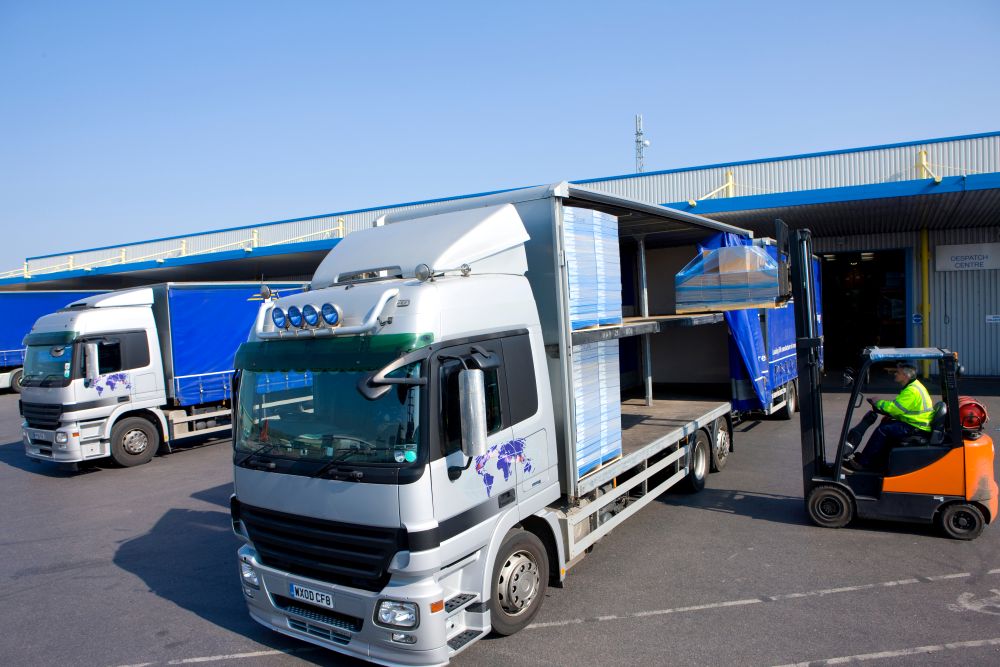
Mechanische apparatuur, zoals palletheffers, vorkheftrucks en transportbanden, elimineert veel verwondingen door manueel hanteren. De ruggen en gewrichten van werknemers hoeven de fysieke belasting niet langer te dragen wanneer machines de last hanteren.

Accu-elektrische pallethefwagens verminderen de vermoeidheid van de bestuurder en het risico op letsel, waardoor de inspanning die nodig is om zware ladingen te verplaatsen wordt gemotoriseerd. Deze machines kunnen aanzienlijk meer gewicht aan dan handmatige versies, terwijl ze minimale fysieke inspanning van de bestuurder vragen.

Vorkheftrucks blinken uit in het transporteren en heffen van materialen in magazijnen en laadperrons. Bestuurders bedienen zware ladingen vanuit een beschermde positie, waardoor overbelasting van de rug en letsel door herhaalde bewegingen als gevolg van handmatig hanteren worden voorkomen.

Voorspellende analyses

Datagestuurde planning met behulp van voorspellende systemen kan patronen in de leveringsvraag identificeren en potentiële vertragingspunten op uw routes. Vlootmanagers kunnen deze inzichten gebruiken om planningen aan te passen, extra middelen toe te wijzen tijdens piekperioden en chauffeurs realistische tijdschema's te geven.

Als chauffeurs zich opgejaagd voelen, zullen ze eerder geneigd zijn om veiligheidsprocedures te verwaarlozen. Een goede planning elimineert deze druk. Werknemers hebben de tijd om mechanische apparatuur op de juiste manier te gebruiken, waar nodig te tillen met een ploeg en de juiste technieken voor manueel hanteren te volgen.

Draagbare technologie

Opkomende draagbare apparaten monitoren de bewegingen en lichaamshouding van werknemers tijdens hun dienst. Deze apparaten maken gebruik van AI-gestuurde wearables voor veiligheid op de werkplek om tiltechnieken te analyseren en in realtime feedback te geven wanneer werknemers onveilige houdingen aannemen.

Vergelijkbare technologie verschijnt in toepassingen voor de veiligheid van bestuurders. Een telematica-app-programma hielp het aantal ongevallen met 42% te verminderen onder jonge bestuurders door real-time feedback te geven. Hetzelfde principe is van toepassing op fysiek werk, waar onmiddellijke waarschuwingen over onjuiste tilvorm cumulatief overbelastingsletsel kunnen voorkomen.

Preventie door ontwerp in vlootoperaties

Wagenparkbeheerders kunnen preventie door ontwerp (PtD) gebruiken om gevaren te elimineren tijdens de planning. Voertuigspecificaties die de vereisten voor handmatig hanteren minimaliseren, magazijnindelingen die veilige verplaatsingen mogelijk maken en inkoopbeslissingen die prioriteit geven aan ergonomie vallen allemaal onder deze proactieve benadering.

Voertuigontwerpkeuzes hebben een directe invloed op het dagelijkse letselrisico. Een lagere laadvloerhoogte verkleint de afstand waarover werknemers zware voorwerpen moeten tillen, terwijl configuraties met zijladers de rug van werknemers minder belasten dan ontwerpen met achterladers. Beslissingen over de lay-out van magazijnen zijn ook van belang, met voldoende ruimte rond laadkades zodat werknemers zich op de juiste manier kunnen opstellen en apparatuur kunnen gebruiken zonder lastig te hoeven manoeuvreren.

Het verstrekken van uitrusting alleen is geen garantie voor veiligheid. Onderzoek toont aan dat 62,2% van de bouwvakkers misschien wel op hoogtes werkt waarvoor bescherming nodig is, maar dat slechts 31% consequent gebruik maakt van de beschikbare veiligheidsuitrusting] (https://renovated.com/prevention-through-design-in-construction-safety/). Deze kloof laat zien waarom PtD belangrijk is. Als je werkzaamheden zo ontwerpt dat de veilige methode ook de gemakkelijkste is, wordt naleving vanzelfsprekend.

Een langdurig streven naar veiligheid

Het voorkomen van letsel aan het bewegingsapparaat vereist voortdurende aandacht. Investeren in de juiste apparatuur, training en operationeel ontwerp beschermt uw personeel en versterkt tegelijkertijd de reputatie en toekomstperspectieven van uw bedrijf.

(https://prodsnapstorage.blob.core.windows.net/public-news/0b88a80c-51b8-4d9e-b1fa-b1a907dd769f-Evelyn%20long%20bio%20new%20new.png)

Ontdek meer van Renovated Magazine.
Deel naar

Anderen lezen ook...

Header Image

donderdag 03 april 2025 • Advies voor bestuurders

HGV-PARKEERREGELS IN HET VERENIGD KONINKRIJK: WAT ELKE BESTUURDER MOET WETEN

Susie Jones

For many truck drivers, it can be challenging trying to navigate the number of regulations surrounding overnight truck parking in the UK. After a long day behind the wheel, they must adhere to several rules before they can even think about parking up for the night. We'll delve into these regulations and provide you with everything you need to know. Before we look at parking regulations, it's vital to understand UK and EU laws regarding rest periods. We've collated all you need to know about . However, in a nutshell, if your vehicle exceeds three and a half tonnes, you must have a tachograph fitted. A tachograph will record the number of breaks a driver takes. Truck drivers must adhere to the following:• Drivers must take 11 continuous hours of rest. This can be reduced to nine. • Truck drivers are required to take at least 45 hours of rest. • Driving time can be no longer than four-and-a-half hours before a break. A break must be at least 45 minutes.To comply with parking laws and ensure safety, truck drivers must follow strict regulations regarding where and when they can park overnight:• Many local authorities do not allow truck drivers to park in residential areas doing so may result in a fine or penalty.• If the maximum loaded weight of the vehicle is more than 7.5 tonnes (including any trailer), you must not park on a verge, pavement, or any land between carriageways unless there is police permission. • Truck drivers can use these for overnight parking. However, they provide less security and no amenities. Parking overnight in a lay-by is often the most straightforward and economical option but can pose a greater security risk.Failure to follow HGV parking regulations can result in fines, vehicle clamping, or impounding. These penalties are in place to encourage drivers to comply with the law and ensure road safety.Suitable parking locations include: Specifically designed for HGVs and include facilities such as fuel, food, showers, toilets, and security options. Many motorway service areas (MSAs) will provide areas for HGV parking. Most offer similar facilities as truck stops. SNAP provides drivers with a network of over across Europe. • Downloading a truck parking app can help drivers find locations near them to park up for the night. enables truck drivers to find parking & washing spots across Europe, allowing drivers to book SNAP sites through the app.• Search for a spot that offers essential amenities like food, toilets, and showers for a more comfortable stay. • Most truck stops and MSAs will have security features. Using the or, drivers can check a site's security features, including fencing, CCTV, night watchmen, and TAPA accreditations. Truck drivers can park on verges or pavements if the parking is for essential loading and unloading. There are a few exceptions they must consider before loading and unloading:• Drivers must not park where yellow markings are on the curb, and upright signs advise restrictions. • The vehicle must not be left unattended.• On red routes, drivers should look out for specially marked and signposted bays showing when and where loading and unloading is permitted. • Councils and private estates may have different regulations. Truck drivers are restricted to using lanes one and two. On a four-lane motorway, drivers can use lane three. However, HGVs are not permitted to use the furthest right lane.A road may be marked unsuitable for heavy goods vehicles for the following reasons: These pose a challenge for many HGVs, especially long or articulated trucks. Ascending a steep incline for an HGV is a difficult task due to its heavy load, leading to reduced traction and wheel spin. Roads with limited width can feature sharp bends or walls on either side and are unsuitable for trucks. Due to their turning radius of HGVs, they require more space to maneuver. Roads with walls on either side leave little room for error and increase the risk of an HGV becoming stuck or causing damage.

Header Image

maandag 02 december 2024 • Advies voor bestuurders

ALLES WAT JE MOET WETEN OVER DE WIJZIGINGEN IN DE CPC VOOR CHAUFFEURS

Susie Jones

On the 3rd of December 2024, changes to the Driver Certificate of Professional Competence (CPC) will come into full effect. The new CPC aims to offer better flexibility to drivers returning to the profession and those undertaking mandatory training. We delve into the upcoming changes and how they will impact drivers. Introduced in 2007, the CPC is a mandatory qualification for professional drivers in the UK and EU wanting to drive a range of heavy vehicles, such as HGVs, LGVs, buses, and coaches. Drivers must pass four tests: • Theory• Case study• Practical• Vehicle safety demonstration. Once passed, the CPC lasts for five years and must be renewed by taking 35 hours of periodic training within the five years.The UK government wanted to understand the effectiveness of the Driver CPC. They did this by asking drivers, trainers, and other parties to take a poll. The government focused on two main areas: improving driver choice and attracting more drivers into the industry for example, making it easier for drivers with foreign qualifications to obtain a licence in the UK. The changes to the Driver CPC are categorised into the following:The international Driver CPC is the new name for how the previous Driver CPC worked. The following applies:• Drivers must take 35 hours of CPC training every five years.• The courses must be at least seven hours long. • If splitting a course over a day, a driver must complete it on two consecutive days.• Drivers are allowed to do a total of 12 hours of e-learning.The National Driver CPC provides more flexibility for those wanting to drive in the UK. Drivers can take either:• 35 hours of training every five years.• A combination of 35 hours of National Driver CPC and International Driver CPC training every five years.The flexibility means that:• Training must be at least 3 hours 30 minutes long training providers can offer longer courses. • It does not need to be completed on two consecutive days if it's a split course course providers can set their time limits.• Training can be e-learning.• Drivers can do 12 hours of e-learning towards their overall 35 hours.From the 3rd of December, 2024, drivers will be able to stay qualified by choosing either:1. International Driver CPC National Driver CPCDrivers wanting to return to the profession must take 35 hours of training before returning. However, this will change from the 1st of February, 2025.Drivers with an expired CPC will have new pathways to make returning to driving easier.Drivers have four options:• Undertake 35 hours of International Driver CPC training.• Regain qualification to drive in the UK and EU.• Complete 35 hours of National Driver CPC training.• Regain qualification to drive in the UK only.• Take a seven-hour "return to driving" module.• Regain UK driving qualification instantly.• To drive in the EU, complete 28 additional hours of training within 12 months.• As part of the National Driver CPC training, complete a seven-hour "return to driving" module.• Regain UK driving qualification instantly.• Take 28 additional hours of training (National or International Driver CPC) within 12 months.Drivers must take 35 hours of training (International or National).The rules surrounding Driver CPC cards remain the same drivers must carry their cards when operating vehicles professionally. However, the type of card differs based on qualification:• Identical to the current design.• The design will include "Domestic UK use only."If a driver is qualified for both categories, they may hold two cards.Fleet managers can prepare for the changes by ensuring the following:• Find out whether their drivers need an International or National CPC.• Training deadlines aren't missed to avoid fines.You are exempt from needing a Driver CPC if you're using the vehicle for:• Non-commercial carriage• Carrying materials you use for your job driving must be less than 30% of your rolling monthly work.• Driving for someone you work for or your own agriculture, horticulture, forestry, farming, or fisheries business driving must be less than 30% of your rolling monthly work. • Driving within 62 miles of your base driving a HGV, bus, or coach must not be your main job.• Driving to or from pre-booked appointments to test centres.• Lessons for anyone wanting to get a driving licence or a Driver CPC.• Maintain public order.Full guidance is on the website.Drivers with grandfather rights don't need to hold the actual qualification as part of their licence. However, they must complete 35 hours of training every five years.

Header Image

woensdag 18 september 2024 • Advies voor bestuurders

HELDER ZICHT IN HET VERSCHIET: HET BELANG VAN OOGZORG VOOR VRACHTWAGENCHAUFFEURS

Susie Jones

takes place from the 23rd to the 29th of September, and as a truck driver, maintaining good vision is crucial to your job. Optical Express reported that road crashes involving drivers with poor vision accounted for roughly yearly casualties.Truck driving is a physically demanding role, but it is just as demanding visually requiring constant vigilance and the ability to quickly identify or react to changing road conditions. Poor vision can affect a driver's ability to judge distances, read signs, and detect other vehicles, reducing safety for the driver and other road users.Drivers must complete a t when applying for an HGV licence this occurs every five years after 45 and every year after the age of 65. As part of the medical, truck drivers must have a vision examination by a doctor, optician, or optometrist.To pass the examination, drivers require visual acuity of at least 0.8 (6/7.5) on the Snellen scale in their best eye and at least 0.1 (6/60) in the other.Group 2 HGV drivers need a horizontal visual field of at least 160 degrees with an extension of at least 70 degrees left and right and 30 degrees up and down. No defects should be present within a radius of the central 30 degrees.After 45 years old, drivers must complete their D4 Medical Assessment every five years and every year after 65. However, opticians recommend that every road user has an eye test at least every two years.If a driver experiences the following, they should get their eyes tested immediately:• Headaches• Eyestrain• Pressure behind the eyes• Double vision• Difficulty seeing during the night• Halos around lights.Under the law, employers must ensure their employees are fit to drive this could cover several things, but eyesight is one of them. Employers should test their driver's eyesight every six months by carrying out a number plate sight check 20 metres away.If an HGV driver requires glasses or contact lenses to reach the minimum vision requirement, they can't have a spectacle power greater than eightdioptres. For contact lenses, there is no restriction on contact lens power.The recommends the following to maintain good eye health:• Eat a well-balanced diet with foods that help your vision.• Exercise regularly to prevent diabetes and other conditions that can lead to vision problems.• Inform an optician if you notice any changes.• Wash your hands before putting them near your eyes or if you're handling contact lenses.• Protect your eyes when performing tasks that could damage them.• Wear sunglasses that block 99% or 100% of UVA and UVB radiation.• Follow the 20-20-20 rule every 20 minutes, look 20 feet away for 20 seconds.• Try not to smoke smoking is just as harmful to your eyes as it is to your body.The visual standards HGV drivers must meet are higher than those of other road users. In the UK, drivers must have a visual acuity of at least 0.5 (6/12) on the Snellen scale. In addition, drivers must be able to read a car number plate made after the 1st of September 2001 from 20 metres.The UK law on vision and driving falls below many European countries.By a number plate self-test from 20 metres. A visual acuity/visual field test is mandatory in other European countries.A driving test examiner performs the test in the UK, Cyprus, The Netherlands, and Norway. Several European countries require an Optometrist/Ophthalmologist/Doctor to carry out the test.• The UK, Austria, Belgium, Czech Republic, France, Germany, and Sweden require no further visual tests.• Algeria, Estonia, Hungary, Italy, Latvia, Spain, and Turkey require a visual assessment every ten years.• Algeria, Estonia, Finland, Greece, Hungary, Italy, Latvia, Portugal, Serbia, Spain, and Turkey require visual tests from 65 or younger.It's vital to inform the DVLA if you have any of the following eye conditions:• Blepharospasm• Cataracts• Diabetic retinopathy• Glaucoma• Eye loss• Macular degeneration• Monocular vision• Nyctalopia• Retinitis pigmentosa• Visual field defect.Drivers need to meet the following standards:• Can read a number plate 20 metres away• No double vision• Have a regular field of vision in at least one eye.If a driver is unsure whether they meet the visual standards for driving, they must get advice from a GP, optician, or eye specialist. of the information a driver receives comes from vision with most maneuvers made based on a sense of sight. Vision cannot be substituted or supplemented and is the most important physical factor behind the wheel.