Guest
Новости индустрии • 9 мин. чтения

Топливо против заряда: Переход на электричество дешевле или просто экологичнее?

Создано: 28.07.2025

Обновлено: 19.09.2025

Рост числа электрозарядных станций для грузовых автомобилей в Европе привел к переходному периоду на обширных дорожных сетях континента. Для многих операторов автопарков и водителей классические грузовые автомобили на дизельном топливе все еще остаются предпочтительным транспортом. Однако переход на электрические грузовики не за горами, поскольку отрасль продолжает развиваться.

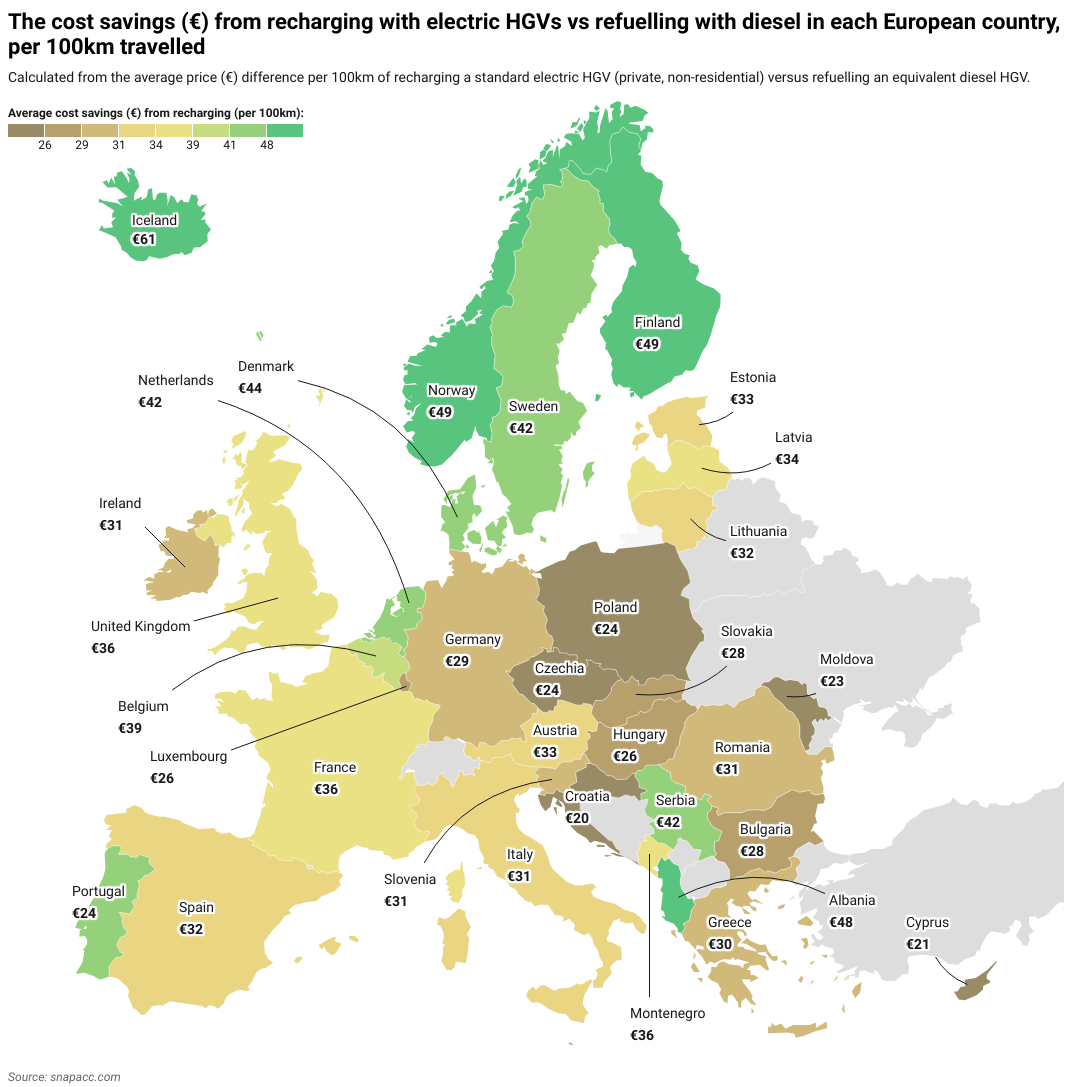
Чтобы оценить целесообразность перехода операторов автопарков с дизельного топлива на электрическое, SNAP провела исследование стоимости подзарядки грузовых автомобилей по сравнению с их заправкой на различных европейских грузовых маршрутах. Мы рассчитали экономию на электричестве по сравнению с дизельным топливом в евро на 100 км в 35 европейских странах.

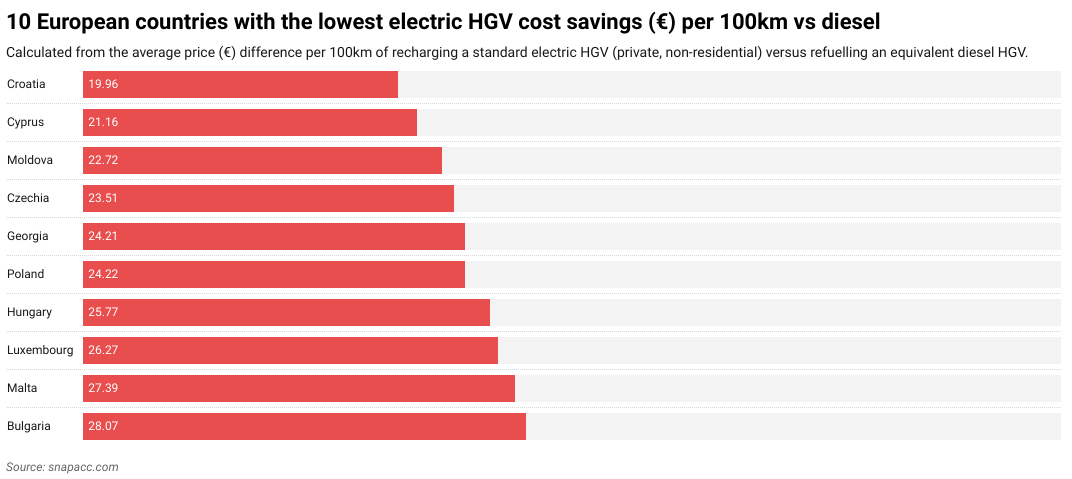
Мы обнаружили, что Исландия лидирует по этому показателю со средней экономией €61,03 на 100 км, а скандинавские страны Норвегия и Финляндия занимают второе и третье места по экономии соответственно. На другом конце шкалы наименьшая экономия - 19,96 евро на 100 км - в Хорватии, за которой следуют Кипр и Молдова.

В этой статье мы раскрываем экономию затрат по странам Европы и анализируем некоторые из них, а также анализируем некоторые внешние факторы, которые могут повлиять на эту экономию. Мы также рассмотрим, каким может быть будущее eHGV в Европе, а также как eHGV могут помочь операторам автопарков и водителям сэкономить деньги, особенно в случае [бюджетов водителей] (https://snapacc.com/newsroom/a-truck-drivers-guide-to-budgeting/).

Как соотносятся расходы на электромобили и дизельное топливо в странах ЕС

Наше исследование показало, что в каждой европейской стране использование eHGV с электрической зарядкой экономит деньги по сравнению с использованием традиционного грузового автомобиля с топливом. Основное различие заключалось в том, насколько сильно варьировалась экономия. Например, цена на электричество в самой дорогой стране Исландии на 206 % (41 евро) выше, чем в самой дешевой стране, Хорватии.

Мы обнаружили, что в среднем водитель электрического грузового автомобиля экономит 30,59 евро на 100 км по сравнению с водителем дизельного грузового автомобиля. Это означает, что средняя экономия составит 37 200 евро в год для водителей дальних электрогрузовиков и 24 800 евро для водителей внутреннего транспорта.

Чтобы собрать данные, мы рассмотрели 35 европейских стран и сравнили стоимость энергии или топлива на 100 км для двух типов большегрузных автомобилей (HGV). Это были стандартный дизельный грузовик, предполагающий расход топлива 35 литров на 100 км при средней розничной цене дизельного топлива в каждой стране, и электрический грузовик, предполагающий расход электроэнергии 108 кВт/ч на 100 км на основе среднего тарифа на электроэнергию для небытовых потребителей. НДС и возмещаемые налоги были исключены из этих расчетов. Сравнение отражает только прямые затраты "у насоса" или "у розетки", без учета таких факторов, как размер автопарка, заключенные энергетические контракты или будущие изменения цен на топливо и электроэнергию.

При изучении цен на дизельное топливо и электроэнергию использовался ряд источников, включая Eurostat, CEIC, GlobalPetrolPrices, Webfleet и Gov.uk. Стоит отметить, что некоторые из этих источников ссылаются на "Великобританию", а другие - на "Соединенное Королевство". В рамках данного исследования оба термина рассматривались как взаимозаменяемые.

Страны, которые больше всего сэкономят, перейдя на электрические грузовики

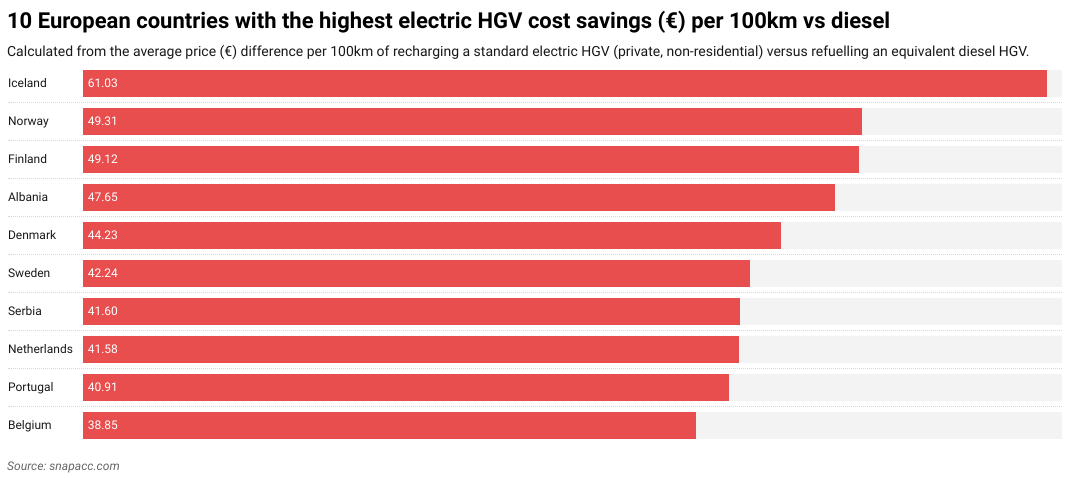
Исландия (€61,03), Норвегия (€49,31) и Финляндия (€49,12) - это страны, где можно сэкономить больше всего, перейдя на электрические грузовики.

Во многом это связано с тем, что эти страны входят в число самых дорогих в Европе по цене дизельного топлива. Исландия - самая дорогая страна в Европе по цене дизельного топлива (2,07 евро за литр). Такая высокая стоимость во многом объясняется ее географической изоляцией по сравнению с остальной Европой, в результате чего стоимость импорта дизельного топлива намного выше, чем в других европейских странах. Исландия, как Норвегия и Финляндия, также известна своей высокой налоговой ставкой, что также способствует высокой стоимости топлива.

Норвегия (32%) и Исландия (18%)** также входят в число двух ведущих стран мира по доле электромобилей на дорогах среди легковых автомобилей. В результате обе страны инвестировали значительные средства в инфраструктуру электрозарядок.

Небольшие размеры Исландии и наличие главной кольцевой дороги также облегчают установку электрических зарядных станций на регулярных интервалах для водителей грузовиков с электроприводом. Те же доводы можно частично использовать и для других стран с небольшими сетями, которые отличаются высоким уровнем экономии, включая Албанию, Сербию и Бельгию, хотя следует отметить, что во всех трех странах также действуют одни из самых дорогих цен на дизельное топливо в Европе, что вносит свой вклад в разницу в экономию.

На диаграмме ниже показаны 10 стран, в которых наблюдается наибольшая экономия средств при использовании электрического грузового автомобиля:
"Водители по всей Европе уже экономят, переходя на электрические грузовики. Переход на зарядку электромобилей - это будущее отрасли, и SNAP готов помочь водителям и операторам автопарков в этом переходе".

Мэтью Беллами - управляющий директор SNAP.

Страны, которые меньше всего экономят, переходя на электрические грузовики

Хорватия (€19,96), Кипр (€21,16) и Молдова (€22,72) - три страны с наименьшей экономией в Европе.

Хорватия занимает второе место в ЕС по темпам внедрения EV (https://www.smf.co.uk/wp-content/uploads/2025/03/Decreasing-transport-poverty-in-Europe-through-public-EV-chargepoints-March2025.pdf) после Польши. Отчасти это связано с неразвитой инфраструктурой зарядки EV в Хорватии, например, зарядными станциями, которые требуют звонка в службу поддержки или использования нескольких различных приложений для запуска процесса зарядки, плохой ориентацией зарядных станций вблизи крупных автомагистралей и потенциально высоким временем ожидания в пик туристического сезона. Кроме того, в Хорватии отсутствуют сверхскоростные зарядные станции (180 кВт и выше), что может стать проблемой для грузовых электромобилей, которым требуется больше энергии, чем обычным EV.

И на Кипре, и в Молдове существуют внутренние геополитические проблемы, которые затрудняют планирование инфраструктуры для зарядки EV (как и национальное планирование в целом). На Кипре северная половина острова, включая половину его столицы Никосии, с 1974 года оккупирована поддерживаемой Турцией Турецкой Республикой Северного Кипра. Для Молдовы восточная провинция Приднестровья действует как государство де-факто с собственным правительством. Это означает, что обе страны не могут последовательно внедрить инфраструктуру EV на территории, которую они считают своей.

Проблемы Кипра также усугубляются высокими ценами на электроэнергию, в то время как в Молдове цены на дизельное топливо пятые по дешевизне в Европе. Молдова также является [второй беднейшей страной Европы] (https://worldpopulationreview.com/country-rankings/poorest-countries-in-europe), что затрудняет инвестиции в инфраструктуру EV. Все эти факторы способствуют общей низкой экономии затрат для электрических грузовых автомобилей.

Польша также занимает низкое место в списке с экономией 24,22 евро. Несмотря на впечатляющий экономический рост и растущие инвестиции в инфраструктуру зарядки EV, ее большие размеры означают, что в некоторых районах страны покрытие все еще остается проблемой, хотя в будущем это, вероятно, [изменится] (https://alternative-fuels-observatory.ec.europa.eu/general-information/news/poland-launches-major-funding-programs-zero-emission-transport).

Такие страны, как Испания (€32,20), Румыния (€30,62) и Ирландия (€30,54), занимают среднюю позицию по экономии затрат на электрические грузовики. Вероятно, это объясняется тем, что в этих странах развита инфраструктура зарядки электромобилей, а стоимость электроэнергии и дизельного топлива находится на среднем уровне.

На диаграмме ниже показаны 10 стран, в которых экономия средств при использовании электрического грузового автомобиля самая низкая:
Экономия затрат на электрический грузовой автомобиль в Великобритании

В Великобритании экономия затрат на электромобили составляет 36,23 евро, что ставит ее на 11-е место по экономии затрат от подзарядки на 100 км. Это во многом объясняется дороговизной топлива в Великобритании, где * цены на дизельное топливо являются третьими по дороговизне в Европе*. Хотя экономия за счет высоких цен на дизельное топливо, безусловно, способствует высокой экономии расходов на электромобили в Великобритании, она могла бы быть гораздо выше, если бы электричество в Великобритании также не было одним из самых дорогих в Европе.

Великобритания также ожидает улучшения инфраструктуры зарядки EV. Британская компания Moto, обслуживающая автострады, активно планирует построить [15 "суперхабов" к 2027 году] (https://www.fleetnews.co.uk/news/electric-hgv-charging-superhubs-planned-for-motorway-services). Эти суперхабы смогут обеспечить более эффективную зарядку EV для eHGV по сравнению со стандартными зарядными устройствами. В настоящее время на дорогах Великобритании имеется менее пяти специальных пунктов зарядки для eHGV. Учитывая, что другие компании, такие как BP Pulse и Aegis Energy, также собираются инвестировать, можно предположить, что в ближайшем будущем в Великобритании появится гораздо более совершенная сеть зарядки грузовых автомобилей.

Что влияет на электрификацию грузовых автомобилей?

В настоящее время на электрификацию грузовых автомобилей влияет несколько факторов, в том числе отсутствие зарядной инфраструктуры, длительное время зарядки, высокие первоначальные затраты на переоборудование грузовиков и их ограниченный запас хода. Кроме того, сравнительно низкая стоимость и доступность дизельного топлива и транспортных средств делают традиционные грузовые автомобили привлекательным вариантом для [операторов автопарков] (https://snapacc.com/fleet-operators/).

Однако все эти последствия могут варьироваться в зависимости от страны эксплуатации. Например, если ваш автопарк работает только внутри страны, такой как Норвегия или Исландия, то он, скорее всего, пострадает меньше, чем автопарк, работающий по всей Европе или в регионах с более слабой инфраструктурой eHGV, например, на Балканах.

Недостаточная зарядная инфраструктура

Основным препятствием на пути электрификации грузовых автомобилей является недостаточная инфраструктура для зарядки электромобилей. Это связано с тем, что для электронных грузовиков требуется мегаваттная зарядка, которую не поддерживает большинство существующих пунктов зарядки EV для пассажирских автомобилей (стандартных электромобилей и фургонов).

В Европе есть много стран, где остро не хватает подобной инфраструктуры, особенно на основных грузовых маршрутах и на стоянках грузовиков. Как правило, это более бедные государства южной и восточной Европы, такие как Молдова, Грузия и Болгария. Неслучайно эти страны входят в первую десятку стран по экономии средств на eHGV.

Бывает и так, что зарядные станции для eHGV существуют, но они находятся в районах, которые просто не могут вместить несколько eHGV, заряжающихся за ночь, из-за слабой местной электросети. Такая проблема часто возникает в сельских и отдаленных районах Европы.

Несмотря на то, что многие европейские страны планируют улучшить инфраструктуру eHGV, это все еще трудоемкий и дорогостоящий процесс, требующий преодоления многочисленных бюрократических, логистических и технических препятствий, не говоря уже о модернизации сопутствующей инфраструктуры, такой как подключение к местным сетям, которая также будет необходима.

Длительное время зарядки

Электрические грузовики заряжаются гораздо дольше, чем стандартные EV. Это означает, что зарядку часто приходится проводить в течение ночи. Даже если удастся приобрести быстрые зарядные устройства для электромобилей, процесс все равно займет [не менее двух часов] (https://dhl-freight-connections.com/en/solutions/charging-times-for-electric-trucks-the-goal-is-less-than-30-minutes/), а не несколько минут, как в случае с бензиновыми автомобилями.

Длительное время зарядки может повлиять на операторов автопарков с точки зрения времени оборота. В отрасли с жесткими графиками и сроками поставок это может потенциально негативно сказаться на эффективности бизнеса.

Ограниченный запас хода электромобилей

Запас хода электрических грузовиков также ограничен по сравнению с пробегом традиционных грузовиков. По данным Safety Shield, запас хода типичного электрического грузовика на одной зарядке составляет около 300 миль (примерно расстояние от Лондона до Роттердама). Однако типичный грузовик с дизельным двигателем может проехать на одном баке топлива до 1 000 миль (примерно расстояние от Лондона до Варшавы).

На пробег электрических грузовиков также могут сильнее влиять внешние факторы, такие как нагрузка, [холодная погода] (https://snapacc.com/newsroom/a-truck-drivers-guide-to-winter-in-europe/) и рельеф местности. Это может привести к беспокойству водителей о дальности пробега, которые могут чаще проводить зарядку, чтобы убедиться, что энергии достаточно для достижения пункта назначения. Это, в свою очередь, может привести к задержкам в доставке, особенно при движении через страны с плохо развитой инфраструктурой зарядки eHGV.

Все это делает [оптимизацию маршрута] (https://snapacc.com/newsroom/route-optimisation-with-fleet-management-software-snap-account/) жизненно важной для операторов автопарков, планирующих поездки для своих eHGV. Следует отметить, что технология аккумуляторных батарей постоянно развивается, и в ближайшем будущем их емкость, а значит, и пробег, будут продолжать увеличиваться.

Высокая стоимость электронного грузовика

Первоначальная стоимость электронного грузовика высока (обычно в пределах £160 000-£200 000, по сравнению с £80 000-£100 000 для дизельного грузовика), что может отпугнуть независимых водителей и небольших операторов автопарков от его приобретения. В основном это связано с дороговизной аккумуляторной технологии. Это означает, что приобретение нового электрического грузовика обойдется недешево, поскольку технология, используемая в нем, дороже, чем в дизельном грузовике.

Высокие первоначальные затраты на покупку электромобилей также означают, что операторы автопарков в странах с более дешевыми тарифами на электроэнергию для зарядки электромобилей, таких как Норвегия, Швеция или Финляндия, с большей вероятностью перейдут на новые технологии, поскольку они быстрее окупят свои инвестиции, чем операторы в странах с дорогой электроэнергией, таких как Ирландия и Хорватия.

Цены на электроэнергию также могут колебаться в зависимости от различных событий. Например, за последние пять лет цены на электроэнергию колебались в связи с открытием экономик после пандемии COVID-19 и вторжением России в Украину в 2022 году (последнее, в частности, оказало значительное влияние на энергоснабжение Европы). В результате в период после вторжения произошел скачок цен на электроэнергию почти на 30 %, с 20,5 до 26,5 евро/кВт-ч для средней столицы ЕС. Однако сейчас средний показатель по ЕС ниже, чем в 2022 году, и, судя по всему, электрозарядка для грузовых автомобилей продолжит свое восхождение.

В Европе средняя стоимость пробега электрического грузовика на 100 км составляет 20,51 евро, что значительно дешевле, чем 51,10 евро для дизельного грузовика на то же расстояние.

По мере повышения эффективности и распространения аккумуляторных технологий, а также снижения стоимости производства, автомобили eHGV будут становиться все более доступными для приобретения.

Дешевизна и доступность дизельного топлива

Дизельное топливо по-прежнему играет доминирующую роль в индустрии грузовых автомобилей. Это объясняется тем, что инфраструктура для дизельного топлива была хорошо развита в Европе на протяжении десятилетий, особенно по сравнению с электрическими зарядными устройствами для грузовых автомобилей. Совместимость дизельного топлива с [топливными картами] (https://snapacc.com/newsroom/fuel-cards-in-transportation-how-snap-simplifies-fleet-life/) и его относительная дешевизна также сохраняют его популярность среди менеджеров грузовых автопарков.

Однако, как и в случае с электричеством, стоимость дизельного топлива колеблется по всему континенту. Поэтому в таких странах, как Молдова, Грузия и Мальта, где дизельное топливо остается дешевым, выгоднее использовать дизельные грузовики. И наоборот, в таких странах, как Исландия и Нидерланды, где дизельное топливо относительно дорого, есть больше стимулов для перехода на электрические грузовики.

Страны с дешевым топливом также могут не решиться вкладывать значительные средства в инфраструктуру электронного грузового транспорта, опасаясь оттолкнуть от себя традиционные автопарки грузовиков, которые в результате могут выбрать альтернативные маршруты.
Будущее электрических грузовиков в Европе

Электрические грузовики - это долгосрочное будущее автоперевозок. Они не только дешевле в эксплуатации с течением времени, но и благодаря тому, что в новую инфраструктуру инвестируют и строят ее высокими темпами, они также станут гораздо более жизнеспособными с финансовой и стратегической точек зрения.

Помимо экономических преимуществ, электрические грузовые автомобили также важны с точки зрения их вклада в достижение экологических целей, таких как Net Zero. Поскольку традиционные грузовые автомобили являются крупными загрязнителями окружающей среды, сэкономленные выбросы от использования электромобилей будут ощущаться в более чистом воздухе по всей Европе.

Следующие тенденции (https://snapacc.com/newsroom/the-road-ahead-for-2025-truck-industry-trends-to-expect/) могут повлиять на электрические грузовые автомобили в будущем:

  • Smart truck parks: Truck parks in the future will evolve to better accommodate eHGVs alongside other smart technological advancements. These truck parks may include up-to-date ultra-fast charging stations, diagnostic machines, battery swap stations, and automated cleaning services, among other features.
  • Increased EU regulations: Low Emission Zones (LEZs) already exist in a number of cities (e.g. Paris, Berlin, and Milan) with more European cities likely to follow suit with more stringent EU transport regulations. Fleet operators may opt for eHGVs to meet EU regulations or retrofit their HGVs with cleaner technologies, like smart tachographs.
  • AI implementation: AI technology has already had a profound sustainability impact across road haulage — with applications in route optimisation, predictive maintenance, and autonomous vehicle development. Electric vehicles will likely incorporate AI to help drive sustainability in the haulage industry over the coming decades.
  • Sustainability: The shift to eHGVs is part of a wider global push toward sustainable living. The effects of extreme weather, including heatwaves and floods across Europe, show no sign of slowing due to climate change. Moving to electric HGVs is one way the world is reducing its dependence on fossil fuels.
  • Fuel variety: During the transition to cleaner fuel sources, there will be a variety of HGV types on the road throughout the 2030s. Many will be older diesel models, some will be electric, and others will be powered by alternative fuels such as biofuel made from renewable biomass sources.

Управляйте расходами на электрогрузовики более разумно

Электрические грузовые автомобили - это будущее, и в этом мало кто сомневается. Экономические и экологические преимущества приведут к тому, что в ближайшие годы все больше операторов автопарков и водителей перейдут на электромобили. Как долго продлится этот переходный период, будет зависеть от того, насколько быстро Европа сможет развить инфраструктуру для зарядки электромобилей.

В настоящее время на континенте есть значительные участки, на которых электронные грузовики неэффективны и требуют значительной оптимизации маршрута из-за меньшего радиуса действия. Кроме того, первоначальные затраты могут отпугнуть независимых водителей и небольших операторов автопарков.

Технологии и инфраструктура будут совершенствоваться, и уже сейчас существуют сервисы, призванные максимально упростить управление парком электронных грузовиков и связанные с этим расходы. От оптимизации маршрутов и управления автопарком до карт парковок и моек для грузовиков - SNAP делает грузоперевозки простыми.

[Подпишитесь на SNAP сегодня.] (https://snapacc.com/sign-up/)

Поделиться с

Другие тоже читают...

Header Image

среда 15 апреля 2026 • Новости индустрии

КРАЖИ ГРУЗОВ В ЕВРОПЕ: ПОЧЕМУ ОНИ РАСТУТ И КАК АВТОПАРКИ МОГУТ СНИЗИТЬ РИСК

Guest

Cargo theft is a growing threat across Europe. What was once seen as an occasional disruption is now a more persistent and organised risk to road transport, affecting fleets, drivers and the wider supply chain. Reported losses and incidents have risen sharply, with one widely cited industry figure pointing to a in recent years. In alone, 557 cargo crimes were recorded across 38 countries in the TAPA EMEA Intelligence System, and even though values were disclosed for fewer than one in five incidents, those 100 cases still totalled more than €43 million.In this article, we explore the current trends and what fleet managers and operators can do to minimise their risks.Food and beverage shipments are among the most commonly targeted categories in Europe, accounting for . also rank highly. These goods are attractive because they are easy to move, easy to sell and often difficult to trace once they enter secondary markets.The recent on its way from Italy to Poland is a useful example. Nestlé said the missing load amounted to roughly 413,793 bars, showing how quickly a mainstream consumer shipment can become a target when moving across borders.These shipments are attractive targets for organised groups because they can be offloaded quickly, resulting in rapid returns. Cargo crime often happens while loads are moving. report found that hijackings accounted for 21% of incidents, while 41% of thefts happened in transit. That is a reminder that risk does not begin when a truck parks for the night. It can begin long before a vehicle stops for the night, particularly on exposed corridors or routes where load visibility and security controls are weaker.Parked vehicles remain a major point of vulnerability. In the UK, Munich Re reported that nearly half of all thefts take place at unsecured roadside parking and rest areas. Across Europe, unsecured roadside locations and rest areas continue to feature prominently in cargo crime reporting, especially where drivers have limited alternatives and secure sites are full.Some of the most concerning incidents show coordination. recently documented attacks in Germany in which dozens of trucks were targeted in a single night along the A1 corridor. In one November 2023 incident, 67 trucks had trailers slashed at service and rest areas including Ostetal South and Grundbergsee South. Similar attacks had already taken place on the same route months earlier.Germany remains one of the clearest hotspots, largely because of the scale of freight passing through the country. Analysis showed that in 2023, more than double France in second place. Other recurring hotspots include France, Italy, Spain and the United Kingdom. That pattern reflects the reality of European freight movement. Dense logistics networks, major freight hubs and heavily used motorways create more opportunities for organised criminals, especially when secure parking capacity fails to keep pace with demand.Munich Re warns that cargo thieves are increasingly using more sophisticated methods, including identity deception, cyber-enabled scams and other tactics that bypass traditional controls. Wider points to GPS jamming, paperwork manipulation and shipment diversion as part of that shift.A stolen load may now begin with compromised data, a fraudulent carrier, a diverted instruction or a vehicle whose movements can no longer be tracked properly. For fleets, that means theft prevention now involves more than physical security. It also requires tighter dispatch processes, better control over shipment data and clearer real-time visibility.The most obvious impact is financial. Stolen goods lead to lost goods, insurance claims and disruption. But the direct value of the missing load is only part of the problem. Delayed deliveries, vehicle damage, missed slots and customer dissatisfaction can all push the true cost much higher. There is also a human cost. Drivers may face intimidation, confrontation or the shock of discovering that their vehicle has been tampered with while they were resting. Even where there is no direct violence, exposure to insecure roadside stops creates stress, fatigue and a sense of vulnerability that can affect driver welfare and retention. Operationally, the knock-on effects spread quickly through the supply chain. A single theft can mean missed delivery windows, rerouted vehicles, stock shortages and added pressure on already stretched teams. For temperature-sensitive, time-critical or high-value loads, the consequences can multiply fast.There is no single fix, but fleets can reduce exposure with a more structured approach to planning, parking and security.Secure parking remains one of the clearest areas for improvement. TAPA’s Parking Security Requirements framework provides an internationally recognised benchmark for secure truck parking, helping operators assess which locations offer stronger protection for vehicles, loads and drivers. Choosing accredited sites will not eliminate cargo theft, but it can significantly reduce the opportunity for organised criminals to strike.In practice, that may mean stopping earlier than planned to reach a safer site rather than pushing on to an unsecured lay-by. While that can feel less efficient in the moment, it is often the more resilient choice.For fleets, the challenge is not just knowing secure parking matters but being able to access it easily. SNAP helps bridge that gap by giving drivers and operators better visibility of trusted parking options across the UK and Europe, making it simpler to plan and reserve safer stops from the outset.Read more: Cybersecurity now sits alongside physical security in any serious theft-prevention strategy. Tracking, geofencing and anti-jamming tools can all help, but only if they are backed by clear processes. Fleets should review how shipment data is shared, who can alter route instructions, how delivery paperwork is verified and what happens if a vehicle suddenly disappears from view. Drivers are often the last line of defence, but they should not carry the burden alone. Clear escalation procedures, regular check-ins, secure rest planning and training on suspicious activity all matter. One of the biggest structural issues behind cargo theft is the shortage of secure truck parking. When drivers cannot find protected sites with proper lighting, access control and welfare facilities, they are more likely to end up in the very locations thieves are already targeting. SNAP has trained working to accredit more parking sites across the UK and continental Europe, helping expand the availability of secure truck parking and reduce opportunities for organised theft.For fleets, the challenge is not just understanding risk, but building safer stopping decisions into everyday operations. At SNAP, we help drivers and operators identify trusted parking options across the UK and Europe, making it easier to plan routes with security and driver welfare in mind.

Header Image

среда 11 марта 2026 • Новости индустрии

ПАРКОВКА ГРУЗОВИКОВ В ЕВРОПЕ: ПРАВИЛА, ПРОБЕЛЫ, РИСКИ

Guest

Ask most fleet operators what makes life harder than it needs to be and you’ll hear the same answer across Europe: truck parking.Drivers have to stop. Hours rules and rest requirements make that non-negotiable. But on many of Europe’s busiest transport corridors, finding a safe, legal place to park is still uncertain. Capacity is low, security varies widely and most urban hubs aren’t built with HGVs in mind.That pressure has consequences. When designated areas are full, drivers are pushed towards places that were never intended for HGV parking: slip roads, access ramps and industrial estates. Compliance becomes a choice between two risks: stop where you shouldn’t, or keep driving when you shouldn’t.When truck parking overflows into unsuitable places, the environment becomes dangerous: poor visibility, high speeds, unpredictable manoeuvres and limited escape routes. starkly in February 2026, reporting fatal crashes in Germany and Belgium involving stationary lorries. The article challenges the easy explanation of “illegal parking” and points back to the underlying cause: drivers were out of driving time and the spaces were gone.In addition, a shortage of truck parking in Europe doesn’t just mean “no space”; it often means the only available space is poorly lit, unmonitored and isolated. That elevates the risk of theft and driver harm, which can have a knock-on effect for supply chain reliability.Poor parking provision also affects workforce sustainability. When drivers face uncertainty around legal, safe stopping, it makes the role harder and less attractive – compounding .For a long time, the conversation about truck parking focused on enforcement: where you can’t park and the penalties that follow. Increasingly, the focus is moving towards provision: where drivers can stop safely, reliably and legally. Under revised Trans-European Transport Network (TEN-T) rules, EU Member States must ensure the development of certified secure parking . The same requirement sets expectations for the location of truck parking. It must be immediately on the network or within 3km of an exit, which will have benefits for route planning. Alongside this shift, the European Commission positions safe and secure truck parking as a priority within its Intelligent Transport Systems work, including the need for to help drivers locate suitable sites.But the EU isn’t just asking Member States to add more truck parking spaces. It’s also defining what “safe and secure” means. In April 2022, the European Commission adopted EU standards for , categorising sites into four security levels: bronze, silver, gold and platinum. The intention is to create transparency for drivers and fleets, and to support investment by giving operators a clear target to design and audit against.This sits against a significant capacity gap. A European Commission study estimates a across the bloc, with the gap potentially rising towards half a million by 2040 if the network does not scale at the pace freight demand requires.Looking at more practical aspects of the situation, what are HGV parking rules and regulations in Europe?At first glance, HGV parking rules across Europe look consistent: Motorways are not designed to absorb overflow parking. Hard shoulders exist for emergencies and safety buffers. Access ramps are not for planned stopping.Urban areas add a layer of complexity. Local restrictions and enforcement are common because HGV parking competes with residents, retail and public space – and because badly parked vehicles create safety risks.Rules around HGV parking in the UK are clear. Trucks should use designated areas such as motorway services, truckstops and lorry parks. Conversely, drivers must avoid parking in locations that create risks, such as pavements, verges and central reservations. Restrictions around parking in residential areas vary by local authority, so it’s vital to check if this is unavoidable. The major constraint is supply. The RHA’s estimate of an , with very high utilisation on key routes, helps explain why informal and unsafe parking persists even where drivers know it isn’t ideal. In 2022, the Department for Transport across England, aimed at better rest areas and more secure parking, framed as part of a broader programme to improve roadside facilities.In Germany, motorway stopping rules are anchored in the (StVO), which makes clear that stopping on the autobahn – including the hard shoulder – is prohibited except in emergencies. That means running out of driving time is not treated as justification. Fines increase if obstruction or danger is caused, and enforcement is active on heavily used corridors. Poland follows the familiar motorway rule that hard shoulders are reserved for breakdowns and emergencies. The nuance appears within cities, where tonnage-based entry restrictions and are common. Overnight HGV parking in urban areas can require municipal approval and enforcement varies between municipalities. For cross-border fleets, that means treating urban stopping as permission-led rather than assumed.France reinforces the same principle through the . Articles R417-9 and R417-10 classify dangerous or obstructive parking offences, and stopping on autoroute carriageways or shoulders is prohibited except in cases of absolute necessity. Penalties can include fines and licence points.However, publishes dedicated information for secure truck parking on its network, reflecting how motorway operators guide HGV stopping into appropriate locations.Spain’s prohibits stopping on motorway shoulders except in emergencies, aligning with broader European practice. Additional complexity lies at municipal level. Many cities operate local overnight bans or restrict HGV parking to designated industrial zones, with enforcement handled by local police rather than motorway authorities. That creates a layered compliance environment: legal on the motorway network does not automatically mean legal in urban areas.To highlight positive developments, that a truck parking facility in La Jonquera became the first in Spain to receive TAPA certification, describing measures such as controlled access, fencing, lighting and continuous monitoring.Italy distinguishes clearly between motorway carriageways, ramps and designated service areas. Stopping on access or exit ramps is explicitly prohibited, and enforcement around motorway infrastructure is consistent. Importantly, Italy differentiates between aree di servizio (full service areas with facilities) and simpler rest or parking lay-bys, which may not support overnight welfare needs. However, Italy is also seeing new secure truck parking developments focused on welfare and security, reflecting the wider European momentum towards better provision.Across Europe, an additional regulatory layer now shapes truck parking decisions: Low Emission Zones (LEZs) and restricted urban traffic zones. Cities in France (Crit’Air), Germany (Umweltzonen), Spain (Zonas de Bajas Emisiones) and Italy (ZTL areas) impose vehicle-class or permit requirements that can apply even to stationary vehicles within the zone. A driver who parks overnight in a restricted area without the correct classification or registration risks fines – even if the stop itself is otherwise legal. Across Europe in 2026, the rules are clear. The constraint is capacity, especially near urban hubs and on high-volume corridors. For fleets, this has a practical impact: European truck parking can’t be left to chance at the end of a shift. It needs to be planned with the same seriousness as , routing, driver hours and security – because when the network fails to provide legal space, every other compliance system gets squeezed.SNAP can help. .

Header Image

четверг 26 февраля 2026 • Новости индустрии

ЖЕНЩИНЫ В ГРУЗОПЕРЕВОЗКАХ: РАСКРЫТИЕ НЕИСПОЛЬЗОВАННЫХ ТАЛАНТОВ

Guest

Across the UK, around . They transport food to supermarkets, materials to construction sites and goods to ports and distribution centres. They underpin daily life and economic stability, forming a critical part of the UK’s national infrastructure.Yet only around . That amounts to roughly one per cent of the UK HGV workforce, according to reporting by . For an industry facing long-term recruitment pressure, that figure raises important questions about where future talent will come from and how the sector presents itself to potential entrants.There are signs of progress, however. The percentage of from 6.7% in 2011/12 to 9.7% by 2021/22. Over the past decade, women securing Category C and C+E licences increased by 144%, according to SME Web. More women are clearly choosing to train and qualify. The pipeline is widening, but the proportion of women behind the wheel remains marginal.Women have not been entirely absent from road transport. One of the earliest recorded female truck drivers was, who began driving heavy vehicles in the United States in 1918. During wartime periods in both the US and the UK, women stepped into transport roles out of necessity. Then, in the 1960s, became the UK’s first long-distance lorry driver, often working 100-hour weeks.However, outside exceptional circumstances, haulage has traditionally been male dominated. Cultural perceptions, physical assumptions about the work and the lifestyle associated with long distance driving have all played a part. Only in recent decades has participation begun to shift in a more sustained way.The reasons for low female participation are not limited to awareness. Structural and practical barriers remain.Facilities are a big concern. Professional drivers depend on secure parking, clean rest areas and appropriate welfare provision. For many years, roadside infrastructure has struggled to meet demand across the board. When rest stops are inadequate, poorly lit, feel unsafe or lack privacy, this can discourage women from joining the sector.Working patterns also play a role. Long-haul journeys can involve overnight stays and time away from home. While many drivers value the independence that comes with the role, the perception of work-life balance may deter some women, especially those with caring responsibilities. There is also the issue of visibility. When only one per cent of drivers are women, prospective candidates may struggle to see themselves in the sector. In addition, menopause symptoms such as fatigue, sleep disruption, hot flushes and anxiety can be difficult to manage in roles that involve long hours, limited access to private facilities and time away from home. In sectors where welfare provision is already under pressure, a lack of understanding or practical support can lead to experienced drivers leaving the workforce.For haulage, this is not a peripheral issue. Retaining experienced drivers is as important as attracting new entrants. Change is not confined to driving roles. Across the broader transport and logistics ecosystem, women are increasingly visible in management, planning and policy functions.The shows that leadership representation by women has increased from 26% to 36% in recent years. However, much of this growth has taken place outside core operational functions. Senior representation within frontline transport roles remains comparatively limited.Several industry organisations are addressing this gap. Women in Transport offers mentorship opportunities, while everywoman recognises excellence through its , raising the profile of female professionals across the sector. The Chartered Institute of Logistics and Transport has also announced a new , aimed at supporting career progression and professional networks.Alongside this, community initiatives such as demonstrate that interest and engagement are growing. The spotlighting female drivers and employees, further increasing visibility. Collectively, these platforms help challenge outdated perceptions and provide practical support for women entering or advancing within the industry.For the UK haulage sector, this is not just a diversity conversation. It is a strategic one.Previous industry reporting has highlighted the scale of recruitment pressure across logistics. The that tens of thousands of new drivers will be required in the coming years to maintain supply chain stability. At the same time, the existing workforce is ageing.With only one per cent of drivers currently women, a significant proportion of the potential labour market remains underrepresented. If participation rates were to move closer to parity with the wider workforce, the impact on recruitment could be substantial.There is also evidence that inclusive cultures contribute to improved retention and engagement. A sector that demonstrates visible progression pathways, fair access to training and appropriate welfare provision is likely to appeal more broadly across demographics.Progress will not accelerate through awareness alone. Structural changes are needed.Investment in safe, well maintained roadside facilities is fundamental. Secure parking, adequate lighting and clean welfare amenities benefit all drivers and remove avoidable barriers to entry.Flexible working models, where operationally feasible, can broaden appeal. This may include regional route design, job sharing arrangements or clearer progression pathways from warehouse and planning roles into driving positions.Funded licence pathways and apprenticeships can also reduce financial barriers. As previously outlined, the cost of training can be significant. Targeted funding initiatives aimed at underrepresented groups can support a more balanced intake.Finally, transparency around workforce data matters. Publishing gender breakdowns, monitoring progression rates and setting measurable objectives signal that inclusion is being taken seriously.International Women’s Day provides an opportunity to reflect on how far the UK haulage industry has come and how far it still has to go. The rise in female licence acquisition and test pass rates demonstrates that interest exists. Leadership representation is improving in some areas and support networks are expanding. However, the scale of underrepresentation remains stark.Haulage is central to national resilience. It keeps shelves stocked, infrastructure projects supplied and trade flowing. Ensuring that this workforce reflects the full breadth of available talent is not simply a question of equity. It is a matter of long term sustainability.Supporting women in haulage also means improving the day-to-day realities of life on the road. Access to secure parking, well-lit rest areas and appropriate facilities is fundamental to retention and wellbeing for all drivers. SNAP’s intruck app helps all drivers locate and book trusted truck stops across the UK and Europe, giving fleets greater visibility and drivers greater confidence wherever their route takes them. .