Guest
Industry News • 9 min read

Fuel vs charge: Is the switch to electric cheaper or just greener?

Created: 28/07/2025

Updated: 19/09/2025

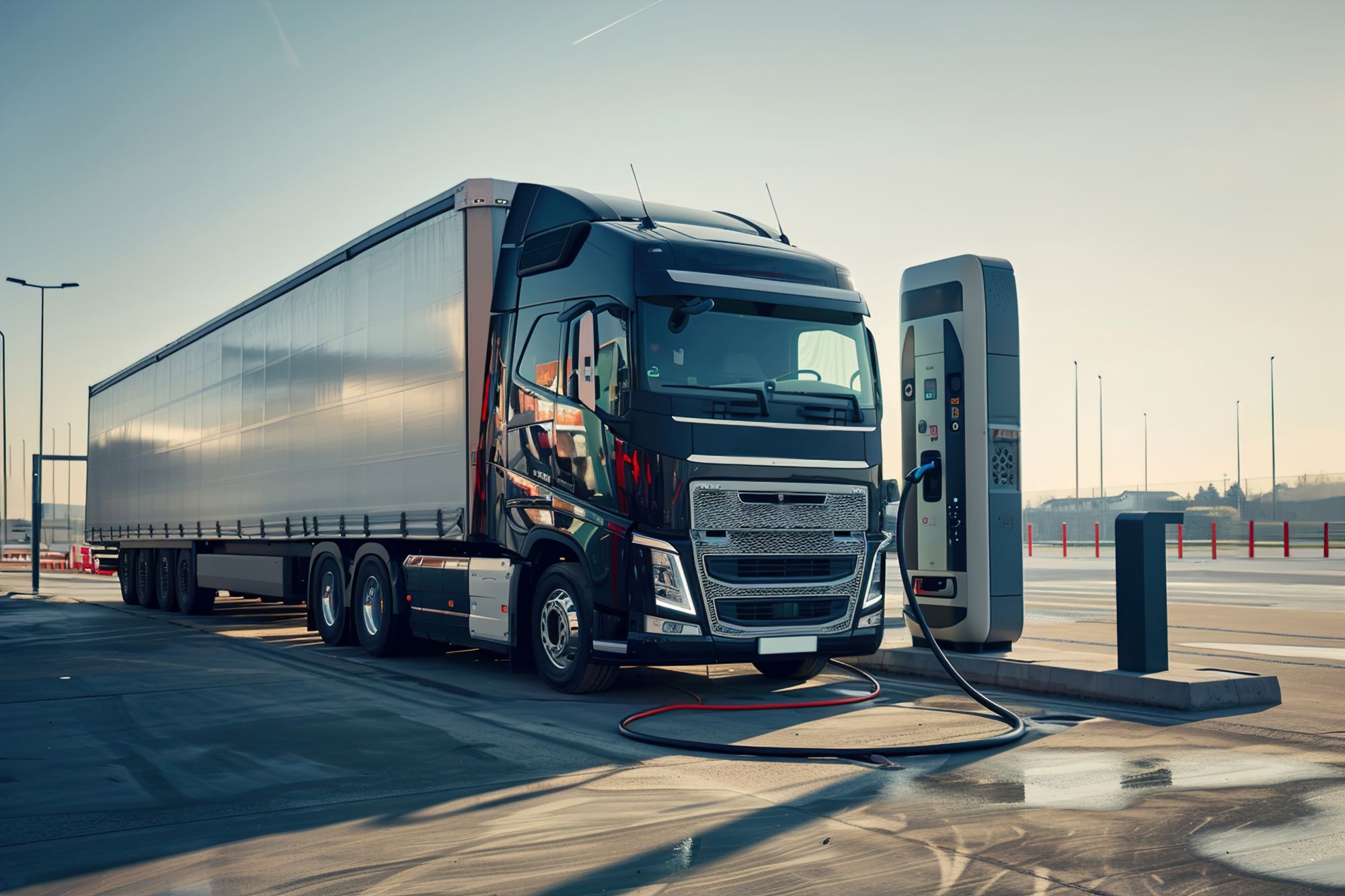
The growth of electric charging stations across Europe for HGVs has led to a transitional period across the continent's vast road networks. For many fleet operators and drivers, classic diesel-fuelled HGVs are still the transport of choice. However, the shift to electric HGVs is looming, as the industry continues to evolve.

To assess the feasibility of fleet operators switching from diesel to electric, SNAP has authored research into the costs of recharging HGVs vs refuelling them across various European freight routes. We calculated the electricity versus diesel savings in euros per 100 km across 35 European countries.

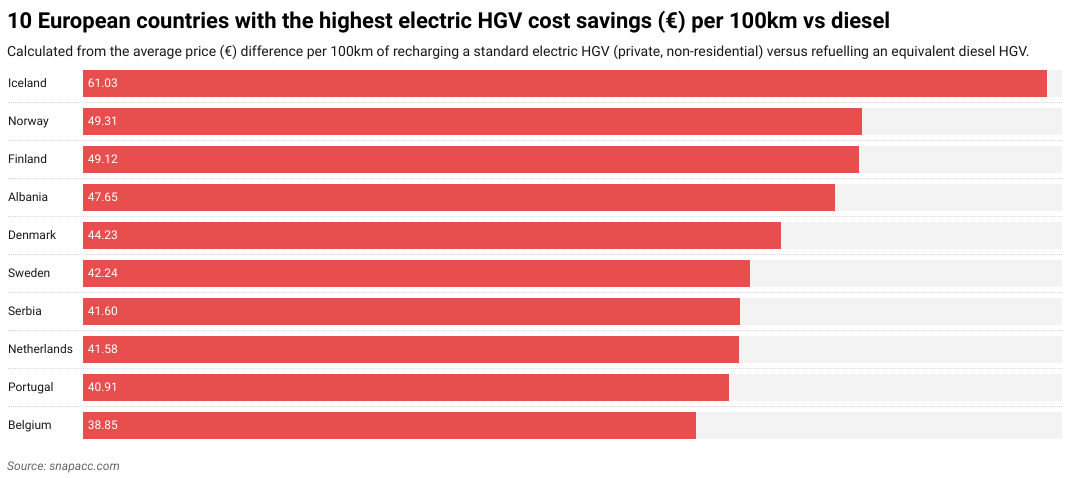
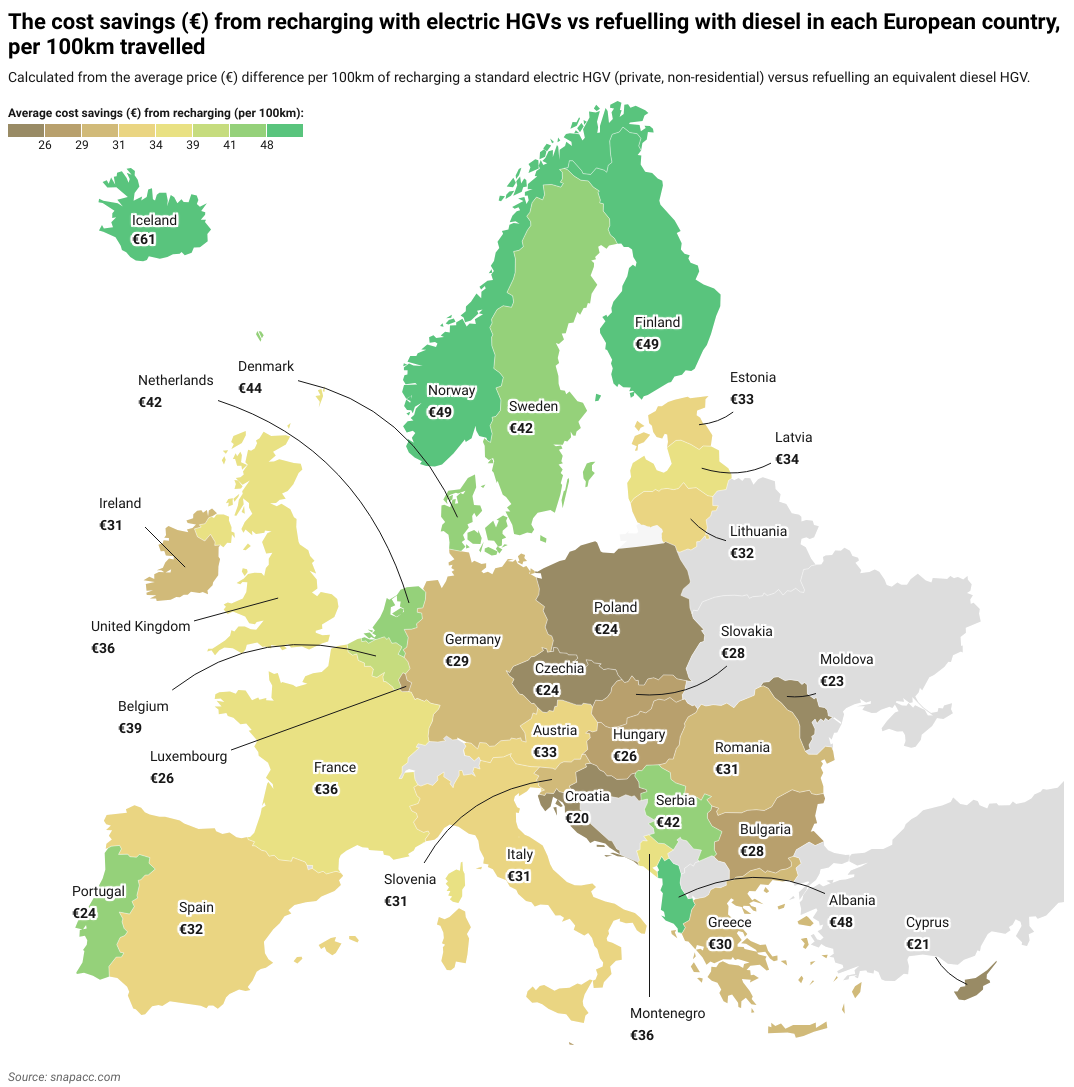
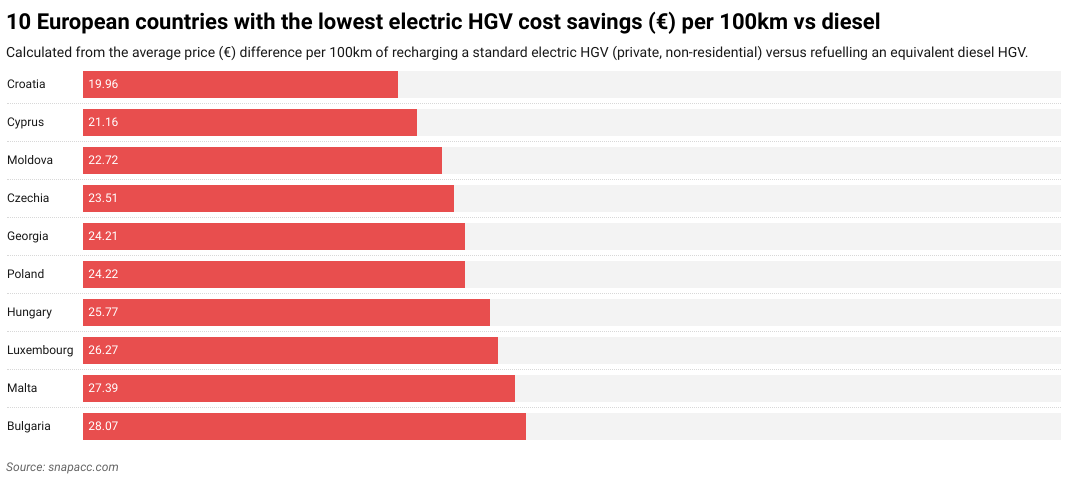
We found that Iceland led the way with an average cost saving of €61.03 per 100 km, with fellow Nordic countries Norway and Finland offering the second and third highest cost savings respectively. At the other end of the scale, Croatia offered the least amount of cost savings with €19.96 per 100 km, followed by Cyprus and Moldova.

In this article, we uncover the cost savings per European country and analyses some of the cost savings per European country and analyses some of the external factors that may be influencing these savings. We also dive into what the future of eHGVs in Europe may look like as well as how eHGVs can help fleet operators and drivers save money, particularly with driver budgets.

How the eHGV and diesel costs stack up across the EU

Our research found that for every European country investigated, using an eHGV with electric charging saved money when compared to using a traditional HGV with fuel. The primary difference was just how much the cost savings varied. For example, the price for electricity in the most expensive country, Iceland is 206% higher (41 euros higher) than the least expensive country, Croatia.

We found that on average, a driver with an electric HGV will save €30.59 per 100 km when compared with a diesel HGV driver. This translates to an estimated average saving of €37,200 a year for long-haul electric HGV drivers and €24,800 for domestic drivers.

To compile our data, we looked at 35 European countries and compared the energy or fuel cost per 100 km for two types of heavy goods vehicles (HGVs). These were a standard diesel HGV, assuming fuel consumption of 35 litres per 100 km at each country's average retail diesel price, and an electric HGV, assuming electricity use of 108 kWh per 100 km based on the average non-household electricity rate. VAT and recoverable taxes were excluded from these calculations. The comparison reflects direct “at-the-pump” or “at-the-plug” costs only, without accounting for factors such as fleet size, negotiated energy contracts, or future changes in fuel and electricity prices.

When researching the pricing for diesel and electricity, a number of sources were drawn from, including Eurostat, CEIC, GlobalPetrolPrices, Webfleet, and Gov.uk. It is worth noting that some of these sources refer to ‘Great Britain’ while others refer to the ‘UK’. For the purposes of this research, both terms were treated interchangeably.

Countries saving the most by converting to electric HGVs

Iceland (€61.03), Norway (€49.31), and Finland (€49.12) are currently the countries where the most can be saved by converting to an electric HGV.

This is largely due to these countries ranking among the most expensive in Europe for diesel. Iceland ranks as the most expensive country in Europe for diesel (€2.07 per litre). This steep cost largely comes from its geographical isolation compared with the rest of Europe, leaving the cost of importing diesel much higher than that of other European nations. Iceland, like Norway and Finland, is also known for its high tax rate, which also contributes to its high fuel cost.

Norway (32%) and Iceland (18%) also make up the top two countries in the world for electric cars on the road as a share of passenger cars on the road. As a result, both countries have invested significantly in electric charging infrastructure.

Iceland’s small size and main ring road also make it easier to install electric charging stations at regular intervals for electric HGV drivers. The same reasoning can be partly used for other countries with smaller networks that have a high rate of cost savings, including Albania, Serbia, and Belgium — although it should be noted that all three also have some of the most expensive diesel prices in Europe, which contributes to the difference in cost savings.

The chart below shows the top 10 countries that have the largest cost savings when using an electric HGV:
“Drivers across Europe are already saving by switching to electric HGVs. Switching to eHGV charging is the future of the industry and SNAP is ready to help drivers and fleet operators in the transition.”

Matthew Bellamy - Managing Director at SNAP

Countries saving the least by converting to electric HGVs

Croatia (€19.96), Cyprus (€21.16), and Moldova (€22.72) are currently the three countries with the lowest cost savings in Europe.

Croatia has the second slowest EV adoption rate in the EU after Poland. This is partly because of Croatia's poor EV charging infrastructure, such as charging stations that require ringing customer service or use multiple different apps to start the charging process, poor directions for charging stations outside major highways, and potentially high wait times during peak tourist season. Additionally, Croatia lacks ultra-high-speed charging stations (180 kW and above), which can prove a problem for electric HGVs that require more power than the average EV.

Both Cyprus and Moldova have internal geopolitical issues that make infrastructure planning for EV charging (as well as national planning in general) difficult. For Cyprus, the northern half of the island — including half of its capital, Nicosia — has been occupied by the Turkish-backed Turkish Republic of Northern Cyprus since 1974. For Moldova, the eastern province of Transnistria acts as a de facto state with its own government. This means that both countries are unable to implement EV infrastructure in a consistent way across the territory they consider their own.

The issues in Cyprus are also compounded by high electricity costs, while Moldova has the fifth cheapest diesel prices in Europe. Moldova is also the second poorest country in Europe, making investment in EV infrastructure a challenge. All these factors contribute to an overall low cost saving for electric HGVs.

Poland is also low on the list with a cost saving of €24.22. Despite its impressive economic growth and growing investment in EV charging infrastructure, its large size means that coverage is still an issue in certain areas of the country — although this looks likely to change in the future.

Countries such as Spain (€32.20), Romania (€30.62), and Ireland (€30.54) occupy the middle of the road when it comes to cost saving for electric HGVs. This is likely due to these countries have growing EV charging infrastructure, and mid-priced electricity and diesel costs.

The chart below shows the top 10 countries that have the lowest cost savings when using an electric HGV:
UK’s electric HGV cost savings

The UK has an eHGV cost saving of €36.23, which places it 11th overall for cost savings from recharging per 100 km. This is largely due to how expensive UK fuel prices are, with diesel prices being the third most expensive in Europe. Although the savings from high diesel costs certainly contribute to the UK’s high eHGV costs savings, it would likely be far higher if the electricity in the UK were not also amongst the most expensive in Europe.

The UK is also expecting improvements to its EV charging infrastructure. The UK motorway service company, Moto is actively planning to build 15 ‘superhubs’ by 2027. These superhubs can better accommodate EV charging for eHGVs more efficiently than a standard EV charger. There are currently fewer than five eHGV-dedicated charging points on UK roads. With other companies like BP Pulse and Aegis Energy also looking to invest, it looks likely that the UK will have a much-improved HGV charging network in the near future.

What is impacting HGV electrification?

There are several factors currently impacting HGV electrification, including a lack of charging infrastructure, long charge times, the high initial costs of eHGV conversion, and their limited range. Additionally, the comparatively low cost and accessibility of diesel fuel and vehicles make traditional HGVs an attractive option for fleet operators.

However, all these impacts can vary depending on the country of operation. For example, if your fleet only runs domestically in a country such as Norway or Iceland, then it is likely to be less affected than a fleet operating across Europe or in regions with poorer eHGV infrastructure, such as the Balkans.

Insufficient charging infrastructure

The main obstacle to HGV electrification is insufficient eHGV charging infrastructure. This is because eHGVs require megawatt-scale charging, which most existing EV charging points for passenger vehicles (standard electric cars and vans) do not support.

There are many countries in Europe that severely lack such infrastructure, especially on major freight routes and at truck stops. These tend to be poorer states in southern and eastern Europe such as Moldova, Georgia, and Bulgaria. It is no coincidence that these states rank in the bottom 10 for eHGV cost savings.

It can also be the case that eHGV charging stations do exist, but they are in areas that simply can’t accommodate multiple eHGVs charging overnight due to a weak local power grid. This is often a problem in more rural and remote parts of Europe.

Although many European countries are planning to improve eHGV infrastructure, it is still a time-consuming and expensive process, with numerous bureaucratic, logistical, and technical obstacles to overcome — not to mention the surrounding infrastructure upgrades, such as local grid connections, that will also be needed.

Long charging times

Electric HGVs take far longer to charge than standard EVs. This means that charging must often take place overnight. Even if rapid eHGV chargers can be acquired, the process still takes at least two hours, rather than a few minutes, as is the case with petrol vehicles.

This long charging time can have a knock-on effect for fleet operators in terms of turnaround times. In an industry with tight delivery schedules and deadlines, this can be potentially detrimental to business performance.

Limited range of eHGVs

Electric HGVs are also constricted by their relatively limited range compared to the mileage afforded by traditional HGVs. According to Safety Shield, a typical electric HGV has a range of around 300 miles on a single charge (roughly the distance from London to Rotterdam). A typical diesel-powered HGV, however, can travel up to 1,000 miles on a single tank of fuel (roughly the distance from London to Warsaw).

Electric HGV mileage can also be more affected by external factors such as load, cold weather, and terrain. This can lead to range anxiety for drivers, who may conduct more frequent charges to ensure they have enough power to reach their destination. This, in turn, can lead to delivery delays, especially when driving through countries with poor eHGV charging infrastructure.

All of this makes it route optimisation vital for fleet operators planning journeys for their eHGVs. It should be noted that battery technology is constantly evolving, and capacity — and therefore mileage — will continue to improve in the near future.

High eHGV costs

The initial cost of an eHGV is high (typically between £160,000-£200,000, compared to between £80,000-£100,000 for a diesel HGV) which can potentially deter independent drivers and smaller fleet operators from owing one. This is largely due to the expense of the battery technology involved. This means that it will be costly to purchase a new electric HGV outright as the technology inside is more expensive than that of a diesel HGV.

High initial eHGV purchasing costs also means that fleet operators in countries with cheaper electricity rates for eHGV charging such as Norway, Sweden, or Finland are more likely to convert since they will recoup their investment quicker than those in countries with expensive electricity, such as Ireland and Croatia.

Electricity prices can also fluctuate in relation to various events. For example, over the past five years, electricity prices have fluctuated in response to economies opening up after the COVID-19 pandemic and then Russia's invasion of Ukraine in 2022 (the latter in particular had major effects on European energy supply). As a result, there was a spike in electricity prices of almost 30%, from 20.5 c€/kWh, to 26.5 c€/kWh for the average EU capital in the post-invasion period. With the EU average now, however, lower than it was in 2022, it appears that electric charging for HGVs is set to continue its ascendency.

Across Europe, the average cost of running an electric HGV over 100 km is €20.51 — significantly cheaper than the €51.10 it costs for a diesel HGV over the same distance.

As efficiency improves and battery technology becomes more widespread and less expensive to produce, eHGVs will also become more affordable to acquire.

Cheapness and accessibility of diesel fuel

Diesel fuel still plays a dominant role in the HGV industry. This is because diesel infrastructure has been well established in Europe for decades, especially in comparison to electric chargers for HGVs. Diesel's compatibility with fuel cards, and its relatively cheapness also keep it popular with truck fleet managers.

As with electricity, however, the value of diesel fluctuates across the continent. This is why it can appear more advantageous to stick with diesel HGVs in countries like Moldova, Georgia, and Malta, where diesel remains cheap. Conversely, for nations like Iceland and the Netherlands, where diesel is relatively expensive, there is greater incentive to switch to an electric HGV.

A country with low-cost fuel may also be more hesitant to invest heavily in eHGV infrastructure for fear of alienating traditional HGV fleets, who may choose alternative routes as a result.
The future of electric HGVs in Europe

Electric HGVs are the long-term future of road haulage. Not only are they cheaper to run over time, but with new infrastructure being invested in and built at a strong rate, they will also become much more financially and strategically viable.

Beyond the economic benefits, electric HGVs are also important for their contribution to environmental goals such as Net Zero. With traditional HGVs being large-scale polluters, the emissions saved by eHGVs will be felt in cleaner air across Europe.

The following trends look set to impact electric HGVs in the future:

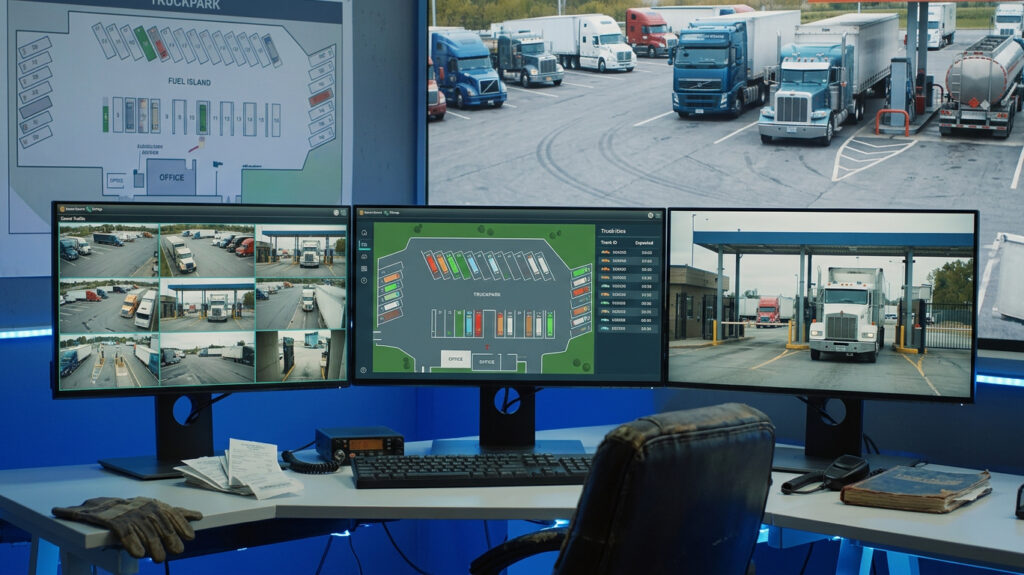
  • Smart truck parks: Truck parks in the future will evolve to better accommodate eHGVs alongside other smart technological advancements. These truck parks may include up-to-date ultra-fast charging stations, diagnostic machines, battery swap stations, and automated cleaning services, among other features.
  • Increased EU regulations: Low Emission Zones (LEZs) already exist in a number of cities (e.g. Paris, Berlin, and Milan) with more European cities likely to follow suit with more stringent EU transport regulations. Fleet operators may opt for eHGVs to meet EU regulations or retrofit their HGVs with cleaner technologies, like smart tachographs.
  • AI implementation: AI technology has already had a profound sustainability impact across road haulage — with applications in route optimisation, predictive maintenance, and autonomous vehicle development. Electric vehicles will likely incorporate AI to help drive sustainability in the haulage industry over the coming decades.
  • Sustainability: The shift to eHGVs is part of a wider global push toward sustainable living. The effects of extreme weather, including heatwaves and floods across Europe, show no sign of slowing due to climate change. Moving to electric HGVs is one way the world is reducing its dependence on fossil fuels.
  • Fuel variety: During the transition to cleaner fuel sources, there will be a variety of HGV types on the road throughout the 2030s. Many will be older diesel models, some will be electric, and others will be powered by alternative fuels such as biofuel made from renewable biomass sources.

Manage eHGV costs smarter

Electric HGVs are the future, of that there is little doubt. The economic and environmental benefits will see more fleet operators and drivers switch to eHGVs in the coming years. How long this transitional period lasts will depend on how quickly Europe can develop its eHGV charging infrastructure.

There are currently large swathes of the continent where eHGVs lack viability and require extensive route optimisation due to their shorter range. Additionally, the upfront costs involved can deter independent drivers and smaller fleet operators.

The technology and infrastructure will continue to improve, and there are already services designed to make managing eHGV fleets and related costs as simple as possible. From route optimisation and fleet management to maps for parking and truck washes, SNAP makes trucking simple.


Sign up to SNAP today.

Share to

Others also read...

Header Image

Thursday 30 April 2026 • Industry News

NEXT-GEN RECRUITMENT: ATTRACTING YOUNGER TALENT TO THE TRUCKING INDUSTRY

Evelyn Long

The UK driver shortage is a familiar headline, but the real story is more complex than the numbers. It’s a fundamental shift in the workforce that requires a new mindset. While it’s a crisis, it’s also an opportunity for forward-thinking fleets to innovate and gain an edge over the competition. The companies that successfully attract the next generation of drivers will thrive in the coming decades. Here is a quick look at the forces fueling the disparity between retiring heavy goods vehicle (HGV) drivers and new apprentices. National unemployment figures are rising. In 2025, it climbed to leading up to December, the highest rate in nearly five years. At the same time, there is a severe shortage of professional drivers.The UK’s driver shortage is not a simple labor deficit. It is a skills shortage. Many barriers prevent the general unemployed population from filling the role, such as: ● High cost and time commitment for obtaining an HGV license● The requirement for a certificate of professional competence● The unique lifestyle demands that do not align with a standard 9-to-5 jobThe paradox of high unemployment and significant driver shortage is why industry bodies are not passively waiting for the job market to fix the problem. The government implemented , from enhancing the current supply chain’s efficiency to improving conditions to attract more drivers to the sector. The shortage is not solely due to a lack of new drivers. The industry is actively losing experienced professionals. While the proportion of businesses reporting vacancies has , the issue lies in the persistent hiring gap. Many are leaving for better pay or benefits elsewhere. Drivers may choose a warehouse job that offers a similar salary to their current one but provides predictable shifts and more social interactions. The physical and mental toll of long hours, social isolation and poor quality of roadside facilities are also push factors. Retirement is normal in any industry. The problem is that retiring drivers in the trucking sector are not being replaced at a comparable rate. This is a growing trend in many industrial industries, potentially pointing towards a larger societal shift towards these careers.The number of HGV drivers under the age of 35 between the third quarters of 2023 and 2024. Despite that, over 53% of the labor force across the industry is aged 50 years and older. Similarly, are 55 years or older. For industrial industries, this figure means a massive impending loss of experience, a shrinking pool of reliable talent and the risk of institutional knowledge walking out the door. The industry’s image is as significant a barrier as any practical challenge. The goal is to shift the narrative from the outdated “lonely trucker” stereotype to that of a “skilled logistics professional.” The first step to rebranding is to define what the job entails in the 21st century. Essentially, HGV professionals drive vehicles with a gross combined weight of , ensuring the safe and efficient delivery of products at the right time, location and condition. To attract young talent, fleet managers must acknowledge that most are seeking career paths and a sense of meaning. Recruiters can map out a visible career ladder to show that the role is not a “dead-end” job. For example, a path can look like a progression from lead driver to new apprentice mentor to transport planner to fleet manager. Connecting the job to a larger purpose is a sound strategy, as many of the younger generations want to make an impact. Link the driver's daily tasks to the bigger picture. Instead of stating how the job involves moving products, recruiters can highlight how the work ensures families have fresh food on their tables. Here are some changes fleet managers can adopt to become more effective employers.Ensure the apprenticeship program provides a modern, engaging and supportive experience. Pair apprentices with experienced drivers who are willing and trained to be mentors. Leverage technology in training. For example, programs can include high-fidelity driving simulators to allow apprentices to practice responding to hazardous conditions. The training must cover more than just passing the driving test. Include modules on customer service, financial literacy for potential owner-operators, in-cab technology and health and wellness courses for those on the road. Flexibility and predictability in scheduling are key attractors. Consider alternative models, such as: ● Hub-and-spoke: Drivers operate out of a local depot, handling the first and last leg of a journey and returning home daily. ● Relay systems: One driver takes a load from point A to a handover point B, where a second driver takes it to point C and so on. ● Fixed rotations: Implement schedules like “four days on, four days off” to provide solid, predictable blocks. Invest in the drivers’ comfort and safety to show them they are valued. There is a shortage of , which adds to the daily stress of drivers, wasted hours searching for safe parking and the risk of cargo theft. Fleet managers must ensure their depots are places professionals want to be, with clean, modern break rooms, showers and kitchens. Another impactful investment is to foster a culture of respect. Ensure dispatchers are supportive partners who help solve problems. Provide training for positive, respectful communication between drivers and the office to improve workforce satisfaction and retention.The shortage is a catalyst for necessary evolution. The fleets that will win the war for talent will be those that adapt their approach to modern drivers' expectations. Strategically rebranding the profession’s perception, modernizing practices and investing in real resources for driver welfare can set apart forward-thinking companies. The need for changes is challenging, but it’s also an exciting opportunity to build a stronger, more resilient workforce that will carry the UK haulage industry into the future. Discover more from

Header Image

Tuesday 28 April 2026 • Industry News

HOW TENSIONS AROUND IRAN COULD AFFECT EUROPEAN LOGISTICS

Lucy Mowatt

Geopolitical conflict rarely stays confined to the region where it began. In global logistics, disruption in one part of the world can quickly ripple through supply chains thousands of kilometres away.That is the reality as tensions escalate around Iran and the Strait of Hormuz – a narrow shipping channel between Iran and Oman that serves as one of the world’s most important transport corridors.Roughly passes through the strait, alongside large volumes of liquefied natural gas and other commodities. When shipping through this corridor slows or stops, the consequences are felt around the world.For transport operators in Europe, the effects are already beginning to emerge through rising fuel costs, rerouted shipping traffic and growing uncertainty in global supply chains. have already begun avoiding routes close to the Strait of Hormuz due to that transit is not allowed and that the area is unsafe. Vessels passing through or caught up in military action. Instead, they are diverting vessels via the at the southern tip of Africa. Although this avoids high-risk zones, it also adds thousands of miles to many journeys.For global supply chains, the effects are clear: Longer transit times Increased fuel consumption for vessels Higher freight costs for cargo ownersWhat begins as a maritime disruption often ends up affecting inland logistics once delayed cargo finally reaches European ports. This creates a “feast or famine” effect: periods with little cargo to move followed by sudden surges when multiple vessels arrive at once.Energy markets have been shaken by activity in the Strait of Hormuz.Because the waterway handles such a large share of global oil exports, any disruption immediately affects expectations about future supply. Even short-term interruptions can cause price volatility across international markets.For road transport, the implications are immediate. Diesel remains the primary fuel for most commercial fleets across Europe; sudden price increases can quickly affect operating margins.Early signals of this shift are already visible. According to, Spain’s carrier federation Fenadismer reports that in the 10 days following the outbreak of the conflict in Iran, diesel prices in Spain rose by more than 30%, reaching about €1.80 per litre.For haulage operators, this kind of volatility creates difficult planning conditions. Fuel often represents one of the largest operational costs for a fleet, and sudden increases can affect everything from freight rates to contract negotiations.Insurance markets respond quickly when geopolitical risks escalate.When tensions rise in maritime corridors, insurers may or otherwise alter policy wording. Ships travelling through or near those areas face higher premiums or additional surcharges for each voyage.These costs rarely remain confined to the shipping sector. Instead, they are passed through the logistics chain in the form of higher freight rates and increased transportation costs.Another, less visible consequence of shipping disruption is the impact on container availability.Global shipping depends on the circulation of containers between ports. When vessels are rerouted onto longer journeys, and take more time to return to export hubs.Over time, this can create imbalances across the global container system.Ports receiving delayed or diverted vessels may also experience when ships arrive, while exporters in other regions may struggle to secure empty containers for outbound cargo.For European freight operators, these disruptions can translate into irregular cargo volumes and more unpredictable container collection schedules.The disruption around the Strait of Hormuz comes at a time when global shipping routes are already under pressure.Since late 2023, instability in the Red Sea corridor – particularly around the Bab el-Mandeb Strait and the southern entrance to the Suez Canal – has forced many shipping companies to divert vessels away from the region.In response, numerous carriers began rerouting ships around the Cape of Good Hope, adding significant time to journeys between Asia and Europe.Now, with tensions affecting traffic near the Strait of Hormuz as well, the pressure on international shipping routes is intensifying.The combined disruption of the Strait of Hormuz and the Red Sea illustrates how dependent global logistics remains on a small number of maritime chokepoints. The Strait of Hormuz is critical for the global flow of oil and energy products. The Red Sea and Suez Canal corridor, meanwhile, is the primary maritime gateway for containerised goods moving between Asia and Europe.When instability affects either corridor individually, shipping networks can usually adapt by adjusting schedules or rerouting vessels.With the Red Sea still heavily disrupted and traffic through the Strait of Hormuz now sharply reduced, the system becomes far less flexible.With fewer safe passages available, containers on affected services remain in transit for longer period, tightening availability on some trade lanes.Although these disruptions start at sea, their consequences are ultimately felt on Europe’s roads.Fleet operators may encounter:Energy market instability can drive rapid changes in diesel prices.Delayed cargo arrivals can put pressure on logistics providers to move goods more quickly once shipments reach port.Insurance premiums, longer shipping routes, rising fuel prices and surcharges all contribute to increased transportation costs.Events around the Strait of Hormuz and the Red Sea highlight a growing reality for global logistics: supply chains now operate in an environment where geopolitical risk can quickly reshape trade routes.“Global logistics has always been interconnected, but events like these show just how disruption can reshape logistics networks,” says Nick Renton, Head of European Strategy & Business Development at SNAP. “Even when the initial crisis occurs thousands of miles away, the effects soon reach European supply chains through fuel prices, shipping delays and tighter delivery windows.“The fleets that adapt most effectively are those that plan for uncertainty – with flexible routes, better information and and rest when schedules change.”With access to reliable information and trusted truck parking across Europe, SNAP helps fleets and drivers stay flexible, plan ahead and keep journeys moving.

Header Image

Wednesday 15 April 2026 • Industry News

CARGO THEFT IN EUROPE: WHY IT'S RISING AND HOW FLEETS CAN REDUCE THE RISK

Guest

Cargo theft is a growing threat across Europe. What was once seen as an occasional disruption is now a more persistent and organised risk to road transport, affecting fleets, drivers and the wider supply chain. Reported losses and incidents have risen sharply, with one widely cited industry figure pointing to a in recent years. In alone, 557 cargo crimes were recorded across 38 countries in the TAPA EMEA Intelligence System, and even though values were disclosed for fewer than one in five incidents, those 100 cases still totalled more than €43 million.In this article, we explore the current trends and what fleet managers and operators can do to minimise their risks.Food and beverage shipments are among the most commonly targeted categories in Europe, accounting for . also rank highly. These goods are attractive because they are easy to move, easy to sell and often difficult to trace once they enter secondary markets.The recent on its way from Italy to Poland is a useful example. Nestlé said the missing load amounted to roughly 413,793 bars, showing how quickly a mainstream consumer shipment can become a target when moving across borders.These shipments are attractive targets for organised groups because they can be offloaded quickly, resulting in rapid returns. Cargo crime often happens while loads are moving. report found that hijackings accounted for 21% of incidents, while 41% of thefts happened in transit. That is a reminder that risk does not begin when a truck parks for the night. It can begin long before a vehicle stops for the night, particularly on exposed corridors or routes where load visibility and security controls are weaker.Parked vehicles remain a major point of vulnerability. In the UK, Munich Re reported that nearly half of all thefts take place at unsecured roadside parking and rest areas. Across Europe, unsecured roadside locations and rest areas continue to feature prominently in cargo crime reporting, especially where drivers have limited alternatives and secure sites are full.Some of the most concerning incidents show coordination. recently documented attacks in Germany in which dozens of trucks were targeted in a single night along the A1 corridor. In one November 2023 incident, 67 trucks had trailers slashed at service and rest areas including Ostetal South and Grundbergsee South. Similar attacks had already taken place on the same route months earlier.Germany remains one of the clearest hotspots, largely because of the scale of freight passing through the country. Analysis showed that in 2023, more than double France in second place. Other recurring hotspots include France, Italy, Spain and the United Kingdom. That pattern reflects the reality of European freight movement. Dense logistics networks, major freight hubs and heavily used motorways create more opportunities for organised criminals, especially when secure parking capacity fails to keep pace with demand.Munich Re warns that cargo thieves are increasingly using more sophisticated methods, including identity deception, cyber-enabled scams and other tactics that bypass traditional controls. Wider points to GPS jamming, paperwork manipulation and shipment diversion as part of that shift.A stolen load may now begin with compromised data, a fraudulent carrier, a diverted instruction or a vehicle whose movements can no longer be tracked properly. For fleets, that means theft prevention now involves more than physical security. It also requires tighter dispatch processes, better control over shipment data and clearer real-time visibility.The most obvious impact is financial. Stolen goods lead to lost goods, insurance claims and disruption. But the direct value of the missing load is only part of the problem. Delayed deliveries, vehicle damage, missed slots and customer dissatisfaction can all push the true cost much higher. There is also a human cost. Drivers may face intimidation, confrontation or the shock of discovering that their vehicle has been tampered with while they were resting. Even where there is no direct violence, exposure to insecure roadside stops creates stress, fatigue and a sense of vulnerability that can affect driver welfare and retention. Operationally, the knock-on effects spread quickly through the supply chain. A single theft can mean missed delivery windows, rerouted vehicles, stock shortages and added pressure on already stretched teams. For temperature-sensitive, time-critical or high-value loads, the consequences can multiply fast.There is no single fix, but fleets can reduce exposure with a more structured approach to planning, parking and security.Secure parking remains one of the clearest areas for improvement. TAPA’s Parking Security Requirements framework provides an internationally recognised benchmark for secure truck parking, helping operators assess which locations offer stronger protection for vehicles, loads and drivers. Choosing accredited sites will not eliminate cargo theft, but it can significantly reduce the opportunity for organised criminals to strike.In practice, that may mean stopping earlier than planned to reach a safer site rather than pushing on to an unsecured lay-by. While that can feel less efficient in the moment, it is often the more resilient choice.For fleets, the challenge is not just knowing secure parking matters but being able to access it easily. SNAP helps bridge that gap by giving drivers and operators better visibility of trusted parking options across the UK and Europe, making it simpler to plan and reserve safer stops from the outset.Read more: Cybersecurity now sits alongside physical security in any serious theft-prevention strategy. Tracking, geofencing and anti-jamming tools can all help, but only if they are backed by clear processes. Fleets should review how shipment data is shared, who can alter route instructions, how delivery paperwork is verified and what happens if a vehicle suddenly disappears from view. Drivers are often the last line of defence, but they should not carry the burden alone. Clear escalation procedures, regular check-ins, secure rest planning and training on suspicious activity all matter. One of the biggest structural issues behind cargo theft is the shortage of secure truck parking. When drivers cannot find protected sites with proper lighting, access control and welfare facilities, they are more likely to end up in the very locations thieves are already targeting. SNAP has trained working to accredit more parking sites across the UK and continental Europe, helping expand the availability of secure truck parking and reduce opportunities for organised theft.For fleets, the challenge is not just understanding risk, but building safer stopping decisions into everyday operations. At SNAP, we help drivers and operators identify trusted parking options across the UK and Europe, making it easier to plan routes with security and driver welfare in mind.