Guest
Industrijske novice • 9 min branja

Gorivo proti polnjenju: Je prehod na elektriko cenejši ali le bolj zelen?

Ustvarjeno: 28. 07. 2025

Posodobljeno: 19. 09. 2025

Razmah električnih polnilnih postaj za težka tovorna vozila po vsej Evropi je povzročil prehodno obdobje na obsežnih cestnih omrežjih celine. Številni upravljavci voznih parkov in vozniki še vedno uporabljajo klasična tovorna vozila na dizelski pogon. Vendar se zaradi nadaljnjega razvoja panoge obeta prehod na električna težka tovorna vozila.

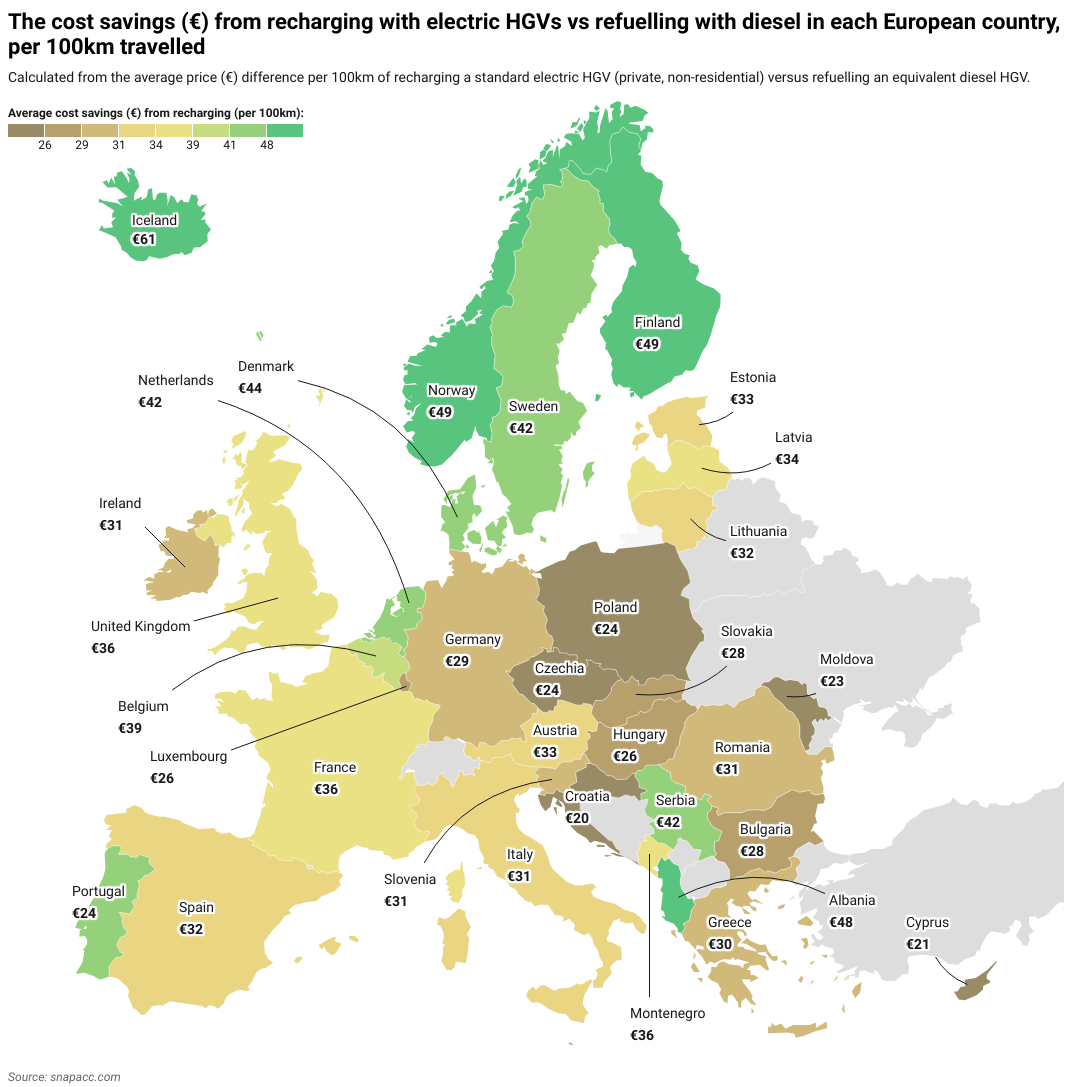
Za oceno izvedljivosti prehoda upravljavcev voznega parka z dizelskega na električni pogon je SNAP pripravil raziskavo o stroških polnjenja težkih tovornih vozil v primerjavi s polnjenjem na različnih evropskih tovornih poteh. Izračunali smo prihranke električne energije v primerjavi z dizelskim gorivom v evrih na 100 km v 35 evropskih državah.

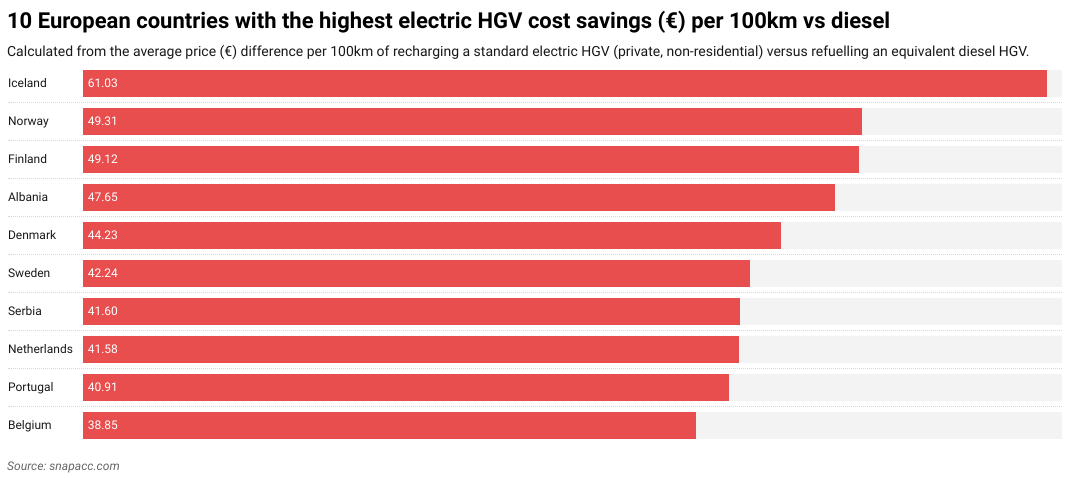
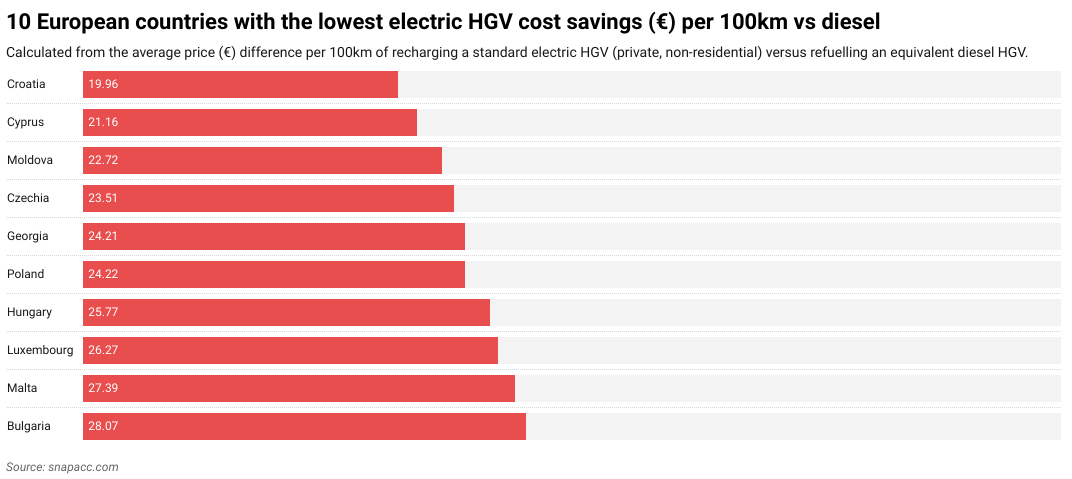
Ugotovili smo, da je Islandija vodilna s povprečnim prihrankom stroškov v višini 61,03 EUR na 100 km, nordijske države Norveška in Finska pa so na drugem oziroma tretjem mestu po višini prihrankov. Na drugi strani lestvice je najmanj stroškov prihranila Hrvaška, in sicer 19,96 EUR na 100 km, sledita pa ji Ciper in Moldavija.

V tem članku razkrivamo prihranke stroškov po evropskih državah in analiziramo nekatere prihranke stroškov po evropskih državah ter analiziramo nekatere zunanje dejavnike, ki bi lahko vplivali na te prihranke. Poglobimo se tudi v to, kakšna je lahko prihodnost vozil eHGV v Evropi ter kako lahko vozila eHGV pomagajo upravljavcem voznih parkov in voznikom prihraniti denar, zlasti pri vozniških proračunih.

Kako se stroški vozil eHGV in dizelskega goriva gibljejo po EU

Naša raziskava je pokazala, da je v vseh preučevanih evropskih državah uporaba eHGV z električnim polnjenjem prihranila denar v primerjavi z uporabo tradicionalnega težkega tovornega vozila z gorivom. Glavna razlika je bila v tem, koliko so se prihranki stroškov razlikovali. Na primer, cena električne energije v najdražji državi, Islandiji, je 206 % višja (41 EUR) kot v najcenejši državi, Hrvaški.

Ugotovili smo, da bo voznik električnega tovornega vozila v primerjavi z voznikom dizelskega tovornega vozila v povprečju prihranil 30,59 EUR na 100 km. To pomeni, da vozniki električnih težkih tovornih vozil na dolge razdalje v povprečju prihranijo 37 200 EUR* na leto, vozniki na domačem trgu pa 24 800 EUR*.

Pri zbiranju podatkov smo pregledali 35 evropskih držav in primerjali stroške energije ali goriva na 100 km za dve vrsti težkih tovornih vozil (HGV). Šlo je za standardno dizelsko težko tovorno vozilo, pri katerem je poraba goriva znašala 35 litrov na 100 km po povprečni maloprodajni ceni dizelskega goriva v vsaki državi, in električno težko tovorno vozilo, pri katerem je poraba električne energije znašala 108 kWh na 100 km na podlagi povprečne cene električne energije za negospodinjstva. DDV in vračljivi davki so bili iz teh izračunov izključeni. Primerjava odraža samo neposredne stroške "na črpalki" ali "na vtičnici" brez upoštevanja dejavnikov, kot so velikost voznega parka, sklenjene pogodbe o dobavi energije ali prihodnje spremembe cen goriva in električne energije.

Pri raziskovanju cen dizelskega goriva in električne energije so bili uporabljeni številni viri, med drugim Eurostat, CEIC, GlobalPetrolPrices, Webfleet in Gov.uk. Opozoriti velja, da se nekateri od teh virov nanašajo na "Veliko Britanijo", drugi pa na "Združeno kraljestvo". Za namene te raziskave sta bila oba izraza obravnavana kot zamenljiva.

Države, ki s prehodom na električna tovorna vozila prihranijo največ

Islandija (61,03 EUR), Norveška (49,31 EUR) in Finska (49,12 EUR) so trenutno države, v katerih je mogoče največ prihraniti s prehodom na električna tovorna vozila.

To je predvsem posledica tega, da so te države med najdražjimi v Evropi za dizelsko gorivo. Islandija je najdražja država v Evropi za dizelsko gorivo (2,07 EUR na liter). Ta visoka cena je v veliki meri posledica geografske izoliranosti v primerjavi s preostalo Evropo, zaradi česar so stroški uvoza dizelskega goriva veliko višji kot v drugih evropskih državah. Islandija je tako kot Norveška in Finska znana tudi po visoki davčni stopnji, ki prav tako prispeva k visokim stroškom goriva.

Norveška (32 %) in Islandija (18 %) sta prav tako dve državi na vrhu na svetu po deležu električnih avtomobilov na cestah med vsemi osebnimi avtomobili na cestah. Zato sta obe državi veliko vlagali v infrastrukturo za polnjenje električnih avtomobilov.

Islandija je majhna in ima glavno obvoznico, zato je tudi lažje v rednih časovnih presledkih namestiti električne polnilne postaje za voznike električnih tovornih vozil. Enako utemeljitev lahko delno uporabimo tudi za druge države z manjšimi omrežji, ki imajo visoko stopnjo prihrankov stroškov, vključno z Albanijo, Srbijo in Belgijo - čeprav je treba opozoriti, da imajo vse tri tudi nekatere od najdražjih cen dizelskega goriva v Evropi, kar prispeva k razliki v prihrankih stroškov.

Spodnja tabela prikazuje 10 držav z največjimi prihranki pri uporabi električnih tovornih vozil:
"Vozniki po vsej Evropi že varčujejo s prehodom na električna tovorna vozila. Prehod na polnjenje električnih tovornih vozil je prihodnost panoge in SNAP je pripravljen pomagati voznikom in upravljavcem voznih parkov pri tem prehodu. "

Matthew Bellamy - upravni direktor v podjetju SNAP

Države, ki s prehodom na električna tovorna vozila prihranijo najmanj

Hrvaška (19,96 EUR), Ciper (21,16 EUR) in Moldavija (22,72 EUR) so trenutno tri države z najnižjimi prihranki v Evropi.

Hrvaška ima drugo najpočasnejšo stopnjo uporabe električnih vozil v EU, takoj za Poljsko. Deloma je to posledica slabe hrvaške infrastrukture za polnjenje električnih vozil, kot so polnilne postaje, pri katerih je treba poklicati službo za pomoč uporabnikom ali uporabiti več različnih aplikacij za začetek postopka polnjenja, slabe usmeritve za polnilne postaje zunaj glavnih avtocest in potencialno dolge čakalne dobe na vrhuncu turistične sezone. Poleg tega na Hrvaškem ni polnilnih postaj za zelo visoke hitrosti (180 kW in več), kar je lahko težava za električna težka tovorna vozila, ki potrebujejo več energije kot povprečno električno vozilo.

Ciper in Moldavija imata notranja geopolitična vprašanja, ki otežujejo načrtovanje infrastrukture za polnjenje električnih vozil (kot tudi nacionalno načrtovanje na splošno). Na Cipru je severna polovica otoka - vključno s polovico glavnega mesta Nikozija - od leta 1974 okupirana s strani Turške republike Severni Ciper, ki jo podpira Turčija. Za Moldavijo vzhodna pokrajina Pridnestrje deluje kot dejanska država z lastno vlado. To pomeni, da obe državi ne moreta dosledno izvajati infrastrukture EV na ozemlju, ki ga štejeta za svoje.

Težave na Cipru so še večje zaradi visokih stroškov električne energije, medtem ko so cene dizelskega goriva v Moldaviji pete najcenejše v Evropi. Moldavija je tudi druga najrevnejša država v Evropi, zaradi česar so naložbe v infrastrukturo za električna vozila velik izziv. Vsi ti dejavniki prispevajo k nizkim splošnim prihrankom pri stroških električnih tovornih vozil.

Tudi Poljska je nizko na seznamu s prihrankom stroškov v višini 24,22 EUR. Kljub impresivni gospodarski rasti in vse večjim naložbam v infrastrukturo za polnjenje električnih vozil je pokritost na nekaterih območjih države še vedno problematična, čeprav se bo to v prihodnosti verjetno spremenilo (https://alternative-fuels-observatory.ec.europa.eu/general-information/news/poland-launches-major-funding-programs-zero-emission-transport).

Države, kot so Španija (32,20 EUR), Romunija (30,62 EUR) in Irska (30,54 EUR), so na sredini poti, ko gre za prihranek stroškov za električna tovorna vozila. To je verjetno posledica tega, da imajo te države vedno bolj razvito infrastrukturo za polnjenje električnih vozil ter srednje visoke cene električne energije in dizelskega goriva.

Spodnja tabela prikazuje 10 držav, v katerih so prihranki pri uporabi električnih tovornih vozil najnižji:
Prihranki stroškov električnih tovornih vozil v Združenem kraljestvu

V Združenem kraljestvu so prihranki pri stroških električnih tovornih vozil znašali 36,23 EUR, kar ga uvršča na 11. mesto na svetu po prihrankih pri stroških polnjenja na 100 km. To je predvsem posledica visokih cen goriva v Združenem kraljestvu, saj so cene dizla tretje najdražje v Evropi. Čeprav prihranki zaradi visokih cen dizelskega goriva vsekakor prispevajo k visokim prihrankom pri stroških eHGV v Združenem kraljestvu, bi bili ti verjetno veliko višji, če električna energija v Združenem kraljestvu ne bi bila tudi med najdražjimi v Evropi.

Tudi v Združenem kraljestvu pričakujejo izboljšanje infrastrukture za polnjenje električnih vozil. Britansko podjetje Moto, ki se ukvarja s storitvami na avtocestah, aktivno načrtuje izgradnjo 15 "superhub" do leta 2027. Ti superhubi lahko učinkoviteje kot standardne polnilnice za električna vozila prilagodijo polnjenje električnih vozil eHGV. Na britanskih cestah je trenutno manj kot pet posebnih polnilnih mest za vozila eHGV. Ker nameravajo vlagati tudi druga podjetja, kot sta BP Pulse in Aegis Energy, se zdi verjetno, da bo Združeno kraljestvo v bližnji prihodnosti imelo precej izboljšano omrežje za polnjenje težkih tovornih vozil.

Kaj vpliva na elektrifikacijo težkih tovornih vozil?

Na elektrifikacijo težkih tovornih vozil trenutno vpliva več dejavnikov, vključno s pomanjkanjem polnilne infrastrukture, dolgim časom polnjenja, visokimi začetnimi stroški predelave eHGV in njihovim omejenim dosegom. Poleg tega so zaradi razmeroma nizkih stroškov in dostopnosti dizelskega goriva in vozil tradicionalna težka tovorna vozila privlačna možnost za [upravljavce voznih parkov] (https://snapacc.com/fleet-operators/).

Vendar se vsi ti vplivi lahko razlikujejo glede na državo delovanja. Na primer, če vaš vozni park obratuje le na domačem trgu v državi, kot sta Norveška ali Islandija, bo verjetno manj prizadet kot vozni park, ki obratuje po vsej Evropi ali v regijah s slabšo infrastrukturo eHGV, na primer na Balkanu.

Nezadostna infrastruktura za polnjenje

Glavna ovira za elektrifikacijo težkih tovornih vozil je nezadostna infrastruktura za polnjenje eHGV. To je zato, ker vozila eHGV zahtevajo megavatno polnjenje, ki ga večina obstoječih polnilnih mest za osebna vozila (standardni električni avtomobili in kombiji) ne podpira.

V Evropi je veliko držav, v katerih takšne infrastrukture zelo primanjkuje, zlasti na glavnih tovornih poteh in postajališčih za tovornjake. To so običajno revnejše države v južni in vzhodni Evropi, kot so Moldavija, Gruzija in Bolgarija. Ni naključje, da se te države uvrščajo v spodnjo deseterico držav, kjer se prihranijo stroški z eHGV.

Lahko se tudi zgodi, da polnilne postaje za vozila eHGV obstajajo, vendar so na območjih, ki zaradi šibkega lokalnega električnega omrežja preprosto ne morejo sprejeti več vozil eHGV, ki se polnijo čez noč. To je pogosto težava v bolj podeželskih in oddaljenih delih Evrope.

Čeprav mnoge evropske države načrtujejo izboljšanje infrastrukture za eHGV, je to še vedno dolgotrajen in drag proces s številnimi birokratskimi, logističnimi in tehničnimi ovirami, ki jih je treba premagati - da ne omenjamo okoliških infrastrukturnih posodobitev, kot so povezave z lokalnim omrežjem, ki bodo prav tako potrebne.

Dolgi časi polnjenja

Električna tovorna vozila se polnijo veliko dlje kot standardna električna vozila. To pomeni, da se morajo pogosto polniti čez noč. Tudi če je mogoče pridobiti hitre polnilnice za vozila eHGV, postopek še vedno traja vsaj dve uri in ne le nekaj minut, kot je to značilno za bencinska vozila.

Ta dolgi čas polnjenja ima lahko za upravljavce voznih parkov posledice v smislu časa obratovanja. V panogi, kjer so urniki in roki za dostavo zelo kratki, je to lahko škodljivo za poslovno uspešnost.

Omejena ponudba vozil eHGV

Električna težka tovorna vozila so omejena tudi zaradi relativno omejenega dosega v primerjavi s kilometrskim dosegom, ki ga omogočajo tradicionalna težka tovorna vozila. Po podatkih podjetja Safety Shield ima tipično električno težko tovorno vozilo z enim polnjenjem doseg približno 300 milj (približno razdalja od Londona do Rotterdama). Tipično težko tovorno vozilo na dizelski pogon pa lahko z enim rezervoarjem goriva prevozi do 1000 milj (približno razdalja od Londona do Varšave).

Na prevožene kilometre električnih tovornih vozil lahko bolj vplivajo tudi zunanji dejavniki, kot so obremenitev, hladno vreme in teren. To lahko pri voznikih povzroči tesnobo glede dosega, zato se lahko pogosteje polnijo, da bi si zagotovili dovolj energije za prihod na cilj. To pa lahko privede do zamud pri dostavi, zlasti pri vožnji skozi države s slabo infrastrukturo za polnjenje vozil eHGV.

Zaradi vsega tega je optimizacija poti ključnega pomena za upravljavce voznih parkov, ki načrtujejo vožnje za svoja vozila eHGV. Opozoriti je treba, da se tehnologija baterij nenehno razvija in da se bo v bližnji prihodnosti zmogljivost - in s tem število prevoženih kilometrov - še naprej izboljševala.

Visoki stroški eHGV

Začetni stroški eHGV so visoki (običajno med 160.000 in 200.000 funtov v primerjavi z 80.000 in 100.000 funtov za dizelsko težko tovorno vozilo), kar lahko odvrne neodvisne voznike in manjše upravljavce voznih parkov od tega, da bi si ga izposodili. Razlog za to je predvsem strošek tehnologije akumulatorjev. To pomeni, da bo nakup novega električnega težkega tovornega vozila drag, saj je tehnologija v njem dražja kot pri dizelskem težkem tovornem vozilu.

Visoki začetni stroški nakupa vozil eHGV pomenijo tudi, da se bodo upravljavci voznih parkov v državah s cenejšo električno energijo za polnjenje vozil eHGV, kot so Norveška, Švedska ali Finska, pogosteje odločali za prehod, saj se jim bo naložba povrnila hitreje kot upravljavcem v državah z drago električno energijo, kot sta Irska in Hrvaška.

Cene električne energije lahko nihajo tudi zaradi različnih dogodkov. V zadnjih petih letih so na primer cene električne energije nihale zaradi odpiranja gospodarstev po pandemiji COVID-19 in nato zaradi ruskega vdora v Ukrajino leta 2022 (zlasti slednji je imel velike posledice za evropsko oskrbo z energijo). Posledično je v obdobju po invaziji prišlo do skoraj 30-odstotnega skoka cen električne energije, in sicer z 20,5 c€/kWh, na 26,5 c€/kWh za povprečno prestolnico EU. Ker pa je povprečje EU zdaj nižje kot leta 2022, se zdi, da se bo električno polnjenje tovornih vozil še naprej krepilo.

V Evropi so povprečni stroški vožnje električnega tovornega vozila na razdalji 100 km 20,51 EUR, kar je bistveno manj kot stroški vožnje dizelskega tovornega vozila na isti razdalji, ki znašajo 51,10 EUR.

Z izboljšanjem učinkovitosti in razširjenostjo tehnologije baterij, ki je cenejša za proizvodnjo, bodo tudi vozila eHGV postala cenovno dostopnejša.

Cenovno ugodno in dostopno dizelsko gorivo

Dizelsko gorivo ima še vedno prevladujočo vlogo v industriji težkih tovornih vozil. To je zato, ker je infrastruktura za dizelsko gorivo v Evropi že desetletja dobro uveljavljena, zlasti v primerjavi z električnimi polnilnicami za težka tovorna vozila. Zaradi združljivosti dizelskega goriva s karticami za gorivo in njegove relativno nizke cene ostaja priljubljeno tudi pri upravljavcih voznih parkov tovornih vozil.

Tako kot pri električni energiji tudi vrednost dizelskega goriva po vsej celini niha. Zato se v državah, kot so Moldavija, Gruzija in Malta, kjer je dizelsko gorivo še vedno poceni, lahko zdi, da je ugodneje ostati pri dizelskih tovornih vozilih. V državah, kot sta Islandija in Nizozemska, kjer je dizelsko gorivo razmeroma drago, pa obstaja večja spodbuda za prehod na električna tovorna vozila.

Država s poceni gorivom bo morda tudi bolj zadržana pri obsežnih naložbah v infrastrukturo za eHGV, saj se boji, da bo odvrnila tradicionalne vozne parke težkih tovornih vozil, ki bodo zaradi tega morda izbrali alternativne poti.
Prihodnost električnih tovornih vozil v Evropi

Električna tovorna vozila so dolgoročna prihodnost cestnega tovornega prometa. Ne le, da je njihova uporaba sčasoma cenejša, temveč bodo zaradi hitrega vlaganja v novo infrastrukturo in njene izgradnje postala tudi finančno in strateško veliko bolj donosna.

Poleg gospodarskih koristi so električna tovorna vozila pomembna tudi zaradi svojega prispevka k okoljskim ciljem, kot je Net Zero. Tradicionalna težka tovorna vozila so velika onesnaževala, zato se bodo prihranjene emisije, ki jih bodo proizvedla eHGV, poznale v čistejšem zraku po vsej Evropi.

Naslednji trendi bodo v prihodnosti vplivali na električna tovorna vozila:

  • Smart truck parks: Truck parks in the future will evolve to better accommodate eHGVs alongside other smart technological advancements. These truck parks may include up-to-date ultra-fast charging stations, diagnostic machines, battery swap stations, and automated cleaning services, among other features.
  • Increased EU regulations: Low Emission Zones (LEZs) already exist in a number of cities (e.g. Paris, Berlin, and Milan) with more European cities likely to follow suit with more stringent EU transport regulations. Fleet operators may opt for eHGVs to meet EU regulations or retrofit their HGVs with cleaner technologies, like smart tachographs.
  • AI implementation: AI technology has already had a profound sustainability impact across road haulage — with applications in route optimisation, predictive maintenance, and autonomous vehicle development. Electric vehicles will likely incorporate AI to help drive sustainability in the haulage industry over the coming decades.
  • Sustainability: The shift to eHGVs is part of a wider global push toward sustainable living. The effects of extreme weather, including heatwaves and floods across Europe, show no sign of slowing due to climate change. Moving to electric HGVs is one way the world is reducing its dependence on fossil fuels.
  • Fuel variety: During the transition to cleaner fuel sources, there will be a variety of HGV types on the road throughout the 2030s. Many will be older diesel models, some will be electric, and others will be powered by alternative fuels such as biofuel made from renewable biomass sources.

Pametnejše upravljanje stroškov eHGV

Električna težka tovorna vozila so prihodnost, o tem ni dvoma. Zaradi ekonomskih in okoljskih koristi bo v prihodnjih letih vse več upravljavcev voznih parkov in voznikov prešlo na električna kombinirana vozila. Kako dolgo bo trajalo to prehodno obdobje, je odvisno od tega, kako hitro bo Evropa razvila svojo polnilno infrastrukturo za eHGV.

Trenutno so na celini velike površine, na katerih vozila eHGV niso izvedljiva in na katerih je zaradi krajšega dosega potrebna obsežna optimizacija poti. Poleg tega lahko začetni stroški odvračajo neodvisne voznike in manjše upravljavce voznih parkov.

Tehnologija in infrastruktura se bosta še naprej izboljševali, na voljo pa so že storitve, namenjene čim enostavnejšemu upravljanju voznih parkov eHGV in s tem povezanih stroškov. Od optimizacije poti in upravljanja voznega parka do zemljevidov za parkiranje in pranje tovornjakov - SNAP poenostavlja prevoz tovornjakov.

Prijavite se na SNAP še danes.

Delite z

Tudi drugi berejo...

Header Image

sreda 15 april 2026 • Industrijske novice

KRAJA TOVORA V EVROPI: ZAKAJ SE POVEČUJE IN KAKO LAHKO VOZNI PARKI ZMANJŠAJO TVEGANJE

Guest

Cargo theft is a growing threat across Europe. What was once seen as an occasional disruption is now a more persistent and organised risk to road transport, affecting fleets, drivers and the wider supply chain. Reported losses and incidents have risen sharply, with one widely cited industry figure pointing to a in recent years. In alone, 557 cargo crimes were recorded across 38 countries in the TAPA EMEA Intelligence System, and even though values were disclosed for fewer than one in five incidents, those 100 cases still totalled more than €43 million.In this article, we explore the current trends and what fleet managers and operators can do to minimise their risks.Food and beverage shipments are among the most commonly targeted categories in Europe, accounting for . also rank highly. These goods are attractive because they are easy to move, easy to sell and often difficult to trace once they enter secondary markets.The recent on its way from Italy to Poland is a useful example. Nestlé said the missing load amounted to roughly 413,793 bars, showing how quickly a mainstream consumer shipment can become a target when moving across borders.These shipments are attractive targets for organised groups because they can be offloaded quickly, resulting in rapid returns. Cargo crime often happens while loads are moving. report found that hijackings accounted for 21% of incidents, while 41% of thefts happened in transit. That is a reminder that risk does not begin when a truck parks for the night. It can begin long before a vehicle stops for the night, particularly on exposed corridors or routes where load visibility and security controls are weaker.Parked vehicles remain a major point of vulnerability. In the UK, Munich Re reported that nearly half of all thefts take place at unsecured roadside parking and rest areas. Across Europe, unsecured roadside locations and rest areas continue to feature prominently in cargo crime reporting, especially where drivers have limited alternatives and secure sites are full.Some of the most concerning incidents show coordination. recently documented attacks in Germany in which dozens of trucks were targeted in a single night along the A1 corridor. In one November 2023 incident, 67 trucks had trailers slashed at service and rest areas including Ostetal South and Grundbergsee South. Similar attacks had already taken place on the same route months earlier.Germany remains one of the clearest hotspots, largely because of the scale of freight passing through the country. Analysis showed that in 2023, more than double France in second place. Other recurring hotspots include France, Italy, Spain and the United Kingdom. That pattern reflects the reality of European freight movement. Dense logistics networks, major freight hubs and heavily used motorways create more opportunities for organised criminals, especially when secure parking capacity fails to keep pace with demand.Munich Re warns that cargo thieves are increasingly using more sophisticated methods, including identity deception, cyber-enabled scams and other tactics that bypass traditional controls. Wider points to GPS jamming, paperwork manipulation and shipment diversion as part of that shift.A stolen load may now begin with compromised data, a fraudulent carrier, a diverted instruction or a vehicle whose movements can no longer be tracked properly. For fleets, that means theft prevention now involves more than physical security. It also requires tighter dispatch processes, better control over shipment data and clearer real-time visibility.The most obvious impact is financial. Stolen goods lead to lost goods, insurance claims and disruption. But the direct value of the missing load is only part of the problem. Delayed deliveries, vehicle damage, missed slots and customer dissatisfaction can all push the true cost much higher. There is also a human cost. Drivers may face intimidation, confrontation or the shock of discovering that their vehicle has been tampered with while they were resting. Even where there is no direct violence, exposure to insecure roadside stops creates stress, fatigue and a sense of vulnerability that can affect driver welfare and retention. Operationally, the knock-on effects spread quickly through the supply chain. A single theft can mean missed delivery windows, rerouted vehicles, stock shortages and added pressure on already stretched teams. For temperature-sensitive, time-critical or high-value loads, the consequences can multiply fast.There is no single fix, but fleets can reduce exposure with a more structured approach to planning, parking and security.Secure parking remains one of the clearest areas for improvement. TAPA’s Parking Security Requirements framework provides an internationally recognised benchmark for secure truck parking, helping operators assess which locations offer stronger protection for vehicles, loads and drivers. Choosing accredited sites will not eliminate cargo theft, but it can significantly reduce the opportunity for organised criminals to strike.In practice, that may mean stopping earlier than planned to reach a safer site rather than pushing on to an unsecured lay-by. While that can feel less efficient in the moment, it is often the more resilient choice.For fleets, the challenge is not just knowing secure parking matters but being able to access it easily. SNAP helps bridge that gap by giving drivers and operators better visibility of trusted parking options across the UK and Europe, making it simpler to plan and reserve safer stops from the outset.Read more: Cybersecurity now sits alongside physical security in any serious theft-prevention strategy. Tracking, geofencing and anti-jamming tools can all help, but only if they are backed by clear processes. Fleets should review how shipment data is shared, who can alter route instructions, how delivery paperwork is verified and what happens if a vehicle suddenly disappears from view. Drivers are often the last line of defence, but they should not carry the burden alone. Clear escalation procedures, regular check-ins, secure rest planning and training on suspicious activity all matter. One of the biggest structural issues behind cargo theft is the shortage of secure truck parking. When drivers cannot find protected sites with proper lighting, access control and welfare facilities, they are more likely to end up in the very locations thieves are already targeting. SNAP has trained working to accredit more parking sites across the UK and continental Europe, helping expand the availability of secure truck parking and reduce opportunities for organised theft.For fleets, the challenge is not just understanding risk, but building safer stopping decisions into everyday operations. At SNAP, we help drivers and operators identify trusted parking options across the UK and Europe, making it easier to plan routes with security and driver welfare in mind.

Header Image

sreda 11 marec 2026 • Industrijske novice

PARKIRANJE TOVORNJAKOV V EVROPI: PRAVILA, VRZELI IN TVEGANJA

Guest

Ask most fleet operators what makes life harder than it needs to be and you’ll hear the same answer across Europe: truck parking.Drivers have to stop. Hours rules and rest requirements make that non-negotiable. But on many of Europe’s busiest transport corridors, finding a safe, legal place to park is still uncertain. Capacity is low, security varies widely and most urban hubs aren’t built with HGVs in mind.That pressure has consequences. When designated areas are full, drivers are pushed towards places that were never intended for HGV parking: slip roads, access ramps and industrial estates. Compliance becomes a choice between two risks: stop where you shouldn’t, or keep driving when you shouldn’t.When truck parking overflows into unsuitable places, the environment becomes dangerous: poor visibility, high speeds, unpredictable manoeuvres and limited escape routes. starkly in February 2026, reporting fatal crashes in Germany and Belgium involving stationary lorries. The article challenges the easy explanation of “illegal parking” and points back to the underlying cause: drivers were out of driving time and the spaces were gone.In addition, a shortage of truck parking in Europe doesn’t just mean “no space”; it often means the only available space is poorly lit, unmonitored and isolated. That elevates the risk of theft and driver harm, which can have a knock-on effect for supply chain reliability.Poor parking provision also affects workforce sustainability. When drivers face uncertainty around legal, safe stopping, it makes the role harder and less attractive – compounding .For a long time, the conversation about truck parking focused on enforcement: where you can’t park and the penalties that follow. Increasingly, the focus is moving towards provision: where drivers can stop safely, reliably and legally. Under revised Trans-European Transport Network (TEN-T) rules, EU Member States must ensure the development of certified secure parking . The same requirement sets expectations for the location of truck parking. It must be immediately on the network or within 3km of an exit, which will have benefits for route planning. Alongside this shift, the European Commission positions safe and secure truck parking as a priority within its Intelligent Transport Systems work, including the need for to help drivers locate suitable sites.But the EU isn’t just asking Member States to add more truck parking spaces. It’s also defining what “safe and secure” means. In April 2022, the European Commission adopted EU standards for , categorising sites into four security levels: bronze, silver, gold and platinum. The intention is to create transparency for drivers and fleets, and to support investment by giving operators a clear target to design and audit against.This sits against a significant capacity gap. A European Commission study estimates a across the bloc, with the gap potentially rising towards half a million by 2040 if the network does not scale at the pace freight demand requires.Looking at more practical aspects of the situation, what are HGV parking rules and regulations in Europe?At first glance, HGV parking rules across Europe look consistent: Motorways are not designed to absorb overflow parking. Hard shoulders exist for emergencies and safety buffers. Access ramps are not for planned stopping.Urban areas add a layer of complexity. Local restrictions and enforcement are common because HGV parking competes with residents, retail and public space – and because badly parked vehicles create safety risks.Rules around HGV parking in the UK are clear. Trucks should use designated areas such as motorway services, truckstops and lorry parks. Conversely, drivers must avoid parking in locations that create risks, such as pavements, verges and central reservations. Restrictions around parking in residential areas vary by local authority, so it’s vital to check if this is unavoidable. The major constraint is supply. The RHA’s estimate of an , with very high utilisation on key routes, helps explain why informal and unsafe parking persists even where drivers know it isn’t ideal. In 2022, the Department for Transport across England, aimed at better rest areas and more secure parking, framed as part of a broader programme to improve roadside facilities.In Germany, motorway stopping rules are anchored in the (StVO), which makes clear that stopping on the autobahn – including the hard shoulder – is prohibited except in emergencies. That means running out of driving time is not treated as justification. Fines increase if obstruction or danger is caused, and enforcement is active on heavily used corridors. Poland follows the familiar motorway rule that hard shoulders are reserved for breakdowns and emergencies. The nuance appears within cities, where tonnage-based entry restrictions and are common. Overnight HGV parking in urban areas can require municipal approval and enforcement varies between municipalities. For cross-border fleets, that means treating urban stopping as permission-led rather than assumed.France reinforces the same principle through the . Articles R417-9 and R417-10 classify dangerous or obstructive parking offences, and stopping on autoroute carriageways or shoulders is prohibited except in cases of absolute necessity. Penalties can include fines and licence points.However, publishes dedicated information for secure truck parking on its network, reflecting how motorway operators guide HGV stopping into appropriate locations.Spain’s prohibits stopping on motorway shoulders except in emergencies, aligning with broader European practice. Additional complexity lies at municipal level. Many cities operate local overnight bans or restrict HGV parking to designated industrial zones, with enforcement handled by local police rather than motorway authorities. That creates a layered compliance environment: legal on the motorway network does not automatically mean legal in urban areas.To highlight positive developments, that a truck parking facility in La Jonquera became the first in Spain to receive TAPA certification, describing measures such as controlled access, fencing, lighting and continuous monitoring.Italy distinguishes clearly between motorway carriageways, ramps and designated service areas. Stopping on access or exit ramps is explicitly prohibited, and enforcement around motorway infrastructure is consistent. Importantly, Italy differentiates between aree di servizio (full service areas with facilities) and simpler rest or parking lay-bys, which may not support overnight welfare needs. However, Italy is also seeing new secure truck parking developments focused on welfare and security, reflecting the wider European momentum towards better provision.Across Europe, an additional regulatory layer now shapes truck parking decisions: Low Emission Zones (LEZs) and restricted urban traffic zones. Cities in France (Crit’Air), Germany (Umweltzonen), Spain (Zonas de Bajas Emisiones) and Italy (ZTL areas) impose vehicle-class or permit requirements that can apply even to stationary vehicles within the zone. A driver who parks overnight in a restricted area without the correct classification or registration risks fines – even if the stop itself is otherwise legal. Across Europe in 2026, the rules are clear. The constraint is capacity, especially near urban hubs and on high-volume corridors. For fleets, this has a practical impact: European truck parking can’t be left to chance at the end of a shift. It needs to be planned with the same seriousness as , routing, driver hours and security – because when the network fails to provide legal space, every other compliance system gets squeezed.SNAP can help. .

Header Image

četrtek 26 februar 2026 • Industrijske novice

ŽENSKE V TOVORNEM PROMETU: ODPIRANJE NEIZKORIŠČENIH TALENTOV

Guest

Across the UK, around . They transport food to supermarkets, materials to construction sites and goods to ports and distribution centres. They underpin daily life and economic stability, forming a critical part of the UK’s national infrastructure.Yet only around . That amounts to roughly one per cent of the UK HGV workforce, according to reporting by . For an industry facing long-term recruitment pressure, that figure raises important questions about where future talent will come from and how the sector presents itself to potential entrants.There are signs of progress, however. The percentage of from 6.7% in 2011/12 to 9.7% by 2021/22. Over the past decade, women securing Category C and C+E licences increased by 144%, according to SME Web. More women are clearly choosing to train and qualify. The pipeline is widening, but the proportion of women behind the wheel remains marginal.Women have not been entirely absent from road transport. One of the earliest recorded female truck drivers was, who began driving heavy vehicles in the United States in 1918. During wartime periods in both the US and the UK, women stepped into transport roles out of necessity. Then, in the 1960s, became the UK’s first long-distance lorry driver, often working 100-hour weeks.However, outside exceptional circumstances, haulage has traditionally been male dominated. Cultural perceptions, physical assumptions about the work and the lifestyle associated with long distance driving have all played a part. Only in recent decades has participation begun to shift in a more sustained way.The reasons for low female participation are not limited to awareness. Structural and practical barriers remain.Facilities are a big concern. Professional drivers depend on secure parking, clean rest areas and appropriate welfare provision. For many years, roadside infrastructure has struggled to meet demand across the board. When rest stops are inadequate, poorly lit, feel unsafe or lack privacy, this can discourage women from joining the sector.Working patterns also play a role. Long-haul journeys can involve overnight stays and time away from home. While many drivers value the independence that comes with the role, the perception of work-life balance may deter some women, especially those with caring responsibilities. There is also the issue of visibility. When only one per cent of drivers are women, prospective candidates may struggle to see themselves in the sector. In addition, menopause symptoms such as fatigue, sleep disruption, hot flushes and anxiety can be difficult to manage in roles that involve long hours, limited access to private facilities and time away from home. In sectors where welfare provision is already under pressure, a lack of understanding or practical support can lead to experienced drivers leaving the workforce.For haulage, this is not a peripheral issue. Retaining experienced drivers is as important as attracting new entrants. Change is not confined to driving roles. Across the broader transport and logistics ecosystem, women are increasingly visible in management, planning and policy functions.The shows that leadership representation by women has increased from 26% to 36% in recent years. However, much of this growth has taken place outside core operational functions. Senior representation within frontline transport roles remains comparatively limited.Several industry organisations are addressing this gap. Women in Transport offers mentorship opportunities, while everywoman recognises excellence through its , raising the profile of female professionals across the sector. The Chartered Institute of Logistics and Transport has also announced a new , aimed at supporting career progression and professional networks.Alongside this, community initiatives such as demonstrate that interest and engagement are growing. The spotlighting female drivers and employees, further increasing visibility. Collectively, these platforms help challenge outdated perceptions and provide practical support for women entering or advancing within the industry.For the UK haulage sector, this is not just a diversity conversation. It is a strategic one.Previous industry reporting has highlighted the scale of recruitment pressure across logistics. The that tens of thousands of new drivers will be required in the coming years to maintain supply chain stability. At the same time, the existing workforce is ageing.With only one per cent of drivers currently women, a significant proportion of the potential labour market remains underrepresented. If participation rates were to move closer to parity with the wider workforce, the impact on recruitment could be substantial.There is also evidence that inclusive cultures contribute to improved retention and engagement. A sector that demonstrates visible progression pathways, fair access to training and appropriate welfare provision is likely to appeal more broadly across demographics.Progress will not accelerate through awareness alone. Structural changes are needed.Investment in safe, well maintained roadside facilities is fundamental. Secure parking, adequate lighting and clean welfare amenities benefit all drivers and remove avoidable barriers to entry.Flexible working models, where operationally feasible, can broaden appeal. This may include regional route design, job sharing arrangements or clearer progression pathways from warehouse and planning roles into driving positions.Funded licence pathways and apprenticeships can also reduce financial barriers. As previously outlined, the cost of training can be significant. Targeted funding initiatives aimed at underrepresented groups can support a more balanced intake.Finally, transparency around workforce data matters. Publishing gender breakdowns, monitoring progression rates and setting measurable objectives signal that inclusion is being taken seriously.International Women’s Day provides an opportunity to reflect on how far the UK haulage industry has come and how far it still has to go. The rise in female licence acquisition and test pass rates demonstrates that interest exists. Leadership representation is improving in some areas and support networks are expanding. However, the scale of underrepresentation remains stark.Haulage is central to national resilience. It keeps shelves stocked, infrastructure projects supplied and trade flowing. Ensuring that this workforce reflects the full breadth of available talent is not simply a question of equity. It is a matter of long term sustainability.Supporting women in haulage also means improving the day-to-day realities of life on the road. Access to secure parking, well-lit rest areas and appropriate facilities is fundamental to retention and wellbeing for all drivers. SNAP’s intruck app helps all drivers locate and book trusted truck stops across the UK and Europe, giving fleets greater visibility and drivers greater confidence wherever their route takes them. .