Guest
Novinky z odvetvia • 9 min čítania

Palivo vs. náplň: Je prechod na elektrický pohon lacnejší alebo len ekologickejší?

Vytvorené: 28. 07. 2025

Aktualizované: 19. 09. 2025

Nárast počtu elektrických nabíjacích staníc pre nákladné vozidlá v Európe viedol k prechodnému obdobiu na rozsiahlych cestných sieťach kontinentu. Pre mnohých prevádzkovateľov vozových parkov a vodičov sú klasické nákladné vozidlá s naftovým motorom stále obľúbeným dopravným prostriedkom. Prechod na elektrické nákladné vozidlá je však na obzore, pretože odvetvie sa naďalej vyvíja.

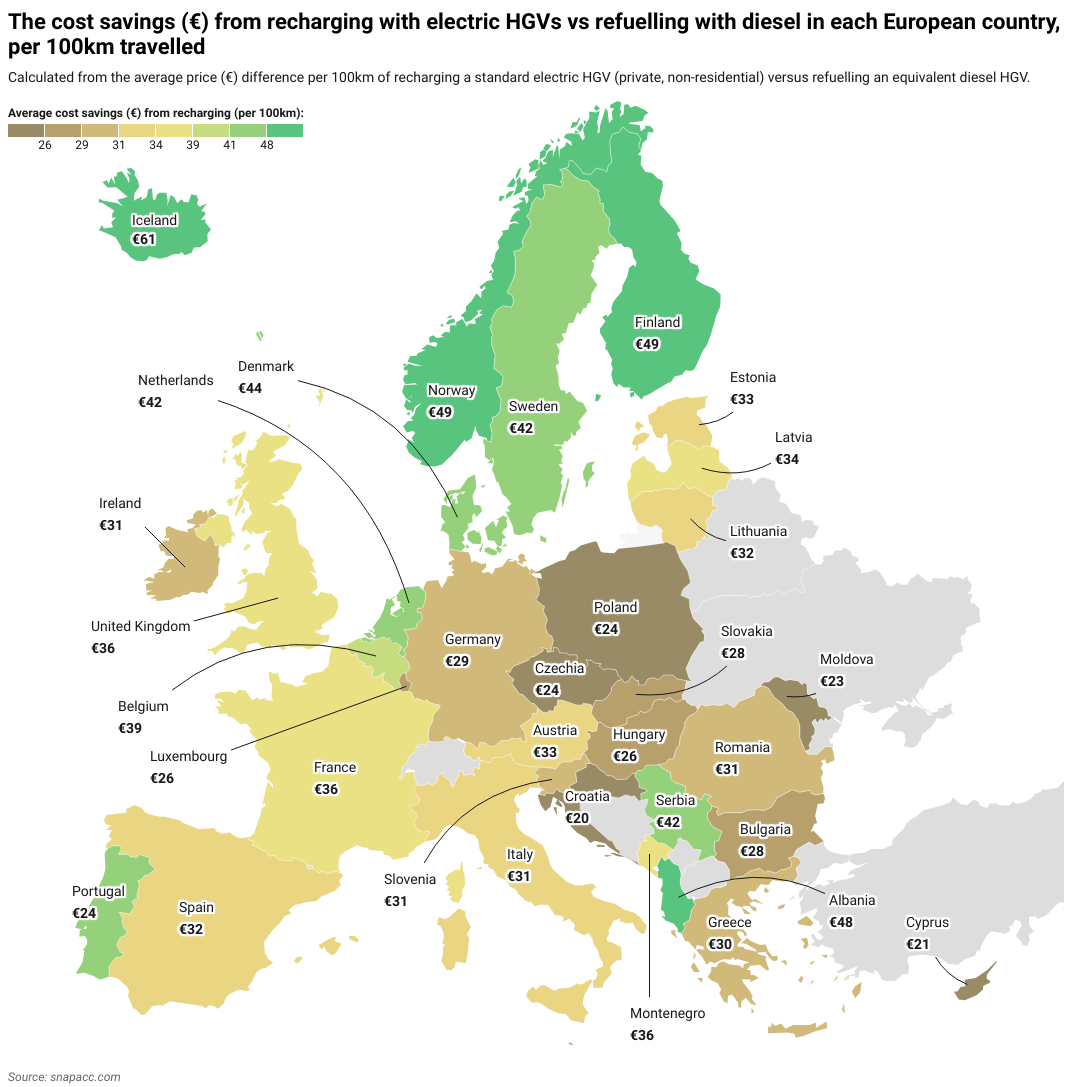
S cieľom posúdiť uskutočniteľnosť prechodu prevádzkovateľov vozového parku z dieselového na elektrický pohon je SNAP autorom výskumu nákladov na dobíjanie ťažkých nákladných vozidiel v porovnaní s ich tankovaním na rôznych európskych trasách nákladnej dopravy. Vypočítali sme úspory elektrickej energie v porovnaní s naftou v eurách na 100 km v 35 európskych krajinách.

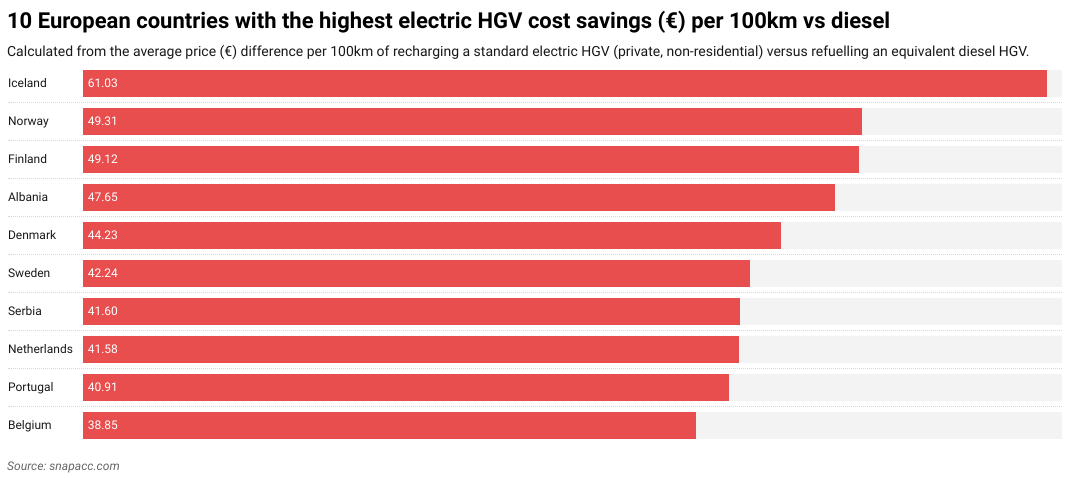
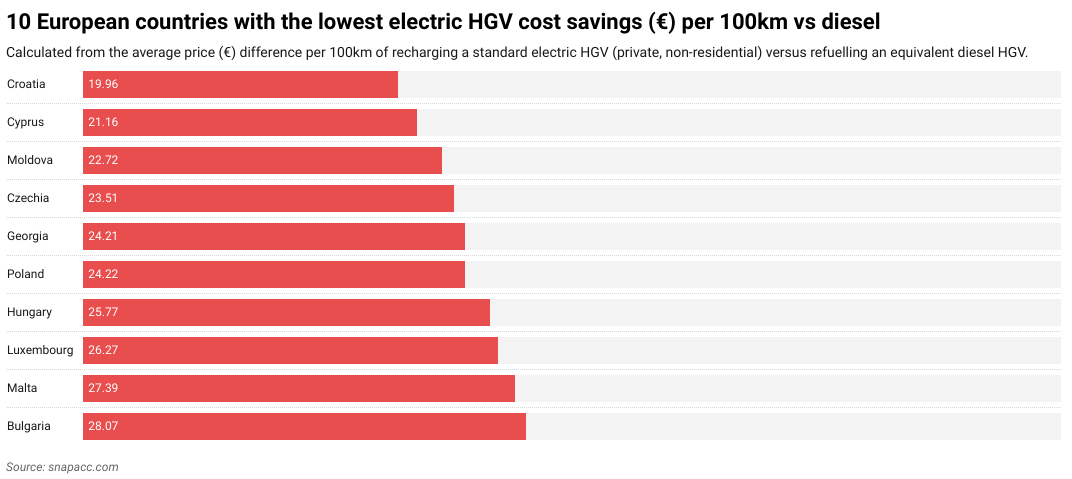
Zistili sme, že Island je na čele s priemernou úsporou nákladov vo výške 61,03 EUR na 100 km, pričom druhú najvyššiu úsporu nákladov dosiahli severské krajiny Nórsko a tretiu Fínsko. Na opačnom konci rebríčka sa nachádza Chorvátsko s najnižšími úsporami nákladov vo výške 19,96 EUR na 100 km, za ktorým nasledujú Cyprus a Moldavsko.

V tomto článku odhaľujeme úspory nákladov v jednotlivých európskych krajinách a analyzujeme niektoré úspory nákladov v jednotlivých európskych krajinách a analyzujeme niektoré externé faktory, ktoré môžu mať vplyv na tieto úspory. Ponoríme sa aj do toho, ako môže vyzerať budúcnosť eHGV v Európe, ako aj do toho, ako môžu eHGV pomôcť prevádzkovateľom vozových parkov a vodičom ušetriť peniaze, najmä v prípade rozpočtov vodičov.

Ako sa vyvíjajú náklady na eHGV a naftu v EÚ

Náš prieskum zistil, že v každej skúmanej európskej krajine ušetrilo používanie eHGV s elektrickým nabíjaním peniaze v porovnaní s používaním tradičného nákladného vozidla s palivom. Hlavný rozdiel bol v tom, ako veľmi sa úspory nákladov líšili. Napríklad cena elektriny v najdrahšej krajine, Islande, je o 206 % vyššia (o 41 eur) ako v najmenej nákladnej krajine, Chorvátsku.

Zistili sme, že vodič elektrického nákladného vozidla ušetrí v priemere 30,59 EUR na 100 km v porovnaní s vodičom nákladného vozidla s naftovým motorom. To znamená odhadovanú priemernú úsporu 37 200 EUR ročne pre vodičov elektrických nákladných vozidiel na dlhé trate a 24 800 EUR pre vodičov na vnútroštátne účely.

Pri zostavovaní našich údajov sme sa zamerali na 35 európskych krajín a porovnali sme náklady na energiu alebo palivo na 100 km pre dva typy ťažkých nákladných vozidiel (HGV). Išlo o štandardné dieselové ťažké nákladné vozidlo, ktoré predpokladalo spotrebu paliva 35 litrov na 100 km pri priemernej maloobchodnej cene nafty v každej krajine, a elektrické ťažké nákladné vozidlo, ktoré predpokladalo spotrebu elektrickej energie 108 kWh na 100 km na základe priemernej sadzby za elektrickú energiu mimo domácností. DPH a vratné dane boli z týchto výpočtov vylúčené. Porovnanie odráža len priame náklady "pri čerpadle" alebo "pri zástrčke" bez zohľadnenia faktorov, ako sú veľkosť vozového parku, dohodnuté zmluvy o dodávke energie alebo budúce zmeny cien palív a elektrickej energie.

Pri skúmaní cien nafty a elektrickej energie sa čerpalo z viacerých zdrojov vrátane Eurostat, CEIC, GlobalPetrolPrices, Webfleet a Gov.uk. Je potrebné poznamenať, že niektoré z týchto zdrojov sa vzťahujú na "Veľkú Britániu", zatiaľ čo iné sa vzťahujú na "Spojené kráľovstvo". Na účely tohto výskumu sa oba pojmy považujú za zameniteľné.

Krajiny, ktoré najviac ušetria prechodom na elektrické nákladné vozidlá

Island (61,03 EUR), Nórsko (49,31 EUR) a Fínsko (49,12 EUR) sú v súčasnosti krajiny, v ktorých možno najviac ušetriť prechodom na elektrické nákladné vozidlá.

Je to spôsobené najmä tým, že tieto krajiny patria k najdrahším v Európe, pokiaľ ide o naftu. Island je najdrahšou krajinou v Európe, pokiaľ ide o naftu (2,07 EUR za liter). Táto vysoká cena je spôsobená najmä jeho geografickou izoláciou v porovnaní so zvyškom Európy, takže náklady na dovoz nafty sú oveľa vyššie ako v iných európskych krajinách. Island, podobne ako Nórsko a Fínsko, je známy aj vysokou daňovou sadzbou, ktorá tiež prispieva k vysokým nákladom na pohonné hmoty.

Nórsko (32 %) a Island (18 %) sú tiež na prvých dvoch miestach na svete, pokiaľ ide o podiel elektromobilov na cestách. V dôsledku toho obe krajiny výrazne investovali do infraštruktúry na nabíjanie elektrických vozidiel.

Malá rozloha Islandu a hlavný cestný okruh tiež uľahčujú inštaláciu elektrických nabíjacích staníc v pravidelných intervaloch pre vodičov elektrických nákladných vozidiel. Rovnakú argumentáciu možno čiastočne použiť aj v prípade ďalších krajín s menšími sieťami, ktoré majú vysokú mieru úspory nákladov, vrátane Albánska, Srbska a Belgicka - hoci treba poznamenať, že všetky tri krajiny majú aj jedny z najdrahších cien nafty v Európe, čo prispieva k rozdielom v úsporách nákladov.

V nasledujúcej tabuľke je uvedených 10 krajín, ktoré dosahujú najväčšie úspory nákladov pri používaní elektrických nákladných vozidiel:
"Vodiči v celej Európe už šetria prechodom na elektrické nákladné vozidlá. Prechod na nabíjanie eHGV je budúcnosťou odvetvia a SNAP je pripravený pomôcť vodičom a prevádzkovateľom vozových parkov pri tomto prechode. "

Matthew Bellamy - Výkonný riaditeľ spoločnosti SNAP

Krajiny, ktoré najmenej ušetria prechodom na elektrické nákladné vozidlá

Chorvátsko (19,96 EUR), Cyprus (21,16 EUR) a Moldavsko (22,72 EUR) sú v súčasnosti tri krajiny s najnižšími úsporami nákladov v Európe.

Chorvátsko má druhú najpomalšiu mieru zavádzania elektrických vozidiel v EÚ po Poľsku. Čiastočne je to spôsobené nedostatočnou infraštruktúrou nabíjania EV v Chorvátsku, napríklad nabíjacími stanicami, ktoré vyžadujú zavolanie na zákaznícku službu alebo použitie viacerých rôznych aplikácií na spustenie procesu nabíjania, zlým smerovaním nabíjacích staníc mimo hlavných diaľnic a potenciálne vysokými čakacími dobami počas hlavnej turistickej sezóny. Okrem toho v Chorvátsku chýbajú ultrarýchle nabíjacie stanice (180 kW a viac), čo môže byť problémom pre elektrické nákladné vozidlá, ktoré potrebujú viac energie ako priemerný elektromobil.

Cyprus aj Moldavsko majú vnútorné geopolitické problémy, ktoré sťažujú plánovanie infraštruktúry pre nabíjanie elektrických vozidiel (ako aj vnútroštátne plánovanie vo všeobecnosti). Pokiaľ ide o Cyprus, severná polovica ostrova - vrátane polovice jeho hlavného mesta Nikózia - je od roku 1974 okupovaná Tureckou republikou Severný Cyprus, podporovanou Tureckom. V prípade Moldavska pôsobí východná provincia Podnestersko ako de facto štát s vlastnou vládou. To znamená, že obe krajiny nie sú schopné zaviesť infraštruktúru EV jednotným spôsobom na celom území, ktoré považujú za svoje vlastné.

Problémy na Cypre sa znásobujú aj vysokými nákladmi na elektrickú energiu, zatiaľ čo Moldavsko má piate najlacnejšie ceny nafty v Európe. Moldavsko je tiež druhou najchudobnejšou krajinou v Európe, čo spôsobuje, že investície do infraštruktúry elektrických vozidiel sú náročné. Všetky tieto faktory prispievajú k celkovo nízkym úsporám nákladov na elektrické nákladné vozidlá.

Poľsko sa tiež umiestnilo na nižšej priečke v zozname s úsporou nákladov vo výške 24,22 EUR. Napriek pôsobivému hospodárskemu rastu a rastúcim investíciám do infraštruktúry na nabíjanie elektrických vozidiel je pokrytie v niektorých oblastiach krajiny stále problémom, aj keď sa to v budúcnosti zrejme zmení (https://alternative-fuels-observatory.ec.europa.eu/general-information/news/poland-launches-major-funding-programs-zero-emission-transport).

Krajiny ako Španielsko (32,20 EUR), Rumunsko (30,62 EUR) a Írsko (30,54 EUR) sa nachádzajú v strede cesty, pokiaľ ide o úsporu nákladov na elektrické nákladné vozidlá. Je to pravdepodobne spôsobené tým, že tieto krajiny majú rastúcu infraštruktúru na nabíjanie elektrických vozidiel a stredné ceny elektrickej energie a nafty.

V nasledujúcej tabuľke je uvedených 10 krajín, ktoré dosahujú najnižšie úspory nákladov pri používaní elektrických nákladných vozidiel:
Úspory nákladov na elektrické nákladné vozidlá v Spojenom kráľovstve

Veľká Británia dosiahla úsporu nákladov na elektrické nákladné vozidlá vo výške 36,23 EUR, čo ju celkovo radí na 11. miesto v rebríčku úspor nákladov na dobíjanie na 100 km. Je to spôsobené najmä tým, aké drahé sú ceny pohonných hmôt v Spojenom kráľovstve, pričom cena nafty je tretia najdrahšia v Európe. Hoci úspory z vysokých cien nafty určite prispievajú k vysokým úsporám nákladov Spojeného kráľovstva na eHGV, boli by pravdepodobne oveľa vyššie, keby elektrická energia v Spojenom kráľovstve nepatrila tiež medzi najdrahšie v Európe.

Spojené kráľovstvo tiež očakáva zlepšenie infraštruktúry na nabíjanie elektrických vozidiel. Britská spoločnosť Moto, ktorá poskytuje služby na diaľniciach, aktívne plánuje vybudovať 15 "superhubov" do roku 2027. Tieto superhuby dokážu lepšie prispôsobiť nabíjanie EV pre eHGV efektívnejšie ako štandardné nabíjačky EV. V súčasnosti je na cestách Spojeného kráľovstva menej ako päť nabíjacích miest určených pre vozidlá eHGV. Vzhľadom na to, že ďalšie spoločnosti, ako napríklad BP Pulse a Aegis Energy, chcú tiež investovať, sa zdá byť pravdepodobné, že Spojené kráľovstvo bude mať v blízkej budúcnosti oveľa lepšiu sieť na nabíjanie ťažkých nákladných vozidiel.

Čo ovplyvňuje elektrifikáciu nákladných vozidiel?

Elektrifikáciu ťažkých nákladných vozidiel v súčasnosti ovplyvňuje niekoľko faktorov vrátane nedostatku nabíjacej infraštruktúry, dlhého času nabíjania, vysokých počiatočných nákladov na prestavbu eHGV a ich obmedzeného dojazdu. Okrem toho relatívne nízke náklady a dostupnosť nafty a vozidiel robia z tradičných ťažkých nákladných vozidiel atraktívnu možnosť pre [prevádzkovateľov vozových parkov] (https://snapacc.com/fleet-operators/).

Všetky tieto vplyvy sa však môžu líšiť v závislosti od krajiny prevádzky. Ak napríklad váš vozový park jazdí len na vnútroštátnej úrovni v krajine, ako je Nórsko alebo Island, potom bude pravdepodobne menej ovplyvnený ako vozový park jazdiaci v celej Európe alebo v regiónoch s horšou infraštruktúrou eHGV, ako je napríklad Balkán.

Nedostatočná nabíjacia infraštruktúra

Hlavnou prekážkou elektrifikácie ťažkých nákladných vozidiel je nedostatočná nabíjacia infraštruktúra eHGV. Je to preto, že eHGV si vyžadujú nabíjanie v megawattovom rozsahu, ktoré väčšina existujúcich nabíjacích miest pre osobné vozidlá (štandardné elektrické automobily a dodávky) nepodporuje.

V Európe je veľa krajín, ktoré majú veľmi nedostatočnú infraštruktúru, najmä na hlavných trasách nákladnej dopravy a na zastávkach pre kamióny. Ide väčšinou o chudobnejšie štáty južnej a východnej Európy, ako sú Moldavsko, Gruzínsko a Bulharsko. Nie je náhoda, že tieto štáty sa umiestnili na poslednom mieste v rebríčku úspory nákladov na eHGV.

Môže sa tiež stať, že nabíjacie stanice eHGV síce existujú, ale nachádzajú sa v oblastiach, ktoré jednoducho nedokážu pojať viacero eHGV nabíjajúcich sa cez noc z dôvodu slabej miestnej elektrickej siete. To je často problém vo vidieckych a odľahlých častiach Európy.

Hoci mnohé európske krajiny plánujú zlepšiť infraštruktúru eHGV, stále ide o časovo náročný a nákladný proces s mnohými byrokratickými, logistickými a technickými prekážkami, ktoré treba prekonať - nehovoriac o modernizácii okolitej infraštruktúry, ako sú miestne sieťové prípojky, ktoré budú tiež potrebné.

Dlhý čas nabíjania

Elektrické nákladné vozidlá sa nabíjajú oveľa dlhšie ako štandardné elektrické vozidlá. To znamená, že nabíjanie musí často prebiehať cez noc. Aj keď sa podarí získať rýchle nabíjačky pre eHGV, proces stále trvá najmenej dve hodiny, a nie niekoľko minút, ako je to v prípade benzínových vozidiel.

Tento dlhý čas nabíjania môže mať pre prevádzkovateľov vozového parku následný efekt v podobe času obratu. V odvetví s prísnymi harmonogramami a termínmi dodávok to môže mať potenciálne negatívny vplyv na výkonnosť podniku.

Obmedzený rozsah eHGV

Elektrické nákladné vozidlá sú tiež obmedzené svojím relatívne obmedzeným dojazdom v porovnaní s dojazdom tradičných nákladných vozidiel. Podľa Safety Shield má typické elektrické nákladné vozidlo dojazd na jedno nabitie približne 300 míľ (približne vzdialenosť z Londýna do Rotterdamu). Typické nákladné vozidlo poháňané naftou však môže na jednu nádrž paliva prejsť až 1 000 míľ (približne vzdialenosť z Londýna do Varšavy).

Kilometráž elektrických nákladných vozidiel môže byť tiež viac ovplyvnená vonkajšími faktormi, ako je zaťaženie, chladné počasie a terén. To môže viesť k obavám vodičov z dojazdu, ktorí môžu častejšie nabíjať, aby mali dostatok energie na dosiahnutie cieľa. To zasa môže viesť k oneskoreniu dodávky, najmä pri prejazde krajinami so slabou infraštruktúrou na nabíjanie eHGV.

To všetko spôsobuje, že optimalizácia trasy je pre prevádzkovateľov vozových parkov, ktorí plánujú cesty pre svoje vozidlá eHGV, veľmi dôležitá. Treba poznamenať, že technológia batérií sa neustále vyvíja a kapacita - a teda aj kilometrový výkon - sa bude v blízkej budúcnosti naďalej zlepšovať.

Vysoké náklady na eHGV

Počiatočné náklady na eHGV sú vysoké (zvyčajne medzi 160 000 a 200 000 GBP v porovnaní s 80 000 až 100 000 GBP za dieselové ťažké nákladné vozidlo), čo môže potenciálne odradiť nezávislých vodičov a menších prevádzkovateľov vozových parkov od vlastníctva takéhoto vozidla. Je to spôsobené najmä nákladmi na príslušnú batériovú technológiu. To znamená, že priama kúpa nového elektrického nákladného vozidla bude nákladná, pretože vnútorná technológia je drahšia ako v prípade dieselového nákladného vozidla.

Vysoké počiatočné obstarávacie náklady na eHGV tiež znamenajú, že prevádzkovatelia vozových parkov v krajinách s lacnejšími sadzbami elektrickej energie na nabíjanie eHGV, ako je Nórsko, Švédsko alebo Fínsko, majú väčšiu šancu prejsť na nový systém, pretože sa im investícia vráti rýchlejšie ako prevádzkovateľom v krajinách s drahou elektrickou energiou, ako je Írsko a Chorvátsko.

Ceny elektriny môžu kolísať aj v súvislosti s rôznymi udalosťami. Napríklad za posledných päť rokov ceny elektriny kolísali v reakcii na otvorenie ekonomík po pandémii COVID-19 a potom na inváziu Ruska na Ukrajinu v roku 2022 (najmä posledná menovaná udalosť mala veľký vplyv na dodávky energie do Európy). V dôsledku toho došlo v období po invázii k prudkému nárastu cien elektriny o takmer 30 %, z 20,5 c€/kWh, na 26,5 c€/kWh pre priemerné hlavné mesto EÚ. Keďže priemer EÚ je teraz nižší ako v roku 2022, zdá sa, že elektrické nabíjanie nákladných vozidiel bude pokračovať vo svojom vzostupe.

V celej Európe sú priemerné náklady na prevádzku elektrického nákladného vozidla na vzdialenosť 100 km 20,51 EUR, čo je výrazne menej ako náklady na prevádzku dieselového nákladného vozidla na rovnakú vzdialenosť 51,10 EUR.

Keďže sa zvyšuje účinnosť a technológia batérií sa stáva rozšírenejšou a lacnejšou na výrobu, eHGV budú aj cenovo dostupnejšie.

Lacnosť a dostupnosť nafty

Nafta stále zohráva dominantnú úlohu v odvetví nákladných vozidiel. Je to preto, že infraštruktúra pre dieselové palivo je v Európe už desaťročia dobre zavedená, najmä v porovnaní s elektrickými nabíjačkami pre nákladné vozidlá. Kompatibilita nafty s palivovými kartami a jej relatívna lacnosť ju tiež udržiavajú v obľube u manažérov vozových parkov nákladných vozidiel.

Podobne ako v prípade elektriny však hodnota nafty na celom kontinente kolíše. Preto sa môže zdať výhodnejšie zostať pri naftových nákladných vozidlách v krajinách ako Moldavsko, Gruzínsko a Malta, kde je nafta stále lacná. Naopak, v krajinách ako Island a Holandsko, kde je nafta relatívne drahá, je väčšia motivácia prejsť na elektrické nákladné vozidlá.

Krajina s lacnými pohonnými hmotami môže tiež viac váhať s rozsiahlymi investíciami do infraštruktúry eHGV z obavy, že si znepriatelí tradičné flotily nákladných vozidiel, ktoré si v dôsledku toho môžu zvoliť alternatívne trasy.
Budúcnosť elektrických nákladných vozidiel v Európe

Elektrické nákladné vozidlá sú dlhodobou budúcnosťou cestnej nákladnej dopravy. Nielenže je ich prevádzka časom lacnejšia, ale s novou infraštruktúrou, do ktorej sa investuje a ktorá sa buduje veľkým tempom, sa stanú aj finančne a strategicky oveľa životaschopnejšími.

Okrem ekonomických výhod sú elektrické nákladné vozidlá dôležité aj pre ich prínos k environmentálnym cieľom, ako je napríklad Net Zero. Keďže tradičné nákladné vozidlá sú veľkými znečisťovateľmi, úspory emisií vďaka eHGV sa prejavia v čistejšom ovzduší v celej Európe.

Zdá sa, že nasledujúce trendy budú mať v budúcnosti vplyv na elektrické nákladné vozidlá:

  • Smart truck parks: Truck parks in the future will evolve to better accommodate eHGVs alongside other smart technological advancements. These truck parks may include up-to-date ultra-fast charging stations, diagnostic machines, battery swap stations, and automated cleaning services, among other features.
  • Increased EU regulations: Low Emission Zones (LEZs) already exist in a number of cities (e.g. Paris, Berlin, and Milan) with more European cities likely to follow suit with more stringent EU transport regulations. Fleet operators may opt for eHGVs to meet EU regulations or retrofit their HGVs with cleaner technologies, like smart tachographs.
  • AI implementation: AI technology has already had a profound sustainability impact across road haulage — with applications in route optimisation, predictive maintenance, and autonomous vehicle development. Electric vehicles will likely incorporate AI to help drive sustainability in the haulage industry over the coming decades.
  • Sustainability: The shift to eHGVs is part of a wider global push toward sustainable living. The effects of extreme weather, including heatwaves and floods across Europe, show no sign of slowing due to climate change. Moving to electric HGVs is one way the world is reducing its dependence on fossil fuels.
  • Fuel variety: During the transition to cleaner fuel sources, there will be a variety of HGV types on the road throughout the 2030s. Many will be older diesel models, some will be electric, and others will be powered by alternative fuels such as biofuel made from renewable biomass sources.

Spravujte náklady na eHGV inteligentnejšie

Elektrické nákladné vozidlá sú budúcnosťou, o tom niet pochýb. Vďaka ekonomickým a environmentálnym výhodám bude v nasledujúcich rokoch čoraz viac prevádzkovateľov vozových parkov a vodičov prechádzať na eHGV. Ako dlho bude toto prechodné obdobie trvať, bude závisieť od toho, ako rýchlo Európa dokáže rozvinúť svoju nabíjaciu infraštruktúru pre eHGV.

V súčasnosti sú na kontinente rozsiahle oblasti, kde sú vozidlá eHGV málo životaschopné a vyžadujú si rozsiahlu optimalizáciu trasy kvôli ich kratšiemu dojazdu. Okrem toho počiatočné náklady môžu odradiť nezávislých vodičov a menších prevádzkovateľov vozových parkov.

Technológie a infraštruktúra sa budú naďalej zlepšovať a už teraz existujú služby, ktoré sú určené na čo najjednoduchšie riadenie vozového parku eHGV a súvisiacich nákladov. SNAP zjednodušuje prepravu nákladných vozidiel - od optimalizácie trás a správy vozového parku až po mapy parkovania a umývania nákladných vozidiel.

Prihláste sa na SNAP ešte dnes.

Zdieľať na

Ostatní tiež čítajú...

Header Image

streda 15 apríla 2026 • Novinky z odvetvia

KRÁDEŽE NÁKLADU V EURÓPE: PREČO SA ZVYŠUJE A AKO MÔŽU VOZOVÉ PARKY ZNÍŽIŤ RIZIKO

Guest

Cargo theft is a growing threat across Europe. What was once seen as an occasional disruption is now a more persistent and organised risk to road transport, affecting fleets, drivers and the wider supply chain. Reported losses and incidents have risen sharply, with one widely cited industry figure pointing to a in recent years. In alone, 557 cargo crimes were recorded across 38 countries in the TAPA EMEA Intelligence System, and even though values were disclosed for fewer than one in five incidents, those 100 cases still totalled more than €43 million.In this article, we explore the current trends and what fleet managers and operators can do to minimise their risks.Food and beverage shipments are among the most commonly targeted categories in Europe, accounting for . also rank highly. These goods are attractive because they are easy to move, easy to sell and often difficult to trace once they enter secondary markets.The recent on its way from Italy to Poland is a useful example. Nestlé said the missing load amounted to roughly 413,793 bars, showing how quickly a mainstream consumer shipment can become a target when moving across borders.These shipments are attractive targets for organised groups because they can be offloaded quickly, resulting in rapid returns. Cargo crime often happens while loads are moving. report found that hijackings accounted for 21% of incidents, while 41% of thefts happened in transit. That is a reminder that risk does not begin when a truck parks for the night. It can begin long before a vehicle stops for the night, particularly on exposed corridors or routes where load visibility and security controls are weaker.Parked vehicles remain a major point of vulnerability. In the UK, Munich Re reported that nearly half of all thefts take place at unsecured roadside parking and rest areas. Across Europe, unsecured roadside locations and rest areas continue to feature prominently in cargo crime reporting, especially where drivers have limited alternatives and secure sites are full.Some of the most concerning incidents show coordination. recently documented attacks in Germany in which dozens of trucks were targeted in a single night along the A1 corridor. In one November 2023 incident, 67 trucks had trailers slashed at service and rest areas including Ostetal South and Grundbergsee South. Similar attacks had already taken place on the same route months earlier.Germany remains one of the clearest hotspots, largely because of the scale of freight passing through the country. Analysis showed that in 2023, more than double France in second place. Other recurring hotspots include France, Italy, Spain and the United Kingdom. That pattern reflects the reality of European freight movement. Dense logistics networks, major freight hubs and heavily used motorways create more opportunities for organised criminals, especially when secure parking capacity fails to keep pace with demand.Munich Re warns that cargo thieves are increasingly using more sophisticated methods, including identity deception, cyber-enabled scams and other tactics that bypass traditional controls. Wider points to GPS jamming, paperwork manipulation and shipment diversion as part of that shift.A stolen load may now begin with compromised data, a fraudulent carrier, a diverted instruction or a vehicle whose movements can no longer be tracked properly. For fleets, that means theft prevention now involves more than physical security. It also requires tighter dispatch processes, better control over shipment data and clearer real-time visibility.The most obvious impact is financial. Stolen goods lead to lost goods, insurance claims and disruption. But the direct value of the missing load is only part of the problem. Delayed deliveries, vehicle damage, missed slots and customer dissatisfaction can all push the true cost much higher. There is also a human cost. Drivers may face intimidation, confrontation or the shock of discovering that their vehicle has been tampered with while they were resting. Even where there is no direct violence, exposure to insecure roadside stops creates stress, fatigue and a sense of vulnerability that can affect driver welfare and retention. Operationally, the knock-on effects spread quickly through the supply chain. A single theft can mean missed delivery windows, rerouted vehicles, stock shortages and added pressure on already stretched teams. For temperature-sensitive, time-critical or high-value loads, the consequences can multiply fast.There is no single fix, but fleets can reduce exposure with a more structured approach to planning, parking and security.Secure parking remains one of the clearest areas for improvement. TAPA’s Parking Security Requirements framework provides an internationally recognised benchmark for secure truck parking, helping operators assess which locations offer stronger protection for vehicles, loads and drivers. Choosing accredited sites will not eliminate cargo theft, but it can significantly reduce the opportunity for organised criminals to strike.In practice, that may mean stopping earlier than planned to reach a safer site rather than pushing on to an unsecured lay-by. While that can feel less efficient in the moment, it is often the more resilient choice.For fleets, the challenge is not just knowing secure parking matters but being able to access it easily. SNAP helps bridge that gap by giving drivers and operators better visibility of trusted parking options across the UK and Europe, making it simpler to plan and reserve safer stops from the outset.Read more: Cybersecurity now sits alongside physical security in any serious theft-prevention strategy. Tracking, geofencing and anti-jamming tools can all help, but only if they are backed by clear processes. Fleets should review how shipment data is shared, who can alter route instructions, how delivery paperwork is verified and what happens if a vehicle suddenly disappears from view. Drivers are often the last line of defence, but they should not carry the burden alone. Clear escalation procedures, regular check-ins, secure rest planning and training on suspicious activity all matter. One of the biggest structural issues behind cargo theft is the shortage of secure truck parking. When drivers cannot find protected sites with proper lighting, access control and welfare facilities, they are more likely to end up in the very locations thieves are already targeting. SNAP has trained working to accredit more parking sites across the UK and continental Europe, helping expand the availability of secure truck parking and reduce opportunities for organised theft.For fleets, the challenge is not just understanding risk, but building safer stopping decisions into everyday operations. At SNAP, we help drivers and operators identify trusted parking options across the UK and Europe, making it easier to plan routes with security and driver welfare in mind.

Header Image

streda 11 marca 2026 • Novinky z odvetvia

PARKOVANIE NÁKLADNÝCH VOZIDIEL V EURÓPE: PRAVIDLÁ, NEDOSTATKY, RIZIKÁ

Guest

Ask most fleet operators what makes life harder than it needs to be and you’ll hear the same answer across Europe: truck parking.Drivers have to stop. Hours rules and rest requirements make that non-negotiable. But on many of Europe’s busiest transport corridors, finding a safe, legal place to park is still uncertain. Capacity is low, security varies widely and most urban hubs aren’t built with HGVs in mind.That pressure has consequences. When designated areas are full, drivers are pushed towards places that were never intended for HGV parking: slip roads, access ramps and industrial estates. Compliance becomes a choice between two risks: stop where you shouldn’t, or keep driving when you shouldn’t.When truck parking overflows into unsuitable places, the environment becomes dangerous: poor visibility, high speeds, unpredictable manoeuvres and limited escape routes. starkly in February 2026, reporting fatal crashes in Germany and Belgium involving stationary lorries. The article challenges the easy explanation of “illegal parking” and points back to the underlying cause: drivers were out of driving time and the spaces were gone.In addition, a shortage of truck parking in Europe doesn’t just mean “no space”; it often means the only available space is poorly lit, unmonitored and isolated. That elevates the risk of theft and driver harm, which can have a knock-on effect for supply chain reliability.Poor parking provision also affects workforce sustainability. When drivers face uncertainty around legal, safe stopping, it makes the role harder and less attractive – compounding .For a long time, the conversation about truck parking focused on enforcement: where you can’t park and the penalties that follow. Increasingly, the focus is moving towards provision: where drivers can stop safely, reliably and legally. Under revised Trans-European Transport Network (TEN-T) rules, EU Member States must ensure the development of certified secure parking . The same requirement sets expectations for the location of truck parking. It must be immediately on the network or within 3km of an exit, which will have benefits for route planning. Alongside this shift, the European Commission positions safe and secure truck parking as a priority within its Intelligent Transport Systems work, including the need for to help drivers locate suitable sites.But the EU isn’t just asking Member States to add more truck parking spaces. It’s also defining what “safe and secure” means. In April 2022, the European Commission adopted EU standards for , categorising sites into four security levels: bronze, silver, gold and platinum. The intention is to create transparency for drivers and fleets, and to support investment by giving operators a clear target to design and audit against.This sits against a significant capacity gap. A European Commission study estimates a across the bloc, with the gap potentially rising towards half a million by 2040 if the network does not scale at the pace freight demand requires.Looking at more practical aspects of the situation, what are HGV parking rules and regulations in Europe?At first glance, HGV parking rules across Europe look consistent: Motorways are not designed to absorb overflow parking. Hard shoulders exist for emergencies and safety buffers. Access ramps are not for planned stopping.Urban areas add a layer of complexity. Local restrictions and enforcement are common because HGV parking competes with residents, retail and public space – and because badly parked vehicles create safety risks.Rules around HGV parking in the UK are clear. Trucks should use designated areas such as motorway services, truckstops and lorry parks. Conversely, drivers must avoid parking in locations that create risks, such as pavements, verges and central reservations. Restrictions around parking in residential areas vary by local authority, so it’s vital to check if this is unavoidable. The major constraint is supply. The RHA’s estimate of an , with very high utilisation on key routes, helps explain why informal and unsafe parking persists even where drivers know it isn’t ideal. In 2022, the Department for Transport across England, aimed at better rest areas and more secure parking, framed as part of a broader programme to improve roadside facilities.In Germany, motorway stopping rules are anchored in the (StVO), which makes clear that stopping on the autobahn – including the hard shoulder – is prohibited except in emergencies. That means running out of driving time is not treated as justification. Fines increase if obstruction or danger is caused, and enforcement is active on heavily used corridors. Poland follows the familiar motorway rule that hard shoulders are reserved for breakdowns and emergencies. The nuance appears within cities, where tonnage-based entry restrictions and are common. Overnight HGV parking in urban areas can require municipal approval and enforcement varies between municipalities. For cross-border fleets, that means treating urban stopping as permission-led rather than assumed.France reinforces the same principle through the . Articles R417-9 and R417-10 classify dangerous or obstructive parking offences, and stopping on autoroute carriageways or shoulders is prohibited except in cases of absolute necessity. Penalties can include fines and licence points.However, publishes dedicated information for secure truck parking on its network, reflecting how motorway operators guide HGV stopping into appropriate locations.Spain’s prohibits stopping on motorway shoulders except in emergencies, aligning with broader European practice. Additional complexity lies at municipal level. Many cities operate local overnight bans or restrict HGV parking to designated industrial zones, with enforcement handled by local police rather than motorway authorities. That creates a layered compliance environment: legal on the motorway network does not automatically mean legal in urban areas.To highlight positive developments, that a truck parking facility in La Jonquera became the first in Spain to receive TAPA certification, describing measures such as controlled access, fencing, lighting and continuous monitoring.Italy distinguishes clearly between motorway carriageways, ramps and designated service areas. Stopping on access or exit ramps is explicitly prohibited, and enforcement around motorway infrastructure is consistent. Importantly, Italy differentiates between aree di servizio (full service areas with facilities) and simpler rest or parking lay-bys, which may not support overnight welfare needs. However, Italy is also seeing new secure truck parking developments focused on welfare and security, reflecting the wider European momentum towards better provision.Across Europe, an additional regulatory layer now shapes truck parking decisions: Low Emission Zones (LEZs) and restricted urban traffic zones. Cities in France (Crit’Air), Germany (Umweltzonen), Spain (Zonas de Bajas Emisiones) and Italy (ZTL areas) impose vehicle-class or permit requirements that can apply even to stationary vehicles within the zone. A driver who parks overnight in a restricted area without the correct classification or registration risks fines – even if the stop itself is otherwise legal. Across Europe in 2026, the rules are clear. The constraint is capacity, especially near urban hubs and on high-volume corridors. For fleets, this has a practical impact: European truck parking can’t be left to chance at the end of a shift. It needs to be planned with the same seriousness as , routing, driver hours and security – because when the network fails to provide legal space, every other compliance system gets squeezed.SNAP can help. .

Header Image

štvrtok 26 februára 2026 • Novinky z odvetvia

ŽENY V NÁKLADNEJ DOPRAVE: ODOMYKANIE NEVYUŽITÝCH TALENTOV

Guest

Across the UK, around . They transport food to supermarkets, materials to construction sites and goods to ports and distribution centres. They underpin daily life and economic stability, forming a critical part of the UK’s national infrastructure.Yet only around . That amounts to roughly one per cent of the UK HGV workforce, according to reporting by . For an industry facing long-term recruitment pressure, that figure raises important questions about where future talent will come from and how the sector presents itself to potential entrants.There are signs of progress, however. The percentage of from 6.7% in 2011/12 to 9.7% by 2021/22. Over the past decade, women securing Category C and C+E licences increased by 144%, according to SME Web. More women are clearly choosing to train and qualify. The pipeline is widening, but the proportion of women behind the wheel remains marginal.Women have not been entirely absent from road transport. One of the earliest recorded female truck drivers was, who began driving heavy vehicles in the United States in 1918. During wartime periods in both the US and the UK, women stepped into transport roles out of necessity. Then, in the 1960s, became the UK’s first long-distance lorry driver, often working 100-hour weeks.However, outside exceptional circumstances, haulage has traditionally been male dominated. Cultural perceptions, physical assumptions about the work and the lifestyle associated with long distance driving have all played a part. Only in recent decades has participation begun to shift in a more sustained way.The reasons for low female participation are not limited to awareness. Structural and practical barriers remain.Facilities are a big concern. Professional drivers depend on secure parking, clean rest areas and appropriate welfare provision. For many years, roadside infrastructure has struggled to meet demand across the board. When rest stops are inadequate, poorly lit, feel unsafe or lack privacy, this can discourage women from joining the sector.Working patterns also play a role. Long-haul journeys can involve overnight stays and time away from home. While many drivers value the independence that comes with the role, the perception of work-life balance may deter some women, especially those with caring responsibilities. There is also the issue of visibility. When only one per cent of drivers are women, prospective candidates may struggle to see themselves in the sector. In addition, menopause symptoms such as fatigue, sleep disruption, hot flushes and anxiety can be difficult to manage in roles that involve long hours, limited access to private facilities and time away from home. In sectors where welfare provision is already under pressure, a lack of understanding or practical support can lead to experienced drivers leaving the workforce.For haulage, this is not a peripheral issue. Retaining experienced drivers is as important as attracting new entrants. Change is not confined to driving roles. Across the broader transport and logistics ecosystem, women are increasingly visible in management, planning and policy functions.The shows that leadership representation by women has increased from 26% to 36% in recent years. However, much of this growth has taken place outside core operational functions. Senior representation within frontline transport roles remains comparatively limited.Several industry organisations are addressing this gap. Women in Transport offers mentorship opportunities, while everywoman recognises excellence through its , raising the profile of female professionals across the sector. The Chartered Institute of Logistics and Transport has also announced a new , aimed at supporting career progression and professional networks.Alongside this, community initiatives such as demonstrate that interest and engagement are growing. The spotlighting female drivers and employees, further increasing visibility. Collectively, these platforms help challenge outdated perceptions and provide practical support for women entering or advancing within the industry.For the UK haulage sector, this is not just a diversity conversation. It is a strategic one.Previous industry reporting has highlighted the scale of recruitment pressure across logistics. The that tens of thousands of new drivers will be required in the coming years to maintain supply chain stability. At the same time, the existing workforce is ageing.With only one per cent of drivers currently women, a significant proportion of the potential labour market remains underrepresented. If participation rates were to move closer to parity with the wider workforce, the impact on recruitment could be substantial.There is also evidence that inclusive cultures contribute to improved retention and engagement. A sector that demonstrates visible progression pathways, fair access to training and appropriate welfare provision is likely to appeal more broadly across demographics.Progress will not accelerate through awareness alone. Structural changes are needed.Investment in safe, well maintained roadside facilities is fundamental. Secure parking, adequate lighting and clean welfare amenities benefit all drivers and remove avoidable barriers to entry.Flexible working models, where operationally feasible, can broaden appeal. This may include regional route design, job sharing arrangements or clearer progression pathways from warehouse and planning roles into driving positions.Funded licence pathways and apprenticeships can also reduce financial barriers. As previously outlined, the cost of training can be significant. Targeted funding initiatives aimed at underrepresented groups can support a more balanced intake.Finally, transparency around workforce data matters. Publishing gender breakdowns, monitoring progression rates and setting measurable objectives signal that inclusion is being taken seriously.International Women’s Day provides an opportunity to reflect on how far the UK haulage industry has come and how far it still has to go. The rise in female licence acquisition and test pass rates demonstrates that interest exists. Leadership representation is improving in some areas and support networks are expanding. However, the scale of underrepresentation remains stark.Haulage is central to national resilience. It keeps shelves stocked, infrastructure projects supplied and trade flowing. Ensuring that this workforce reflects the full breadth of available talent is not simply a question of equity. It is a matter of long term sustainability.Supporting women in haulage also means improving the day-to-day realities of life on the road. Access to secure parking, well-lit rest areas and appropriate facilities is fundamental to retention and wellbeing for all drivers. SNAP’s intruck app helps all drivers locate and book trusted truck stops across the UK and Europe, giving fleets greater visibility and drivers greater confidence wherever their route takes them. .