Guest
Новини галузі • 9 хв читання

Паливо vs заряд: Перехід на електромобілі дешевший чи просто екологічніший?

Створено: 28.07.2025

Оновлено: 19.09.2025

Зростання кількості електричних зарядних станцій для вантажівок по всій Європі призвело до перехідного періоду на великих дорожніх мережах континенту. Для багатьох операторів автопарків і водіїв класичні вантажівки на дизельному паливі все ще залишаються кращим транспортом. Однак перехід на електричні вантажівки вже намічається, оскільки галузь продовжує розвиватися.

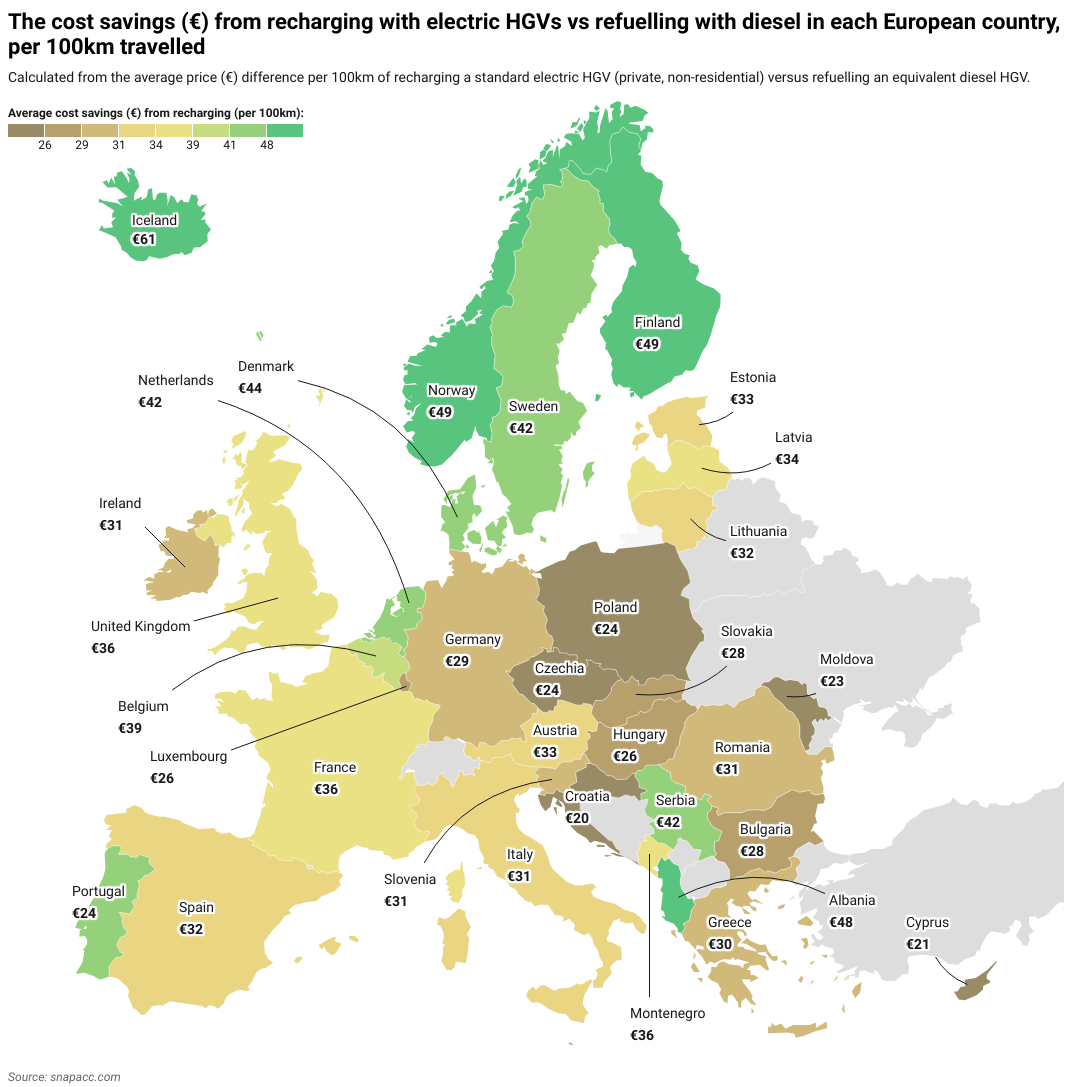
Щоб оцінити доцільність переходу операторів автопарків з дизельного на електричний транспорт, SNAP провів дослідження витрат на підзарядку вантажівок у порівнянні з їх заправкою на різних європейських вантажних маршрутах. Ми розрахували економію електроенергії порівняно з дизельним паливом у євро на 100 км у 35 європейських країнах.

Ми виявили, що Ісландія лідирує з середньою економією витрат у розмірі 61,03 євро на 100 км, а Норвегія та Фінляндія посідають друге та третє місця за рівнем економії витрат відповідно. З іншого боку, Хорватія запропонувала найменшу економію витрат - **19,96 євро на 100 км, за нею йдуть Кіпр і Молдова.

У цій статті ми розкриваємо економію витрат у кожній європейській країні та аналізуємо деякі з них, а також аналізуємо деякі зовнішні фактори, які можуть впливати на цю економію. Ми також заглиблюємося в те, яким може бути майбутнє електромобілів у Європі, а також у те, як електромобілі можуть допомогти операторам автопарків і водіям заощадити гроші, зокрема, на [бюджеті водія] (https://snapacc.com/newsroom/a-truck-drivers-guide-to-budgeting/).

Як співвідносяться витрати на електромобілі та дизельне пальне в ЄС

Наше дослідження показало, що в кожній досліджуваній європейській країні використання електромобіля з електричною зарядкою заощаджує кошти порівняно з використанням традиційного вантажного автомобіля на паливі. Основна відмінність полягала в тому, наскільки сильно варіювалася економія витрат. Наприклад, ціна на електроенергію в найдорожчій країні, Ісландії, на 206% вища (на 41 євро), ніж у найдешевшій країні, Хорватії.

Ми виявили, що в середньому водій електричного вантажного автомобіля заощаджує 30,59 євро на 100 км порівняно з водієм дизельного вантажного автомобіля. Це означає, що, за оцінками, середня економія становить 37 200 євро на рік для водіїв електричних вантажівок на далекі відстані та 24 800 євро для водіїв, які здійснюють внутрішні перевезення.

Щоб зібрати наші дані, ми розглянули 35 європейських країн і порівняли витрати енергії або палива на 100 км для двох типів великовантажних транспортних засобів (ВТЗ). Це були стандартні дизельні вантажівки з витратою палива 35 літрів на 100 км за середньою роздрібною ціною на дизельне паливо в кожній країні та електричні вантажівки з витратою електроенергії 108 кВт/год на 100 км за середнім тарифом на електроенергію для непобутових споживачів. ПДВ та податки, що підлягають відшкодуванню, були виключені з цих розрахунків. Порівняння відображає лише прямі витрати "на виході з бензоколонки" або "з розетки", без урахування таких факторів, як розмір автопарку, укладені енергетичні контракти або майбутні зміни цін на паливо та електроенергію.

При дослідженні цін на дизельне паливо та електроенергію було використано низку джерел, зокрема [Eurostat] (https://ec.europa.eu/eurostat/databrowser/view/nrgpc205_custom16953972/default/table?lang=en), [CEIC] (https://www.ceicdata.com/en/iceland/electricity-price-nonhousehold-consumers), [GlobalPetrolPrices] (https://www.globalpetrolprices.com/), [Webfleet] (https://www.webfleet.com/en_gb/webfleet/blog/how-much-diesel-does-a-truck-use-per-mile/) та [Gov.uk] (https://www.gov.uk/government/collections/road-fuel-and-other-petroleum-product-prices). Варто зазначити, що деякі з цих джерел посилаються на "Велику Британію", а інші - на "Сполучене Королівство". Для цілей цього дослідження обидва терміни розглядаються як взаємозамінні.

Країни, які заощаджують найбільше за рахунок переходу на електричні вантажівки

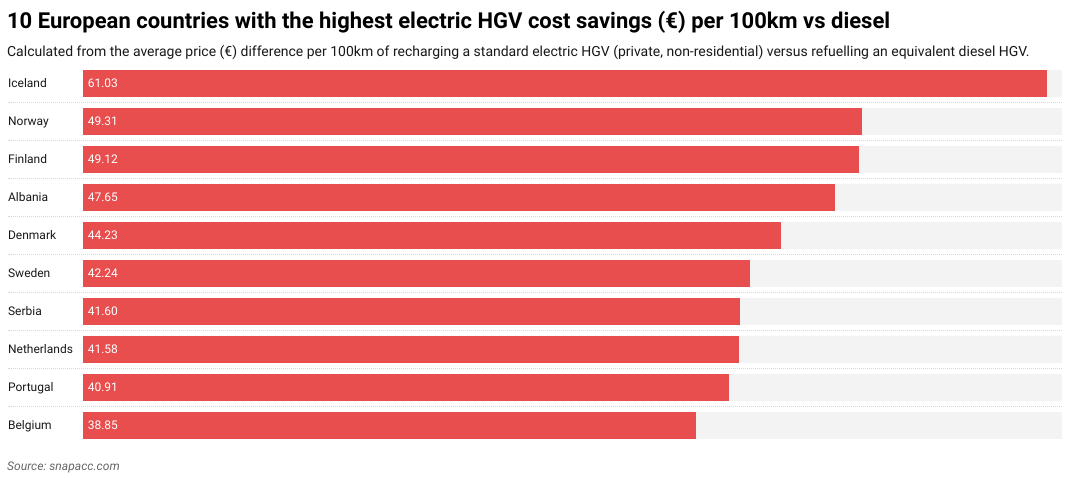
Ісландія (61,03 євро), Норвегія (49,31 євро) та Фінляндія (49,12 євро) наразі є країнами, де найбільше можна заощадити, перейшовши на електричні вантажівки.

Це значною мірою пов'язано з тим, що в цих країнах дизельне пальне є одним з найдорожчих в Європі. Ісландія є найдорожчою країною в Європі за ціною на дизельне пальне (2,07 євро за літр). Така висока вартість значною мірою пояснюється її географічною ізоляцією порівняно з рештою Європи, внаслідок чого вартість імпорту дизельного палива значно вища, ніж в інших європейських країнах. Ісландія, як і Норвегія та Фінляндія, також відома своїми високими податковими ставками, що також сприяє високій вартості палива.

Норвегія (32%) та Ісландія (18%) також складають дві провідні країни світу за часткою електромобілів на дорогах від загальної кількості легкових автомобілів на дорогах. Як наслідок, обидві країни інвестували значні кошти в інфраструктуру електрозарядок.

Невеликий розмір Ісландії та наявність головної кільцевої дороги також полегшують встановлення електрозарядних станцій через рівні проміжки часу для водіїв електричних вантажівок. Ці ж міркування можна частково використати для інших країн з меншими мережами, які мають високий рівень економії витрат, зокрема Албанії, Сербії та Бельгії - хоча слід зазначити, що всі три країни мають одні з найдорожчих цін на дизельне паливо в Європі, що також впливає на різницю в економії витрат.

На діаграмі нижче показано 10 країн, які мають найбільшу економію витрат при використанні електричних вантажівок:
*"Водії по всій Європі вже заощаджують, переходячи на електричні вантажівки. Перехід на зарядки для електромобілів - це майбутнє галузі, і SNAP готова допомогти водіям та операторам автопарків у цьому переході".

Метью Белламі - керуючий директор SNAP

Країни, які заощаджують найменше за рахунок переходу на електричні вантажівки

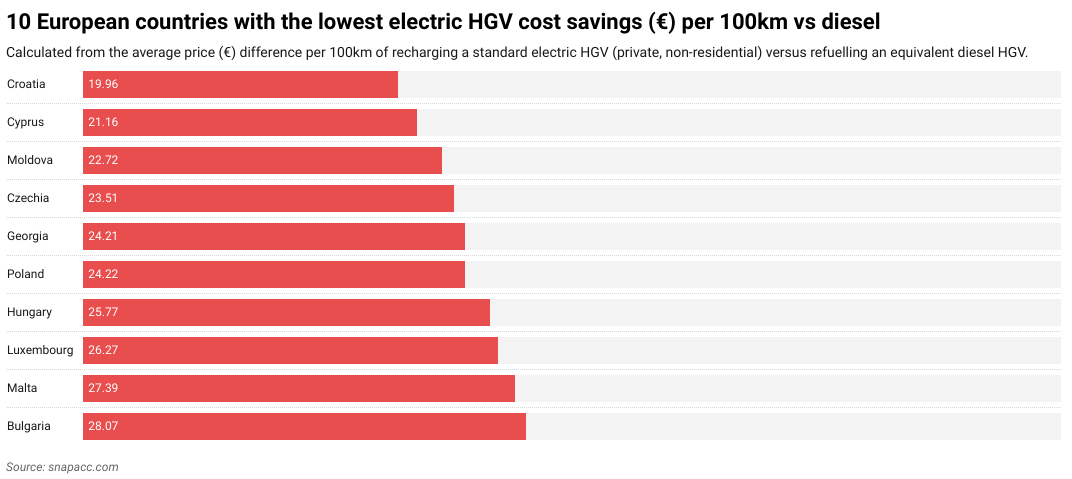
Хорватія (19,96 євро), Кіпр (21,16 євро) та Молдова (22,72 євро) наразі є трьома країнами з найнижчим рівнем економії в Європі.

Хорватія посідає [друге місце за темпами впровадження електромобілів] (https://www.smf.co.uk/wp-content/uploads/2025/03/Decreasing-transport-poverty-in-Europe-through-public-EV-chargepoints-March2025.pdf) в ЄС після Польщі. Частково це пов'язано з поганою інфраструктурою зарядних станцій для електромобілів у Хорватії, наприклад, зарядними станціями, які вимагають дзвінка в службу підтримки або використання декількох різних додатків для початку процесу зарядки, поганими напрямками до зарядних станцій за межами основних автомагістралей і потенційно великим часом очікування під час пікового туристичного сезону. Крім того, в Хорватії бракує надшвидкісних зарядних станцій (180 кВт і вище), що може стати проблемою для електричних вантажівок, які потребують більшої потужності, ніж середній електромобіль.

І Кіпр, і Молдова мають внутрішні геополітичні проблеми, які ускладнюють планування інфраструктури для зарядки електромобілів (як і національне планування загалом). Що стосується Кіпру, то північна половина острова, включаючи половину його столиці Нікосії, з 1974 року окупована Турецькою Республікою Північного Кіпру, яку підтримує Туреччина. Для Молдови східна провінція Придністров'я діє як де-факто держава з власним урядом. Це означає, що обидві країни не можуть послідовно впроваджувати інфраструктуру електромобілів на території, яку вони вважають своєю.

Проблеми на Кіпрі також ускладнюються високими цінами на електроенергію, тоді як Молдова має п'яту найдешевшу ціну на дизельне паливо в Європі. Молдова також є [другою найбіднішою країною в Європі] (https://worldpopulationreview.com/country-rankings/poorest-countries-in-europe), що робить інвестиції в інфраструктуру електромобілів складним завданням. Всі ці фактори сприяють загальній низькій економії витрат для електричних вантажівок.

Польща також посідає останнє місце в списку з показником економії витрат у розмірі 24,22 євро. Незважаючи на вражаюче економічне зростання та зростаючі інвестиції в інфраструктуру зарядних станцій для електромобілів, її великі розміри означають, що покриття все ще залишається проблемою в певних районах країни - хоча це, ймовірно, [зміниться в майбутньому] (https://alternative-fuels-observatory.ec.europa.eu/general-information/news/poland-launches-major-funding-programs-zero-emission-transport).

Такі країни, як Іспанія (32,20 євро), Румунія (30,62 євро) та Ірландія (30,54 євро) займають середню позицію, коли йдеться про економію витрат на електричні вантажні автомобілі. Це, ймовірно, пов'язано з тим, що в цих країнах розвивається інфраструктура зарядних станцій для електромобілів, а також середні ціни на електроенергію та дизельне паливо.

На діаграмі нижче показано 10 країн, які мають найнижчу економію витрат при використанні електричних вантажівок:
Економія витрат на електричні вантажівки у Великобританії

У Великобританії економія витрат на електромобілі становить 36,23 євро, що ставить її на 11-е місце за економією витрат на підзарядку на 100 км. Це значною мірою пов'язано з високими цінами на пальне у Великобританії, де ціни на дизельне пальне є третіми за вартістю в Європі. Хоча економія від високих цін на дизельне пальне, безумовно, сприяє високому рівню економії витрат на електромобілі у Великій Британії, вона, ймовірно, була б набагато вищою, якби електроенергія у Великій Британії не була однією з найдорожчих в Європі.

Великобританія також очікує на покращення інфраструктури зарядних станцій для електромобілів. Британська сервісна компанія Moto активно планує побудувати [15 "суперхабів" до 2027 року] (https://www.fleetnews.co.uk/news/electric-hgv-charging-superhubs-planned-for-motorway-services). Ці суперхаби можуть краще забезпечити зарядку електромобілів більш ефективно, ніж стандартні зарядні пристрої для електромобілів. Наразі на дорогах Великої Британії існує менше п'яти спеціальних зарядних пунктів для електромобілів. Оскільки [інші компанії] (https://www.fleetnews.co.uk/news/electric-hgv-charging-superhubs-planned-for-motorway-services), такі як BP Pulse та Aegis Energy, також прагнуть інвестувати, цілком ймовірно, що в найближчому майбутньому Великобританія матиме значно покращену мережу зарядних станцій для вантажівок.

Що впливає на електрифікацію вантажівок?

Наразі на електрифікацію вантажівок впливає кілька факторів, зокрема відсутність зарядної інфраструктури, тривалий час заряджання, високі початкові витрати на переобладнання електромобілів та їх обмежений запас ходу. Крім того, порівняно низька вартість і доступність дизельного палива і транспортних засобів роблять традиційні вантажні автомобілі привабливим варіантом для [операторів автопарків] (https://snapacc.com/fleet-operators/).

Однак усі ці впливи можуть відрізнятися залежно від країни, в якій працює автопарк. Наприклад, якщо ваш автопарк експлуатується лише всередині країни, наприклад, у Норвегії чи Ісландії, то він, швидше за все, зазнає меншого впливу, ніж автопарк, що працює по всій Європі або в регіонах з гіршою інфраструктурою для електромобілів, наприклад, на Балканах.

Недостатня інфраструктура зарядних станцій

Основною перешкодою для електрифікації вантажного транспорту є недостатня інфраструктура зарядних станцій для електромобілів. Це пов'язано з тим, що електромобілі потребують мегаватної зарядки, яку більшість існуючих пунктів зарядки для легкових автомобілів (стандартних електромобілів та мікроавтобусів) не підтримують.

У Європі є багато країн, яким гостро бракує такої інфраструктури, особливо на основних вантажних маршрутах і на зупинках вантажівок. Це, як правило, бідні країни Південної та Східної Європи, такі як Молдова, Грузія та Болгарія. Не випадково, що ці країни посідають останні 10 місць за економією витрат на електромобілі.

Також бувають випадки, коли зарядні станції для електромобілів існують, але вони знаходяться в районах, які просто не можуть вмістити кілька електромобілів, що заряджаються протягом ночі, через слабку місцеву електромережу. Це часто є проблемою в більш сільських і віддалених частинах Європи.

Хоча багато європейських країн планують покращити інфраструктуру для електромобілів, це все ще тривалий і дорогий процес з численними бюрократичними, логістичними та технічними перешкодами, які необхідно подолати, не кажучи вже про модернізацію навколишньої інфраструктури, наприклад, підключення до місцевих електромереж, яка також буде необхідна.

Довгий час заряджання

Електричні вантажівки заряджаються набагато довше, ніж стандартні електромобілі. Це означає, що заряджання часто має відбуватися протягом ночі. Навіть якщо можна придбати швидкі зарядні пристрої для електромобілів, процес все одно займе не кілька хвилин, як у випадку з бензиновими автомобілями, а щонайменше дві години (https://dhl-freight-connections.com/en/solutions/charging-times-for-electric-trucks-the-goal-is-less-than-30-minutes/).

Такий тривалий час заряджання може мати зворотний ефект для операторів автопарків з точки зору часу виконання замовлень. У галузі з жорсткими графіками поставок і дедлайнами це може потенційно негативно вплинути на ефективність бізнесу.

Обмежений запас ходу електричних вантажівок

Електричні вантажівки також мають відносно обмежений запас ходу порівняно з традиційними вантажними автомобілями. За даними Safety Shield, типовий електричний вантажний автомобіль може проїхати близько 300 миль на одному заряді (приблизно відстань від Лондона до Роттердама). Типовий дизельний вантажний автомобіль може проїхати до 1 000 миль на одному баку пального (приблизно відстань від Лондона до Варшави).

На пробіг електричних вантажівок також можуть більше впливати зовнішні фактори, такі як навантаження, холодна погода та рельєф місцевості. Це може призвести до занепокоєння водіїв щодо запасу ходу, які можуть частіше підзаряджатися, щоб забезпечити достатню потужність для досягнення пункту призначення. Це, в свою чергу, може призвести до затримок доставки, особливо при проїзді через країни з погано розвиненою інфраструктурою зарядки електромобілів.

Все це робить оптимізацію маршрутів життєво важливою для операторів автопарків, які планують поїздки для своїх електромобілів. Слід зазначити, що технологія акумуляторів постійно розвивається, і в найближчому майбутньому їхня ємність, а отже, і пробіг, продовжуватимуть зростати.

Високі витрати на електромобілі

Початкова вартість електромобіля є високою (зазвичай від [160 000 до 200 000 фунтів стерлінгів] (https://electriccarguide.co.uk/the-electric-hgv-guide/), порівняно з 80 000-100 000 фунтів стерлінгів для дизельних вантажівок), що потенційно може стримувати незалежних водіїв та операторів невеликих автопарків від придбання такого транспортного засобу. Це значною мірою пов'язано з вартістю технології акумуляторних батарей. Це означає, що купівля нового електричного вантажного автомобіля обійдеться дуже дорого, оскільки технологія, яка використовується в ньому, є дорожчою, ніж у дизельному вантажному автомобілі.

Високі початкові витрати на придбання електромобілів також означають, що оператори автопарків у країнах з дешевшими тарифами на електроенергію для зарядки електромобілів, таких як Норвегія, Швеція або Фінляндія, більш схильні до переобладнання, оскільки вони швидше окуплять свої інвестиції, ніж оператори автопарків у країнах з дорогою електроенергією, таких як Ірландія та Хорватія.

Ціни на електроенергію також можуть коливатися у зв'язку з різними подіями. Наприклад, за останні п'ять років ціни на електроенергію коливалися у відповідь на відкриття економік після пандемії COVID-19, а потім вторгнення Росії в Україну в 2022 році (останнє, зокрема, мало значний вплив на європейське енергопостачання). Як наслідок, ціни на електроенергію зросли майже на 30%, з 20,5 євро/кВт-год до 26,5 євро/кВт-год для середнього показника по ЄС у період після вторгнення. Однак, оскільки середній показник по ЄС зараз нижчий, ніж у 2022 році, схоже, що електричні зарядки для вантажівок продовжать своє зростання.

По всій Європі середня вартість пробігу електричного вантажного автомобіля на 100 км становить 20,51 євро - значно дешевше, ніж 51,10 євро для дизельного вантажного автомобіля на ту ж відстань.

В міру того, як ефективність підвищується, а технології акумуляторів стають все більш поширеними і дешевшими у виробництві, електромобілі також стануть більш доступними для придбання.

Дешевизна та доступність дизельного палива

Дизельне паливо все ще відіграє домінуючу роль у галузі вантажних автомобілів. Це пов'язано з тим, що дизельна інфраструктура була добре розвинена в Європі протягом десятиліть, особливо у порівнянні з електричними зарядними пристроями для вантажівок. Сумісність дизельного палива з [паливними картками] (https://snapacc.com/newsroom/fuel-cards-in-transportation-how-snap-simplifies-fleet-life/) та його відносна дешевизна також роблять його популярним серед менеджерів вантажних автопарків.

Однак, як і у випадку з електроенергією, вартість дизельного палива коливається по всьому континенту. Ось чому в таких країнах, як Молдова, Грузія та Мальта, де дизельне пальне залишається дешевим, може виявитися вигіднішим використовувати дизельні вантажівки. І навпаки, для таких країн, як Ісландія та Нідерланди, де дизельне паливо є відносно дорогим, існує більший стимул для переходу на електричні вантажівки.

Країна з дешевим пальним може також не поспішати інвестувати значні кошти в інфраструктуру електромобілів, побоюючись відштовхнути традиційні автопарки, які в результаті можуть обрати альтернативні маршрути.
Майбутнє електричних вантажівок в Європі

Електричні вантажівки - це довгострокове майбутнє автомобільних перевезень. Вони не тільки дешевші в експлуатації, але й завдяки інвестиціям у нову інфраструктуру, яка будується швидкими темпами, стануть набагато більш фінансово та стратегічно життєздатними.

Окрім економічних переваг, електричні вантажівки також важливі для досягнення екологічних цілей, таких як "Чистий нуль" (Net Zero). Оскільки традиційні вантажівки є масштабними забруднювачами, скорочення викидів завдяки електромобілям буде відчутно в більш чистому повітрі по всій Європі.

Наступні тенденції (https://snapacc.com/newsroom/the-road-ahead-for-2025-truck-industry-trends-to-expect/), схоже, вплинуть на електричні вантажівки в майбутньому:

  • Smart truck parks: Truck parks in the future will evolve to better accommodate eHGVs alongside other smart technological advancements. These truck parks may include up-to-date ultra-fast charging stations, diagnostic machines, battery swap stations, and automated cleaning services, among other features.
  • Increased EU regulations: Low Emission Zones (LEZs) already exist in a number of cities (e.g. Paris, Berlin, and Milan) with more European cities likely to follow suit with more stringent EU transport regulations. Fleet operators may opt for eHGVs to meet EU regulations or retrofit their HGVs with cleaner technologies, like smart tachographs.
  • AI implementation: AI technology has already had a profound sustainability impact across road haulage — with applications in route optimisation, predictive maintenance, and autonomous vehicle development. Electric vehicles will likely incorporate AI to help drive sustainability in the haulage industry over the coming decades.
  • Sustainability: The shift to eHGVs is part of a wider global push toward sustainable living. The effects of extreme weather, including heatwaves and floods across Europe, show no sign of slowing due to climate change. Moving to electric HGVs is one way the world is reducing its dependence on fossil fuels.
  • Fuel variety: During the transition to cleaner fuel sources, there will be a variety of HGV types on the road throughout the 2030s. Many will be older diesel models, some will be electric, and others will be powered by alternative fuels such as biofuel made from renewable biomass sources.

Керуйте витратами на електричні вантажівки розумніше

За електричними вантажівками - майбутнє, в цьому мало хто сумнівається. Економічні та екологічні переваги призведуть до того, що в найближчі роки все більше операторів автопарків та водіїв перейдуть на електромобілі. Тривалість цього перехідного періоду залежатиме від того, як швидко Європа зможе розвинути свою інфраструктуру зарядних станцій для електромобілів.

Наразі існують великі ділянки континенту, де електромобілі не є життєздатними і потребують значної оптимізації маршрутів через меншу дальність пробігу. Крім того, авансові витрати можуть відлякувати незалежних водіїв та операторів невеликих автопарків.

Технології та інфраструктура будуть продовжувати вдосконалюватися, і вже зараз існують сервіси, покликані максимально спростити управління автопарками електромобілів та пов'язаними з ними витратами. Від оптимізації маршрутів та управління автопарком до карт для паркування та мийки вантажівок - SNAP робить вантажні перевезення простими.

[Підпишіться на SNAP сьогодні.] (https://snapacc.com/sign-up/)

Поділіться на

Читайте також...

Header Image

середа 15 квітня 2026 • Новини галузі

КРАДІЖКИ ВАНТАЖІВ У ЄВРОПІ: ЧОМУ ВОНА ЗРОСТАЄ І ЯК ФЛОТ МОЖЕ ЗМЕНШИТИ РИЗИК

Guest

Cargo theft is a growing threat across Europe. What was once seen as an occasional disruption is now a more persistent and organised risk to road transport, affecting fleets, drivers and the wider supply chain. Reported losses and incidents have risen sharply, with one widely cited industry figure pointing to a in recent years. In alone, 557 cargo crimes were recorded across 38 countries in the TAPA EMEA Intelligence System, and even though values were disclosed for fewer than one in five incidents, those 100 cases still totalled more than €43 million.In this article, we explore the current trends and what fleet managers and operators can do to minimise their risks.Food and beverage shipments are among the most commonly targeted categories in Europe, accounting for . also rank highly. These goods are attractive because they are easy to move, easy to sell and often difficult to trace once they enter secondary markets.The recent on its way from Italy to Poland is a useful example. Nestlé said the missing load amounted to roughly 413,793 bars, showing how quickly a mainstream consumer shipment can become a target when moving across borders.These shipments are attractive targets for organised groups because they can be offloaded quickly, resulting in rapid returns. Cargo crime often happens while loads are moving. report found that hijackings accounted for 21% of incidents, while 41% of thefts happened in transit. That is a reminder that risk does not begin when a truck parks for the night. It can begin long before a vehicle stops for the night, particularly on exposed corridors or routes where load visibility and security controls are weaker.Parked vehicles remain a major point of vulnerability. In the UK, Munich Re reported that nearly half of all thefts take place at unsecured roadside parking and rest areas. Across Europe, unsecured roadside locations and rest areas continue to feature prominently in cargo crime reporting, especially where drivers have limited alternatives and secure sites are full.Some of the most concerning incidents show coordination. recently documented attacks in Germany in which dozens of trucks were targeted in a single night along the A1 corridor. In one November 2023 incident, 67 trucks had trailers slashed at service and rest areas including Ostetal South and Grundbergsee South. Similar attacks had already taken place on the same route months earlier.Germany remains one of the clearest hotspots, largely because of the scale of freight passing through the country. Analysis showed that in 2023, more than double France in second place. Other recurring hotspots include France, Italy, Spain and the United Kingdom. That pattern reflects the reality of European freight movement. Dense logistics networks, major freight hubs and heavily used motorways create more opportunities for organised criminals, especially when secure parking capacity fails to keep pace with demand.Munich Re warns that cargo thieves are increasingly using more sophisticated methods, including identity deception, cyber-enabled scams and other tactics that bypass traditional controls. Wider points to GPS jamming, paperwork manipulation and shipment diversion as part of that shift.A stolen load may now begin with compromised data, a fraudulent carrier, a diverted instruction or a vehicle whose movements can no longer be tracked properly. For fleets, that means theft prevention now involves more than physical security. It also requires tighter dispatch processes, better control over shipment data and clearer real-time visibility.The most obvious impact is financial. Stolen goods lead to lost goods, insurance claims and disruption. But the direct value of the missing load is only part of the problem. Delayed deliveries, vehicle damage, missed slots and customer dissatisfaction can all push the true cost much higher. There is also a human cost. Drivers may face intimidation, confrontation or the shock of discovering that their vehicle has been tampered with while they were resting. Even where there is no direct violence, exposure to insecure roadside stops creates stress, fatigue and a sense of vulnerability that can affect driver welfare and retention. Operationally, the knock-on effects spread quickly through the supply chain. A single theft can mean missed delivery windows, rerouted vehicles, stock shortages and added pressure on already stretched teams. For temperature-sensitive, time-critical or high-value loads, the consequences can multiply fast.There is no single fix, but fleets can reduce exposure with a more structured approach to planning, parking and security.Secure parking remains one of the clearest areas for improvement. TAPA’s Parking Security Requirements framework provides an internationally recognised benchmark for secure truck parking, helping operators assess which locations offer stronger protection for vehicles, loads and drivers. Choosing accredited sites will not eliminate cargo theft, but it can significantly reduce the opportunity for organised criminals to strike.In practice, that may mean stopping earlier than planned to reach a safer site rather than pushing on to an unsecured lay-by. While that can feel less efficient in the moment, it is often the more resilient choice.For fleets, the challenge is not just knowing secure parking matters but being able to access it easily. SNAP helps bridge that gap by giving drivers and operators better visibility of trusted parking options across the UK and Europe, making it simpler to plan and reserve safer stops from the outset.Read more: Cybersecurity now sits alongside physical security in any serious theft-prevention strategy. Tracking, geofencing and anti-jamming tools can all help, but only if they are backed by clear processes. Fleets should review how shipment data is shared, who can alter route instructions, how delivery paperwork is verified and what happens if a vehicle suddenly disappears from view. Drivers are often the last line of defence, but they should not carry the burden alone. Clear escalation procedures, regular check-ins, secure rest planning and training on suspicious activity all matter. One of the biggest structural issues behind cargo theft is the shortage of secure truck parking. When drivers cannot find protected sites with proper lighting, access control and welfare facilities, they are more likely to end up in the very locations thieves are already targeting. SNAP has trained working to accredit more parking sites across the UK and continental Europe, helping expand the availability of secure truck parking and reduce opportunities for organised theft.For fleets, the challenge is not just understanding risk, but building safer stopping decisions into everyday operations. At SNAP, we help drivers and operators identify trusted parking options across the UK and Europe, making it easier to plan routes with security and driver welfare in mind.

Header Image

середа 11 березня 2026 • Новини галузі

ПАРКУВАННЯ ВАНТАЖІВОК У ЄВРОПІ: ПРАВИЛА, ПРОГАЛИНИ, РИЗИКИ

Guest

Ask most fleet operators what makes life harder than it needs to be and you’ll hear the same answer across Europe: truck parking.Drivers have to stop. Hours rules and rest requirements make that non-negotiable. But on many of Europe’s busiest transport corridors, finding a safe, legal place to park is still uncertain. Capacity is low, security varies widely and most urban hubs aren’t built with HGVs in mind.That pressure has consequences. When designated areas are full, drivers are pushed towards places that were never intended for HGV parking: slip roads, access ramps and industrial estates. Compliance becomes a choice between two risks: stop where you shouldn’t, or keep driving when you shouldn’t.When truck parking overflows into unsuitable places, the environment becomes dangerous: poor visibility, high speeds, unpredictable manoeuvres and limited escape routes. starkly in February 2026, reporting fatal crashes in Germany and Belgium involving stationary lorries. The article challenges the easy explanation of “illegal parking” and points back to the underlying cause: drivers were out of driving time and the spaces were gone.In addition, a shortage of truck parking in Europe doesn’t just mean “no space”; it often means the only available space is poorly lit, unmonitored and isolated. That elevates the risk of theft and driver harm, which can have a knock-on effect for supply chain reliability.Poor parking provision also affects workforce sustainability. When drivers face uncertainty around legal, safe stopping, it makes the role harder and less attractive – compounding .For a long time, the conversation about truck parking focused on enforcement: where you can’t park and the penalties that follow. Increasingly, the focus is moving towards provision: where drivers can stop safely, reliably and legally. Under revised Trans-European Transport Network (TEN-T) rules, EU Member States must ensure the development of certified secure parking . The same requirement sets expectations for the location of truck parking. It must be immediately on the network or within 3km of an exit, which will have benefits for route planning. Alongside this shift, the European Commission positions safe and secure truck parking as a priority within its Intelligent Transport Systems work, including the need for to help drivers locate suitable sites.But the EU isn’t just asking Member States to add more truck parking spaces. It’s also defining what “safe and secure” means. In April 2022, the European Commission adopted EU standards for , categorising sites into four security levels: bronze, silver, gold and platinum. The intention is to create transparency for drivers and fleets, and to support investment by giving operators a clear target to design and audit against.This sits against a significant capacity gap. A European Commission study estimates a across the bloc, with the gap potentially rising towards half a million by 2040 if the network does not scale at the pace freight demand requires.Looking at more practical aspects of the situation, what are HGV parking rules and regulations in Europe?At first glance, HGV parking rules across Europe look consistent: Motorways are not designed to absorb overflow parking. Hard shoulders exist for emergencies and safety buffers. Access ramps are not for planned stopping.Urban areas add a layer of complexity. Local restrictions and enforcement are common because HGV parking competes with residents, retail and public space – and because badly parked vehicles create safety risks.Rules around HGV parking in the UK are clear. Trucks should use designated areas such as motorway services, truckstops and lorry parks. Conversely, drivers must avoid parking in locations that create risks, such as pavements, verges and central reservations. Restrictions around parking in residential areas vary by local authority, so it’s vital to check if this is unavoidable. The major constraint is supply. The RHA’s estimate of an , with very high utilisation on key routes, helps explain why informal and unsafe parking persists even where drivers know it isn’t ideal. In 2022, the Department for Transport across England, aimed at better rest areas and more secure parking, framed as part of a broader programme to improve roadside facilities.In Germany, motorway stopping rules are anchored in the (StVO), which makes clear that stopping on the autobahn – including the hard shoulder – is prohibited except in emergencies. That means running out of driving time is not treated as justification. Fines increase if obstruction or danger is caused, and enforcement is active on heavily used corridors. Poland follows the familiar motorway rule that hard shoulders are reserved for breakdowns and emergencies. The nuance appears within cities, where tonnage-based entry restrictions and are common. Overnight HGV parking in urban areas can require municipal approval and enforcement varies between municipalities. For cross-border fleets, that means treating urban stopping as permission-led rather than assumed.France reinforces the same principle through the . Articles R417-9 and R417-10 classify dangerous or obstructive parking offences, and stopping on autoroute carriageways or shoulders is prohibited except in cases of absolute necessity. Penalties can include fines and licence points.However, publishes dedicated information for secure truck parking on its network, reflecting how motorway operators guide HGV stopping into appropriate locations.Spain’s prohibits stopping on motorway shoulders except in emergencies, aligning with broader European practice. Additional complexity lies at municipal level. Many cities operate local overnight bans or restrict HGV parking to designated industrial zones, with enforcement handled by local police rather than motorway authorities. That creates a layered compliance environment: legal on the motorway network does not automatically mean legal in urban areas.To highlight positive developments, that a truck parking facility in La Jonquera became the first in Spain to receive TAPA certification, describing measures such as controlled access, fencing, lighting and continuous monitoring.Italy distinguishes clearly between motorway carriageways, ramps and designated service areas. Stopping on access or exit ramps is explicitly prohibited, and enforcement around motorway infrastructure is consistent. Importantly, Italy differentiates between aree di servizio (full service areas with facilities) and simpler rest or parking lay-bys, which may not support overnight welfare needs. However, Italy is also seeing new secure truck parking developments focused on welfare and security, reflecting the wider European momentum towards better provision.Across Europe, an additional regulatory layer now shapes truck parking decisions: Low Emission Zones (LEZs) and restricted urban traffic zones. Cities in France (Crit’Air), Germany (Umweltzonen), Spain (Zonas de Bajas Emisiones) and Italy (ZTL areas) impose vehicle-class or permit requirements that can apply even to stationary vehicles within the zone. A driver who parks overnight in a restricted area without the correct classification or registration risks fines – even if the stop itself is otherwise legal. Across Europe in 2026, the rules are clear. The constraint is capacity, especially near urban hubs and on high-volume corridors. For fleets, this has a practical impact: European truck parking can’t be left to chance at the end of a shift. It needs to be planned with the same seriousness as , routing, driver hours and security – because when the network fails to provide legal space, every other compliance system gets squeezed.SNAP can help. .

Header Image

четвер 26 лютого 2026 • Новини галузі

ЖІНКИ У СФЕРІ ВАНТАЖОПЕРЕВЕЗЕНЬ: РОЗКРИТТЯ НЕВИКОРИСТАНИХ ТАЛАНТІВ

Guest

Across the UK, around . They transport food to supermarkets, materials to construction sites and goods to ports and distribution centres. They underpin daily life and economic stability, forming a critical part of the UK’s national infrastructure.Yet only around . That amounts to roughly one per cent of the UK HGV workforce, according to reporting by . For an industry facing long-term recruitment pressure, that figure raises important questions about where future talent will come from and how the sector presents itself to potential entrants.There are signs of progress, however. The percentage of from 6.7% in 2011/12 to 9.7% by 2021/22. Over the past decade, women securing Category C and C+E licences increased by 144%, according to SME Web. More women are clearly choosing to train and qualify. The pipeline is widening, but the proportion of women behind the wheel remains marginal.Women have not been entirely absent from road transport. One of the earliest recorded female truck drivers was, who began driving heavy vehicles in the United States in 1918. During wartime periods in both the US and the UK, women stepped into transport roles out of necessity. Then, in the 1960s, became the UK’s first long-distance lorry driver, often working 100-hour weeks.However, outside exceptional circumstances, haulage has traditionally been male dominated. Cultural perceptions, physical assumptions about the work and the lifestyle associated with long distance driving have all played a part. Only in recent decades has participation begun to shift in a more sustained way.The reasons for low female participation are not limited to awareness. Structural and practical barriers remain.Facilities are a big concern. Professional drivers depend on secure parking, clean rest areas and appropriate welfare provision. For many years, roadside infrastructure has struggled to meet demand across the board. When rest stops are inadequate, poorly lit, feel unsafe or lack privacy, this can discourage women from joining the sector.Working patterns also play a role. Long-haul journeys can involve overnight stays and time away from home. While many drivers value the independence that comes with the role, the perception of work-life balance may deter some women, especially those with caring responsibilities. There is also the issue of visibility. When only one per cent of drivers are women, prospective candidates may struggle to see themselves in the sector. In addition, menopause symptoms such as fatigue, sleep disruption, hot flushes and anxiety can be difficult to manage in roles that involve long hours, limited access to private facilities and time away from home. In sectors where welfare provision is already under pressure, a lack of understanding or practical support can lead to experienced drivers leaving the workforce.For haulage, this is not a peripheral issue. Retaining experienced drivers is as important as attracting new entrants. Change is not confined to driving roles. Across the broader transport and logistics ecosystem, women are increasingly visible in management, planning and policy functions.The shows that leadership representation by women has increased from 26% to 36% in recent years. However, much of this growth has taken place outside core operational functions. Senior representation within frontline transport roles remains comparatively limited.Several industry organisations are addressing this gap. Women in Transport offers mentorship opportunities, while everywoman recognises excellence through its , raising the profile of female professionals across the sector. The Chartered Institute of Logistics and Transport has also announced a new , aimed at supporting career progression and professional networks.Alongside this, community initiatives such as demonstrate that interest and engagement are growing. The spotlighting female drivers and employees, further increasing visibility. Collectively, these platforms help challenge outdated perceptions and provide practical support for women entering or advancing within the industry.For the UK haulage sector, this is not just a diversity conversation. It is a strategic one.Previous industry reporting has highlighted the scale of recruitment pressure across logistics. The that tens of thousands of new drivers will be required in the coming years to maintain supply chain stability. At the same time, the existing workforce is ageing.With only one per cent of drivers currently women, a significant proportion of the potential labour market remains underrepresented. If participation rates were to move closer to parity with the wider workforce, the impact on recruitment could be substantial.There is also evidence that inclusive cultures contribute to improved retention and engagement. A sector that demonstrates visible progression pathways, fair access to training and appropriate welfare provision is likely to appeal more broadly across demographics.Progress will not accelerate through awareness alone. Structural changes are needed.Investment in safe, well maintained roadside facilities is fundamental. Secure parking, adequate lighting and clean welfare amenities benefit all drivers and remove avoidable barriers to entry.Flexible working models, where operationally feasible, can broaden appeal. This may include regional route design, job sharing arrangements or clearer progression pathways from warehouse and planning roles into driving positions.Funded licence pathways and apprenticeships can also reduce financial barriers. As previously outlined, the cost of training can be significant. Targeted funding initiatives aimed at underrepresented groups can support a more balanced intake.Finally, transparency around workforce data matters. Publishing gender breakdowns, monitoring progression rates and setting measurable objectives signal that inclusion is being taken seriously.International Women’s Day provides an opportunity to reflect on how far the UK haulage industry has come and how far it still has to go. The rise in female licence acquisition and test pass rates demonstrates that interest exists. Leadership representation is improving in some areas and support networks are expanding. However, the scale of underrepresentation remains stark.Haulage is central to national resilience. It keeps shelves stocked, infrastructure projects supplied and trade flowing. Ensuring that this workforce reflects the full breadth of available talent is not simply a question of equity. It is a matter of long term sustainability.Supporting women in haulage also means improving the day-to-day realities of life on the road. Access to secure parking, well-lit rest areas and appropriate facilities is fundamental to retention and wellbeing for all drivers. SNAP’s intruck app helps all drivers locate and book trusted truck stops across the UK and Europe, giving fleets greater visibility and drivers greater confidence wherever their route takes them. .