Guest
Ipari hírek • 9 min olvasni

Üzemanyag kontra töltés: Olcsóbb vagy csak zöldebb az elektromosra való átállás?

Létrehozva: 28. 07. 2025

Frissítve: 19. 09. 2025

A tehergépjárművek elektromos töltőállomásainak európai elterjedése átmeneti időszakot eredményezett a kontinens hatalmas úthálózatán. Sok flottaüzemeltető és járművezető számára még mindig a klasszikus dízelüzemű nehéz tehergépjárművek jelentik a választott közlekedési eszközt. Az iparág folyamatos fejlődésével azonban az elektromos tehergépkocsikra való átállás küszöbön áll.

A [flottaüzemeltetők] (https://snapacc.com/fleet-operators/) dízelről elektromosra való átállásának megvalósíthatóságának felmérése érdekében a SNAP kutatást végzett a nehéz tehergépjárművek feltöltésének és tankolásának költségeiről különböző európai áruszállítási útvonalakon. Kiszámítottuk a villamos energiával és a gázolajjal szembeni megtakarításokat euróban 100 km-enként 35 európai országban.

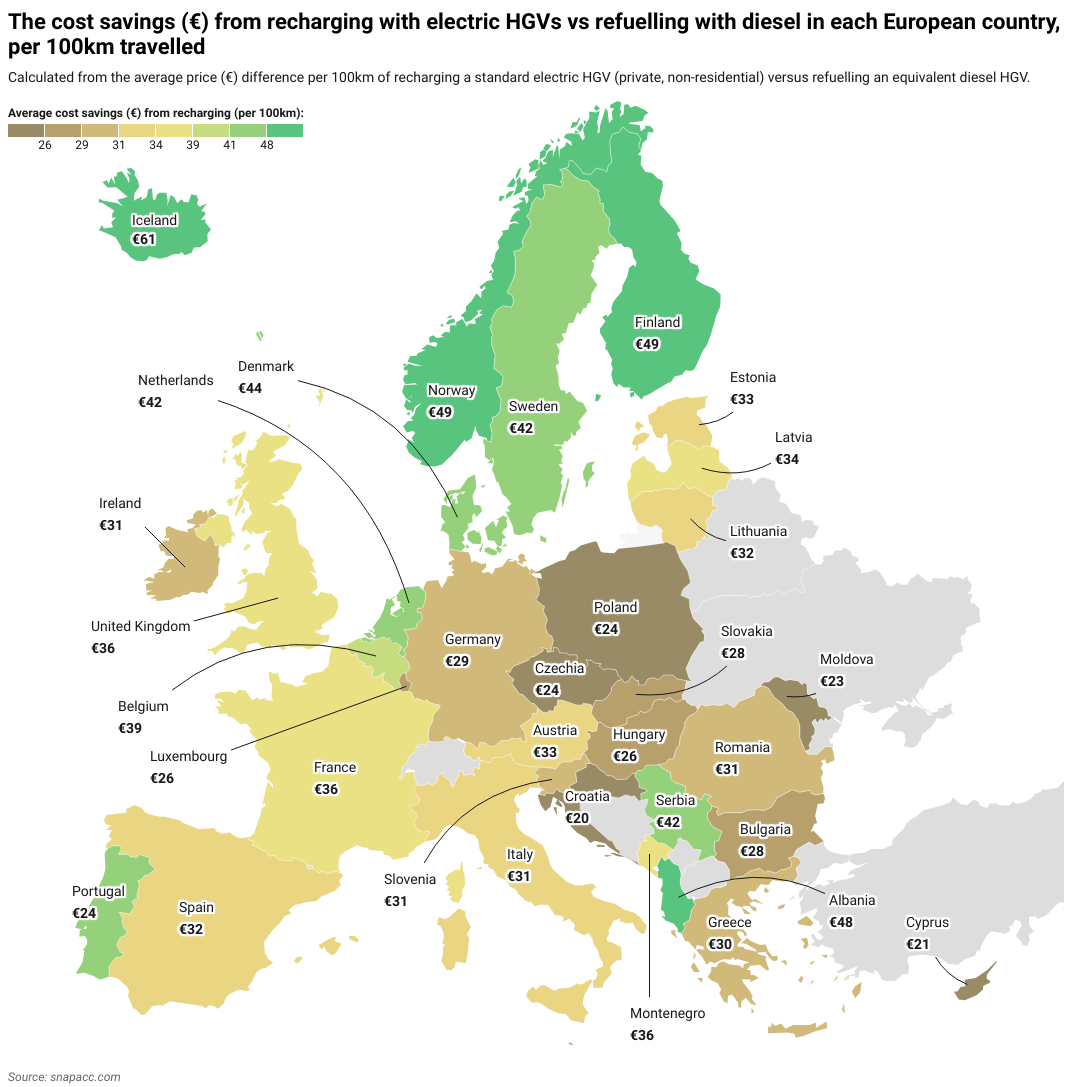
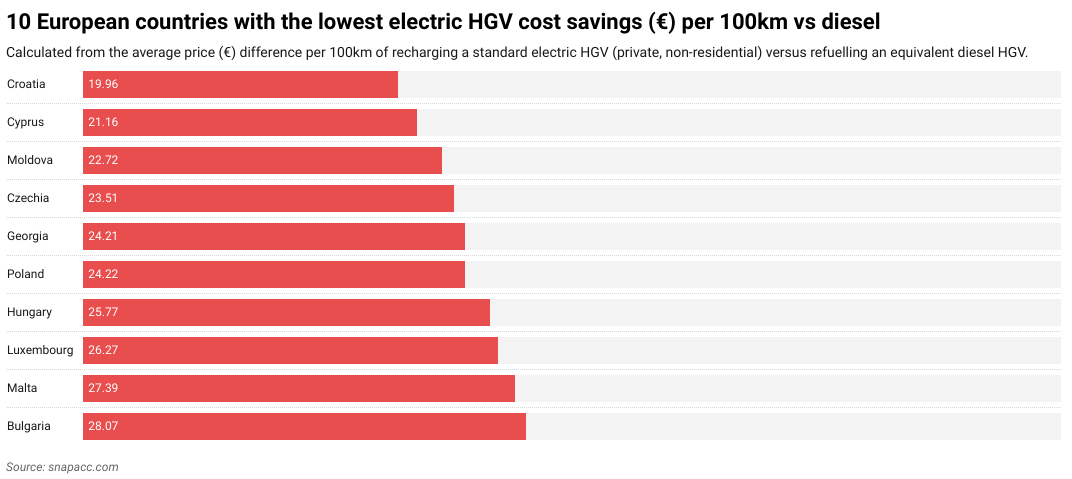
Megállapítottuk, hogy Izland áll az élen a 100 kilométerenként 61,03 EUR átlagos költségmegtakarítással, míg a második és harmadik legnagyobb költségmegtakarítást a skandináv országok, Norvégia és Finnország kínálják. A skála másik végén Horvátország kínálta a legkevesebb költségmegtakarítást (19,96 EUR/100 km), amelyet Ciprus és Moldova követett.

Ebben a cikkben feltárjuk az európai országonkénti költségmegtakarításokat, és elemezzük az európai országonkénti költségmegtakarításokat, valamint elemezzük az ezeket a megtakarításokat befolyásoló néhány külső tényezőt. Elmerülünk abban is, hogy milyen lehet az eHGV-k jövője Európában, valamint hogy az eHGV-k hogyan segíthetnek a flottaüzemeltetőknek és a járművezetőknek pénzt megtakarítani, különösen a [járművezetői költségvetésekkel] (https://snapacc.com/newsroom/a-truck-drivers-guide-to-budgeting/).

Hogyan alakulnak az eHGV és a dízel költségei az EU-ban

Kutatásunk megállapította, hogy minden vizsgált európai országban az elektromos töltéssel ellátott eHGV használata pénzt takarított meg a hagyományos, üzemanyaggal működő tehergépjárművek használatához képest. Az elsődleges különbség az volt, hogy a költségmegtakarítás mértéke mennyire változott. Például a legdrágább országban, Izlandban az áram ára 206%-kal magasabb (41 euróval magasabb), mint a legolcsóbb országban, Horvátországban.

Megállapítottuk, hogy egy elektromos tehergépkocsit vezető sofőr átlagosan 30,59 €/100 km megtakarítást ér el egy dízelüzemű tehergépkocsi vezetőjéhez képest. Ez a hosszú távú elektromos tehergépkocsik vezetői esetében évente átlagosan 37 200 EUR, a belföldi sofőrök esetében pedig 24 800 EUR megtakarítást jelent.

Adataink összeállításához 35 európai országot vizsgáltunk meg, és összehasonlítottuk a nehéz tehergépjárművek (HGV-k) két típusának 100 kilométerenkénti energia- vagy üzemanyagköltségét. Ezek egy standard dízelüzemű nehéz tehergépkocsi, amely 35 liter üzemanyag-fogyasztást feltételez 100 km-enként az egyes országok átlagos kiskereskedelmi dízelárával, és egy elektromos tehergépkocsi, amely 108 kWh/100 km áramfogyasztást feltételez a nem háztartási átlagos villamosenergia-tarifa alapján. A HÉA-t és a visszaigényelhető adókat nem vettük figyelembe ezekben a számításokban. Az összehasonlítás csak a közvetlen "a szivattyúnál" vagy "a konnektornál" felmerülő költségeket tükrözi, és nem veszi figyelembe az olyan tényezőket, mint a flotta mérete, a tárgyalásos energiaszerződések vagy az üzemanyag- és villamosenergia-árak jövőbeni változásai.

A gázolaj és a villamos energia árképzésének kutatásakor számos forrásból merítettünk, többek között az Eurostat, CEIC, GlobalPetrolPrices, Webfleet és Gov.uk forrásaiból. Érdemes megjegyezni, hogy e források némelyike "Nagy-Britanniára", míg mások az "Egyesült Királyságra" vonatkoznak. E kutatás céljaira a két kifejezést felcserélhetően kezelték.

Az elektromos tehergépjárművekre való átállással a legtöbbet megtakarító országok

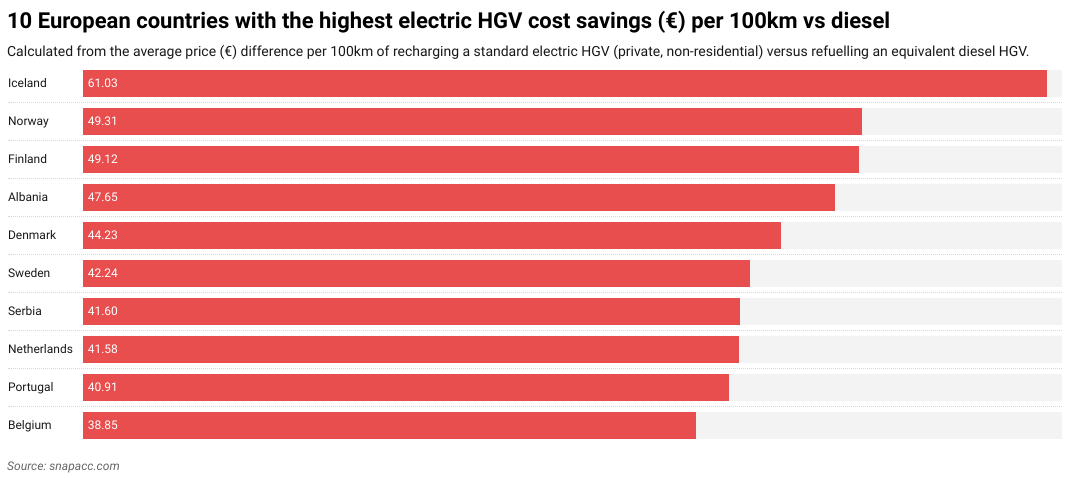
Jelenleg Izland (61,03 EUR), Norvégia (49,31 EUR) és Finnország (49,12 EUR) azok az országok, ahol a legtöbbet lehet megtakarítani az elektromos tehergépjárművekre való átállással.

Ez nagyrészt annak köszönhető, hogy ezek az országok Európában a legdrágábbak közé tartoznak a dízelüzemanyag tekintetében. Európában Izlandon a legdrágább a gázolaj (2,07 euró/liter). Ez a meredek ár nagyrészt abból adódik, hogy Izland Európa többi részéhez képest földrajzi elszigeteltsége miatt a gázolaj importköltsége sokkal magasabb, mint más európai országoké. Izland, Norvégiához és Finnországhoz hasonlóan, magas adókulcsáról is ismert, ami szintén hozzájárul a magas üzemanyagköltségekhez.

Norvégia (32%) és Izland (18%) szintén az első két ország a világon, ahol a forgalomban lévő elektromos autók aránya a forgalomban lévő személygépkocsik között az első két helyen áll. Ennek eredményeként mindkét ország jelentős beruházásokat eszközölt az elektromos töltőinfrastruktúrába.

Izland kis mérete és fő körgyűrűje megkönnyíti az elektromos töltőállomások rendszeres időközönként történő telepítését az elektromos tehergépkocsik vezetői számára. Részben ugyanez az érvelés alkalmazható más, kisebb hálózattal rendelkező országok esetében is, amelyekben a költségmegtakarítás magas, például Albánia, Szerbia és Belgium esetében - bár meg kell jegyezni, hogy mindhárom országban az egyik legdrágábbak a gázolajárak Európában, ami hozzájárul a költségmegtakarításban mutatkozó különbséghez.

Az alábbi táblázat azt a 10 országot mutatja, ahol a legnagyobb költségmegtakarítás érhető el elektromos nehéz tehergépjárművek használata esetén:
*"A járművezetők Európa-szerte már most is megtakarításokat érnek el az elektromos tehergépkocsikra való átállással. Az eGV-töltésre való átállás az iparág jövője, és a SNAP készen áll arra, hogy segítse a járművezetőket és a flottaüzemeltetőket az átállásban." *.

Matthew Bellamy - A SNAP ügyvezető igazgatója

Az elektromos tehergépkocsikra való átállással a legkevesebbet megtakarító országok

Horvátország (19,96 EUR), Ciprus (21,16 EUR) és Moldova (22,72 EUR) jelenleg a három legkevesebb költségmegtakarítást elérő ország Európában.

Lengyelország után Horvátországban [a második leglassabb az elektromos járművek elterjedtségi aránya] (https://www.smf.co.uk/wp-content/uploads/2025/03/Decreasing-transport-poverty-in-Europe-through-public-EV-chargepoints-March2025.pdf) az EU-ban. Ez részben a horvátországi EV-töltési infrastruktúra hiányosságai miatt van így: a töltőállomásokon az ügyfélszolgálatot kell felhívni, vagy több különböző alkalmazást kell használni a töltési folyamat elindításához, a főbb autópályákon kívüli töltőállomások rossz útbaigazítása, valamint a turisztikai főszezonban potenciálisan magas várakozási idő. Emellett Horvátországban nincsenek ultra-nagysebességű töltőállomások. (180 kW vagy annál nagyobb teljesítményű) töltőállomások, ami problémát jelenthet az elektromos tehergépjárművek számára, amelyeknek az átlagos EV-knél nagyobb teljesítményre van szükségük.

Cipruson és Moldovában is vannak olyan belső geopolitikai problémák, amelyek megnehezítik az elektromos járművek töltésére szolgáló infrastruktúra tervezését (és általában a nemzeti tervezést). Ciprus esetében a sziget északi felét - beleértve a főváros, Nicosia felét is - 1974 óta a török (https://www.bbc.co.uk/news/world-europe-17217956) támogatású Észak-Ciprusi Török Köztársaság [tartja megszállva]. Moldova esetében a keleti Dnyeszteren túli tartomány de facto államként működik, saját kormánnyal. Ez azt jelenti, hogy mindkét ország képtelen az EV-infrastruktúrát következetesen megvalósítani a sajátjának tekintett területen.

A ciprusi problémákat a magas villamosenergia-árak is súlyosbítják, míg Moldovában az ötödik legolcsóbb a gázolaj ára Európában. Moldova emellett [Európa második legszegényebb országa] (https://worldpopulationreview.com/country-rankings/poorest-countries-in-europe), ami kihívást jelent az EV-infrastruktúrába való beruházás szempontjából. Mindezek a tényezők hozzájárulnak ahhoz, hogy az elektromos nehéz tehergépjárművek összességében alacsony költségmegtakarítást eredményeznek.

Lengyelország szintén alacsonyan szerepel a listán 24,22 EUR költségmegtakarítással. A lenyűgöző gazdasági növekedés és az elektromos járművek töltőinfrastruktúrájába történő növekvő beruházások ellenére Lengyelország nagy mérete azt jelenti, hogy az ország egyes területein még mindig problémát jelent a lefedettség - bár ez valószínűleg [a jövőben változni fog] (https://alternative-fuels-observatory.ec.europa.eu/general-information/news/poland-launches-major-funding-programs-zero-emission-transport).

Az olyan országok, mint Spanyolország (32,20 EUR), Románia (30,62 EUR) és Írország (30,54 EUR) az út közepén helyezkednek el, amikor az elektromos nehéz tehergépjárművek költségmegtakarításáról van szó. Ez valószínűleg annak köszönhető, hogy ezekben az országokban az elektromos járművek töltési infrastruktúrája növekszik, és a villamosenergia- és gázolajköltségek közepes árúak.

Az alábbi táblázat azt a 10 országot mutatja, ahol a legalacsonyabb a költségmegtakarítás elektromos nehéz tehergépjárművek használata esetén:
Az Egyesült Királyság elektromos nehéz tehergépjárműveinek költségmegtakarítása

Az UK 36,23 EUR költségmegtakarítással rendelkezik, ami a 11. helyet jelenti a 100 kilométerenkénti feltöltésből származó költségmegtakarítás tekintetében. Ez nagyrészt annak köszönhető, hogy az Egyesült Királyságban mennyire drágák az üzemanyagárak, mivel a dízel ára a harmadik legdrágább Európában. Bár a magas dízelárakból eredő megtakarítások minden bizonnyal hozzájárulnak az Egyesült Királyság magas eHGV költségmegtakarításához, ez a megtakarítás valószínűleg sokkal magasabb lenne, ha az Egyesült Királyságban a villamos energia nem lenne a legdrágább Európában.

Az Egyesült Királyságban az EV-töltési infrastruktúra fejlesztésére is számítanak. Az Egyesült Királyság autópálya-szolgáltató vállalata, a Moto aktívan tervezi [15 "szuperközpont" építését 2027-ig] (https://www.fleetnews.co.uk/news/electric-hgv-charging-superhubs-planned-for-motorway-services). Ezek a szuperközpontok hatékonyabban tudják fogadni az eHGV-k EV-töltését, mint a hagyományos EV-töltők. Az Egyesült Királyság útjain jelenleg ötnél kevesebb eHGV-töltőpont található. Mivel [más vállalatok] (https://www.fleetnews.co.uk/news/electric-hgv-charging-superhubs-planned-for-motorway-services), mint például a BP Pulse és az Aegis Energy szintén befektetni kívánnak, valószínűsíthető, hogy az Egyesült Királyságban a közeljövőben jelentősen javuló tehergépjármű-töltőhálózat áll majd rendelkezésre.

Mi befolyásolja a nehéz tehergépjárművek villamosítását?

A nehéz tehergépjárművek villamosítását jelenleg több tényező is akadályozza, többek között a töltőinfrastruktúra hiánya, a hosszú töltési idő, az eHGV-k átalakításának magas kezdeti költségei és a korlátozott hatótávolság. Emellett a dízelüzemanyag és a járművek viszonylag alacsony ára és hozzáférhetősége miatt a hagyományos nehéz tehergépjárművek vonzó opciót jelentenek a [flottaüzemeltetők] számára.(https://snapacc.com/fleet-operators/)

Mindezek a hatások azonban a működési országtól függően változhatnak. Ha például az Ön flottája csak belföldön, például Norvégiában vagy Izlandon közlekedik, akkor valószínűleg kevésbé lesz érintett, mint egy olyan flotta, amely Európa-szerte vagy a gyengébb eHGV-infrastruktúrával rendelkező régiókban, például a Balkánon üzemel.

Elégtelen töltési infrastruktúra

A nehéz tehergépjárművek villamosításának legfőbb akadálya az eHGV töltőinfrastruktúra elégtelensége. Ennek oka, hogy az eHGV-k megawattos töltést igényelnek, amit a személygépkocsik (szabványos elektromos személygépkocsik és kisteherautók) számára a legtöbb meglévő elektromos töltőpont nem támogat.

Európában számos olyan ország van, ahol súlyos hiányosságok vannak az ilyen infrastruktúrában, különösen a főbb teherforgalmi útvonalakon és a teherautó-megállókban. Ezek általában a szegényebb dél- és kelet-európai államok, például Moldova, Grúzia és Bulgária. Nem véletlen, hogy ezek az államok az eHGV költségmegtakarítás tekintetében az utolsó 10 helyen állnak.

Az is előfordulhat, hogy léteznek ugyan eHGV töltőállomások, de olyan területeken, ahol a gyenge helyi elektromos hálózat miatt egyszerűen nem tudnak több eHGV-t éjszakai töltésre befogadni. Ez gyakran probléma Európa vidéki és távolibb részein.

Bár számos európai ország tervezi az eHGV-infrastruktúra fejlesztését, ez még mindig időigényes és költséges folyamat, amelynek számos bürokratikus, logisztikai és technikai akadályt kell leküzdenie - nem is beszélve a környező infrastruktúra-fejlesztésekről, például a helyi hálózati csatlakozásokról, amelyekre szintén szükség lesz.

Hosszú töltési idők

Az elektromos tehergépjárművek töltése sokkal hosszabb időt vesz igénybe, mint a hagyományos EV-ké. Ez azt jelenti, hogy a töltésnek gyakran éjszaka kell történnie. Még ha az eGV-gyorstöltők beszerzése lehetséges is, a folyamat akkor is [legalább két órát] (https://dhl-freight-connections.com/en/solutions/charging-times-for-electric-trucks-the-goal-is-less-than-30-minutes/) vesz igénybe, nem pedig néhány percet, mint a benzinüzemű járművek esetében.

Ez a hosszú töltési idő a flottaüzemeltetők számára az átfutási idő szempontjából is kihatással lehet. Egy olyan iparágban, ahol a szállítási ütemtervek és határidők szorosak, ez potenciálisan káros lehet az üzleti teljesítményre.

Az eHGV-k korlátozott választéka

Az elektromos tehergépkocsik hatótávolságát a hagyományos tehergépkocsik által biztosított hatótávolsághoz képest viszonylag korlátozott hatótávolságuk is korlátozza. A Safety Shield szerint egy tipikus elektromos tehergépkocsi hatótávolsága egyetlen feltöltéssel körülbelül 300 mérföld (nagyjából a London és Rotterdam közötti távolság). Egy tipikus dízelüzemű tehergépkocsi azonban akár 1 000 mérföldet is megtehet egyetlen tank üzemanyaggal (nagyjából a London és Varsó közötti távolságot).

Az elektromos nehéz tehergépjárművek futásteljesítményét külső tényezők, például a terhelés, a hideg időjárás és a terepviszonyok is jobban befolyásolhatják. Ez hatótávolsággal kapcsolatos aggodalomhoz vezethet a járművezetőknél, akik gyakrabban töltik fel a járművet, hogy biztosítsák, hogy elegendő energiával rendelkeznek az úti cél eléréséhez. Ez viszont szállítási késésekhez vezethet, különösen, ha olyan országokon keresztül vezetnek, ahol az eHGV-k töltési infrastruktúrája gyenge.

Mindezek miatt az [útvonal-optimalizálás] (https://snapacc.com/newsroom/route-optimisation-with-fleet-management-software-snap-account/) létfontosságú az eHGV-k útjait tervező flottaüzemeltetők számára. Meg kell jegyezni, hogy az akkumulátortechnológia folyamatosan fejlődik, és a kapacitás - és így a futásteljesítmény - a közeljövőben tovább fog javulni.

Magas eHGV költségek

Az eHGV kezdeti költségei magasak (jellemzően [160 000-200 000 font] (https://electriccarguide.co.uk/the-electric-hgv-guide/) között mozognak, szemben a dízel tehergépkocsik 80 000-100 000 fontjával), ami potenciálisan visszatarthatja a független járművezetőket és a kisebb flottaüzemeltetőket attól, hogy egy ilyen járművel rendelkezzenek. Ez nagyrészt az akkumulátortechnológia költségeinek köszönhető. Ez azt jelenti, hogy egy új elektromos tehergépkocsi megvásárlása költséges lesz, mivel a benne lévő technológia drágább, mint a dízel tehergépkocsiké.

A magas kezdeti eHGV beszerzési költségek azt is jelentik, hogy az olyan országokban, ahol az eHGV-töltéshez olcsóbbak az áramdíjak, mint például Norvégiában, Svédországban vagy Finnországban, a flottaüzemeltetők nagyobb valószínűséggel állnak át, mivel gyorsabban megtérül a beruházásuk, mint a drága árammal rendelkező országokban, például Írországban és Horvátországban.

A villamosenergia-árak különböző események függvényében is ingadozhatnak. Az elmúlt öt évben például a villamosenergia-árak a COVID-19 világjárványt követő gazdasági nyitásra, majd Oroszország 2022-es ukrajnai inváziójára reagálva ingadoztak (különösen az utóbbi volt jelentős hatással az európai energiaellátásra). Ennek eredményeképpen a villamosenergia-árak közel 30%-os, 20,5 c€/kWh-ról 26,5 c€/kWh-ra ugrottak meg az átlagos uniós fővárosban az inváziót követő időszakban. Mivel azonban az uniós átlag jelenleg alacsonyabb, mint 2022-ben volt, úgy tűnik, hogy a nehéz tehergépjárművek elektromos töltése tovább folytatódik.

Európa-szerte az elektromos tehergépkocsik átlagos üzemeltetési költsége 100 km-en 20,51 euró, ami lényegesen olcsóbb, mint a dízelüzemű tehergépkocsiké 51,10 euró ugyanezen a távon.

A hatékonyság javulásával és az akkumulátortechnológia elterjedésével és olcsóbbá válásával az eHGV-k beszerzése is megfizethetőbbé válik.

A dízelüzemanyag olcsósága és hozzáférhetősége

A dízelüzemanyag még mindig meghatározó szerepet játszik a nehéz tehergépjármű-iparban. Ennek oka, hogy a dízelüzemű infrastruktúra évtizedek óta jól kiépített Európában, különösen a nehéz tehergépjárművek elektromos töltőivel összehasonlítva. A dízel [üzemanyagkártyákkal] (https://snapacc.com/newsroom/fuel-cards-in-transportation-how-snap-simplifies-fleet-life/) való kompatibilitása és viszonylag olcsósága miatt is népszerű a tehergépkocsiflotta-üzemeltetők körében.

A villamos energiához hasonlóan azonban a gázolaj értéke is ingadozik az egész kontinensen. Ezért tűnhet előnyösebbnek a dízelüzemű tehergépkocsikhoz ragaszkodni olyan országokban, mint Moldova, Grúzia és Málta, ahol a gázolaj továbbra is olcsó. Ezzel szemben az olyan országok esetében, mint Izland és Hollandia, ahol a dízel viszonylag drága, nagyobb az ösztönzés az elektromos tehergépkocsira való átállásra.

Az alacsony üzemanyagköltséggel rendelkező országokban az eHGV-infrastruktúrába való erőteljes beruházástól való félelem miatt a hagyományos nehéz tehergépkocsi-flották elidegenedésétől tartva, amelyek ennek következtében alternatív útvonalakat választhatnak, szintén vonakodhatnak.
Az elektromos nehéz tehergépjárművek jövője Európában

Az elektromos tehergépkocsik jelentik a közúti áruszállítás hosszú távú jövőjét. Nemcsak hogy idővel olcsóbbak lesznek, de az új infrastruktúrába való erőteljes beruházás és építés miatt pénzügyileg és stratégiailag is sokkal életképesebbé válnak.

A gazdasági előnyökön túl az elektromos nehéz tehergépjárművek azért is fontosak, mert hozzájárulnak az olyan környezetvédelmi célokhoz, mint a Net Zero. Mivel a hagyományos tehergépkocsik nagymértékű szennyezést okoznak, az elektromos tehergépkocsik által megtakarított [kibocsátás] (https://snapacc.com/newsroom/the-road-to-sustainability-the-european-emissions-challenge-within-the-transport-sector/) az Európa-szerte tisztább levegőben fog megmutatkozni.

A [következő trendek] (https://snapacc.com/newsroom/the-road-ahead-for-2025-truck-industry-trends-to-expect/) a jövőben hatással lesznek az elektromos nehéz tehergépjárművekre:

  • Smart truck parks: Truck parks in the future will evolve to better accommodate eHGVs alongside other smart technological advancements. These truck parks may include up-to-date ultra-fast charging stations, diagnostic machines, battery swap stations, and automated cleaning services, among other features.
  • Increased EU regulations: Low Emission Zones (LEZs) already exist in a number of cities (e.g. Paris, Berlin, and Milan) with more European cities likely to follow suit with more stringent EU transport regulations. Fleet operators may opt for eHGVs to meet EU regulations or retrofit their HGVs with cleaner technologies, like smart tachographs.
  • AI implementation: AI technology has already had a profound sustainability impact across road haulage — with applications in route optimisation, predictive maintenance, and autonomous vehicle development. Electric vehicles will likely incorporate AI to help drive sustainability in the haulage industry over the coming decades.
  • Sustainability: The shift to eHGVs is part of a wider global push toward sustainable living. The effects of extreme weather, including heatwaves and floods across Europe, show no sign of slowing due to climate change. Moving to electric HGVs is one way the world is reducing its dependence on fossil fuels.
  • Fuel variety: During the transition to cleaner fuel sources, there will be a variety of HGV types on the road throughout the 2030s. Many will be older diesel models, some will be electric, and others will be powered by alternative fuels such as biofuel made from renewable biomass sources.

Kezelje okosabban az eHGV költségeket

Az elektromos tehergépjárműveké a jövő, ehhez aligha fér kétség. A gazdasági és környezetvédelmi előnyök miatt az elkövetkező években egyre több flottaüzemeltető és járművezető fog átállni az eHGV-kre. Az, hogy ez az átmeneti időszak meddig tart, attól függ, hogy Európa milyen gyorsan tudja fejleszteni az eHGV töltőinfrastruktúráját.

Jelenleg a kontinens nagy része olyan terület, ahol az eHGV-k nem életképesek, és a rövidebb hatótávolságuk miatt széleskörű útvonal-optimalizálást igényelnek. Emellett a felmerülő kezdeti költségek elriaszthatják a független járművezetőket és a kisebb flottaüzemeltetőket.

A technológia és az infrastruktúra tovább fog fejlődni, és már most is léteznek olyan szolgáltatások, amelyek célja, hogy a lehető legegyszerűbbé tegyék az eHGV-flották és a kapcsolódó költségek kezelését. Az útvonal-optimalizálástól és a flottakezeléstől kezdve a parkolási térképekig és a teherautómosókig, a SNAP egyszerűvé teszi a teherautó-közlekedést.

Megjelentkezés a SNAP-ra még ma.

Megosztás a

Mások is olvasnak...

Header Image

szerda 11 március 2026 • Ipari hírek

TEHERGÉPKOCSIK PARKOLÁSA EURÓPÁBAN: A SZABÁLYOK, A HIÁNYOSSÁGOK, A KOCKÁZATOK

Guest

Ask most fleet operators what makes life harder than it needs to be and you’ll hear the same answer across Europe: truck parking.Drivers have to stop. Hours rules and rest requirements make that non-negotiable. But on many of Europe’s busiest transport corridors, finding a safe, legal place to park is still uncertain. Capacity is low, security varies widely and most urban hubs aren’t built with HGVs in mind.That pressure has consequences. When designated areas are full, drivers are pushed towards places that were never intended for HGV parking: slip roads, access ramps and industrial estates. Compliance becomes a choice between two risks: stop where you shouldn’t, or keep driving when you shouldn’t.When truck parking overflows into unsuitable places, the environment becomes dangerous: poor visibility, high speeds, unpredictable manoeuvres and limited escape routes. starkly in February 2026, reporting fatal crashes in Germany and Belgium involving stationary lorries. The article challenges the easy explanation of “illegal parking” and points back to the underlying cause: drivers were out of driving time and the spaces were gone.In addition, a shortage of truck parking in Europe doesn’t just mean “no space”; it often means the only available space is poorly lit, unmonitored and isolated. That elevates the risk of theft and driver harm, which can have a knock-on effect for supply chain reliability.Poor parking provision also affects workforce sustainability. When drivers face uncertainty around legal, safe stopping, it makes the role harder and less attractive – compounding .For a long time, the conversation about truck parking focused on enforcement: where you can’t park and the penalties that follow. Increasingly, the focus is moving towards provision: where drivers can stop safely, reliably and legally. Under revised Trans-European Transport Network (TEN-T) rules, EU Member States must ensure the development of certified secure parking . The same requirement sets expectations for the location of truck parking. It must be immediately on the network or within 3km of an exit, which will have benefits for route planning. Alongside this shift, the European Commission positions safe and secure truck parking as a priority within its Intelligent Transport Systems work, including the need for to help drivers locate suitable sites.But the EU isn’t just asking Member States to add more truck parking spaces. It’s also defining what “safe and secure” means. In April 2022, the European Commission adopted EU standards for , categorising sites into four security levels: bronze, silver, gold and platinum. The intention is to create transparency for drivers and fleets, and to support investment by giving operators a clear target to design and audit against.This sits against a significant capacity gap. A European Commission study estimates a across the bloc, with the gap potentially rising towards half a million by 2040 if the network does not scale at the pace freight demand requires.Looking at more practical aspects of the situation, what are HGV parking rules and regulations in Europe?At first glance, HGV parking rules across Europe look consistent: Motorways are not designed to absorb overflow parking. Hard shoulders exist for emergencies and safety buffers. Access ramps are not for planned stopping.Urban areas add a layer of complexity. Local restrictions and enforcement are common because HGV parking competes with residents, retail and public space – and because badly parked vehicles create safety risks.Rules around HGV parking in the UK are clear. Trucks should use designated areas such as motorway services, truckstops and lorry parks. Conversely, drivers must avoid parking in locations that create risks, such as pavements, verges and central reservations. Restrictions around parking in residential areas vary by local authority, so it’s vital to check if this is unavoidable. The major constraint is supply. The RHA’s estimate of an , with very high utilisation on key routes, helps explain why informal and unsafe parking persists even where drivers know it isn’t ideal. In 2022, the Department for Transport across England, aimed at better rest areas and more secure parking, framed as part of a broader programme to improve roadside facilities.In Germany, motorway stopping rules are anchored in the (StVO), which makes clear that stopping on the autobahn – including the hard shoulder – is prohibited except in emergencies. That means running out of driving time is not treated as justification. Fines increase if obstruction or danger is caused, and enforcement is active on heavily used corridors. Poland follows the familiar motorway rule that hard shoulders are reserved for breakdowns and emergencies. The nuance appears within cities, where tonnage-based entry restrictions and are common. Overnight HGV parking in urban areas can require municipal approval and enforcement varies between municipalities. For cross-border fleets, that means treating urban stopping as permission-led rather than assumed.France reinforces the same principle through the . Articles R417-9 and R417-10 classify dangerous or obstructive parking offences, and stopping on autoroute carriageways or shoulders is prohibited except in cases of absolute necessity. Penalties can include fines and licence points.However, publishes dedicated information for secure truck parking on its network, reflecting how motorway operators guide HGV stopping into appropriate locations.Spain’s prohibits stopping on motorway shoulders except in emergencies, aligning with broader European practice. Additional complexity lies at municipal level. Many cities operate local overnight bans or restrict HGV parking to designated industrial zones, with enforcement handled by local police rather than motorway authorities. That creates a layered compliance environment: legal on the motorway network does not automatically mean legal in urban areas.To highlight positive developments, that a truck parking facility in La Jonquera became the first in Spain to receive TAPA certification, describing measures such as controlled access, fencing, lighting and continuous monitoring.Italy distinguishes clearly between motorway carriageways, ramps and designated service areas. Stopping on access or exit ramps is explicitly prohibited, and enforcement around motorway infrastructure is consistent. Importantly, Italy differentiates between aree di servizio (full service areas with facilities) and simpler rest or parking lay-bys, which may not support overnight welfare needs. However, Italy is also seeing new secure truck parking developments focused on welfare and security, reflecting the wider European momentum towards better provision.Across Europe, an additional regulatory layer now shapes truck parking decisions: Low Emission Zones (LEZs) and restricted urban traffic zones. Cities in France (Crit’Air), Germany (Umweltzonen), Spain (Zonas de Bajas Emisiones) and Italy (ZTL areas) impose vehicle-class or permit requirements that can apply even to stationary vehicles within the zone. A driver who parks overnight in a restricted area without the correct classification or registration risks fines – even if the stop itself is otherwise legal. Across Europe in 2026, the rules are clear. The constraint is capacity, especially near urban hubs and on high-volume corridors. For fleets, this has a practical impact: European truck parking can’t be left to chance at the end of a shift. It needs to be planned with the same seriousness as , routing, driver hours and security – because when the network fails to provide legal space, every other compliance system gets squeezed.SNAP can help. .

Header Image

csütörtök 26 február 2026 • Ipari hírek

NŐK A FUVAROZÁSBAN: A KIAKNÁZATLAN TEHETSÉGEK FELSZABADÍTÁSA

Guest

Across the UK, around . They transport food to supermarkets, materials to construction sites and goods to ports and distribution centres. They underpin daily life and economic stability, forming a critical part of the UK’s national infrastructure.Yet only around . That amounts to roughly one per cent of the UK HGV workforce, according to reporting by . For an industry facing long-term recruitment pressure, that figure raises important questions about where future talent will come from and how the sector presents itself to potential entrants.There are signs of progress, however. The percentage of from 6.7% in 2011/12 to 9.7% by 2021/22. Over the past decade, women securing Category C and C+E licences increased by 144%, according to SME Web. More women are clearly choosing to train and qualify. The pipeline is widening, but the proportion of women behind the wheel remains marginal.Women have not been entirely absent from road transport. One of the earliest recorded female truck drivers was, who began driving heavy vehicles in the United States in 1918. During wartime periods in both the US and the UK, women stepped into transport roles out of necessity. Then, in the 1960s, became the UK’s first long-distance lorry driver, often working 100-hour weeks.However, outside exceptional circumstances, haulage has traditionally been male dominated. Cultural perceptions, physical assumptions about the work and the lifestyle associated with long distance driving have all played a part. Only in recent decades has participation begun to shift in a more sustained way.The reasons for low female participation are not limited to awareness. Structural and practical barriers remain.Facilities are a big concern. Professional drivers depend on secure parking, clean rest areas and appropriate welfare provision. For many years, roadside infrastructure has struggled to meet demand across the board. When rest stops are inadequate, poorly lit, feel unsafe or lack privacy, this can discourage women from joining the sector.Working patterns also play a role. Long-haul journeys can involve overnight stays and time away from home. While many drivers value the independence that comes with the role, the perception of work-life balance may deter some women, especially those with caring responsibilities. There is also the issue of visibility. When only one per cent of drivers are women, prospective candidates may struggle to see themselves in the sector. In addition, menopause symptoms such as fatigue, sleep disruption, hot flushes and anxiety can be difficult to manage in roles that involve long hours, limited access to private facilities and time away from home. In sectors where welfare provision is already under pressure, a lack of understanding or practical support can lead to experienced drivers leaving the workforce.For haulage, this is not a peripheral issue. Retaining experienced drivers is as important as attracting new entrants. Change is not confined to driving roles. Across the broader transport and logistics ecosystem, women are increasingly visible in management, planning and policy functions.The shows that leadership representation by women has increased from 26% to 36% in recent years. However, much of this growth has taken place outside core operational functions. Senior representation within frontline transport roles remains comparatively limited.Several industry organisations are addressing this gap. Women in Transport offers mentorship opportunities, while everywoman recognises excellence through its , raising the profile of female professionals across the sector. The Chartered Institute of Logistics and Transport has also announced a new , aimed at supporting career progression and professional networks.Alongside this, community initiatives such as demonstrate that interest and engagement are growing. The spotlighting female drivers and employees, further increasing visibility. Collectively, these platforms help challenge outdated perceptions and provide practical support for women entering or advancing within the industry.For the UK haulage sector, this is not just a diversity conversation. It is a strategic one.Previous industry reporting has highlighted the scale of recruitment pressure across logistics. The that tens of thousands of new drivers will be required in the coming years to maintain supply chain stability. At the same time, the existing workforce is ageing.With only one per cent of drivers currently women, a significant proportion of the potential labour market remains underrepresented. If participation rates were to move closer to parity with the wider workforce, the impact on recruitment could be substantial.There is also evidence that inclusive cultures contribute to improved retention and engagement. A sector that demonstrates visible progression pathways, fair access to training and appropriate welfare provision is likely to appeal more broadly across demographics.Progress will not accelerate through awareness alone. Structural changes are needed.Investment in safe, well maintained roadside facilities is fundamental. Secure parking, adequate lighting and clean welfare amenities benefit all drivers and remove avoidable barriers to entry.Flexible working models, where operationally feasible, can broaden appeal. This may include regional route design, job sharing arrangements or clearer progression pathways from warehouse and planning roles into driving positions.Funded licence pathways and apprenticeships can also reduce financial barriers. As previously outlined, the cost of training can be significant. Targeted funding initiatives aimed at underrepresented groups can support a more balanced intake.Finally, transparency around workforce data matters. Publishing gender breakdowns, monitoring progression rates and setting measurable objectives signal that inclusion is being taken seriously.International Women’s Day provides an opportunity to reflect on how far the UK haulage industry has come and how far it still has to go. The rise in female licence acquisition and test pass rates demonstrates that interest exists. Leadership representation is improving in some areas and support networks are expanding. However, the scale of underrepresentation remains stark.Haulage is central to national resilience. It keeps shelves stocked, infrastructure projects supplied and trade flowing. Ensuring that this workforce reflects the full breadth of available talent is not simply a question of equity. It is a matter of long term sustainability.Supporting women in haulage also means improving the day-to-day realities of life on the road. Access to secure parking, well-lit rest areas and appropriate facilities is fundamental to retention and wellbeing for all drivers. SNAP’s intruck app helps all drivers locate and book trusted truck stops across the UK and Europe, giving fleets greater visibility and drivers greater confidence wherever their route takes them. .

Header Image

kedd 03 február 2026 • Ipari hírek

AZ INTEGRÁLT LOGISZTIKAI FOLYOSÓK KIALAKULÁSA: MIÉRT FONTOSAK A FUVAROZÓK SZÁMÁRA

Guest

For decades, European haulage has been built around road networks. Although rail, inland waterways and ports have always played a role, most freight journeys relied on HGVs to bridge the gaps. That model is now being reshaped.Across the EU, governments and infrastructure bodies are investing in integrated logistics corridors – long-distance, multimodal routes designed to move goods more efficiently across borders while reducing congestion, emissions and pressure on roads. For hauliers, these corridors are not an abstract policy concept. They are already influencing where trucks can travel, how journeys are planned and the technologies that fleets must adopt.Understanding how these corridors work – and what they mean in practice – is becoming essential for operators covering international routes.In Europe, integrated logistics corridors sit alongside the EU’s Trans-European Transport Network (TEN-T). This long-term programme is designed to connect member states through coordinated road, rail, port and inland waterway infrastructure.At the core of this system are : Baltic-Adriatic North Sea-Baltic Mediterranean Orient-East Med Scandinavian-Mediterranean Rhine-Alpine Atlantic North Sea-Mediterranean Rhine-DanubeRather than treating road, rail and ports as separate systems, these corridors aim to integrate them. As such, there are aligned infrastructure standards, digital systems and operational rules, allowing freight to move more smoothly from origin to destination.In short, they prioritise multimodal freight. That might mean containers transferred seamlessly between ship, rail and truck, or trailers loaded onto trains for part of a journey before returning to the road network.One example is the use of , where entire HGVs are transported on low-floor rail wagons. Drivers often travel with their vehicles, resuming road journeys at the other end. Although they are typically associated with Alpine regions, Spain is investing heavily in to improve transport links. To make this coordination possible, logistics corridors rely heavily on digital infrastructure, including: Multimodal traffic management systems that coordinate rail slots, terminal capacity and road access. Digital freight documents to reduce paperwork at borders and terminals. and GNSS positioning to support compliance and monitoring. Real-time data sharing between infrastructure operators, logistics hubs and enforcement bodies.The goal is not to remove road haulage from the equation, but to make it part of a wider, more controlled system.Key European road routes are subject to high volumes of traffic, resulting in congestion and bottlenecks. Integrated corridors aim to relieve pressure by shifting some freight to rail or waterways where possible.In addition, recent data suggests that road transport accounts for . Integrated corridors support EU climate targets by encouraging use of other forms of transport, which will improve traffic flow and reduce stop-start congestion.For operators, the benefits of integrated logistics corridors are tangible, if not immediate. One of the most significant advantages is more predictable cross-border movement. Over time, this reduces uncertainty around journey times and improves scheduling for international routes.Corridors also expand options when road-only transport becomes constrained. Rolling highways and intermodal terminals can provide practical alternatives during periods of congestion, severe weather or regulatory restriction. At the same time, integrated digital systems improve visibility across journeys, giving fleet managers better data to plan rest breaks, terminal access and driving hours with greater accuracy and confidence.There are commercial implications too. By shifting long-haul legs to rail and reserving road transport for firstand last-mile delivery, some operators may limit their exposure to low-emission zones and urban access restrictions. In addition, trucks tied up on long-distance international routes are freed up for shorter, higher-frequency routes linked to logistics hubs and terminals. In parallel, removing the most expensive kilometres from a journey – those affected by , congestion or restrictions – can reduce operating costs. For hauliers that adapt their operating model, profitability becomes less about distance travelled and more about efficiency, reliability and the ability to deliver consistent service within tighter, more controlled time windows.Despite the advantages, integrated logistics corridors also introduce new complexity for hauliers. In several parts of Europe, restrictions on HGV movements are already in force, including night bans and quota-based access. As corridor strategies expand and environmental pressures increase, these measures could become more widespread and tightly enforced, adding constraints to route planning and scheduling.Progress across corridors is also uneven. While some routes benefit from modern terminals and upgraded rail links, others, such as the Rhine-Alpine corridor suffer from limited rail capacity, congested hubs and infrastructure gaps. In these areas, the promised efficiency gains can be undermined by delays and bottlenecks rather than resolved by them. This challenge is compounded by the complications of multimodal transport. Rail and terminal slots often involve advance booking and fixed timetables, reducing the flexibility that road-only operations have traditionally relied on to absorb disruption.Digital integration brings its own demands. Although shared data systems, smart tachographs and electronic documentation offer long-term efficiency, upfront investment in compatible fleet management tools is needed, alongside driver training and process change. For some operators this transition can be resource-intensive.Perhaps the most significant challenge, however, lies in competition. Integrated corridors tend to favour operators that can move freight predictably, digitally and across modes. Smaller or road-only operators may find themselves under pressure from larger fleets, intermodal specialists or logistics integrators offering bundled, end-to-end corridor solutions.For international hauliers, integrated corridors affect planning. Route choice is no longer just about distance and tolls. It involves:Assessing where road access may be limited. Identifying intermodal alternatives. Managing driver welfare across longer, more complex journeys. Ensuring compliance across multiple systems and jurisdictions.Fleets that understand how these corridors function and plan accordingly will be best placed to adapt as rules tighten and expectations rise.Integrated logistics corridors are reshaping how transport moves across Europe. They bring opportunities for greater efficiency and resilience, but also introduce new layers of operational and regulatory complexity for hauliers. As road transport becomes more tightly integrated with rail, ports and digital systems, driver welfare, planning certainty and access to reliable infrastructure matter more than ever. Fleet managers need clear visibility and control over costs, alongside confidence that drivers can stop and rest safely.Through our network of safe, reliable truck stops, paired with integrated payment solutions, we make life on the road simpler for both drivers and operators.