Guest
Novinky z oboru • 9 min čtení

Palivo vs. náplň: Je přechod na elektřinu levnější, nebo jen ekologičtější?

Vytvořeno: 28.07.2025

Aktualizováno: 19.09.2025

Růst počtu elektrických dobíjecích stanic pro nákladní vozidla v Evropě vedl k přechodnému období na rozsáhlých silnicích kontinentu. Pro mnoho provozovatelů vozových parků a řidičů jsou klasická nákladní vozidla s naftovými motory stále oblíbeným dopravním prostředkem. Přechod na elektrická nákladní vozidla je však na obzoru, protože odvětví se stále vyvíjí.

Pro posouzení proveditelnosti přechodu provozovatelů vozových parků z dieselového na elektrický pohon je SNAP autorem výzkumu nákladů na dobíjení těžkých nákladních vozidel oproti jejich tankování na různých evropských trasách nákladní dopravy. Vypočítali jsme úspory elektřiny oproti naftě v eurech na 100 km v 35 evropských zemích.

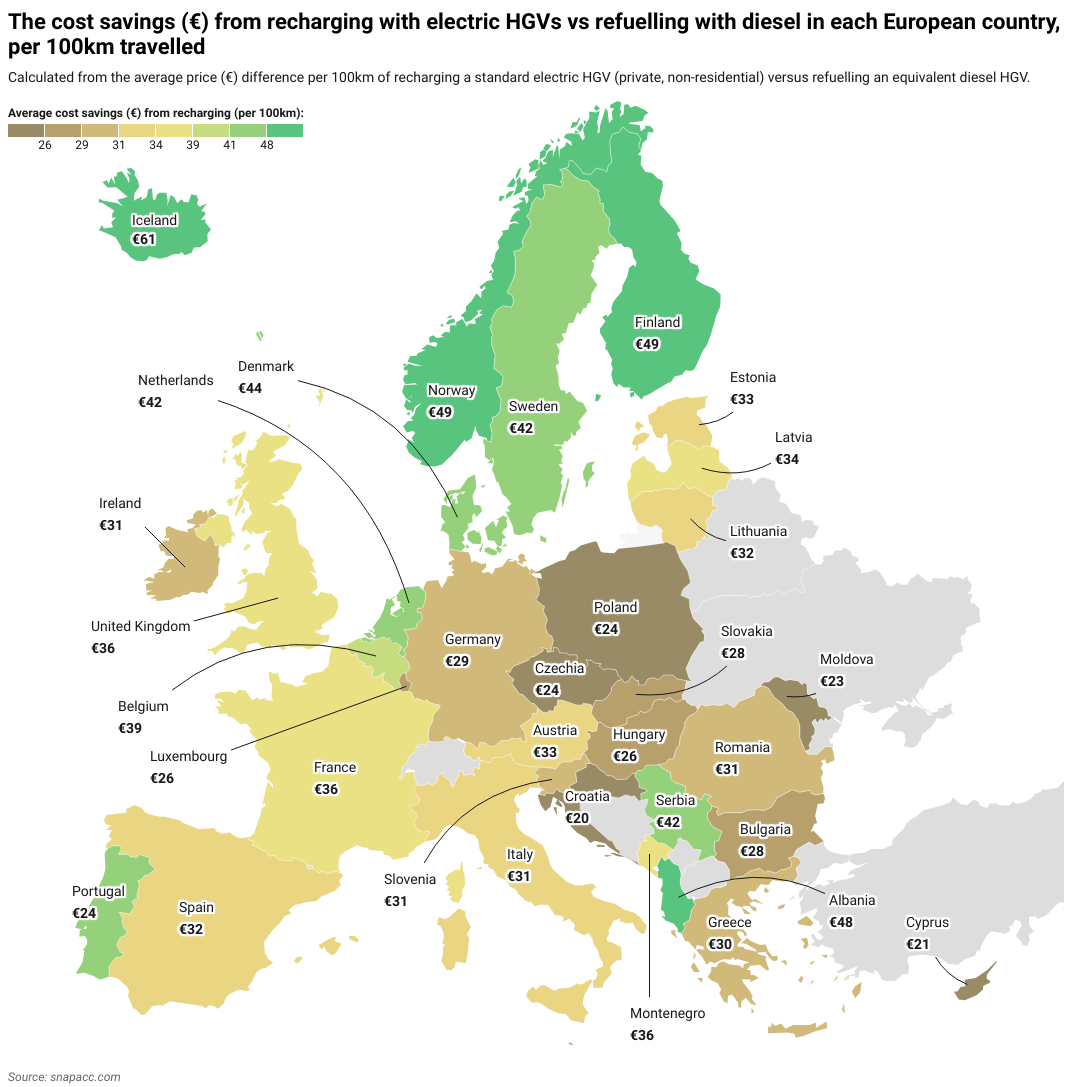
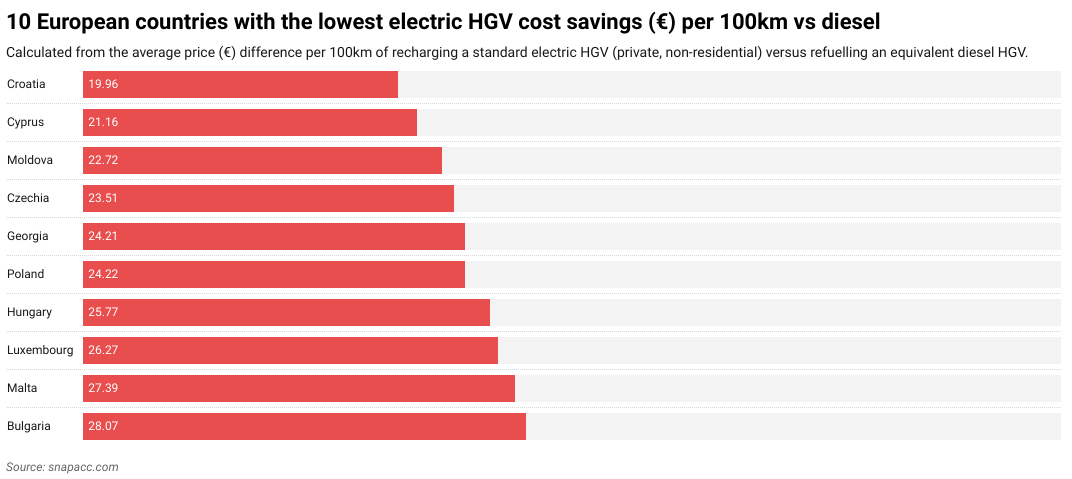
Zjistili jsme, že Island vede s průměrnou úsporou nákladů ve výši 61,03 EUR na 100 km, přičemž druhou nejvyšší úsporu nákladů nabízejí severské země Norsko a třetí Finsko. Na opačném konci žebříčku se nachází Chorvatsko s nejnižšími úsporami nákladů (19,96 EUR na 100 km), následované Kyprem a Moldavskem.

V tomto článku odhalujeme úspory nákladů v jednotlivých evropských zemích a analyzujeme některé úspory nákladů v jednotlivých evropských zemích a analyzujeme některé vnější faktory, které mohou mít na tyto úspory vliv. Ponoříme se také do toho, jak může vypadat budoucnost eHGV v Evropě, a také do toho, jak mohou eHGV pomoci provozovatelům vozových parků a řidičům ušetřit peníze, zejména v případě rozpočtu řidiče.

Jak se vyvíjejí náklady na eHGV a naftu v EU

Náš průzkum zjistil, že v každé zkoumané evropské zemi ušetřilo používání eHGV s elektrickým nabíjením peníze ve srovnání s používáním tradičního nákladního vozidla s pohonnými hmotami. Hlavní rozdíl byl v tom, jak moc se úspory nákladů lišily. Například cena elektřiny v nejdražší zemi, Islandu, je o 206 % vyšší (o 41 eur) než v nejméně nákladné zemi, Chorvatsku.

Zjistili jsme, že řidič elektrického nákladního vozidla ušetří v průměru 30,59 EUR na 100 km ve srovnání s řidičem nákladního vozidla s dieselovým motorem. To znamená odhadovanou průměrnou úsporu 37 200 EUR ročně u řidičů elektrických nákladních vozidel na dlouhé vzdálenosti a 24 800 EUR u řidičů v tuzemsku.

Při sestavování našich údajů jsme se zaměřili na 35 evropských zemí a porovnávali jsme náklady na energii nebo palivo na 100 km u dvou typů těžkých nákladních vozidel (HGV). Jednalo se o standardní dieselové nákladní vozidlo, které předpokládalo spotřebu paliva 35 litrů na 100 km při průměrné maloobchodní ceně nafty v každé zemi, a elektrické nákladní vozidlo, které předpokládalo spotřebu elektřiny 108 kWh na 100 km na základě průměrné sazby za elektřinu mimo domácnosti. DPH a vratné daně byly z těchto výpočtů vyloučeny. Srovnání odráží pouze přímé náklady "u pumpy" nebo "u zásuvky" bez zohlednění faktorů, jako je velikost vozového parku, sjednané smlouvy o dodávkách energie nebo budoucí změny cen pohonných hmot a elektřiny.

Při zkoumání cen nafty a elektřiny bylo čerpáno z řady zdrojů, včetně Eurostat, CEIC, GlobalPetrolPrices, Webfleet a Gov.uk. Je třeba poznamenat, že některé z těchto zdrojů odkazují na "Velkou Británii", zatímco jiné na "Spojené království". Pro účely tohoto výzkumu byly oba termíny považovány za zaměnitelné.

Země, které nejvíce ušetří přechodem na elektrická nákladní vozidla

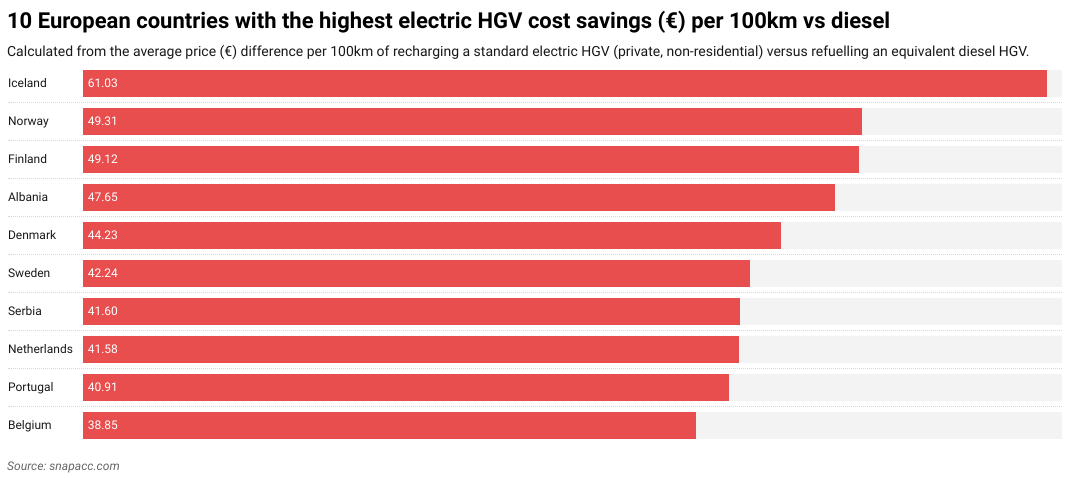
Island (61,03 EUR), Norsko (49,31 EUR) a Finsko (49,12 EUR) jsou v současnosti země, kde lze nejvíce ušetřit přechodem na elektrická nákladní vozidla.

To je způsobeno především tím, že tyto země patří k nejdražším v Evropě, pokud jde o naftu. Nejdražší naftou v Evropě je Island (2,07 EUR za litr). Tato vysoká cena je do značné míry způsobena jeho geografickou izolací ve srovnání se zbytkem Evropy, takže náklady na dovoz nafty jsou mnohem vyšší než v jiných evropských zemích. Island, stejně jako Norsko a Finsko, je také známý svou vysokou daňovou sazbou, která rovněž přispívá k vysokým cenám pohonných hmot.

Norsko (32 %) a Island (18 %) jsou rovněž na prvních dvou místech na světě, pokud jde o podíl elektromobilů na silnicích. Obě země proto významně investovaly do infrastruktury pro nabíjení elektromobilů.

Malá rozloha Islandu a hlavní silniční okruh také usnadňují instalaci elektrických dobíjecích stanic v pravidelných intervalech pro řidiče elektrických nákladních vozidel. Stejnou argumentaci lze částečně použít i pro další země s menšími sítěmi, které vykazují vysokou míru úspory nákladů, včetně Albánie, Srbska a Belgie - i když je třeba poznamenat, že všechny tři mají také jedny z nejdražších cen nafty v Evropě, což přispívá k rozdílu v úsporách nákladů.

Následující graf ukazuje 10 zemí, které dosahují největších úspor nákladů při používání elektrických nákladních vozidel:
"Řidiči v celé Evropě již šetří přechodem na elektrická nákladní vozidla. Přechod na nabíjení eHGV je budoucností odvětví a SNAP je připraven pomoci řidičům a provozovatelům vozových parků v tomto přechodu. "

Matthew Bellamy - Vedoucí ředitel společnosti SNAP

Země, které ušetří nejméně přechodem na elektrická nákladní vozidla

Chorvatsko (19,96 EUR), Kypr (21,16 EUR) a Moldavsko (22,72 EUR) jsou v současné době tři země s nejnižšími úsporami nákladů v Evropě.

Chorvatsko má druhou nejpomalejší míru zavádění elektromobilů v EU po Polsku. Částečně je to způsobeno špatnou infrastrukturou pro nabíjení EV v Chorvatsku, například nabíjecími stanicemi, u kterých je nutné volat na zákaznickou linku nebo používat několik různých aplikací pro spuštění procesu nabíjení, špatnou orientací nabíjecích stanic mimo hlavní dálnice a potenciálně vysokou čekací dobou během hlavní turistické sezóny. V Chorvatsku navíc chybí ultrarychlé nabíjecí stanice. (180 kW a více), což může být problém pro elektrická nákladní vozidla, která potřebují větší výkon než průměrný elektromobil.

Kypr i Moldavsko mají vnitřní geopolitické problémy, které ztěžují plánování infrastruktury pro dobíjení elektrických vozidel (i plánování na národní úrovni obecně). Pokud jde o Kypr, severní polovina ostrova - včetně poloviny jeho hlavního města Nikósie - je od roku 1974 okupována Tureckou republikou Severní Kypr. V případě Moldavska působí východní provincie Podněstří jako de facto stát s vlastní vládou. To znamená, že obě země nejsou schopny důsledně zavádět infrastrukturu EV na celém území, které považují za své.

Problémy na Kypru umocňují také vysoké náklady na elektřinu, zatímco Moldavsko má páté nejlevnější ceny nafty v Evropě. Moldavsko je také druhou nejchudší zemí v Evropě, což ztěžuje investice do infrastruktury pro elektromobily. Všechny tyto faktory přispívají k celkově nízkým úsporám nákladů na elektrická nákladní vozidla.

Polsko je na seznamu také nízko s úsporou nákladů ve výši 24,22 EUR. Navzdory působivému hospodářskému růstu a rostoucím investicím do infrastruktury pro dobíjení elektromobilů je v některých oblastech země pokrytí stále problémem, i když se zdá, že se to v budoucnu změní (https://alternative-fuels-observatory.ec.europa.eu/general-information/news/poland-launches-major-funding-programs-zero-emission-transport).

Země jako Španělsko (32,20 EUR), Rumunsko (30,62 EUR) a Irsko (30,54 EUR) jsou v oblasti úspor nákladů na elektrická nákladní vozidla uprostřed cesty. To je pravděpodobně způsobeno tím, že tyto země mají rostoucí infrastrukturu pro nabíjení elektrických vozidel a střední ceny elektřiny a nafty.

Následující graf ukazuje 10 zemí, které mají nejnižší úspory nákladů při používání elektrických nákladních vozidel:
Úspory nákladů na elektrická nákladní vozidla ve Spojeném království

Velká Británie dosahuje úspory nákladů na elektrická nákladní vozidla ve výši 36,23 EUR, což ji řadí na 11. místo v celkovém žebříčku úspor nákladů na dobíjení na 100 km. To je do značné míry způsobeno tím, jak drahé jsou ceny pohonných hmot ve Spojeném království, kde jsou ceny nafty třetí nejdražší v Evropě. Ačkoli úspory plynoucí z vysokých cen nafty jistě přispívají k vysokým úsporám nákladů na eHGV ve Spojeném království, byly by pravděpodobně mnohem vyšší, kdyby elektřina ve Spojeném království nepatřila také k nejdražším v Evropě.

Také Velká Británie očekává zlepšení infrastruktury pro nabíjení elektromobilů. Britská společnost Moto, která se zabývá servisem dálnic, aktivně plánuje vybudovat 15 "superhubů" do roku 2027. Tyto superhuby mohou lépe pojmout nabíjení EV pro eHGV efektivněji než standardní nabíječky EV. V současné době je na britských silnicích méně než pět speciálních nabíjecích míst pro vozidla eHGV. Vzhledem k tomu, že další společnosti jako BP Pulse a Aegis Energy chtějí také investovat, zdá se pravděpodobné, že Spojené království bude mít v blízké budoucnosti mnohem lepší síť pro nabíjení těžkých nákladních vozidel.

Co ovlivňuje elektrifikaci nákladních vozidel?

Elektrifikaci nákladních vozidel v současnosti ovlivňuje několik faktorů, včetně nedostatku nabíjecí infrastruktury, dlouhé doby nabíjení, vysokých počátečních nákladů na přestavbu na eHGV a jejich omezeného dojezdu. Kromě toho relativně nízké náklady a dostupnost motorové nafty a vozidel činí z tradičních nákladních vozidel atraktivní volbu pro [provozovatele vozových parků] (https://snapacc.com/fleet-operators/).

Všechny tyto dopady se však mohou lišit v závislosti na zemi provozu. Pokud například váš vozový park jezdí pouze na domácím trhu v zemi, jako je Norsko nebo Island, bude pravděpodobně ovlivněn méně než vozový park provozovaný v celé Evropě nebo v regionech s horší infrastrukturou eHGV, jako je Balkán.

Nedostatečná infrastruktura pro nabíjení

Hlavní překážkou elektrifikace nákladních vozidel je nedostatečná infrastruktura pro nabíjení eHGV. Je to proto, že eHGV vyžadují megawattové nabíjení, které většina stávajících nabíjecích míst pro osobní vozidla (standardní elektromobily a dodávky) nepodporuje.

V Evropě je mnoho zemí, kde tato infrastruktura velmi chybí, zejména na hlavních trasách nákladní dopravy a na zastávkách pro kamiony. Jedná se většinou o chudší státy v jižní a východní Evropě, jako je Moldavsko, Gruzie a Bulharsko. Není náhodou, že se tyto státy řadí na poslední místo v žebříčku úspor nákladů na eHGV.

Může se také stát, že nabíjecí stanice pro eHGV sice existují, ale nacházejí se v oblastech, které kvůli slabé místní elektrické síti jednoduše nemohou pojmout více eHGV nabíjejících se přes noc. To je často problém ve venkovských a odlehlých částech Evropy.

Ačkoli mnoho evropských zemí plánuje zlepšení infrastruktury eHGV, stále se jedná o časově náročný a nákladný proces, který vyžaduje překonání mnoha byrokratických, logistických a technických překážek - nemluvě o modernizaci okolní infrastruktury, jako je například připojení k místní síti, která bude rovněž nutná.

Dlouhá doba nabíjení

Elektrická nákladní vozidla se nabíjejí mnohem déle než standardní elektromobily. To znamená, že nabíjení musí často probíhat přes noc. I když se podaří pořídit rychlonabíječky eHGV, proces stále trvá nejméně dvě hodiny, nikoliv několik minut, jako je tomu u benzinových vozidel.

Tato dlouhá doba nabíjení může mít pro provozovatele vozových parků následný efekt v podobě doby obratu. V odvětví s napjatými harmonogramy a termíny dodávek to může mít potenciálně negativní vliv na výkonnost podniku.

Omezená nabídka vozidel eHGV

Elektrická nákladní vozidla jsou také omezena svým relativně omezeným dojezdem ve srovnání s dojezdem tradičních nákladních vozidel. Podle Safety Shield má typické elektrické nákladní vozidlo dojezd na jedno nabití přibližně 300 mil (zhruba vzdálenost z Londýna do Rotterdamu). Typické nákladní vozidlo poháněné naftou však může na jednu nádrž ujet až 1 000 mil (zhruba vzdálenost z Londýna do Varšavy).

Kilometráž elektrických nákladních vozidel může být také více ovlivněna vnějšími faktory, jako je zatížení, chladné počasí a terén. To může vést k obavám řidičů z dojezdu, kteří mohou častěji nabíjet, aby měli dostatek energie na dojetí do cíle. To zase může vést ke zpoždění dodávek, zejména při jízdě přes země se špatnou infrastrukturou pro nabíjení eHGV.

To vše je pro provozovatele vozových parků, kteří plánují jízdy svých vozidel eHGV, optimalizace trasy zásadní. Je třeba poznamenat, že technologie baterií se neustále vyvíjí a kapacita - a tedy i kilometrový výkon - se bude v blízké budoucnosti dále zlepšovat.

Vysoké náklady na eHGV

Počáteční náklady na eHGV jsou vysoké (obvykle mezi 160 000 a 200 000 GBP ve srovnání s 80 000 až 100 000 GBP za dieselové těžké nákladní vozidlo), což může potenciálně odradit nezávislé řidiče a menší provozovatele vozových parků od pořízení takového vozidla. Důvodem jsou především náklady na příslušnou technologii baterií. To znamená, že přímý nákup nového elektrického nákladního vozidla bude nákladný, protože vnitřní technologie je dražší než u dieselového nákladního vozidla.

Vysoké počáteční pořizovací náklady na eHGV také znamenají, že provozovatelé vozových parků v zemích s levnějšími sazbami za elektřinu pro nabíjení eHGV, jako je Norsko, Švédsko nebo Finsko, mají větší šanci na přechod na nový systém, protože se jim investice vrátí rychleji než provozovatelům v zemích s drahou elektřinou, jako je Irsko nebo Chorvatsko.

Ceny elektřiny mohou kolísat také v závislosti na různých událostech. Například v posledních pěti letech ceny elektřiny kolísaly v reakci na otevření ekonomik po pandemii COVID-19 a následně na ruskou invazi na Ukrajinu v roce 2022 (zejména ta měla zásadní dopad na evropské dodávky energie). V důsledku toho došlo v období po invazi k nárůstu cen elektřiny o téměř 30 %, z 20,5 c€/kWh, na 26,5 c€/kWh pro průměrné hlavní město EU. Vzhledem k tomu, že průměrná cena v EU je nyní nižší než v roce 2022, se zdá, že elektrické nabíjení nákladních vozidel bude pokračovat ve svém vzestupu.

Průměrné náklady na provoz elektrického nákladního vozidla na vzdálenost 100 km jsou v Evropě 20,51 EUR, což je výrazně méně než 51,10 EUR u nákladního vozidla s dieselovým motorem na stejnou vzdálenost.

Se zvyšující se účinností a rozšiřováním technologie baterií a snižováním nákladů na jejich výrobu budou i vozidla eHGV cenově dostupnější.

Levnost a dostupnost nafty

Motorová nafta stále hraje dominantní roli v odvětví nákladních vozidel. Důvodem je skutečnost, že infrastruktura pro motorovou naftu je v Evropě dobře zavedená již desítky let, zejména ve srovnání s elektrickými nabíječkami pro nákladní vozidla. Kompatibilita nafty s palivovými kartami a její relativně nízká cena ji rovněž udržují v oblibě u správců vozových parků nákladních vozidel.

Stejně jako u elektřiny však hodnota nafty na celém kontinentu kolísá. Proto se může zdát výhodnější zůstat u naftových nákladních vozidel v zemích, jako je Moldavsko, Gruzie a Malta, kde je nafta stále levná. Naopak pro země jako Island a Nizozemsko, kde je nafta relativně drahá, existuje větší motivace k přechodu na elektrická nákladní vozidla.

Země s levnými pohonnými hmotami může také váhat s rozsáhlými investicemi do infrastruktury eHGV z obavy, že si znepřátelí tradiční flotily nákladních vozidel, které by v důsledku toho mohly zvolit alternativní trasy.
Budoucnost elektrických nákladních vozidel v Evropě

Elektrická nákladní vozidla jsou dlouhodobou budoucností silniční nákladní dopravy. Nejenže je jejich provoz časem levnější, ale s novými investicemi do infrastruktury, které se budují velkým tempem, se stanou také finančně a strategicky mnohem životaschopnějšími.

Kromě ekonomických přínosů jsou elektrická nákladní vozidla důležitá také pro svůj přínos k cílům v oblasti životního prostředí, jako je například Net Zero. Vzhledem k tomu, že tradiční nákladní vozidla jsou velkými znečišťovateli životního prostředí, projeví se úspora emisí díky eHGV v čistším ovzduší v celé Evropě.

Zdá se, že následující trendy budou mít v budoucnu vliv na elektrická nákladní vozidla:

  • Smart truck parks: Truck parks in the future will evolve to better accommodate eHGVs alongside other smart technological advancements. These truck parks may include up-to-date ultra-fast charging stations, diagnostic machines, battery swap stations, and automated cleaning services, among other features.
  • Increased EU regulations: Low Emission Zones (LEZs) already exist in a number of cities (e.g. Paris, Berlin, and Milan) with more European cities likely to follow suit with more stringent EU transport regulations. Fleet operators may opt for eHGVs to meet EU regulations or retrofit their HGVs with cleaner technologies, like smart tachographs.
  • AI implementation: AI technology has already had a profound sustainability impact across road haulage — with applications in route optimisation, predictive maintenance, and autonomous vehicle development. Electric vehicles will likely incorporate AI to help drive sustainability in the haulage industry over the coming decades.
  • Sustainability: The shift to eHGVs is part of a wider global push toward sustainable living. The effects of extreme weather, including heatwaves and floods across Europe, show no sign of slowing due to climate change. Moving to electric HGVs is one way the world is reducing its dependence on fossil fuels.
  • Fuel variety: During the transition to cleaner fuel sources, there will be a variety of HGV types on the road throughout the 2030s. Many will be older diesel models, some will be electric, and others will be powered by alternative fuels such as biofuel made from renewable biomass sources.

Chytřejší řízení nákladů na eHGV

Elektrická nákladní vozidla jsou budoucností, o tom není pochyb. Díky ekonomickým a ekologickým výhodám bude v příštích letech přecházet na eHGV stále více provozovatelů vozových parků a řidičů. Jak dlouho bude toto přechodné období trvat, bude záviset na tom, jak rychle se v Evropě podaří vybudovat nabíjecí infrastrukturu pro eHGV.

V současné době existují rozsáhlé oblasti kontinentu, kde jsou vozidla eHGV málo životaschopná a vyžadují rozsáhlou optimalizaci tras kvůli svému kratšímu dojezdu. Navíc počáteční náklady mohou odradit nezávislé řidiče a menší provozovatele vozových parků.

Technologie a infrastruktura se budou nadále zdokonalovat a již nyní existují služby, které mají co nejvíce zjednodušit správu vozového parku eHGV a souvisejících nákladů. SNAP zjednodušuje provoz nákladních vozidel - od optimalizace tras a správy vozového parku až po mapy pro parkování a mytí nákladních vozidel.

Přihlaste se k SNAPu ještě dnes.

Sdílet na

Ostatní také čtou...

Header Image

úterý 16 prosince 2025 • Novinky z oboru

CO ZNAMENÁ ŠPANĚLSKÁ POVINNÁ DIGITÁLNÍ EVIDENCE PRO VOZOVÉ PARKY PŮSOBÍCÍ V EVROPĚ?

Guest

Spain is preparing for one of the most significant transport reforms in its recent history. The Sustainable Mobility Law (Ley de Movilidad Sostenible), which received final approval in November 2025, will introduce mandatory digital records for road freight control documentation, creating a more transparent, enforceable and efficient system for domestic and international carriers. Although this is a major national change, it forms part of a wider trend. Across Europe, governments and operators are moving towards a fully digital freight environment as the EU prepares to implement the (eFTI).For fleets working in and out of Spain, this is the start of an important transition. It signals a future in which paper documentation becomes the exception rather than the rule and in which digital processes support faster checks, smoother operations and greater consistency across borders.While the Sustainable Mobility Law addresses wide-ranging transport reforms – from urban mobility to domestic flight restrictions – the provisions most relevant to international freight operators centre on digital documentation. A central section of the law introduces a mandatory digital “control document” for road freight. This includes the use of approved digital formats, such as the electronic consignment note (eCMR), which Spain has already ratified and treats as legally equivalent to the paper CMR note. The law aims to reduce administrative burdens, eliminate inconsistencies in paperwork and shorten the time required for checks and inspections. Rather than relying on handwritten notes or physical documents that can be misplaced, carriers will store, share and verify transport information digitally. For operators, this should mean fewer disputes over documentation, less ambiguity around compliance requirements and greater certainty when preparing for audits or regulatory reviews.In practice, the obligation focuses first on the digital control document used for roadside and regulatory checks, but it is expected to accelerate wider use of eCMR and other digital freight documents across the supply chain.The timeline for implementation will begin once the law is published in Spain's Official State Gazette. Carriers should expect the digital control document obligation to take effect roughly ten months after publication, making 2026 the likely year when full compliance will be required.The Mobility Law applies to road transport operations that fall under Spanish control rules on Spanish territory, not just Spanish-registered companies. Carriers will need to ensure their systems can produce and transmit digital records in compliant formats. Any delay in adopting digital documentation could slow down inspections or disrupt customer schedules.This means that foreign operators running international loads into, out of or through Spain should plan on being able to provide the required control document in digital form when requested by Spanish authorities.The Spanish reforms align closely with the EU’s eFTI Regulation, which will require Member States to accept digital freight documentation once the technical and certification rules are in place (from mid-2027). eFTI sets a unified framework for how information is structured, transmitted and verified. While it obliges authorities to accept digital records, it does not require operators to use them. Spain’s Mobility Law therefore goes further, making digital control documents mandatory for road freight.Under eFTI, carriers will be able to provide freight information electronically through certified platforms. Enforcement authorities will receive that information through secure digital channels. This should reduce administrative friction across the EU’s busiest freight routes.Spain is not alone in taking early steps. Several EU countries have already moved towards paperless freight systems and their experience demonstrates what a fully digital environment could look like.● The Netherlands has been one of the earliest adopters of eCMR and has trialled end-to-end digital workflows across different modes of transport. ● France also moved early, supporting digital documentation and faster roadside checks following its ratification of the eCMR protocol. ● In the Benelux region, Belgium, Luxembourg and the Netherlands are running a joint eCMR pilot and digital logistics corridor, illustrating how interoperable documentation can work across national boundaries.● Denmark and Sweden have operated national e-freight trials designed to simplify the sharing of transport information. Taken together, these examples show that Spain’s Mobility Law is part of a broader European transition. Rather than standing apart, Spain is moving in step with a continental shift towards digital documentation that aims to make road freight faster, more transparent and more consistent across borders.The move to digital records brings several practical advantages. Digital documents reduce the time drivers and enforcement officers spend handling paperwork and shorten inspections during roadside checks. This mirrors the benefits seen with the introduction of , which have reduced unnecessary stops for compliant drivers and improved the consistency of enforcement across Europe.Digital documentation also removes the errors that can arise from handwritten notes or damaged paper notes. Fleet managers can instantly retrieve records, resolve errors more easily and maintain clearer oversight of documentation across multiple routes. For operators managing complex schedules, this increased predictability supports better planning and stronger customer service.Drivers are likely to benefit too. A shift to digital records reduces administrative pressure and helps avoid disagreement at delivery points. With all documents stored digitally, drivers have a single source of truth that is accepted across the supply chain.Fleets may need to invest in updated transport management systems or integrate new tools that support digital documentation. Operators may require additional support and training to shift from paper-based processes to new digital workflows.There will also be a period of adjustment in which paper and digital systems may operate side by side. As eFTI becomes established across Europe, some countries will move faster than others. Operators travelling across different borders may encounter varying expectations, particularly in the early years.Throughout this transition, driver welfare should remain a priority. The administrative load associated with new processes often falls on drivers. Clear training and straightforward systems will be essential.Spain’s Mobility Law marks an important moment in the evolution of European freight. It reflects a sector that is modernising at speed and preparing for a future built on digital workflows rather than manual paperwork. Operators that begin preparing now will be in a strong position as Spain’s digital control document requirements take effect and eFTI comes into force across Europe.At SNAP, we support fleets across Spain and the wider continent with tools that make daily operations simpler and more predictable. The intruck app helps drivers locate and book secure parking along their route, which is particularly valuable as compliance processes evolve. If your fleet is preparing for Spain’s new requirements or the broader digital transition across Europe, SNAP is here to support every step of the journey.

Header Image

středa 10 prosince 2025 • Novinky z oboru

ROZPOČET SPOJENÉHO KRÁLOVSTVÍ NA ROK 2025: CO TO ZNAMENÁ PRO NÁKLADNÍ DOPRAVU

Guest

The arrives at a difficult moment for the road transport sector. Operators are working against rising wages and operating costs, tight margins, ageing infrastructure and ongoing pressures around recruitment. At the same time, the shift towards cleaner mobility is accelerating, creating new expectations and increasing the need for long-term investment.The following article outlines what the Budget means for infrastructure, investment, workforce costs and the wider operating environment for haulage.For many years, fleets have been affected by deteriorating roads, weight restrictions on ageing bridges and the growing unpredictability of journey times. Government and industry data makes this clear. More than one in every ten miles of network in England and Wales is likely to require maintenance within the next year, according to reporting, and the backlogs for resurfacing work continue to rise. These issues lead to vehicle damage, driver fatigue, higher insurance costs and disrupted schedules. They also place additional pressure on operators already dealing with narrow margins.The new Budget acknowledges these concerns. One positive step is the substantial funding for strategic national projects, including almost £900 million allocated to the , which should reduce congestion, provide more reliable journey times and a safer driving environment for HGVs.Local authorities will also receive a share of and address the growing number of potholes. This could make a noticeable difference for fleets. Local roads carry the majority of domestic freight and serve as the first and last mile of nearly every delivery. Improving them should reduce wear and tear on vehicles as well as operational strain. These commitments will not fix decades of underinvestment immediately, but they represent an important shift towards a road network that is more resilient and better suited to the realities of modern logistics.The Budget also places more focus on skills. for under-25s working in small and medium-sized businesses could help attract new entrants into a profession that urgently needs them. The driver shortage is well documented. The UK must recruit around in order to stabilise supply chains, and across Europe the average age of professional drivers continues to climb. Only a small proportion of drivers are under 25, and training costs have been a barrier for many younger candidates.Providing funded apprenticeships makes logistics more accessible at a critical time. It also supports smaller operators, who often struggle to invest in training despite needing to expand their teams. The Budget introduces further support for investment, particularly around fleet renewal. Operators installing charging infrastructure can take advantage of a 100% first-year allowance until March 2027. This will help offset the upfront cost of electric HGVs and depot charging equipment.From January 2026, a new 40% first-year allowance will be available on many main-rate assets, including trucks – particularly useful where full expensing or the Annual Investment Allowance don’t apply, such as some leased fleets and unincorporated operators.While the Autumn Budget contains several positive measures, operators will also need to plan for increasing costs. Fuel duty will rise in stages between the end of August 2026 and March 2027. Fuel is already one of the largest expenses for operators, and the planned rises are likely to increase the emphasis on fuel efficiency, telematics, consolidated routing and fleet renewal.Vehicle Excise Duty (Road Tax) will be uprated in line with inflation from April 2026, including for HGVs. From April 2028, a new Electric Vehicle Excise Duty (eVED) will also apply a mileage-based charge to battery-electric and plug-in hybrid cars, on top of existing VED. Although eVED initially excludes electric vans and trucks, it signals a longer-term shift toward distance-based taxation that fleets will need to factor into future planning.The HGV Levy will also return to rising with inflation. Vehicles over twelve tonnes must pay the levy before using A roads or motorways, and the revised rate will add another cost that fleets must factor into forward planning.Larger, higher‑value properties are also likely to feel more pressure from business rates changes. The Budget confirms permanently lower business rates for retail, hospitality and leisure, funded in part by higher charges on the most expensive commercial premises. These include big warehouses and distribution centres, so operators with large sites can expect proportionately higher bills over time than smaller depots or high‑street locations.In addition, the Budget introduces several measures that directly affect the financial landscape for operators and the people who run or work within haulage businesses. Labour already represents one of the sector’s highest costs, and these changes will shape payroll planning, staff retention and the personal finances of many owner-operators.Minimum wage increases mean that employers will face higher staffing costs across warehousing, last-mile logistics and support roles. Many operators have already tackled wage rises in recent years, and this further uplift will add pressure at a time when margins remain narrow. For fleets that rely on overtime, night work or seasonal peaks, the impact will be even more noticeable.The Budget continues the government’s move toward greater digitalisation of tax and reporting. Compliance expectations will grow over the coming years, with stricter penalties for late VAT and Self Assessment returns and an expanded Making Tax Digital framework from 2027. Mandatory electronic invoicing will follow in 2029. Parcel carriers and mixed load operators will also be affected by changes to customs duty for low-value imports, which will apply to items worth less than £135 by March 2029 at the latest. While the aim is to even the playing field for UK manufacturers, it is likely to increase administrative pressure on haulage firms. These changes may eventually improve efficiency, but they will require investment in systems and staff training. Smaller fleets without dedicated administrative teams are likely to feel the adjustment most sharply.Although operators will face higher costs and increased administrative complexity, the 2025 Budget also provides some of the most significant commitments to the road network and skills pipeline seen in recent years. Taken together, these measures signal a Budget that attempts to balance fiscal constraints with long-term needs. The road ahead will still require careful planning and strategic investment, but there are genuine opportunities to strengthen the sector’s foundations and support a more resilient future for haulage.SNAP gives fleets practical tools to manage this shifting landscape, from parking access to data that supports compliance and operational decision-making. to discover how SNAP can help strengthen your fleet’s resilience in the months ahead.

Header Image

pondělí 03 listopadu 2025 • Novinky z oboru

9 ZPŮSOBŮ, JAK DETEKCE AI MĚNÍ ODVĚTVÍ VOZOVÝCH PARKŮ

Guest

Artificial intelligence (AI) has redefined how fleet professionals approach daily operations. Modern technologies let managers measurably improve maintenance, safety and compliance across their vehicles. As regulatory pressures rise, AI-driven insights will be more critical in gaining a decisive edge. Here are nine ways AI detection is transforming the fleet industry. Advanced telematics and machine learning (ML) algorithms help AI detection in fleets by monitoring driver behaviour. These devices analyse real-time patterns and flag risky driving behaviours like speeding and harsh braking. ML models instantly process data from in-vehicle sensors and identify deviations from safe driving norms and company policies.Drivers receive immediate feedback in the vehicle, while fleet managers get detailed reports on trends. The wealth of information helps supervisors personalise coaching sessions and find specific improvement areas. Telematics solutions have been critical to fleets nationwide because through improved behaviour and training programmes. AI algorithms are essential to analysing real-time traffic data, like road closures and weather conditions. Congestion can be significant, especially if your routes pass through London. A 2024 Inrix report said drivers when driving in the capital city. ML models can quickly identify bottlenecks and adverse weather to meet critical delivery times. Fleet managers benefit because their drivers can improve on-time performance. Route optimisation means deliveries are more likely to arrive during scheduled windows. It also enhances driver behaviours by idling less and covering fewer miles. Modern AI technologies rapidly detect roadway closures and unexpected weather changes to minimise disruptions. Accident reporting used to include manual logs and documentation. However, AI can reduce labour needs by automatically detecting and submitting incident reports. From collisions to near misses, these technologies can recognise potential incidents. Sensors gather relevant information at the event’s timing to provide more context. Unusual circumstances like airbag deployment can also be part of the automatic reporting. Once AI detection is complete, the system compiles information into a standardised report. Manual logs can create time-consuming tasks, so AI can automate these processes and free up staff. Fleet managers and insurers receive the report, thus ensuring compliance and accurate communication. Advanced technologies capture relevant data and use consistent formatting, so all parties get the critical details. Unexpected vehicle breakdowns can disrupt schedules and delay deliveries. AI helps fleet managers detect these problems before they become significant issues. From engine temperature to oil pressure, characteristics are monitored in real time. Advanced algorithms identify subtle anomalies and alert operators when a component is nearing failure. While fixed service intervals can be beneficial, AI lets you be more proactive and schedule maintenance precisely. Tire pressure sensors are an excellent example, especially for construction and utility companies. Experts say air compressors than equipment needs to maintain best practises. These sensors continually monitor output and detect gradual drops, flagging early signs of leaks.AI detection in fleets goes beyond studying driver behaviour. Telematics and sensors analyse speed and acceleration patterns to better understand fuel consumption. The systems monitor your vehicles for excessive idling and inefficient routing that increases petrol or diesel usage. AI can tailor recommendations to drivers by offering optimised speed ranges or maintenance needs.Fleet managers benefit by getting aggregated data on fuel consumption and spending. This information helps them make more informed vehicle procurement and route planning decisions. If older vehicles show inefficiencies, it may be time to upgrade the lot. Logistics professionals should compare individual vehicles against industry standards to see outliers. The U.K.’s environmental goals by 2050. Therefore, fleet managers must be more aware of tightening standards and the risk of fines. AI detection helps vehicles through sensors and onboard diagnostics systems, which collect data during operations. ML algorithms identify patterns and anomalies within the information and notify of excessive emissions. AI can alert fleet managers and enable proactive maintenance if a vehicle exceeds emissions thresholds. While humans take measures to reduce greenhouse gases, AI detection is rising to help the transportation industry. A 2025 study said by adapting eco-driving capabilities. The U.S. researchers said implementing it in 10% of vehicles would reduce carbon emissions up to 50%. Another way fleet managers can reduce emissions is through electric vehicle (EV) conversion. EV ownership is rising nationally through private drivers and fleet owners, as a 2025 report from 2023. AI can assist logistics professionals in the transition by recommending when, where and how to electrify their fleets. First-time EV owners may need help with charging windows and infrastructure needs. AI-powered systems detect when and where electric cars could naturally align with charging windows. For example, it could recommend the best times to charge to reduce schedule disruptions. Some may be pondering the switch to EVs, so logistics managers can leverage AI to compare cost data between electric and petrol cars. While AI investment can be a barrier, it may be financially beneficial in the long run. These software options that slows daily operations. Early detection of issues can lead to a more well-maintained fleet, which creates more uptime and revenue. Fleet managers can also save money through enhanced route optimisation and fuel management. AI detection in fleets is essential for streamlining administrative processes. These technologies can automatically perform compliance checks and incident documentation, thus reducing the need for manual paperwork. Your operators can focus more on the bigger picture and less on administrative overhead. If monitoring helps your drivers, it could reduce the cost of vehicle repairs and legal claims. Vehicle and cargo theft ., though they remain significant concerns. AI detection offers additional security layers by reducing the window of opportunity for thieves. Asset tracking features combine GPS and telematics capabilities to monitor real-time location, essential for companies transporting high-value assets. Fleet managers benefit from geofencing features, allowing them to set virtual boundaries. If a truck or van exits these zones, AI-powered systems automatically flag the event and notify logistics professionals. The algorithm is intelligent enough to understand anomalies and security protocols. Abnormalities can trigger security measures like remote disabling. AI is a practical, game-changing tool for fleet managers. Advanced analytics and real-time monitoring empower logistics professionals to drive measurable safety and performance improvements. While technologies are developing, the future is here. Your business should be willing to invest in AI-driven solutions to reduce costs and minimise risks. Discover more from .