Guest
Noticias del sector • 9 min leer

Combustible frente a carga: ¿Es el cambio a la electricidad más barato o simplemente más ecológico?

Creado: 28/07/2025

Actualizado: 19/09/2025

El crecimiento de las estaciones de recarga eléctrica para camiones en toda Europa ha dado lugar a un periodo de transición en las vastas redes de carreteras del continente. Para muchos operadores de flotas y conductores, los clásicos camiones diésel siguen siendo el medio de transporte preferido. Sin embargo, el cambio a los camiones eléctricos es inminente, ya que el sector sigue evolucionando.

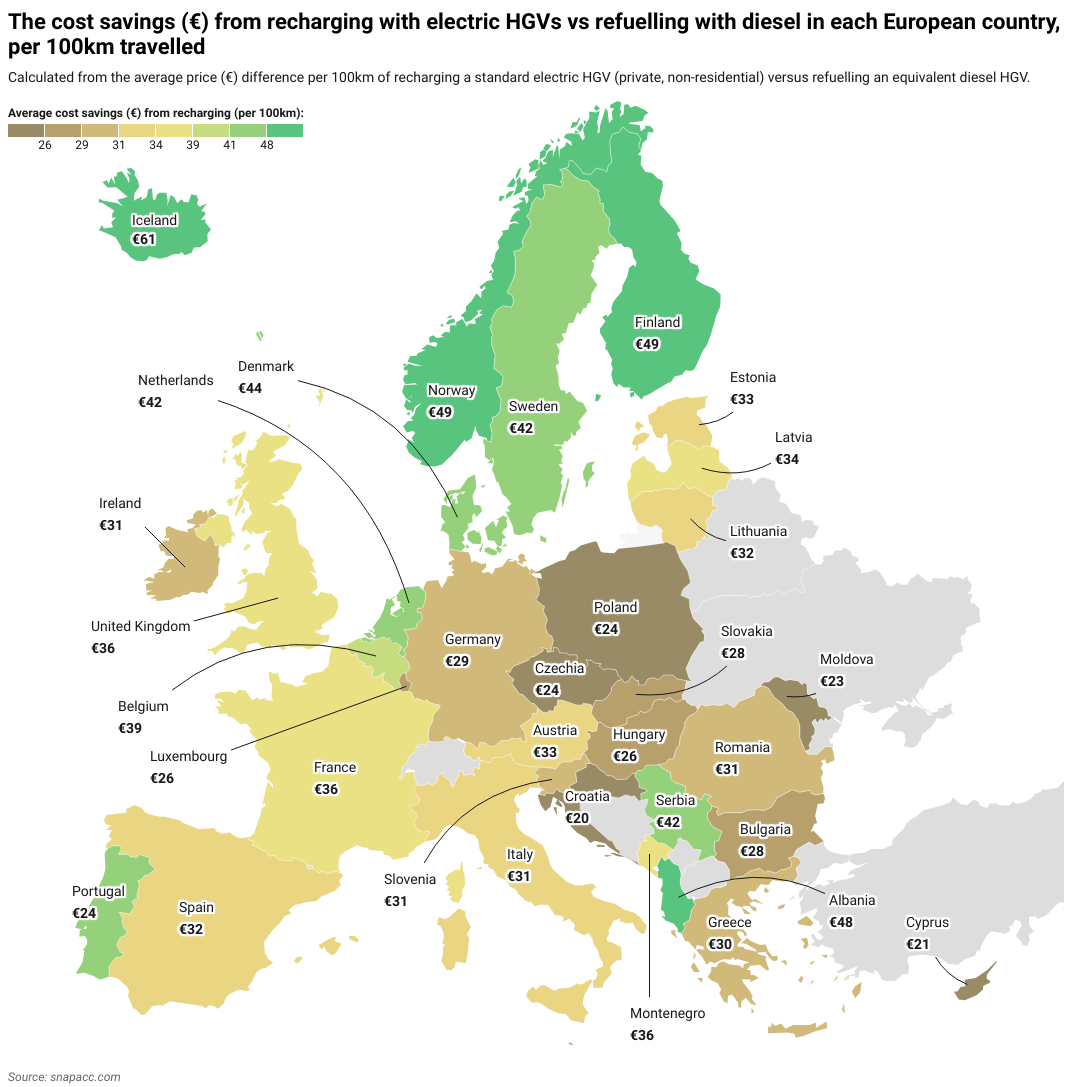
Para evaluar la viabilidad de que los operadores de flotas cambien el diésel por la electricidad, SNAP ha realizado una investigación sobre los costes de recargar los vehículos pesados frente a repostarlos en varias rutas europeas de transporte de mercancías. Hemos calculado el ahorro de electricidad frente al de gasóleo en euros por cada 100 km en 35 países europeos.

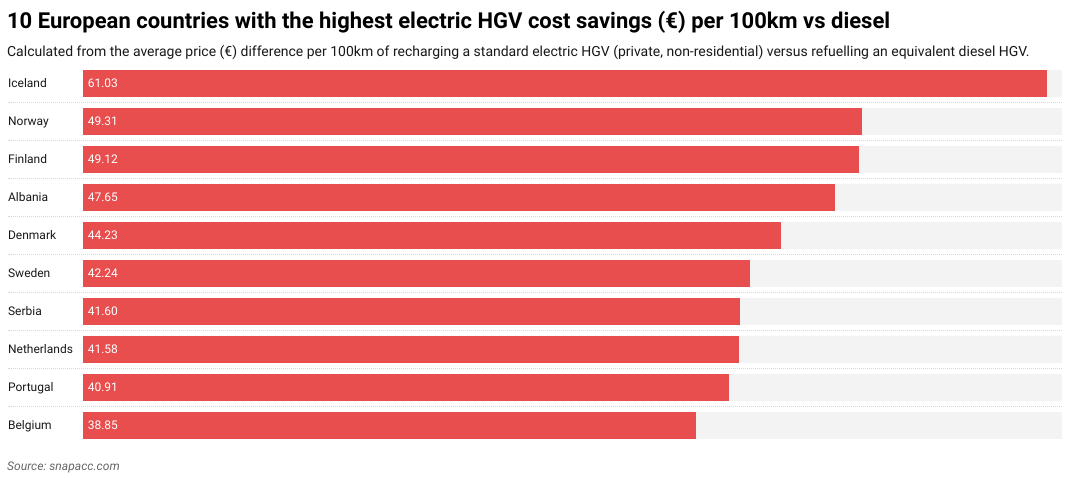
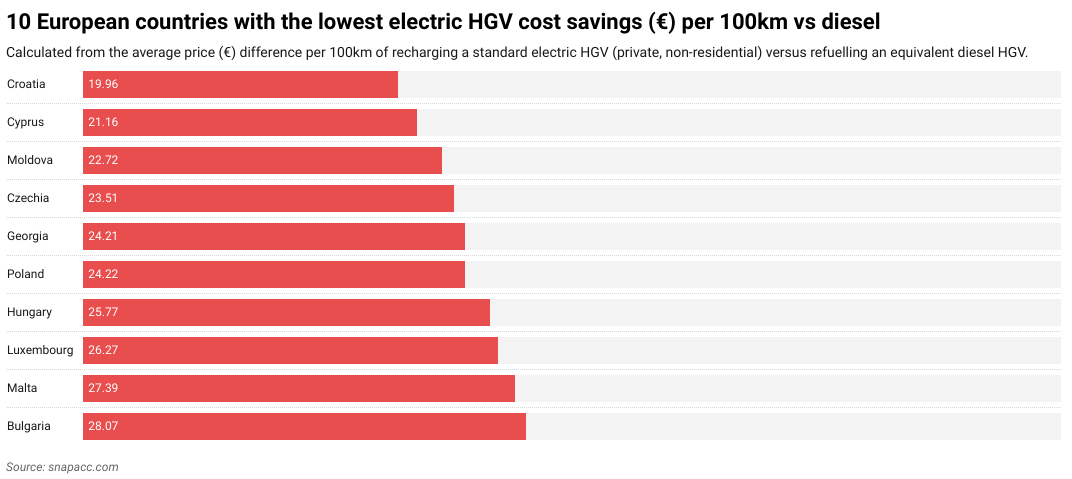
Islandia se sitúa a la cabeza, con un ahorro medio de 61,03 euros por cada 100 km, mientras que Noruega y Finlandia ocupan el segundo y tercer puesto, respectivamente. En el otro extremo de la escala, Croacia ofrece el menor ahorro de costes, con 19,96 euros por cada 100 km, seguida de Chipre y Moldavia.

En este artículo, desvelamos el ahorro de costes por país europeo y analizamos algunos de los factores externos que pueden estar influyendo en este ahorro. También nos sumergimos en cómo puede ser el futuro de los eHGV en Europa, así como en la forma en que los eHGV pueden ayudar a los operadores de flotas y a los conductores a ahorrar dinero, en particular con presupuestos para conductores.

Cómo se comparan los costes del eHGV y el gasóleo en la UE

Según nuestro estudio, en todos los países europeos investigados, el uso de un eHGV con recarga eléctrica ahorra dinero en comparación con el uso de un HGV tradicional con combustible. La principal diferencia estriba en la magnitud del ahorro. Por ejemplo, el precio de la electricidad en el país más caro, Islandia, es un 206% más alto** (41 euros más) que en el país menos caro, Croacia.

Hemos descubierto que, de media, un conductor de un camión eléctrico ahorrará 30,59 euros por cada 100 km** en comparación con un conductor de un camión diésel. Esto se traduce en un ahorro medio estimado de 37 200 euros al año para los conductores de camiones eléctricos de larga distancia y de 24 800 euros para los conductores nacionales.

Para recopilar los datos, analizamos 35 países europeos y comparamos el coste energético o de combustible por 100 km de dos tipos de vehículos pesados. Se trataba de un camión diésel estándar, con un consumo de 35 litros cada 100 km al precio medio de venta al público del gasóleo en cada país, y de un camión eléctrico, con un consumo de 108 kWh cada 100 km basado en la tarifa eléctrica media no doméstica. El IVA y los impuestos recuperables se excluyeron de estos cálculos. La comparación refleja únicamente los costes directos "en el surtidor" o "en el enchufe", sin tener en cuenta factores como el tamaño de la flota, los contratos energéticos negociados o los cambios futuros en los precios del combustible y la electricidad.

A la hora de investigar los precios del gasóleo y la electricidad, se recurrió a diversas fuentes, como Eurostat, CEIC, GlobalPetrolPrices, Webfleet y Gov.uk. Cabe señalar que algunas de estas fuentes hacen referencia a "Gran Bretaña", mientras que otras se refieren al "Reino Unido". A efectos de esta investigación, ambos términos se han tratado indistintamente.

Los países que más ahorran con la conversión a vehículos pesados eléctricos

Islandia (61,03 euros), Noruega (49,31 euros) y Finlandia (49,12 euros) son actualmente los países en los que más se puede ahorrar convirtiéndose a un vehículo pesado eléctrico.

Esto se debe en gran parte a que estos países figuran entre los más caros de Europa para el gasóleo. Islandia es el país más caro de Europa para el gasóleo (2,07 euros por litro). Este elevado coste se debe en gran medida a su aislamiento geográfico respecto al resto de Europa, lo que hace que el coste de importación del gasóleo sea mucho más elevado que el de otras naciones europeas. Islandia, al igual que Noruega y Finlandia, también es conocida por su elevado tipo impositivo, que también contribuye a su elevado coste de combustible.

Noruega (32%) e Islandia (18%)** son también los dos primeros países del mundo en porcentaje de vehículos eléctricos en circulación. Por ello, ambos países han realizado importantes inversiones en infraestructuras de recarga eléctrica.

El pequeño tamaño de Islandia y su principal carretera de circunvalación también facilitan la instalación de estaciones de carga eléctrica a intervalos regulares para los conductores de camiones eléctricos. El mismo razonamiento puede aplicarse en parte a otros países con redes más pequeñas que presentan un alto índice de ahorro de costes, como Albania, Serbia y Bélgica, aunque cabe señalar que los tres también tienen algunos de los precios del gasóleo más caros de Europa, lo que contribuye a la diferencia en el ahorro de costes.

En el siguiente gráfico se muestran los 10 países con mayor ahorro de costes al utilizar un camión eléctrico:
*"Los conductores de toda Europa ya están ahorrando al pasarse a los vehículos pesados eléctricos. El cambio a la recarga eléctrica de los vehículos pesados es el futuro del sector y SNAP está preparado para ayudar a los conductores y a los operadores de flotas en la transición".

Matthew Bellamy - Director General de SNAP

Los países que menos ahorran con la conversión a vehículos pesados eléctricos

Croacia (19,96 euros), Chipre (21,16 euros) y Moldavia (22,72 euros) son actualmente los tres países con menor ahorro de costes de Europa.

Croacia tiene la segunda tasa de adopción de VE más lenta de la UE, después de Polonia. Esto se debe en parte a la deficiente infraestructura de recarga de vehículos eléctricos de Croacia, como las estaciones de recarga que requieren llamar al servicio de atención al cliente o utilizar varias aplicaciones diferentes para iniciar el proceso de recarga, las malas indicaciones para llegar a las estaciones de recarga fuera de las principales autopistas y los tiempos de espera potencialmente elevados durante la temporada alta de turismo. Además, Croacia carece de estaciones de carga de alta velocidad (180 kW y superiores), lo que puede suponer un problema para los vehículos pesados eléctricos que requieren más potencia que un VE medio.

Tanto Chipre como Moldavia tienen problemas geopolíticos internos que dificultan la planificación de infraestructuras para la recarga de VE (así como la planificación nacional en general). En el caso de Chipre, la mitad norte de la isla -incluida la mitad de su capital, Nicosia- está ocupada por la República Turca del Norte de Chipre, apoyada por Turquía desde 1974. En cuanto a Moldavia, la provincia oriental de Transnistria actúa como un Estado de facto con gobierno propio. Esto significa que ambos países son incapaces de implantar infraestructuras de VE de forma coherente en el territorio que consideran suyo.

Los problemas de Chipre también se ven agravados por los elevados costes de la electricidad, mientras que Moldavia tiene los quintos precios del gasóleo más baratos de Europa. Moldavia es también el segundo país más pobre de Europa, lo que dificulta la inversión en infraestructuras para vehículos eléctricos. Todos estos factores contribuyen a que el ahorro global en costes de los vehículos pesados eléctricos sea bajo.

Polonia también ocupa un lugar bajo en la lista, con un ahorro de costes de 24,22 euros. A pesar de su impresionante crecimiento económico y de la creciente inversión en infraestructura de recarga de VE, su gran tamaño significa que la cobertura sigue siendo un problema en algunas zonas del país, aunque es probable que esto cambie en el futuro.

Países como España (32,20 euros), Rumanía (30,62 euros) e Irlanda (30,54 euros) se sitúan en una posición intermedia en cuanto a ahorro de costes para los vehículos pesados eléctricos. Esto se debe probablemente a que estos países cuentan con una creciente infraestructura de recarga de VE y unos costes de electricidad y gasóleo de precio medio.

El siguiente gráfico muestra los 10 países con menor ahorro de costes al utilizar un camión eléctrico:
Ahorro de costes de los vehículos pesados eléctricos en el Reino Unido

El Reino Unido tiene un ahorro de costes de los vehículos pesados eléctricos de 36,23 euros, lo que le sitúa en el 11º puesto en cuanto a ahorro de costes por recarga cada 100 km. Esto se debe en gran medida a lo caros que son los precios del combustible en el Reino Unido, donde el gasóleo es el tercero más caro de Europa. Aunque el ahorro derivado de los elevados costes del gasóleo contribuye sin duda al elevado ahorro de costes de los eHGV del Reino Unido, probablemente sería mucho mayor si la electricidad en el Reino Unido no estuviera también entre las más caras de Europa.

El Reino Unido también espera mejoras en su infraestructura de recarga de vehículos eléctricos. La empresa británica de servicios de autopistas Moto tiene previsto construir 15 "supercentros" para 2027. Estos "superhubs" pueden acomodar mejor la recarga de los vehículos eléctricos más eficientemente que un cargador estándar. Actualmente hay menos de cinco puntos de recarga dedicados a los eHGV en las carreteras del Reino Unido. Dado que otras empresas como BP Pulse y Aegis Energy también tienen previsto invertir, parece probable que el Reino Unido cuente con una red de recarga de vehículos pesados muy mejorada en un futuro próximo.

¿Qué está afectando a la electrificación de los vehículos pesados?

Hay varios factores que afectan actualmente a la electrificación de los vehículos pesados, como la falta de infraestructuras de recarga, los largos tiempos de recarga, los elevados costes iniciales de la conversión a vehículos pesados eléctricos y su limitada autonomía. Además, el coste comparativamente bajo y la accesibilidad del combustible y los vehículos diésel hacen que los vehículos pesados tradicionales sean una opción atractiva para los operadores de flotas (https://snapacc.com/fleet-operators/).

Sin embargo, todas estas repercusiones pueden variar en función del país en el que se opere. Por ejemplo, si su flota solo opera a nivel nacional en un país como Noruega o Islandia, es probable que se vea menos afectada que una flota que opere en toda Europa o en regiones con una infraestructura de eHGV más pobre, como los Balcanes.

Infraestructura de recarga insuficiente

El principal obstáculo para la electrificación de los vehículos pesados es la insuficiente infraestructura de recarga. Esto se debe a que los eHGV requieren una recarga a escala de megavatios, que la mayoría de los puntos de recarga existentes para vehículos de pasajeros (coches eléctricos estándar y furgonetas) no soportan.

Hay muchos países en Europa que carecen gravemente de este tipo de infraestructuras, especialmente en las principales rutas de transporte de mercancías y en las paradas de camiones. Suelen ser los países más pobres del sur y el este de Europa, como Moldavia, Georgia y Bulgaria. No es casualidad que estos países se sitúen entre los 10 últimos en cuanto a ahorro de costes de eHGV.

También puede darse el caso de que existan estaciones de recarga para vehículos eléctricos, pero se encuentren en zonas en las que simplemente no se pueden cargar varios vehículos eléctricos durante la noche debido a la debilidad de la red eléctrica local. Esto suele ser un problema en las zonas más rurales y remotas de Europa.

Aunque muchos países europeos están planeando mejorar la infraestructura del eHGV, sigue siendo un proceso largo y costoso, con numerosos obstáculos burocráticos, logísticos y técnicos que superar, por no hablar de las mejoras de la infraestructura circundante, como las conexiones a la red local, que también serán necesarias.

Largos tiempos de carga

Los camiones eléctricos tardan mucho más en cargarse que los vehículos eléctricos estándar. Esto significa que la carga debe realizarse a menudo durante la noche. Incluso si se pueden adquirir cargadores rápidos para vehículos pesados, el proceso sigue tardando al menos dos horas (https://dhl-freight-connections.com/en/solutions/charging-times-for-electric-trucks-the-goal-is-less-than-30-minutes/), en lugar de unos pocos minutos, como es el caso de los vehículos de gasolina.

Este largo tiempo de carga puede repercutir en los tiempos de respuesta de los operadores de flotas. En un sector con calendarios y plazos de entrega muy ajustados, esto puede ser potencialmente perjudicial para el rendimiento empresarial.

Autonomía limitada de los eHGVs

Los vehículos pesados eléctricos también se ven limitados por su autonomía relativamente limitada en comparación con el kilometraje que ofrecen los vehículos pesados tradicionales. Según Safety Shield, un camión eléctrico típico tiene una autonomía de unas 300 millas con una sola carga (aproximadamente la distancia de Londres a Rotterdam). En cambio, un camión diésel típico puede recorrer hasta 1.000 km** con un solo depósito de combustible (aproximadamente la distancia de Londres a Varsovia).

El kilometraje de los camiones eléctricos también puede verse más afectado por factores externos como la carga, el clima frío (https://snapacc.com/newsroom/a-truck-drivers-guide-to-winter-in-europe/) y el terreno. Esto puede provocar ansiedad de autonomía a los conductores, que pueden realizar cargas más frecuentes para asegurarse de que tienen suficiente energía para llegar a su destino. Esto, a su vez, puede provocar retrasos en las entregas, especialmente cuando se circula por países con una infraestructura de recarga de eHGV deficiente.

Todo ello hace que la optimización de rutas sea vital para los operadores de flotas que planifican los trayectos de sus eHGV. Hay que tener en cuenta que la tecnología de las baterías está en constante evolución y que la capacidad, y por tanto el kilometraje, seguirán mejorando en un futuro próximo.

Costes elevados del eHGV

El coste inicial de un eHGV es elevado (normalmente entre 160.000£-£200.000, comparado con los entre 80.000£-£100.000 de un HGV diésel), lo que puede disuadir a los conductores independientes y a los operadores de flotas más pequeñas de adquirir uno. Esto se debe en gran parte al coste de la tecnología de baterías. Esto significa que será costoso comprar un nuevo camión eléctrico, ya que la tecnología es más cara que la de un camión diesel.

Los elevados costes iniciales de adquisición de eHGV también significan que los operadores de flotas en países con tarifas eléctricas más baratas para la recarga de eHGV, como Noruega, Suecia o Finlandia, son más propensos a la conversión, ya que recuperarán su inversión más rápidamente que los de países con electricidad cara, como Irlanda y Croacia.

Los precios de la electricidad también pueden fluctuar en relación con diversos acontecimientos. Por ejemplo, en los últimos cinco años, los precios de la electricidad han fluctuado en respuesta a la apertura de las economías tras la pandemia del COVID-19 y, posteriormente, a la invasión de Ucrania por Rusia en 2022 (esta última, en particular, tuvo importantes efectos en el suministro energético europeo). Como resultado, se produjo un repunte de los precios de la electricidad de casi el 30%, de 20,5 c€/kWh, a 26,5 c€/kWh para la capital media de la UE en el periodo posterior a la invasión. Sin embargo, ahora que la media de la UE es más baja de lo que era en 2022, parece que la carga eléctrica para los vehículos pesados va a continuar su ascenso.

En toda Europa, el coste medio de un camión eléctrico en 100 km es de 20,51 euros, mucho menos que los 51,10 euros que cuesta un camión diésel en la misma distancia.

A medida que mejore la eficiencia y la tecnología de las baterías se generalice y sea menos costosa de producir, los eHGV también serán más asequibles de adquirir.

Baratura y accesibilidad del gasóleo

El gasóleo sigue desempeñando un papel dominante en el sector de los vehículos pesados. Esto se debe a que la infraestructura de gasóleo está bien establecida en Europa desde hace décadas, especialmente en comparación con los cargadores eléctricos para vehículos pesados. La compatibilidad del gasóleo con las tarjetas de combustible y su precio relativamente bajo también lo hacen popular entre los gestores de flotas de camiones.

Sin embargo, al igual que ocurre con la electricidad, el valor del gasóleo fluctúa en todo el continente. Por eso puede parecer más ventajoso seguir utilizando vehículos pesados diésel en países como Moldavia, Georgia y Malta, donde el gasóleo sigue siendo barato. Por el contrario, en países como Islandia y los Países Bajos, donde el gasóleo es relativamente caro, existe un mayor incentivo para cambiar a un camión eléctrico.

Un país con bajo coste de combustible también puede ser más reacio a invertir fuertemente en infraestructura de eHGV por temor a alienar a las flotas tradicionales de camiones, que podrían elegir rutas alternativas como resultado.
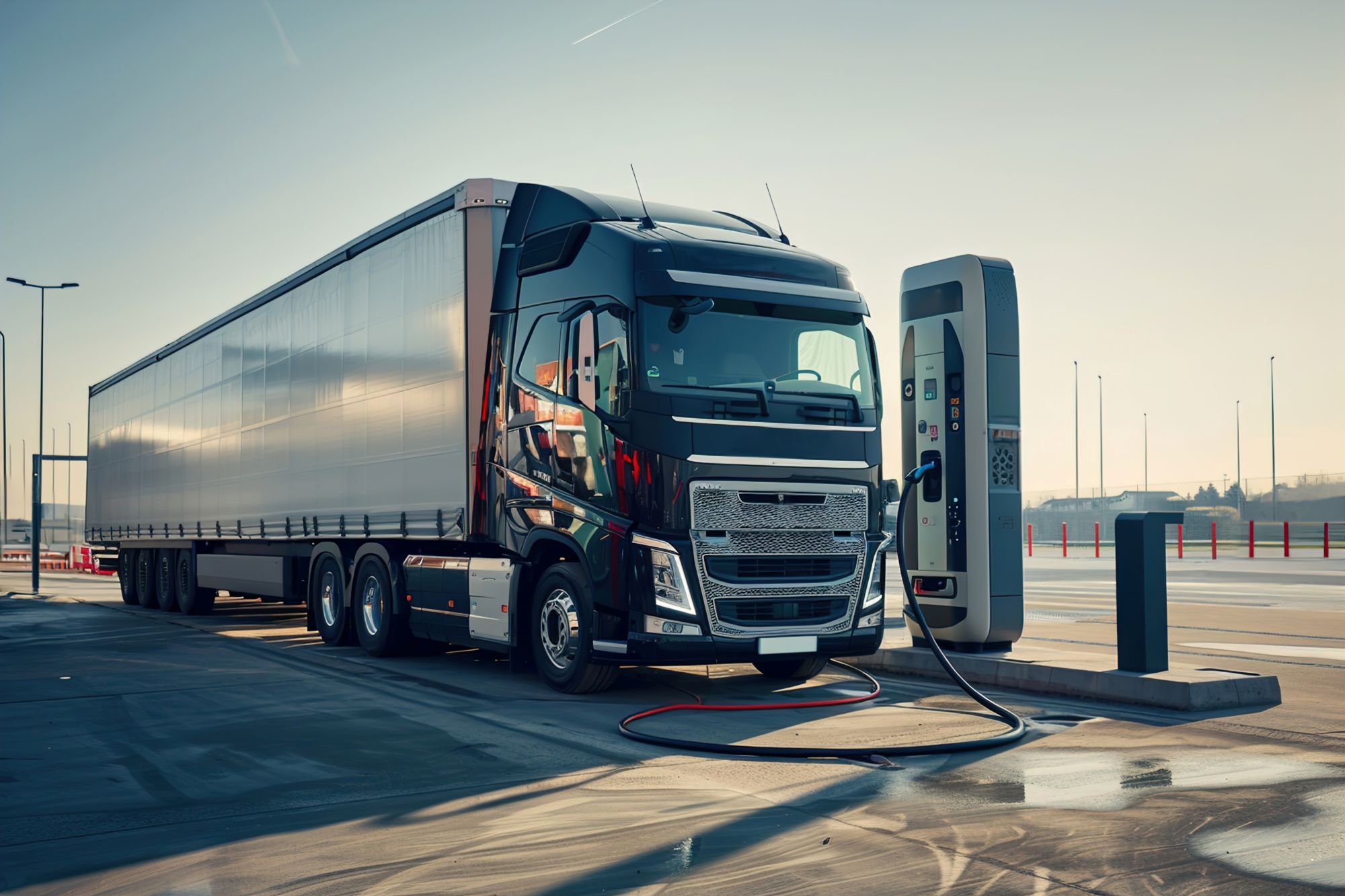
El futuro de los camiones eléctricos en Europa

Los camiones eléctricos son el futuro a largo plazo del transporte por carretera. No sólo son más baratos con el paso del tiempo, sino que, con el fuerte ritmo de inversión y construcción de nuevas infraestructuras, también serán mucho más viables desde el punto de vista financiero y estratégico.

Más allá de los beneficios económicos, los vehículos pesados eléctricos también son importantes por su contribución a objetivos medioambientales como el Net Zero. Dado que los vehículos pesados tradicionales contaminan a gran escala, las emisiones ahorradas por los vehículos pesados eléctricos se traducirán en un aire más limpio en toda Europa.

Las siguientes tendencias parece que afectarán a los vehículos pesados eléctricos en el futuro:

  • Smart truck parks: Truck parks in the future will evolve to better accommodate eHGVs alongside other smart technological advancements. These truck parks may include up-to-date ultra-fast charging stations, diagnostic machines, battery swap stations, and automated cleaning services, among other features.
  • Increased EU regulations: Low Emission Zones (LEZs) already exist in a number of cities (e.g. Paris, Berlin, and Milan) with more European cities likely to follow suit with more stringent EU transport regulations. Fleet operators may opt for eHGVs to meet EU regulations or retrofit their HGVs with cleaner technologies, like smart tachographs.
  • AI implementation: AI technology has already had a profound sustainability impact across road haulage — with applications in route optimisation, predictive maintenance, and autonomous vehicle development. Electric vehicles will likely incorporate AI to help drive sustainability in the haulage industry over the coming decades.
  • Sustainability: The shift to eHGVs is part of a wider global push toward sustainable living. The effects of extreme weather, including heatwaves and floods across Europe, show no sign of slowing due to climate change. Moving to electric HGVs is one way the world is reducing its dependence on fossil fuels.
  • Fuel variety: During the transition to cleaner fuel sources, there will be a variety of HGV types on the road throughout the 2030s. Many will be older diesel models, some will be electric, and others will be powered by alternative fuels such as biofuel made from renewable biomass sources.

Gestionar los costes del eHGV de forma más inteligente

No cabe duda de que los vehículos pesados eléctricos son el futuro. Los beneficios económicos y medioambientales harán que más operadores de flotas y conductores se pasen a los vehículos eléctricos en los próximos años. La duración de este periodo de transición dependerá de la rapidez con la que Europa pueda desarrollar su infraestructura de recarga de vehículos pesados eléctricos.

En la actualidad hay grandes franjas del continente en las que los eHGV no son viables y requieren una amplia optimización de las rutas debido a su menor autonomía. Además, los costes iniciales pueden disuadir a los conductores independientes y a los pequeños operadores de flotas.

La tecnología y la infraestructura seguirán mejorando, y ya existen servicios diseñados para simplificar al máximo la gestión de las flotas de vehículos pesados y los costes asociados. Desde la optimización de rutas y la gestión de flotas hasta mapas de aparcamientos y lavaderos de camiones, SNAP simplifica el transporte por carretera.

[Regístrese hoy en SNAP (https://snapacc.com/sign-up/)
Compartir con

Otros también leen...

Header Image

martes 16 diciembre 2025 • Noticias del sector

QUÉ SIGNIFICA EL REGISTRO DIGITAL OBLIGATORIO EN ESPAÑA PARA LAS FLOTAS QUE OPERAN EN EUROPA

Guest

Spain is preparing for one of the most significant transport reforms in its recent history. The Sustainable Mobility Law (Ley de Movilidad Sostenible), which received final approval in November 2025, will introduce mandatory digital records for road freight control documentation, creating a more transparent, enforceable and efficient system for domestic and international carriers. Although this is a major national change, it forms part of a wider trend. Across Europe, governments and operators are moving towards a fully digital freight environment as the EU prepares to implement the (eFTI).For fleets working in and out of Spain, this is the start of an important transition. It signals a future in which paper documentation becomes the exception rather than the rule and in which digital processes support faster checks, smoother operations and greater consistency across borders.While the Sustainable Mobility Law addresses wide-ranging transport reforms – from urban mobility to domestic flight restrictions – the provisions most relevant to international freight operators centre on digital documentation. A central section of the law introduces a mandatory digital “control document” for road freight. This includes the use of approved digital formats, such as the electronic consignment note (eCMR), which Spain has already ratified and treats as legally equivalent to the paper CMR note. The law aims to reduce administrative burdens, eliminate inconsistencies in paperwork and shorten the time required for checks and inspections. Rather than relying on handwritten notes or physical documents that can be misplaced, carriers will store, share and verify transport information digitally. For operators, this should mean fewer disputes over documentation, less ambiguity around compliance requirements and greater certainty when preparing for audits or regulatory reviews.In practice, the obligation focuses first on the digital control document used for roadside and regulatory checks, but it is expected to accelerate wider use of eCMR and other digital freight documents across the supply chain.The timeline for implementation will begin once the law is published in Spain's Official State Gazette. Carriers should expect the digital control document obligation to take effect roughly ten months after publication, making 2026 the likely year when full compliance will be required.The Mobility Law applies to road transport operations that fall under Spanish control rules on Spanish territory, not just Spanish-registered companies. Carriers will need to ensure their systems can produce and transmit digital records in compliant formats. Any delay in adopting digital documentation could slow down inspections or disrupt customer schedules.This means that foreign operators running international loads into, out of or through Spain should plan on being able to provide the required control document in digital form when requested by Spanish authorities.The Spanish reforms align closely with the EU’s eFTI Regulation, which will require Member States to accept digital freight documentation once the technical and certification rules are in place (from mid-2027). eFTI sets a unified framework for how information is structured, transmitted and verified. While it obliges authorities to accept digital records, it does not require operators to use them. Spain’s Mobility Law therefore goes further, making digital control documents mandatory for road freight.Under eFTI, carriers will be able to provide freight information electronically through certified platforms. Enforcement authorities will receive that information through secure digital channels. This should reduce administrative friction across the EU’s busiest freight routes.Spain is not alone in taking early steps. Several EU countries have already moved towards paperless freight systems and their experience demonstrates what a fully digital environment could look like.● The Netherlands has been one of the earliest adopters of eCMR and has trialled end-to-end digital workflows across different modes of transport. ● France also moved early, supporting digital documentation and faster roadside checks following its ratification of the eCMR protocol. ● In the Benelux region, Belgium, Luxembourg and the Netherlands are running a joint eCMR pilot and digital logistics corridor, illustrating how interoperable documentation can work across national boundaries.● Denmark and Sweden have operated national e-freight trials designed to simplify the sharing of transport information. Taken together, these examples show that Spain’s Mobility Law is part of a broader European transition. Rather than standing apart, Spain is moving in step with a continental shift towards digital documentation that aims to make road freight faster, more transparent and more consistent across borders.The move to digital records brings several practical advantages. Digital documents reduce the time drivers and enforcement officers spend handling paperwork and shorten inspections during roadside checks. This mirrors the benefits seen with the introduction of , which have reduced unnecessary stops for compliant drivers and improved the consistency of enforcement across Europe.Digital documentation also removes the errors that can arise from handwritten notes or damaged paper notes. Fleet managers can instantly retrieve records, resolve errors more easily and maintain clearer oversight of documentation across multiple routes. For operators managing complex schedules, this increased predictability supports better planning and stronger customer service.Drivers are likely to benefit too. A shift to digital records reduces administrative pressure and helps avoid disagreement at delivery points. With all documents stored digitally, drivers have a single source of truth that is accepted across the supply chain.Fleets may need to invest in updated transport management systems or integrate new tools that support digital documentation. Operators may require additional support and training to shift from paper-based processes to new digital workflows.There will also be a period of adjustment in which paper and digital systems may operate side by side. As eFTI becomes established across Europe, some countries will move faster than others. Operators travelling across different borders may encounter varying expectations, particularly in the early years.Throughout this transition, driver welfare should remain a priority. The administrative load associated with new processes often falls on drivers. Clear training and straightforward systems will be essential.Spain’s Mobility Law marks an important moment in the evolution of European freight. It reflects a sector that is modernising at speed and preparing for a future built on digital workflows rather than manual paperwork. Operators that begin preparing now will be in a strong position as Spain’s digital control document requirements take effect and eFTI comes into force across Europe.At SNAP, we support fleets across Spain and the wider continent with tools that make daily operations simpler and more predictable. The intruck app helps drivers locate and book secure parking along their route, which is particularly valuable as compliance processes evolve. If your fleet is preparing for Spain’s new requirements or the broader digital transition across Europe, SNAP is here to support every step of the journey.

Header Image

miércoles 10 diciembre 2025 • Noticias del sector

PRESUPUESTO DEL REINO UNIDO PARA 2025: LO QUE SIGNIFICA PARA EL TRANSPORTE

Guest

The arrives at a difficult moment for the road transport sector. Operators are working against rising wages and operating costs, tight margins, ageing infrastructure and ongoing pressures around recruitment. At the same time, the shift towards cleaner mobility is accelerating, creating new expectations and increasing the need for long-term investment.The following article outlines what the Budget means for infrastructure, investment, workforce costs and the wider operating environment for haulage.For many years, fleets have been affected by deteriorating roads, weight restrictions on ageing bridges and the growing unpredictability of journey times. Government and industry data makes this clear. More than one in every ten miles of network in England and Wales is likely to require maintenance within the next year, according to reporting, and the backlogs for resurfacing work continue to rise. These issues lead to vehicle damage, driver fatigue, higher insurance costs and disrupted schedules. They also place additional pressure on operators already dealing with narrow margins.The new Budget acknowledges these concerns. One positive step is the substantial funding for strategic national projects, including almost £900 million allocated to the , which should reduce congestion, provide more reliable journey times and a safer driving environment for HGVs.Local authorities will also receive a share of and address the growing number of potholes. This could make a noticeable difference for fleets. Local roads carry the majority of domestic freight and serve as the first and last mile of nearly every delivery. Improving them should reduce wear and tear on vehicles as well as operational strain. These commitments will not fix decades of underinvestment immediately, but they represent an important shift towards a road network that is more resilient and better suited to the realities of modern logistics.The Budget also places more focus on skills. for under-25s working in small and medium-sized businesses could help attract new entrants into a profession that urgently needs them. The driver shortage is well documented. The UK must recruit around in order to stabilise supply chains, and across Europe the average age of professional drivers continues to climb. Only a small proportion of drivers are under 25, and training costs have been a barrier for many younger candidates.Providing funded apprenticeships makes logistics more accessible at a critical time. It also supports smaller operators, who often struggle to invest in training despite needing to expand their teams. The Budget introduces further support for investment, particularly around fleet renewal. Operators installing charging infrastructure can take advantage of a 100% first-year allowance until March 2027. This will help offset the upfront cost of electric HGVs and depot charging equipment.From January 2026, a new 40% first-year allowance will be available on many main-rate assets, including trucks – particularly useful where full expensing or the Annual Investment Allowance don’t apply, such as some leased fleets and unincorporated operators.While the Autumn Budget contains several positive measures, operators will also need to plan for increasing costs. Fuel duty will rise in stages between the end of August 2026 and March 2027. Fuel is already one of the largest expenses for operators, and the planned rises are likely to increase the emphasis on fuel efficiency, telematics, consolidated routing and fleet renewal.Vehicle Excise Duty (Road Tax) will be uprated in line with inflation from April 2026, including for HGVs. From April 2028, a new Electric Vehicle Excise Duty (eVED) will also apply a mileage-based charge to battery-electric and plug-in hybrid cars, on top of existing VED. Although eVED initially excludes electric vans and trucks, it signals a longer-term shift toward distance-based taxation that fleets will need to factor into future planning.The HGV Levy will also return to rising with inflation. Vehicles over twelve tonnes must pay the levy before using A roads or motorways, and the revised rate will add another cost that fleets must factor into forward planning.Larger, higher‑value properties are also likely to feel more pressure from business rates changes. The Budget confirms permanently lower business rates for retail, hospitality and leisure, funded in part by higher charges on the most expensive commercial premises. These include big warehouses and distribution centres, so operators with large sites can expect proportionately higher bills over time than smaller depots or high‑street locations.In addition, the Budget introduces several measures that directly affect the financial landscape for operators and the people who run or work within haulage businesses. Labour already represents one of the sector’s highest costs, and these changes will shape payroll planning, staff retention and the personal finances of many owner-operators.Minimum wage increases mean that employers will face higher staffing costs across warehousing, last-mile logistics and support roles. Many operators have already tackled wage rises in recent years, and this further uplift will add pressure at a time when margins remain narrow. For fleets that rely on overtime, night work or seasonal peaks, the impact will be even more noticeable.The Budget continues the government’s move toward greater digitalisation of tax and reporting. Compliance expectations will grow over the coming years, with stricter penalties for late VAT and Self Assessment returns and an expanded Making Tax Digital framework from 2027. Mandatory electronic invoicing will follow in 2029. Parcel carriers and mixed load operators will also be affected by changes to customs duty for low-value imports, which will apply to items worth less than £135 by March 2029 at the latest. While the aim is to even the playing field for UK manufacturers, it is likely to increase administrative pressure on haulage firms. These changes may eventually improve efficiency, but they will require investment in systems and staff training. Smaller fleets without dedicated administrative teams are likely to feel the adjustment most sharply.Although operators will face higher costs and increased administrative complexity, the 2025 Budget also provides some of the most significant commitments to the road network and skills pipeline seen in recent years. Taken together, these measures signal a Budget that attempts to balance fiscal constraints with long-term needs. The road ahead will still require careful planning and strategic investment, but there are genuine opportunities to strengthen the sector’s foundations and support a more resilient future for haulage.SNAP gives fleets practical tools to manage this shifting landscape, from parking access to data that supports compliance and operational decision-making. to discover how SNAP can help strengthen your fleet’s resilience in the months ahead.

Header Image

lunes 03 noviembre 2025 • Noticias del sector

9 FORMAS EN QUE LA DETECCIÓN DE AI ESTÁ TRANSFORMANDO EL SECTOR DE LAS FLOTAS DE VEHÍCULOS

Guest

Artificial intelligence (AI) has redefined how fleet professionals approach daily operations. Modern technologies let managers measurably improve maintenance, safety and compliance across their vehicles. As regulatory pressures rise, AI-driven insights will be more critical in gaining a decisive edge. Here are nine ways AI detection is transforming the fleet industry. Advanced telematics and machine learning (ML) algorithms help AI detection in fleets by monitoring driver behaviour. These devices analyse real-time patterns and flag risky driving behaviours like speeding and harsh braking. ML models instantly process data from in-vehicle sensors and identify deviations from safe driving norms and company policies.Drivers receive immediate feedback in the vehicle, while fleet managers get detailed reports on trends. The wealth of information helps supervisors personalise coaching sessions and find specific improvement areas. Telematics solutions have been critical to fleets nationwide because through improved behaviour and training programmes. AI algorithms are essential to analysing real-time traffic data, like road closures and weather conditions. Congestion can be significant, especially if your routes pass through London. A 2024 Inrix report said drivers when driving in the capital city. ML models can quickly identify bottlenecks and adverse weather to meet critical delivery times. Fleet managers benefit because their drivers can improve on-time performance. Route optimisation means deliveries are more likely to arrive during scheduled windows. It also enhances driver behaviours by idling less and covering fewer miles. Modern AI technologies rapidly detect roadway closures and unexpected weather changes to minimise disruptions. Accident reporting used to include manual logs and documentation. However, AI can reduce labour needs by automatically detecting and submitting incident reports. From collisions to near misses, these technologies can recognise potential incidents. Sensors gather relevant information at the event’s timing to provide more context. Unusual circumstances like airbag deployment can also be part of the automatic reporting. Once AI detection is complete, the system compiles information into a standardised report. Manual logs can create time-consuming tasks, so AI can automate these processes and free up staff. Fleet managers and insurers receive the report, thus ensuring compliance and accurate communication. Advanced technologies capture relevant data and use consistent formatting, so all parties get the critical details. Unexpected vehicle breakdowns can disrupt schedules and delay deliveries. AI helps fleet managers detect these problems before they become significant issues. From engine temperature to oil pressure, characteristics are monitored in real time. Advanced algorithms identify subtle anomalies and alert operators when a component is nearing failure. While fixed service intervals can be beneficial, AI lets you be more proactive and schedule maintenance precisely. Tire pressure sensors are an excellent example, especially for construction and utility companies. Experts say air compressors than equipment needs to maintain best practises. These sensors continually monitor output and detect gradual drops, flagging early signs of leaks.AI detection in fleets goes beyond studying driver behaviour. Telematics and sensors analyse speed and acceleration patterns to better understand fuel consumption. The systems monitor your vehicles for excessive idling and inefficient routing that increases petrol or diesel usage. AI can tailor recommendations to drivers by offering optimised speed ranges or maintenance needs.Fleet managers benefit by getting aggregated data on fuel consumption and spending. This information helps them make more informed vehicle procurement and route planning decisions. If older vehicles show inefficiencies, it may be time to upgrade the lot. Logistics professionals should compare individual vehicles against industry standards to see outliers. The U.K.’s environmental goals by 2050. Therefore, fleet managers must be more aware of tightening standards and the risk of fines. AI detection helps vehicles through sensors and onboard diagnostics systems, which collect data during operations. ML algorithms identify patterns and anomalies within the information and notify of excessive emissions. AI can alert fleet managers and enable proactive maintenance if a vehicle exceeds emissions thresholds. While humans take measures to reduce greenhouse gases, AI detection is rising to help the transportation industry. A 2025 study said by adapting eco-driving capabilities. The U.S. researchers said implementing it in 10% of vehicles would reduce carbon emissions up to 50%. Another way fleet managers can reduce emissions is through electric vehicle (EV) conversion. EV ownership is rising nationally through private drivers and fleet owners, as a 2025 report from 2023. AI can assist logistics professionals in the transition by recommending when, where and how to electrify their fleets. First-time EV owners may need help with charging windows and infrastructure needs. AI-powered systems detect when and where electric cars could naturally align with charging windows. For example, it could recommend the best times to charge to reduce schedule disruptions. Some may be pondering the switch to EVs, so logistics managers can leverage AI to compare cost data between electric and petrol cars. While AI investment can be a barrier, it may be financially beneficial in the long run. These software options that slows daily operations. Early detection of issues can lead to a more well-maintained fleet, which creates more uptime and revenue. Fleet managers can also save money through enhanced route optimisation and fuel management. AI detection in fleets is essential for streamlining administrative processes. These technologies can automatically perform compliance checks and incident documentation, thus reducing the need for manual paperwork. Your operators can focus more on the bigger picture and less on administrative overhead. If monitoring helps your drivers, it could reduce the cost of vehicle repairs and legal claims. Vehicle and cargo theft ., though they remain significant concerns. AI detection offers additional security layers by reducing the window of opportunity for thieves. Asset tracking features combine GPS and telematics capabilities to monitor real-time location, essential for companies transporting high-value assets. Fleet managers benefit from geofencing features, allowing them to set virtual boundaries. If a truck or van exits these zones, AI-powered systems automatically flag the event and notify logistics professionals. The algorithm is intelligent enough to understand anomalies and security protocols. Abnormalities can trigger security measures like remote disabling. AI is a practical, game-changing tool for fleet managers. Advanced analytics and real-time monitoring empower logistics professionals to drive measurable safety and performance improvements. While technologies are developing, the future is here. Your business should be willing to invest in AI-driven solutions to reduce costs and minimise risks. Discover more from .