Guest
Notizie sul settore • 9 leggere

Carburante vs carica: Il passaggio all'elettrico è più economico o semplicemente più verde?

Creato: 28/07/2025

Aggiornato: 19/09/2025

La crescita delle stazioni di ricarica elettrica per i mezzi pesanti in Europa ha portato a un periodo di transizione sulle vaste reti stradali del continente. Per molti operatori di flotte e conducenti, i classici mezzi pesanti alimentati a diesel sono ancora la scelta di trasporto. Tuttavia, il passaggio ai mezzi pesanti elettrici è imminente, in quanto il settore continua a evolversi.

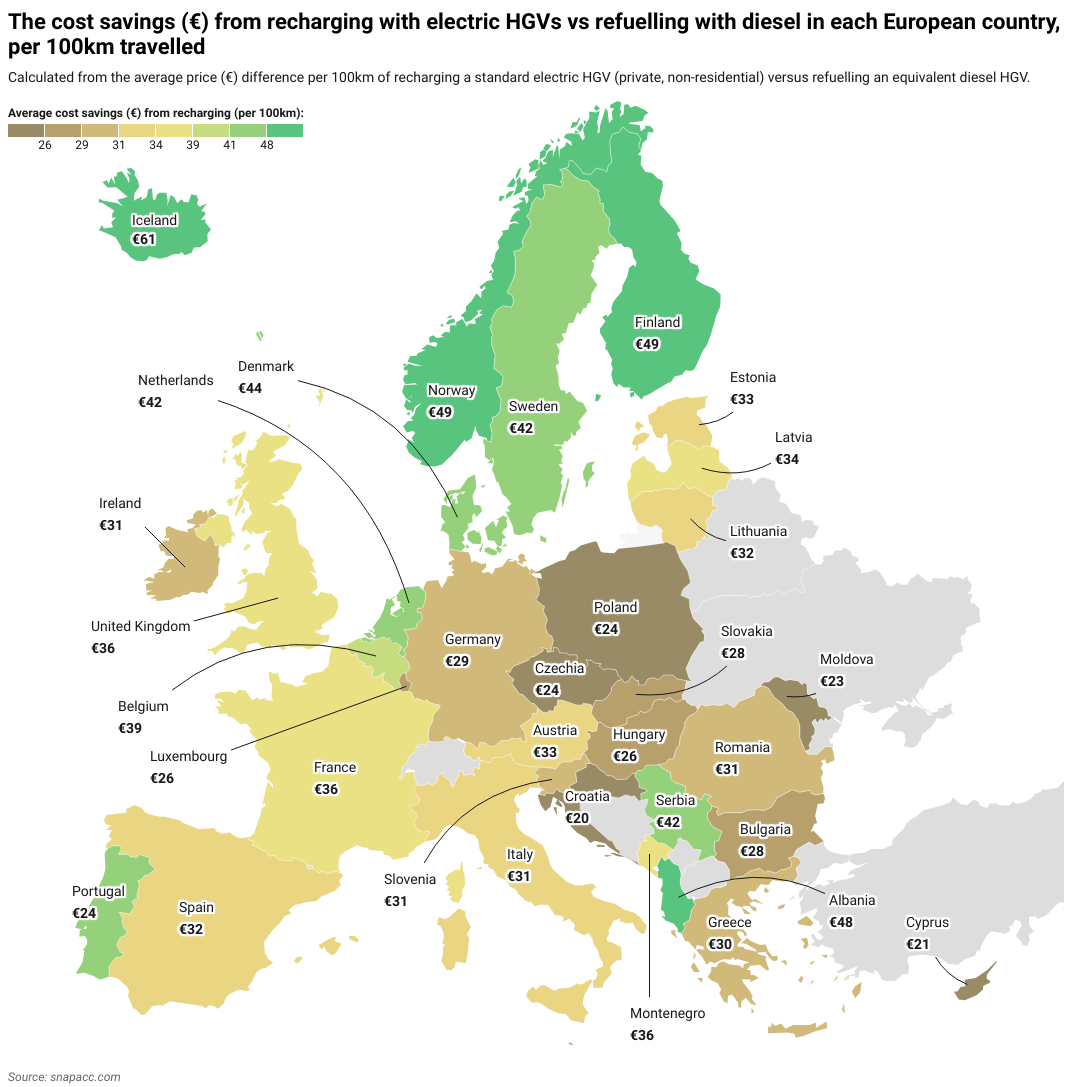
Per valutare la fattibilità del passaggio dal diesel all'elettrico da parte di operatori di flotta, SNAP ha condotto una ricerca sui costi di ricarica dei mezzi pesanti rispetto al rifornimento di carburante su diverse rotte di trasporto merci europee. Abbiamo calcolato il risparmio di elettricità rispetto al diesel in euro per 100 km in 35 Paesi europei.

Abbiamo riscontrato che l'Islanda è in testa con un risparmio medio di 61,03 euro per 100 km, mentre i paesi nordici Norvegia e Finlandia offrono rispettivamente il secondo e il terzo risparmio più elevato. All'altra estremità della scala, la Croazia ha offerto il minor numero di risparmi sui costi con 19,96 euro per 100 km, seguita da Cipro e dalla Moldavia.

In questo articolo, scopriamo i risparmi sui costi per paese europeo e analizziamo alcuni dei risparmi sui costi per paese europeo e analizziamo alcuni dei fattori esterni che possono influenzare questi risparmi. Ci addentriamo anche in quello che potrebbe essere il futuro degli eHGV in Europa e in che modo gli eHGV possono aiutare gli operatori delle flotte e i conducenti a risparmiare, in particolare con i driver budgets.

Come i costi dell'eHGV e del gasolio si confrontano nell'UE

Dalla nostra ricerca è emerso che, in tutti i Paesi europei esaminati, l'utilizzo di un veicolo elettrico con ricarica elettrica ha permesso di risparmiare rispetto a un veicolo pesante tradizionale con carburante. La differenza principale è stata l'entità dei risparmi. Ad esempio, il prezzo dell'elettricità nel paese più costoso, l'Islanda, è superiore del 206%** (41 euro in più) rispetto al paese meno costoso, la Croazia.

Abbiamo riscontrato che, in media, un autista di un mezzo pesante elettrico risparmierà 30,59 euro per 100 km rispetto a un autista di un mezzo pesante diesel. Ciò si traduce in un risparmio medio stimato di 37.200 euro* all'anno per i conducenti di mezzi pesanti elettrici a lungo raggio e di 24.800 euro per i conducenti nazionali*.

Per compilare i nostri dati, abbiamo preso in considerazione 35 Paesi europei e abbiamo confrontato il costo dell'energia o del carburante per 100 km per due tipi di veicoli commerciali pesanti (HGV). Si trattava di un mezzo pesante diesel standard, ipotizzando un consumo di carburante di 35 litri per 100 km al prezzo medio al dettaglio del gasolio in ciascun Paese, e di un mezzo pesante elettrico, ipotizzando un consumo di elettricità di 108 kWh per 100 km basato sulla tariffa media dell'elettricità non domestica. L'IVA e le imposte recuperabili sono state escluse da questi calcoli. Il confronto riflette solo i costi diretti "alla pompa" o "alla spina", senza tenere conto di fattori quali le dimensioni della flotta, i contratti energetici negoziati o le future variazioni dei prezzi di carburante ed elettricità.

Per la ricerca dei prezzi del gasolio e dell'elettricità sono state utilizzate diverse fonti, tra cui Eurostat, CEIC, GlobalPetrolPrices, Webfleet e Gov.uk. Vale la pena notare che alcune di queste fonti si riferiscono alla "Gran Bretagna" mentre altre al "Regno Unito". Ai fini della presente ricerca, i due termini sono stati trattati in modo intercambiabile.

Paesi che risparmiano di più con la conversione ai mezzi pesanti elettrici

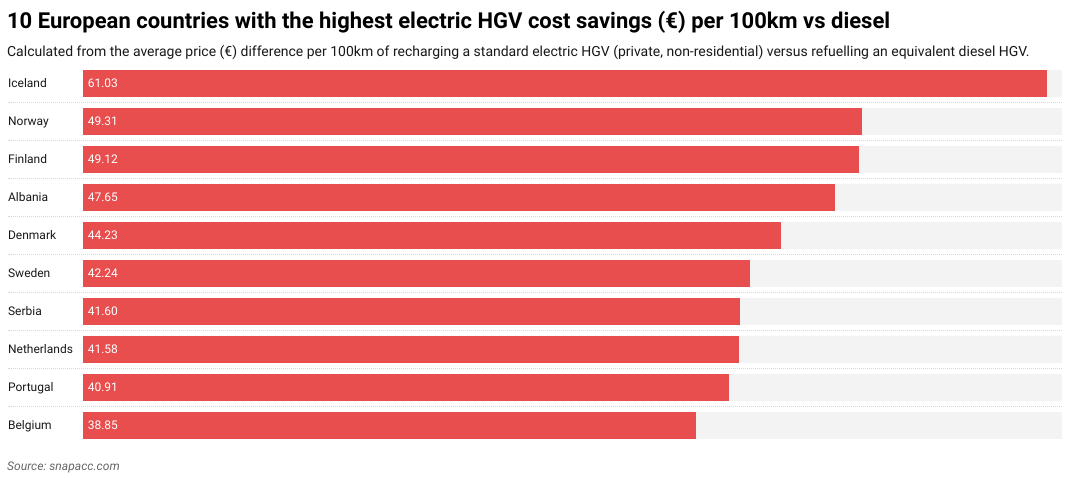
Islanda (61,03 euro), Norvegia (49,31 euro) e Finlandia (49,12 euro) sono attualmente i Paesi in cui si può risparmiare di più convertendosi a un veicolo pesante elettrico.

Ciò è dovuto in gran parte al fatto che questi Paesi sono tra i più cari in Europa per il gasolio. L'Islanda è il Paese più caro d'Europa per il gasolio (2,07 euro al litro). Questo costo elevato deriva in gran parte dal suo isolamento geografico rispetto al resto d'Europa, che rende il costo dell'importazione di gasolio molto più alto rispetto a quello di altri Paesi europei. L'Islanda, come la Norvegia e la Finlandia, è nota anche per l'elevata aliquota fiscale, che contribuisce anch'essa al costo elevato del carburante.

La Norvegia (32%) e l'Islanda (18%) sono anche i primi due Paesi al mondo per quanto riguarda le auto elettriche in circolazione come percentuale di autovetture circolanti. Di conseguenza, entrambi i Paesi hanno investito in modo significativo nelle infrastrutture di ricarica elettrica.

Le dimensioni ridotte e la tangenziale principale dell'Islanda facilitano inoltre l'installazione di stazioni di ricarica elettrica a intervalli regolari per i conducenti di mezzi pesanti elettrici. Lo stesso ragionamento può essere in parte utilizzato per altri Paesi con reti più piccole che hanno un alto tasso di risparmio sui costi, tra cui l'Albania, la Serbia e il Belgio - anche se va notato che tutti e tre hanno anche alcuni dei prezzi del gasolio più cari d'Europa, il che contribuisce alla differenza di risparmio sui costi.

Il grafico seguente mostra i 10 Paesi che registrano i maggiori risparmi sui costi di utilizzo di un camion elettrico:
Gli autisti di tutta Europa stanno già risparmiando passando ai mezzi pesanti elettrici. Il passaggio alla ricarica degli eHGV è il futuro del settore e SNAP è pronta ad aiutare i conducenti e gli operatori di flotte nella transizione ".

Matthew Bellamy - Direttore generale di SNAP

I Paesi che risparmiano di meno con la conversione ai mezzi pesanti elettrici

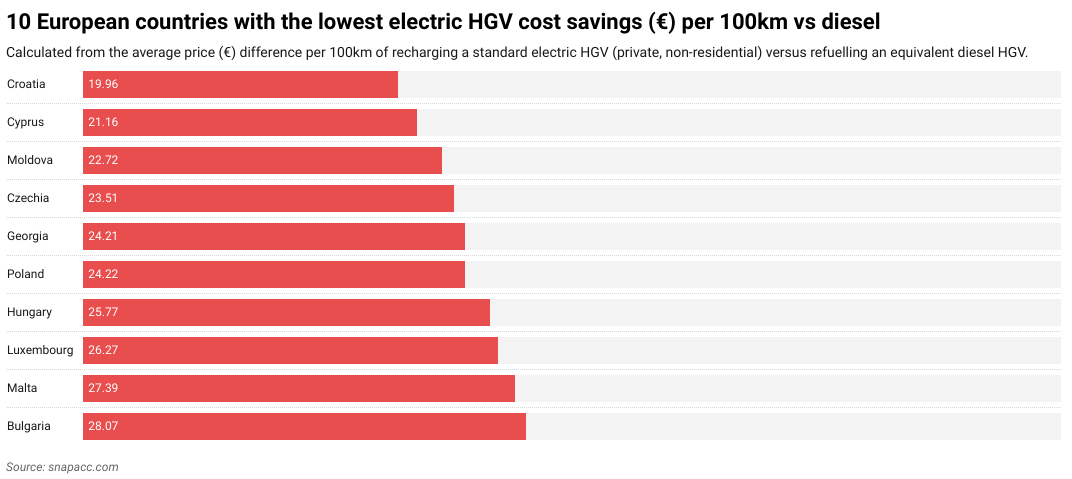
Croazia (19,96 euro), Cipro (21,16 euro) e Moldavia (22,72 euro) sono attualmente i tre Paesi con i minori risparmi in Europa.

La Croazia ha il [secondo più lento tasso di adozione dei veicoli elettrici] (https://www.smf.co.uk/wp-content/uploads/2025/03/Decreasing-transport-poverty-in-Europe-through-public-EV-chargepoints-March2025.pdf) nell'UE dopo la Polonia. Ciò è dovuto in parte alle scarse infrastrutture di ricarica dei veicoli elettrici in Croazia, come le stazioni di ricarica che richiedono uno squillo al servizio clienti o l'utilizzo di diverse applicazioni per avviare il processo di ricarica, le scarse indicazioni per le stazioni di ricarica al di fuori delle principali autostrade e i tempi di attesa potenzialmente elevati durante l'alta stagione turistica. Inoltre, la Croazia non dispone di stazioni di ricarica ad altissima velocità (180 kW e oltre), che (180 kW e oltre), il che può rappresentare un problema per i mezzi pesanti elettrici che richiedono una potenza maggiore rispetto alla media dei veicoli elettrici.

Sia Cipro che la Moldavia hanno problemi geopolitici interni che rendono difficile la pianificazione delle infrastrutture per la ricarica dei veicoli elettrici (così come la pianificazione nazionale in generale). Per quanto riguarda Cipro, la metà settentrionale dell'isola - compresa la metà della sua capitale, Nicosia - è [occupata dalla Repubblica turca di Cipro del Nord] (https://www.bbc.co.uk/news/world-europe-17217956) dal 1974. Per la Moldavia, la provincia orientale della Transnistria agisce come uno Stato de facto con un proprio governo. Ciò significa che entrambi i Paesi non sono in grado di implementare infrastrutture EV in modo coerente nel territorio che considerano proprio.

I problemi di Cipro sono aggravati anche dagli alti costi dell'elettricità, mentre la Moldavia ha il quinto prezzo del gasolio più basso d'Europa. La Moldavia è anche il [secondo Paese più povero d'Europa] (https://worldpopulationreview.com/country-rankings/poorest-countries-in-europe), il che rende difficile l'investimento in infrastrutture per veicoli elettrici. Tutti questi fattori contribuiscono a un risparmio complessivo dei costi per i mezzi pesanti elettrici.

Anche la Polonia è in fondo alla lista, con un risparmio di 24,22€. Nonostante l'impressionante crescita economica e i crescenti investimenti nelle infrastrutture di ricarica dei veicoli elettrici, le sue grandi dimensioni fanno sì che la copertura sia ancora un problema in alcune aree del Paese, anche se questo sembra destinato a [cambiare in futuro] (https://alternative-fuels-observatory.ec.europa.eu/general-information/news/poland-launches-major-funding-programs-zero-emission-transport).

Paesi come la Spagna (32,20 euro), la Romania (30,62 euro) e l'Irlanda (30,54 euro) occupano la posizione intermedia per quanto riguarda il risparmio sui costi dei mezzi pesanti elettrici. Ciò è probabilmente dovuto al fatto che questi Paesi dispongono di una crescente infrastruttura di ricarica per i veicoli elettrici e di costi medi per l'elettricità e il gasolio.

Il grafico seguente mostra i 10 Paesi che registrano i minori risparmi sui costi di utilizzo dei mezzi pesanti elettrici:
Risparmio sui costi dei mezzi pesanti elettrici nel Regno Unito

Il Regno Unito ha un risparmio sui costi degli eHGV di 36,23 euro, che lo colloca all'undicesimo posto assoluto per quanto riguarda il risparmio sui costi di ricarica per 100 km. Ciò è dovuto in gran parte al costo del carburante nel Regno Unito, con i prezzi del diesel che sono i terzi più cari in Europa. Sebbene il risparmio derivante dagli alti costi del diesel contribuisca certamente all'elevato risparmio sui costi degli eHGV nel Regno Unito, esso sarebbe probabilmente molto più elevato se l'elettricità nel Regno Unito non fosse anche tra le più costose in Europa.

Anche nel Regno Unito sono previsti miglioramenti all'infrastruttura di ricarica dei veicoli elettrici. La società di servizi autostradali britannica Moto sta pianificando attivamente la costruzione di 15 "superhub" entro il 2027. Questi superhub possono ospitare la ricarica dei veicoli elettrici in modo più efficiente rispetto ai caricabatterie standard. Attualmente ci sono meno di cinque punti di ricarica dedicati agli eHGV sulle strade del Regno Unito. Con altre aziende come BP Pulse e Aegis Energy che intendono investire, sembra probabile che il Regno Unito avrà una rete di ricarica per mezzi pesanti molto migliorata nel prossimo futuro.

Cosa ostacola l'elettrificazione dei mezzi pesanti?

L'elettrificazione dei mezzi pesanti è attualmente ostacolata da diversi fattori, tra cui la mancanza di infrastrutture di ricarica, i lunghi tempi di ricarica, gli elevati costi iniziali di conversione dei mezzi pesanti e la loro autonomia limitata. Inoltre, il costo relativamente basso e l'accessibilità del carburante e dei veicoli diesel rendono i mezzi pesanti tradizionali un'opzione attraente per gli operatori delle flotte.

Tuttavia, tutti questi impatti possono variare a seconda del Paese in cui si opera. Ad esempio, se la vostra flotta opera solo a livello nazionale in un paese come la Norvegia o l'Islanda, è probabile che sia meno colpita di una flotta che opera in tutta Europa o in regioni con infrastrutture eHGV più carenti, come i Balcani.

Infrastruttura di ricarica insufficiente

Il principale ostacolo all'elettrificazione dei mezzi pesanti è l'insufficienza delle infrastrutture di ricarica per i veicoli elettrici pesanti. Questo perché gli eHGV richiedono una ricarica su scala megawatt, che la maggior parte dei punti di ricarica EV esistenti per i veicoli passeggeri (auto e furgoni elettrici standard) non supporta.

Ci sono molti Paesi in Europa che mancano gravemente di queste infrastrutture, soprattutto sulle principali vie di trasporto e negli autogrill. Si tratta tendenzialmente degli Stati più poveri dell'Europa meridionale e orientale, come la Moldavia, la Georgia e la Bulgaria. Non è una coincidenza che questi Paesi si collochino agli ultimi 10 posti per quanto riguarda i risparmi sui costi dei veicoli elettrici pesanti.

Può anche accadere che le stazioni di ricarica per eHGV esistano, ma si trovino in aree che semplicemente non possono ospitare più eHGV in carica durante la notte a causa della debolezza della rete elettrica locale. Questo è spesso un problema nelle zone più rurali e remote d'Europa.

Sebbene molti Paesi europei stiano pianificando il miglioramento dell'infrastruttura eHGV, si tratta ancora di un processo lungo e costoso, con numerosi ostacoli burocratici, logistici e tecnici da superare - per non parlare degli aggiornamenti delle infrastrutture circostanti, come i collegamenti alla rete locale, che saranno necessari.

Tempi di ricarica lunghi

La ricarica dei mezzi pesanti elettrici è molto più lunga di quella dei veicoli elettrici standard. Ciò significa che spesso la ricarica deve avvenire durante la notte. Anche se è possibile acquistare caricatori rapidi per i veicoli elettrici, il processo richiede comunque almeno due ore, anziché pochi minuti, come nel caso dei veicoli a benzina.

Questo lungo tempo di ricarica può avere un effetto a catena per gli operatori delle flotte in termini di tempi di rotazione. In un settore in cui i tempi di consegna e le scadenze sono stretti, ciò può essere potenzialmente dannoso per le prestazioni aziendali.

Autonomia limitata dei veicoli commerciali leggeri

I mezzi pesanti elettrici sono anche limitati dalla loro autonomia relativamente limitata rispetto al chilometraggio offerto dai mezzi pesanti tradizionali. Secondo Safety Shield, un tipico veicolo commerciale elettrico ha un'autonomia di circa 300 miglia con una singola carica (all'incirca la distanza da Londra a Rotterdam). Un tipico veicolo commerciale diesel, invece, può percorrere fino a 1.000 miglia con un solo pieno di carburante (all'incirca la distanza da Londra a Varsavia).

Il chilometraggio dei mezzi pesanti elettrici può anche essere maggiormente influenzato da fattori esterni come il carico, il [clima freddo] (https://snapacc.com/newsroom/a-truck-drivers-guide-to-winter-in-europe/) e il terreno. Ciò può causare ansia da autonomia per i conducenti, che possono effettuare ricariche più frequenti per assicurarsi di avere energia sufficiente per raggiungere la destinazione. Questo, a sua volta, può portare a ritardi nelle consegne, soprattutto quando si attraversano paesi con scarse infrastrutture di ricarica per eHGV.

Tutto ciò rende l'ottimizzazione del percorso vitale per gli operatori delle flotte che pianificano i viaggi dei loro eHGV. Va notato che la tecnologia delle batterie è in continua evoluzione e la capacità - e quindi il chilometraggio - continuerà a migliorare nel prossimo futuro.

Costi elevati degli eHGV

Il costo iniziale di un eHGV è elevato (tipicamente tra £160.000-£200.000, rispetto a £80.000-£100.000 per un HGV diesel) e ciò può potenzialmente scoraggiare i conducenti indipendenti e i piccoli operatori di flotte dal possederne uno. Ciò è dovuto in gran parte al costo della tecnologia delle batterie. Ciò significa che sarà costoso acquistare un nuovo veicolo commerciale elettrico a titolo definitivo, poiché la tecnologia al suo interno è più costosa di quella di un veicolo commerciale diesel.

Gli elevati costi iniziali di acquisto dei veicoli elettrici leggeri fanno sì che i gestori di flotte in paesi con tariffe elettriche più convenienti per la ricarica dei veicoli elettrici leggeri, come la Norvegia, la Svezia o la Finlandia, siano più propensi a convertirsi, in quanto recupereranno più rapidamente l'investimento rispetto a quelli in paesi con elettricità costosa, come l'Irlanda e la Croazia.

I prezzi dell'elettricità possono fluttuare anche in relazione a vari eventi. Ad esempio, negli ultimi cinque anni, i prezzi dell'elettricità hanno fluttuato in risposta all'apertura delle economie dopo la pandemia COVID-19 e all'invasione dell'Ucraina da parte della Russia nel 2022 (quest'ultima, in particolare, ha avuto effetti importanti sull'approvvigionamento energetico europeo). Di conseguenza, nel periodo successivo all'invasione, i prezzi dell'elettricità hanno subito un'impennata di quasi il 30%, passando da 20,5 c€/kWh a 26,5 c€/kWh per la capitale media dell'UE. Con la media dell'UE ora, tuttavia, inferiore a quella del 2022, sembra che la ricarica elettrica per i mezzi pesanti sia destinata a continuare la sua ascesa.

In tutta Europa, il costo medio di gestione di un camion elettrico per 100 km è di 20,51 euro, molto più basso rispetto ai 51,10 euro di un camion diesel per la stessa distanza.

Con il miglioramento dell'efficienza e con la diffusione della tecnologia delle batterie e la riduzione dei costi di produzione, anche i veicoli elettrici leggeri diventeranno più accessibili.

Economicità e accessibilità del gasolio

Il gasolio gioca ancora un ruolo dominante nel settore dei mezzi pesanti. Questo perché l'infrastruttura del diesel è ben consolidata in Europa da decenni, soprattutto rispetto ai caricabatterie elettrici per i mezzi pesanti. La compatibilità del diesel con le [carte carburante] (https://snapacc.com/newsroom/fuel-cards-in-transportation-how-snap-simplifies-fleet-life/) e la sua relativa economicità lo rendono popolare tra i gestori di flotte di camion.

Come per l'elettricità, tuttavia, il valore del gasolio fluttua in tutto il continente. Per questo motivo, in paesi come la Moldavia, la Georgia e Malta, dove il gasolio rimane a buon mercato, può risultare più vantaggioso mantenere i mezzi pesanti diesel. Al contrario, in nazioni come l'Islanda e i Paesi Bassi, dove il diesel è relativamente costoso, è maggiore l'incentivo a passare a un camion elettrico.

Un Paese con un carburante a basso costo può anche essere più esitante a investire pesantemente nell'infrastruttura eHGV per paura di allontanare le flotte di mezzi pesanti tradizionali, che potrebbero di conseguenza scegliere percorsi alternativi.
Il futuro dei mezzi pesanti elettrici in Europa

I mezzi pesanti elettrici sono il futuro a lungo termine del trasporto su strada. Non solo sono più economici da gestire nel tempo, ma con le nuove infrastrutture che vengono investite e costruite ad un ritmo sostenuto, diventeranno anche molto più redditizi dal punto di vista finanziario e strategico.

Oltre ai vantaggi economici, i mezzi pesanti elettrici sono importanti anche per il loro contributo agli obiettivi ambientali come Net Zero. Poiché i mezzi pesanti tradizionali sono inquinanti su larga scala, le emissioni risparmiate dai veicoli elettrici si tradurranno in un'aria più pulita in tutta Europa.

Le seguenti tendenze sembrano destinate ad avere un impatto sui mezzi pesanti elettrici in futuro:

  • Smart truck parks: Truck parks in the future will evolve to better accommodate eHGVs alongside other smart technological advancements. These truck parks may include up-to-date ultra-fast charging stations, diagnostic machines, battery swap stations, and automated cleaning services, among other features.
  • Increased EU regulations: Low Emission Zones (LEZs) already exist in a number of cities (e.g. Paris, Berlin, and Milan) with more European cities likely to follow suit with more stringent EU transport regulations. Fleet operators may opt for eHGVs to meet EU regulations or retrofit their HGVs with cleaner technologies, like smart tachographs.
  • AI implementation: AI technology has already had a profound sustainability impact across road haulage — with applications in route optimisation, predictive maintenance, and autonomous vehicle development. Electric vehicles will likely incorporate AI to help drive sustainability in the haulage industry over the coming decades.
  • Sustainability: The shift to eHGVs is part of a wider global push toward sustainable living. The effects of extreme weather, including heatwaves and floods across Europe, show no sign of slowing due to climate change. Moving to electric HGVs is one way the world is reducing its dependence on fossil fuels.
  • Fuel variety: During the transition to cleaner fuel sources, there will be a variety of HGV types on the road throughout the 2030s. Many will be older diesel models, some will be electric, and others will be powered by alternative fuels such as biofuel made from renewable biomass sources.

Gestire i costi degli eHGV in modo più intelligente

I mezzi pesanti elettrici sono il futuro, su questo ci sono pochi dubbi. Grazie ai vantaggi economici e ambientali, nei prossimi anni un numero sempre maggiore di operatori di flotte e di conducenti passerà ai mezzi pesanti elettrici. La durata di questo periodo di transizione dipenderà dalla rapidità con cui l'Europa riuscirà a sviluppare l'infrastruttura di ricarica dei veicoli elettrici.

Attualmente vi sono ampie zone del continente in cui gli eHGV non sono redditizi e richiedono un'ampia ottimizzazione dei percorsi a causa della loro ridotta autonomia. Inoltre, i costi iniziali possono scoraggiare gli autisti indipendenti e gli operatori di flotte più piccole.

La tecnologia e l'infrastruttura continueranno a migliorare e ci sono già servizi progettati per semplificare al massimo la gestione delle flotte di eHGV e dei relativi costi. Dall'ottimizzazione dei percorsi alla gestione della flotta, fino alle mappe per il parcheggio e il lavaggio dei camion, SNAP semplifica l'attività di autotrasportatore.

Iscriviti oggi a SNAP.

Condividi con

Anche altri leggono...

Header Image

martedì 16 dicembre 2025 • Notizie sul settore

COSA SIGNIFICA L'OBBLIGO DI REGISTRAZIONE DIGITALE IN SPAGNA PER LE FLOTTE CHE OPERANO IN EUROPA

Guest

Spain is preparing for one of the most significant transport reforms in its recent history. The Sustainable Mobility Law (Ley de Movilidad Sostenible), which received final approval in November 2025, will introduce mandatory digital records for road freight control documentation, creating a more transparent, enforceable and efficient system for domestic and international carriers. Although this is a major national change, it forms part of a wider trend. Across Europe, governments and operators are moving towards a fully digital freight environment as the EU prepares to implement the (eFTI).For fleets working in and out of Spain, this is the start of an important transition. It signals a future in which paper documentation becomes the exception rather than the rule and in which digital processes support faster checks, smoother operations and greater consistency across borders.While the Sustainable Mobility Law addresses wide-ranging transport reforms – from urban mobility to domestic flight restrictions – the provisions most relevant to international freight operators centre on digital documentation. A central section of the law introduces a mandatory digital “control document” for road freight. This includes the use of approved digital formats, such as the electronic consignment note (eCMR), which Spain has already ratified and treats as legally equivalent to the paper CMR note. The law aims to reduce administrative burdens, eliminate inconsistencies in paperwork and shorten the time required for checks and inspections. Rather than relying on handwritten notes or physical documents that can be misplaced, carriers will store, share and verify transport information digitally. For operators, this should mean fewer disputes over documentation, less ambiguity around compliance requirements and greater certainty when preparing for audits or regulatory reviews.In practice, the obligation focuses first on the digital control document used for roadside and regulatory checks, but it is expected to accelerate wider use of eCMR and other digital freight documents across the supply chain.The timeline for implementation will begin once the law is published in Spain's Official State Gazette. Carriers should expect the digital control document obligation to take effect roughly ten months after publication, making 2026 the likely year when full compliance will be required.The Mobility Law applies to road transport operations that fall under Spanish control rules on Spanish territory, not just Spanish-registered companies. Carriers will need to ensure their systems can produce and transmit digital records in compliant formats. Any delay in adopting digital documentation could slow down inspections or disrupt customer schedules.This means that foreign operators running international loads into, out of or through Spain should plan on being able to provide the required control document in digital form when requested by Spanish authorities.The Spanish reforms align closely with the EU’s eFTI Regulation, which will require Member States to accept digital freight documentation once the technical and certification rules are in place (from mid-2027). eFTI sets a unified framework for how information is structured, transmitted and verified. While it obliges authorities to accept digital records, it does not require operators to use them. Spain’s Mobility Law therefore goes further, making digital control documents mandatory for road freight.Under eFTI, carriers will be able to provide freight information electronically through certified platforms. Enforcement authorities will receive that information through secure digital channels. This should reduce administrative friction across the EU’s busiest freight routes.Spain is not alone in taking early steps. Several EU countries have already moved towards paperless freight systems and their experience demonstrates what a fully digital environment could look like.● The Netherlands has been one of the earliest adopters of eCMR and has trialled end-to-end digital workflows across different modes of transport. ● France also moved early, supporting digital documentation and faster roadside checks following its ratification of the eCMR protocol. ● In the Benelux region, Belgium, Luxembourg and the Netherlands are running a joint eCMR pilot and digital logistics corridor, illustrating how interoperable documentation can work across national boundaries.● Denmark and Sweden have operated national e-freight trials designed to simplify the sharing of transport information. Taken together, these examples show that Spain’s Mobility Law is part of a broader European transition. Rather than standing apart, Spain is moving in step with a continental shift towards digital documentation that aims to make road freight faster, more transparent and more consistent across borders.The move to digital records brings several practical advantages. Digital documents reduce the time drivers and enforcement officers spend handling paperwork and shorten inspections during roadside checks. This mirrors the benefits seen with the introduction of , which have reduced unnecessary stops for compliant drivers and improved the consistency of enforcement across Europe.Digital documentation also removes the errors that can arise from handwritten notes or damaged paper notes. Fleet managers can instantly retrieve records, resolve errors more easily and maintain clearer oversight of documentation across multiple routes. For operators managing complex schedules, this increased predictability supports better planning and stronger customer service.Drivers are likely to benefit too. A shift to digital records reduces administrative pressure and helps avoid disagreement at delivery points. With all documents stored digitally, drivers have a single source of truth that is accepted across the supply chain.Fleets may need to invest in updated transport management systems or integrate new tools that support digital documentation. Operators may require additional support and training to shift from paper-based processes to new digital workflows.There will also be a period of adjustment in which paper and digital systems may operate side by side. As eFTI becomes established across Europe, some countries will move faster than others. Operators travelling across different borders may encounter varying expectations, particularly in the early years.Throughout this transition, driver welfare should remain a priority. The administrative load associated with new processes often falls on drivers. Clear training and straightforward systems will be essential.Spain’s Mobility Law marks an important moment in the evolution of European freight. It reflects a sector that is modernising at speed and preparing for a future built on digital workflows rather than manual paperwork. Operators that begin preparing now will be in a strong position as Spain’s digital control document requirements take effect and eFTI comes into force across Europe.At SNAP, we support fleets across Spain and the wider continent with tools that make daily operations simpler and more predictable. The intruck app helps drivers locate and book secure parking along their route, which is particularly valuable as compliance processes evolve. If your fleet is preparing for Spain’s new requirements or the broader digital transition across Europe, SNAP is here to support every step of the journey.

Header Image

mercoledì 10 dicembre 2025 • Notizie sul settore

IL BILANCIO BRITANNICO 2025: COSA SIGNIFICA PER L'AUTOTRASPORTO

Guest

The arrives at a difficult moment for the road transport sector. Operators are working against rising wages and operating costs, tight margins, ageing infrastructure and ongoing pressures around recruitment. At the same time, the shift towards cleaner mobility is accelerating, creating new expectations and increasing the need for long-term investment.The following article outlines what the Budget means for infrastructure, investment, workforce costs and the wider operating environment for haulage.For many years, fleets have been affected by deteriorating roads, weight restrictions on ageing bridges and the growing unpredictability of journey times. Government and industry data makes this clear. More than one in every ten miles of network in England and Wales is likely to require maintenance within the next year, according to reporting, and the backlogs for resurfacing work continue to rise. These issues lead to vehicle damage, driver fatigue, higher insurance costs and disrupted schedules. They also place additional pressure on operators already dealing with narrow margins.The new Budget acknowledges these concerns. One positive step is the substantial funding for strategic national projects, including almost £900 million allocated to the , which should reduce congestion, provide more reliable journey times and a safer driving environment for HGVs.Local authorities will also receive a share of and address the growing number of potholes. This could make a noticeable difference for fleets. Local roads carry the majority of domestic freight and serve as the first and last mile of nearly every delivery. Improving them should reduce wear and tear on vehicles as well as operational strain. These commitments will not fix decades of underinvestment immediately, but they represent an important shift towards a road network that is more resilient and better suited to the realities of modern logistics.The Budget also places more focus on skills. for under-25s working in small and medium-sized businesses could help attract new entrants into a profession that urgently needs them. The driver shortage is well documented. The UK must recruit around in order to stabilise supply chains, and across Europe the average age of professional drivers continues to climb. Only a small proportion of drivers are under 25, and training costs have been a barrier for many younger candidates.Providing funded apprenticeships makes logistics more accessible at a critical time. It also supports smaller operators, who often struggle to invest in training despite needing to expand their teams. The Budget introduces further support for investment, particularly around fleet renewal. Operators installing charging infrastructure can take advantage of a 100% first-year allowance until March 2027. This will help offset the upfront cost of electric HGVs and depot charging equipment.From January 2026, a new 40% first-year allowance will be available on many main-rate assets, including trucks – particularly useful where full expensing or the Annual Investment Allowance don’t apply, such as some leased fleets and unincorporated operators.While the Autumn Budget contains several positive measures, operators will also need to plan for increasing costs. Fuel duty will rise in stages between the end of August 2026 and March 2027. Fuel is already one of the largest expenses for operators, and the planned rises are likely to increase the emphasis on fuel efficiency, telematics, consolidated routing and fleet renewal.Vehicle Excise Duty (Road Tax) will be uprated in line with inflation from April 2026, including for HGVs. From April 2028, a new Electric Vehicle Excise Duty (eVED) will also apply a mileage-based charge to battery-electric and plug-in hybrid cars, on top of existing VED. Although eVED initially excludes electric vans and trucks, it signals a longer-term shift toward distance-based taxation that fleets will need to factor into future planning.The HGV Levy will also return to rising with inflation. Vehicles over twelve tonnes must pay the levy before using A roads or motorways, and the revised rate will add another cost that fleets must factor into forward planning.Larger, higher‑value properties are also likely to feel more pressure from business rates changes. The Budget confirms permanently lower business rates for retail, hospitality and leisure, funded in part by higher charges on the most expensive commercial premises. These include big warehouses and distribution centres, so operators with large sites can expect proportionately higher bills over time than smaller depots or high‑street locations.In addition, the Budget introduces several measures that directly affect the financial landscape for operators and the people who run or work within haulage businesses. Labour already represents one of the sector’s highest costs, and these changes will shape payroll planning, staff retention and the personal finances of many owner-operators.Minimum wage increases mean that employers will face higher staffing costs across warehousing, last-mile logistics and support roles. Many operators have already tackled wage rises in recent years, and this further uplift will add pressure at a time when margins remain narrow. For fleets that rely on overtime, night work or seasonal peaks, the impact will be even more noticeable.The Budget continues the government’s move toward greater digitalisation of tax and reporting. Compliance expectations will grow over the coming years, with stricter penalties for late VAT and Self Assessment returns and an expanded Making Tax Digital framework from 2027. Mandatory electronic invoicing will follow in 2029. Parcel carriers and mixed load operators will also be affected by changes to customs duty for low-value imports, which will apply to items worth less than £135 by March 2029 at the latest. While the aim is to even the playing field for UK manufacturers, it is likely to increase administrative pressure on haulage firms. These changes may eventually improve efficiency, but they will require investment in systems and staff training. Smaller fleets without dedicated administrative teams are likely to feel the adjustment most sharply.Although operators will face higher costs and increased administrative complexity, the 2025 Budget also provides some of the most significant commitments to the road network and skills pipeline seen in recent years. Taken together, these measures signal a Budget that attempts to balance fiscal constraints with long-term needs. The road ahead will still require careful planning and strategic investment, but there are genuine opportunities to strengthen the sector’s foundations and support a more resilient future for haulage.SNAP gives fleets practical tools to manage this shifting landscape, from parking access to data that supports compliance and operational decision-making. to discover how SNAP can help strengthen your fleet’s resilience in the months ahead.

Header Image

lunedì 03 novembre 2025 • Notizie sul settore

9 MODI IN CUI IL RILEVAMENTO AI STA TRASFORMANDO L'INDUSTRIA DELLE FLOTTE

Guest

Artificial intelligence (AI) has redefined how fleet professionals approach daily operations. Modern technologies let managers measurably improve maintenance, safety and compliance across their vehicles. As regulatory pressures rise, AI-driven insights will be more critical in gaining a decisive edge. Here are nine ways AI detection is transforming the fleet industry. Advanced telematics and machine learning (ML) algorithms help AI detection in fleets by monitoring driver behaviour. These devices analyse real-time patterns and flag risky driving behaviours like speeding and harsh braking. ML models instantly process data from in-vehicle sensors and identify deviations from safe driving norms and company policies.Drivers receive immediate feedback in the vehicle, while fleet managers get detailed reports on trends. The wealth of information helps supervisors personalise coaching sessions and find specific improvement areas. Telematics solutions have been critical to fleets nationwide because through improved behaviour and training programmes. AI algorithms are essential to analysing real-time traffic data, like road closures and weather conditions. Congestion can be significant, especially if your routes pass through London. A 2024 Inrix report said drivers when driving in the capital city. ML models can quickly identify bottlenecks and adverse weather to meet critical delivery times. Fleet managers benefit because their drivers can improve on-time performance. Route optimisation means deliveries are more likely to arrive during scheduled windows. It also enhances driver behaviours by idling less and covering fewer miles. Modern AI technologies rapidly detect roadway closures and unexpected weather changes to minimise disruptions. Accident reporting used to include manual logs and documentation. However, AI can reduce labour needs by automatically detecting and submitting incident reports. From collisions to near misses, these technologies can recognise potential incidents. Sensors gather relevant information at the event’s timing to provide more context. Unusual circumstances like airbag deployment can also be part of the automatic reporting. Once AI detection is complete, the system compiles information into a standardised report. Manual logs can create time-consuming tasks, so AI can automate these processes and free up staff. Fleet managers and insurers receive the report, thus ensuring compliance and accurate communication. Advanced technologies capture relevant data and use consistent formatting, so all parties get the critical details. Unexpected vehicle breakdowns can disrupt schedules and delay deliveries. AI helps fleet managers detect these problems before they become significant issues. From engine temperature to oil pressure, characteristics are monitored in real time. Advanced algorithms identify subtle anomalies and alert operators when a component is nearing failure. While fixed service intervals can be beneficial, AI lets you be more proactive and schedule maintenance precisely. Tire pressure sensors are an excellent example, especially for construction and utility companies. Experts say air compressors than equipment needs to maintain best practises. These sensors continually monitor output and detect gradual drops, flagging early signs of leaks.AI detection in fleets goes beyond studying driver behaviour. Telematics and sensors analyse speed and acceleration patterns to better understand fuel consumption. The systems monitor your vehicles for excessive idling and inefficient routing that increases petrol or diesel usage. AI can tailor recommendations to drivers by offering optimised speed ranges or maintenance needs.Fleet managers benefit by getting aggregated data on fuel consumption and spending. This information helps them make more informed vehicle procurement and route planning decisions. If older vehicles show inefficiencies, it may be time to upgrade the lot. Logistics professionals should compare individual vehicles against industry standards to see outliers. The U.K.’s environmental goals by 2050. Therefore, fleet managers must be more aware of tightening standards and the risk of fines. AI detection helps vehicles through sensors and onboard diagnostics systems, which collect data during operations. ML algorithms identify patterns and anomalies within the information and notify of excessive emissions. AI can alert fleet managers and enable proactive maintenance if a vehicle exceeds emissions thresholds. While humans take measures to reduce greenhouse gases, AI detection is rising to help the transportation industry. A 2025 study said by adapting eco-driving capabilities. The U.S. researchers said implementing it in 10% of vehicles would reduce carbon emissions up to 50%. Another way fleet managers can reduce emissions is through electric vehicle (EV) conversion. EV ownership is rising nationally through private drivers and fleet owners, as a 2025 report from 2023. AI can assist logistics professionals in the transition by recommending when, where and how to electrify their fleets. First-time EV owners may need help with charging windows and infrastructure needs. AI-powered systems detect when and where electric cars could naturally align with charging windows. For example, it could recommend the best times to charge to reduce schedule disruptions. Some may be pondering the switch to EVs, so logistics managers can leverage AI to compare cost data between electric and petrol cars. While AI investment can be a barrier, it may be financially beneficial in the long run. These software options that slows daily operations. Early detection of issues can lead to a more well-maintained fleet, which creates more uptime and revenue. Fleet managers can also save money through enhanced route optimisation and fuel management. AI detection in fleets is essential for streamlining administrative processes. These technologies can automatically perform compliance checks and incident documentation, thus reducing the need for manual paperwork. Your operators can focus more on the bigger picture and less on administrative overhead. If monitoring helps your drivers, it could reduce the cost of vehicle repairs and legal claims. Vehicle and cargo theft ., though they remain significant concerns. AI detection offers additional security layers by reducing the window of opportunity for thieves. Asset tracking features combine GPS and telematics capabilities to monitor real-time location, essential for companies transporting high-value assets. Fleet managers benefit from geofencing features, allowing them to set virtual boundaries. If a truck or van exits these zones, AI-powered systems automatically flag the event and notify logistics professionals. The algorithm is intelligent enough to understand anomalies and security protocols. Abnormalities can trigger security measures like remote disabling. AI is a practical, game-changing tool for fleet managers. Advanced analytics and real-time monitoring empower logistics professionals to drive measurable safety and performance improvements. While technologies are developing, the future is here. Your business should be willing to invest in AI-driven solutions to reduce costs and minimise risks. Discover more from .