Guest
Wiadomości branżowe • 9 min read

Paliwo vs ładowanie: Czy przejście na energię elektryczną jest tańsze, czy po prostu bardziej ekologiczne?

Utworzony: 28.07.2025

Aktualizacja: 19.09.2025

Rozwój elektrycznych stacji ładowania pojazdów ciężarowych w całej Europie doprowadził do okresu przejściowego na rozległych sieciach drogowych kontynentu. Dla wielu operatorów flot i kierowców klasyczne samochody ciężarowe z silnikami wysokoprężnymi są nadal preferowanym środkiem transportu. Jednak przejście na elektryczne pojazdy ciężarowe zbliża się wielkimi krokami, ponieważ branża nadal ewoluuje.

Aby ocenić wykonalność przejścia operatorów flot z oleju napędowego na energię elektryczną, SNAP opracował badania dotyczące kosztów ładowania pojazdów ciężarowych w porównaniu z ich tankowaniem na różnych europejskich trasach towarowych. Obliczyliśmy oszczędności energii elektrycznej w stosunku do oleju napędowego w euro na 100 km w 35 krajach europejskich.

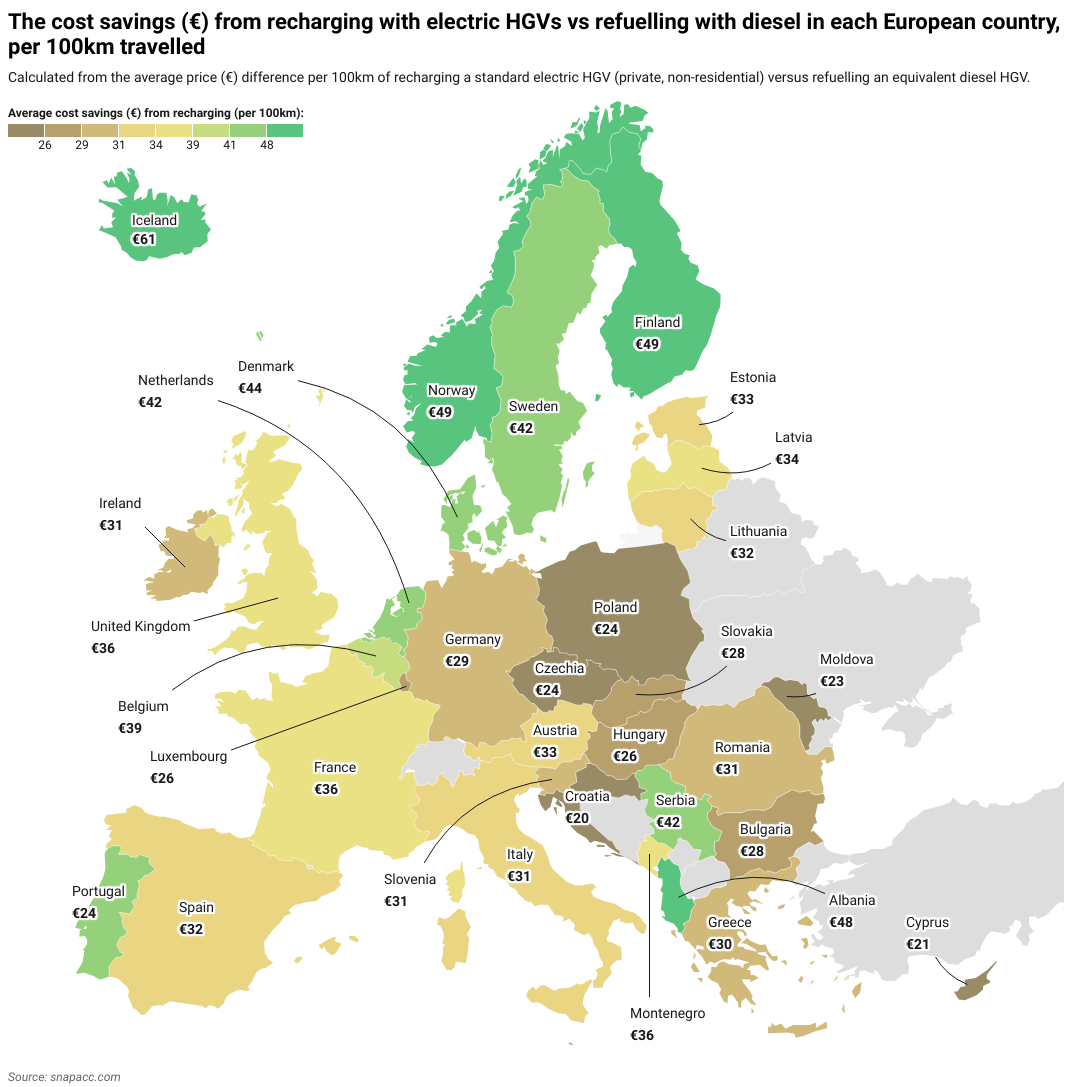
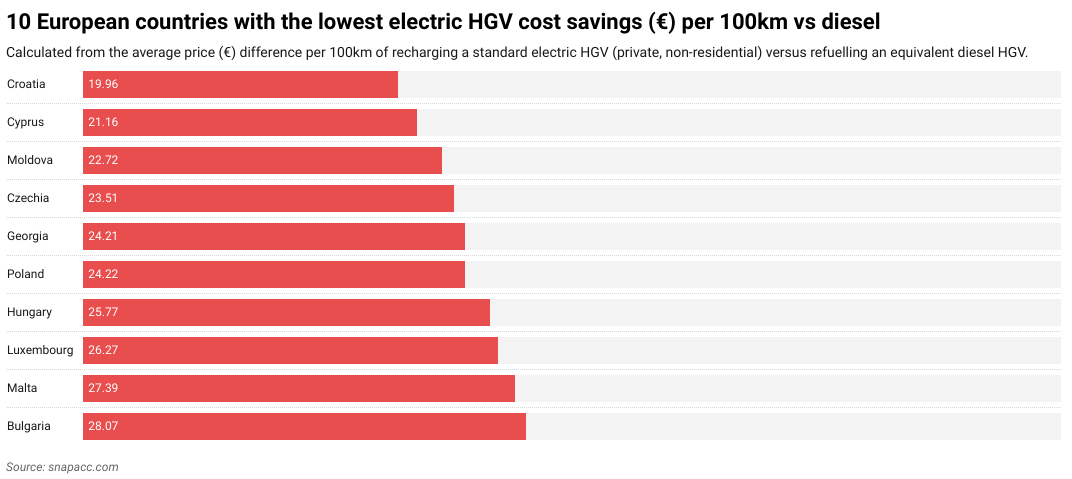
Okazało się, że Islandia jest liderem ze średnią oszczędnością kosztów wynoszącą 61,03 euro na 100 km, a inne kraje nordyckie, Norwegia i Finlandia, oferują odpowiednio drugą i trzecią najwyższą oszczędność kosztów. Na drugim końcu skali, Chorwacja oferowała najmniejszą oszczędność kosztów z 19,96 euro na 100 km, a następnie Cypr i Mołdawia.

W tym artykule ujawniamy oszczędności kosztów w poszczególnych krajach europejskich i analizujemy niektóre z nich, a także czynniki zewnętrzne, które mogą mieć wpływ na te oszczędności. Zastanawiamy się również, jak może wyglądać przyszłość pojazdów eHGV w Europie, a także w jaki sposób pojazdy eHGV mogą pomóc operatorom flot i kierowcom zaoszczędzić pieniądze, szczególnie w przypadku [budżetów kierowców] (https://snapacc.com/newsroom/a-truck-drivers-guide-to-budgeting/).

Porównanie kosztów eHGV i oleju napędowego w UE

Nasze badania wykazały, że w każdym badanym kraju europejskim korzystanie z eHGV z ładowaniem elektrycznym pozwoliło zaoszczędzić pieniądze w porównaniu z korzystaniem z tradycyjnego samochodu ciężarowego na paliwo. Podstawową różnicą było to, jak bardzo różniły się oszczędności. Na przykład cena energii elektrycznej w najdroższym kraju, Islandii, jest o 206% wyższa (41 euro więcej) niż w najtańszym kraju, Chorwacji.

Stwierdziliśmy, że kierowca elektrycznego samochodu ciężarowego zaoszczędzi średnio 30,59 euro na 100 km w porównaniu z kierowcą samochodu ciężarowego z silnikiem wysokoprężnym. Przekłada się to na szacunkową średnią oszczędność w wysokości 37 200 EUR rocznie dla kierowców elektrycznych samochodów ciężarowych na długich trasach i 24 800 EUR dla kierowców krajowych.

Aby opracować nasze dane, przyjrzeliśmy się 35 krajom europejskim i porównaliśmy koszty energii lub paliwa na 100 km dla dwóch typów pojazdów ciężarowych (HGV). Były to standardowy samochód ciężarowy z silnikiem wysokoprężnym, przy założeniu zużycia paliwa na poziomie 35 litrów na 100 km przy średniej cenie detalicznej oleju napędowego w każdym kraju, oraz elektryczny samochód ciężarowy, przy założeniu zużycia energii elektrycznej na poziomie 108 kWh na 100 km w oparciu o średnią stawkę za energię elektryczną dla gospodarstw domowych. VAT i podatki podlegające zwrotowi zostały wyłączone z tych obliczeń. Porównanie odzwierciedla jedynie bezpośrednie koszty "przy dystrybutorze" lub "przy wtyczce", bez uwzględnienia czynników takich jak wielkość floty, wynegocjowane umowy energetyczne lub przyszłe zmiany cen paliw i energii elektrycznej.

Podczas badania cen oleju napędowego i energii elektrycznej korzystano z wielu źródeł, w tym Eurostat, CEIC, GlobalPetrolPrices, Webfleet i Gov.uk. Warto zauważyć, że niektóre z tych źródeł odnoszą się do "Wielkiej Brytanii", podczas gdy inne odnoszą się do "Wielkiej Brytanii". Na potrzeby tego badania oba terminy były traktowane zamiennie.

Kraje, w których można zaoszczędzić najwięcej dzięki przejściu na elektryczne pojazdy ciężarowe

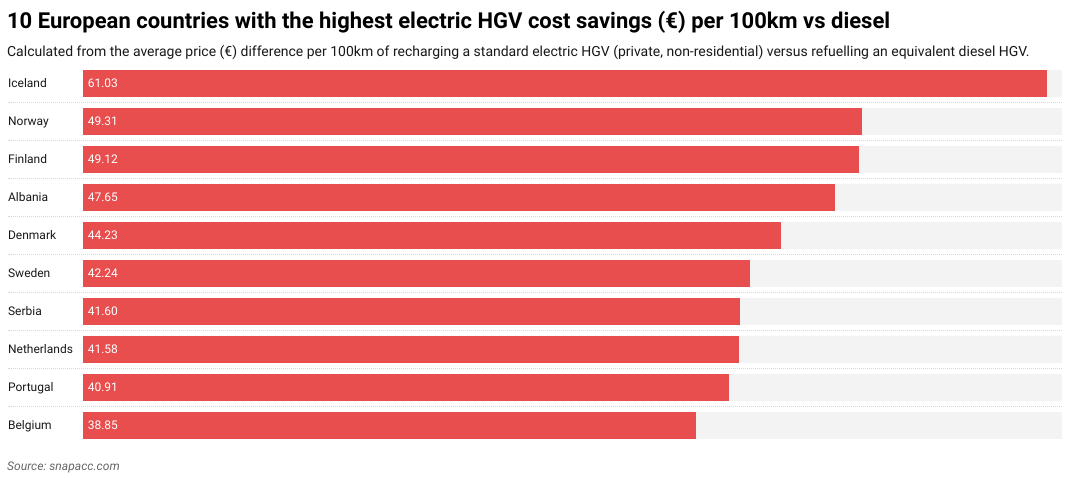
Islandia (61,03 euro), Norwegia (49,31 euro)* i Finlandia (49,12 euro)* są obecnie krajami, w których można zaoszczędzić najwięcej, przechodząc na elektryczne samochody ciężarowe.

Wynika to głównie z faktu, że kraje te należą do najdroższych w Europie pod względem cen oleju napędowego. Islandia jest najdroższym krajem w Europie pod względem ceny oleju napędowego (2,07 euro za litr). Ten wysoki koszt w dużej mierze wynika z jej geograficznej izolacji w porównaniu z resztą Europy, przez co koszt importu oleju napędowego jest znacznie wyższy niż w innych krajach europejskich. Islandia, podobnie jak Norwegia i Finlandia, znana jest również z wysokiej stawki podatkowej, która również przyczynia się do wysokich kosztów paliwa.

Norwegia (32%) i Islandia (18%)** również znajdują się w pierwszej dwójce krajów na świecie pod względem udziału samochodów elektrycznych w samochodach osobowych na drogach. W rezultacie oba kraje zainwestowały znaczne środki w infrastrukturę ładowania elektrycznego.

Niewielki rozmiar Islandii i główna obwodnica ułatwiają również instalowanie stacji ładowania elektrycznego w regularnych odstępach czasu dla kierowców elektrycznych samochodów ciężarowych. To samo rozumowanie można częściowo zastosować do innych krajów o mniejszych sieciach, które mają wysoki wskaźnik oszczędności kosztów, w tym Albanii, Serbii i Belgii - chociaż należy zauważyć, że wszystkie trzy mają również jedne z najdroższych cen oleju napędowego w Europie, co przyczynia się do różnicy w oszczędnościach kosztów.

Poniższy wykres przedstawia 10 krajów, które odnotowują największe oszczędności w przypadku korzystania z elektrycznych pojazdów ciężarowych:
*"Kierowcy w całej Europie już oszczędzają, przechodząc na elektryczne pojazdy ciężarowe. Przejście na ładowanie eHGV to przyszłość branży, a SNAP jest gotowy pomóc kierowcom i operatorom flot w tym przejściu."

Matthew Bellamy - Dyrektor zarządzający w SNAP

Kraje oszczędzające najmniej dzięki przejściu na elektryczne pojazdy ciężarowe

Chorwacja (19,96 euro), Cypr (21,16 euro) i Mołdawia (22,72 euro) to obecnie trzy kraje o najniższych oszczędnościach w Europie.

Chorwacja ma [drugi najwolniejszy wskaźnik adopcji pojazdów elektrycznych] (https://www.smf.co.uk/wp-content/uploads/2025/03/Decreasing-transport-poverty-in-Europe-through-public-EV-chargepoints-March2025.pdf) w UE po Polsce. Wynika to częściowo ze słabej infrastruktury ładowania pojazdów elektrycznych w Chorwacji, takiej jak stacje ładowania, które wymagają dzwonienia do obsługi klienta lub korzystania z wielu różnych aplikacji w celu rozpoczęcia procesu ładowania, słabe wskazówki dotyczące stacji ładowania poza głównymi autostradami oraz potencjalnie długi czas oczekiwania w szczycie sezonu turystycznego. Ponadto w Chorwacji brakuje ultraszybkich stacji ładowania (180 kW i więcej), co może stanowić problem dla elektrycznych pojazdów ciężarowych, które wymagają większej mocy niż przeciętny pojazd elektryczny.

Zarówno Cypr, jak i Mołdawia mają wewnętrzne kwestie geopolityczne, które utrudniają planowanie infrastruktury do ładowania pojazdów elektrycznych (a także ogólnie planowanie krajowe). W przypadku Cypru, północna połowa wyspy - w tym połowa jej stolicy, Nikozji - jest okupowana przez wspieraną przez Turcję Turecką Republikę Cypru Północnego od 1974 roku. W przypadku Mołdawii, wschodnia prowincja Naddniestrza działa de facto jako państwo z własnym rządem. Oznacza to, że oba kraje nie są w stanie wdrożyć infrastruktury EV w spójny sposób na całym terytorium, które uważają za swoje.

Problemy na Cyprze są również potęgowane przez wysokie koszty energii elektrycznej, podczas gdy Mołdawia ma piąte najtańsze ceny oleju napędowego w Europie. Mołdawia jest również [drugim najbiedniejszym krajem w Europie] (https://worldpopulationreview.com/country-rankings/poorest-countries-in-europe), co sprawia, że inwestycje w infrastrukturę pojazdów elektrycznych są wyzwaniem. Wszystkie te czynniki przyczyniają się do ogólnie niskich oszczędności kosztów elektrycznych pojazdów ciężarowych.

Polska również znajduje się nisko na liście z oszczędnością kosztów na poziomie 24,22 EUR. Pomimo imponującego wzrostu gospodarczego i rosnących inwestycji w infrastrukturę ładowania pojazdów elektrycznych, jej duży rozmiar oznacza, że zasięg jest nadal problemem w niektórych obszarach kraju - choć wygląda na to, że [zmieni się to w przyszłości] (https://alternative-fuels-observatory.ec.europa.eu/general-information/news/poland-launches-major-funding-programs-zero-emission-transport).

Kraje takie jak Hiszpania (32,20 EUR), Rumunia (30,62 EUR) i Irlandia (30,54 EUR) zajmują środkową pozycję, jeśli chodzi o oszczędność kosztów elektrycznych pojazdów ciężarowych. Wynika to prawdopodobnie z faktu, że kraje te mają rozwijającą się infrastrukturę ładowania pojazdów elektrycznych oraz średnie koszty energii elektrycznej i oleju napędowego.

Poniższy wykres przedstawia 10 krajów, które mają najniższe oszczędności w przypadku korzystania z elektrycznych samochodów ciężarowych:
Oszczędności kosztów elektrycznych samochodów ciężarowych w Wielkiej Brytanii

Wielka Brytania ma oszczędności kosztów eHGV w wysokości 36,23 euro, co plasuje ją na 11. miejscu pod względem oszczędności kosztów ładowania na 100 km. Jest to w dużej mierze spowodowane wysokimi cenami paliw w Wielkiej Brytanii, gdzie ceny oleju napędowego są trzecimi najdroższymi w Europie. Chociaż oszczędności wynikające z wysokich kosztów oleju napędowego z pewnością przyczyniają się do wysokich oszczędności kosztów eHGV w Wielkiej Brytanii, prawdopodobnie byłyby one znacznie wyższe, gdyby energia elektryczna w Wielkiej Brytanii nie należała również do najdroższych w Europie.

Wielka Brytania również oczekuje poprawy infrastruktury ładowania pojazdów elektrycznych. Brytyjska firma Moto, zajmująca się obsługą autostrad, aktywnie planuje budowę [15 "superhubów" do 2027 r.] (https://www.fleetnews.co.uk/news/electric-hgv-charging-superhubs-planned-for-motorway-services). Te superhuby mogą lepiej obsługiwać ładowanie pojazdów elektrycznych bardziej efektywnie niż standardowa ładowarka pojazdów elektrycznych. Obecnie na brytyjskich drogach znajduje się mniej niż pięć punktów ładowania dedykowanych pojazdom elektrycznym**. Ponieważ inne firmy, takie jak BP Pulse i Aegis Energy, również chcą inwestować, wydaje się prawdopodobne, że Wielka Brytania będzie miała znacznie ulepszoną sieć ładowania pojazdów ciężarowych w najbliższej przyszłości.

Co wpływa na elektryfikację pojazdów ciężarowych?

Obecnie istnieje kilka czynników wpływających na elektryfikację pojazdów ciężarowych, w tym brak infrastruktury ładowania, długi czas ładowania, wysokie koszty początkowe konwersji eHGV i ich ograniczony zasięg. Ponadto stosunkowo niski koszt i dostępność oleju napędowego i pojazdów sprawiają, że tradycyjne samochody ciężarowe są atrakcyjną opcją dla [operatorów flot] (https://snapacc.com/fleet-operators/).

Jednak wszystkie te skutki mogą się różnić w zależności od kraju działania. Na przykład, jeśli flota działa tylko na rynku krajowym w kraju takim jak Norwegia lub Islandia, prawdopodobnie będzie to miało mniejszy wpływ niż flota działająca w całej Europie lub w regionach o słabszej infrastrukturze eHGV, takich jak Bałkany.

Niewystarczająca infrastruktura ładowania

Główną przeszkodą w elektryfikacji samochodów ciężarowych jest niewystarczająca infrastruktura ładowania pojazdów elektrycznych. Wynika to z faktu, że pojazdy eHGV wymagają ładowania megawatowego, którego większość istniejących punktów ładowania pojazdów elektrycznych dla pojazdów osobowych (standardowych samochodów elektrycznych i dostawczych) nie obsługuje.

W Europie jest wiele krajów, w których bardzo brakuje takiej infrastruktury, zwłaszcza na głównych trasach towarowych i przystankach dla ciężarówek. Są to zazwyczaj biedniejsze państwa w południowej i wschodniej Europie, takie jak Mołdawia, Gruzja i Bułgaria. To nie przypadek, że kraje te znajdują się w pierwszej dziesiątce pod względem oszczędności kosztów eHGV.

Może się również zdarzyć, że stacje ładowania eHGV istnieją, ale znajdują się na obszarach, które po prostu nie mogą pomieścić wielu eHGV ładujących się w ciągu nocy z powodu słabej lokalnej sieci energetycznej. Jest to często problem w bardziej wiejskich i odległych częściach Europy.

Chociaż wiele krajów europejskich planuje poprawę infrastruktury eHGV, jest to nadal czasochłonny i kosztowny proces, z licznymi biurokratycznymi, logistycznymi i technicznymi przeszkodami do pokonania - nie wspominając o modernizacji infrastruktury, takiej jak lokalne połączenia sieciowe, które również będą potrzebne.

Długi czas ładowania

Elektryczne pojazdy ciężarowe ładują się znacznie dłużej niż standardowe pojazdy elektryczne. Oznacza to, że ładowanie często musi odbywać się w nocy. Nawet jeśli można nabyć szybkie ładowarki do pojazdów elektrycznych, proces ten nadal trwa co najmniej dwie godziny (https://dhl-freight-connections.com/en/solutions/charging-times-for-electric-trucks-the-goal-is-less-than-30-minutes/), a nie kilka minut, jak w przypadku pojazdów benzynowych.

Ten długi czas ładowania może mieć efekt domina dla operatorów flot pod względem czasu realizacji. W branży, w której obowiązują napięte harmonogramy i terminy dostaw, może to być potencjalnie szkodliwe dla wyników biznesowych.

Ograniczony zasięg elektrycznych pojazdów ciężarowych

Elektryczne pojazdy ciężarowe mają również ograniczony zasięg w porównaniu do tradycyjnych pojazdów ciężarowych. Według Safety Shield, typowy elektryczny samochód ciężarowy ma zasięg około 300 mil na jednym ładowaniu (mniej więcej odległość z Londynu do Rotterdamu). Typowy samochód ciężarowy z silnikiem wysokoprężnym może jednak przejechać do 1000 mil na jednym zbiorniku paliwa (mniej więcej odległość z Londynu do Warszawy).

Na przebieg elektrycznych pojazdów ciężarowych mogą mieć również większy wpływ czynniki zewnętrzne, takie jak obciążenie, [zimna pogoda] (https://snapacc.com/newsroom/a-truck-drivers-guide-to-winter-in-europe/) i ukształtowanie terenu. Może to prowadzić do niepokoju o zasięg dla kierowców, którzy mogą przeprowadzać częstsze ładowania, aby upewnić się, że mają wystarczającą moc, aby dotrzeć do celu. To z kolei może prowadzić do opóźnień w dostawach, zwłaszcza podczas jazdy przez kraje o słabej infrastrukturze ładowania eHGV.

Wszystko to sprawia, że [optymalizacja trasy] (https://snapacc.com/newsroom/route-optimisation-with-fleet-management-software-snap-account/) ma kluczowe znaczenie dla operatorów flot planujących podróże dla swoich pojazdów eHGV. Należy zauważyć, że technologia akumulatorów stale się rozwija, a pojemność - a tym samym przebieg - będzie nadal poprawiana w najbliższej przyszłości.

Wysokie koszty eHGV

Początkowy koszt pojazdu eHGV jest wysoki (zazwyczaj od [160 000 do 200 000 funtów] (https://electriccarguide.co.uk/the-electric-hgv-guide/), w porównaniu do od 80 000 do 100 000 funtów za pojazd z silnikiem wysokoprężnym), co może potencjalnie zniechęcić niezależnych kierowców i mniejszych operatorów flot do posiadania takiego pojazdu. Wynika to w dużej mierze z kosztów technologii akumulatorowej. Oznacza to, że bezpośredni zakup nowego elektrycznego pojazdu ciężarowego będzie kosztowny, ponieważ zastosowana w nim technologia jest droższa niż w przypadku pojazdu ciężarowego z silnikiem wysokoprężnym.

Wysokie początkowe koszty zakupu eHGV oznaczają również, że operatorzy flot w krajach o tańszych stawkach za energię elektryczną do ładowania eHGV, takich jak Norwegia, Szwecja czy Finlandia, są bardziej skłonni do konwersji, ponieważ ich inwestycja zwróci się szybciej niż w krajach o drogiej energii elektrycznej, takich jak Irlandia i Chorwacja.

Ceny energii elektrycznej mogą również ulegać wahaniom w związku z różnymi wydarzeniami. Na przykład w ciągu ostatnich pięciu lat ceny energii elektrycznej wahały się w odpowiedzi na otwarcie gospodarek po pandemii COVID-19, a następnie inwazję Rosji na Ukrainę w 2022 r. (ta ostatnia miała szczególnie duży wpływ na europejskie dostawy energii). W rezultacie nastąpił wzrost cen energii elektrycznej o prawie 30%, z [20,5 c€/kWh do 26,5 c€/kWh] (https://www.euronews.com/business/2025/02/24/three-years-on-how-russias-invasion-reshaped-energy-prices-across-europe) dla średniej stolicy UE w okresie po inwazji. Ponieważ jednak średnia UE jest obecnie [niższa niż w 2022 r.] (https://ec.europa.eu/eurostat/databrowser/view/nrgpc205_custom16953972/default/table?lang=en), wydaje się, że ładowanie elektryczne pojazdów ciężarowych będzie nadal rosło.

W całej Europie średni koszt eksploatacji elektrycznego pojazdu ciężarowego na dystansie 100 km wynosi 20,51 euro - znacznie mniej niż 51,10 euro w przypadku pojazdu z silnikiem wysokoprężnym na tym samym dystansie.

Wraz ze wzrostem wydajności i upowszechnianiem się technologii akumulatorów oraz obniżaniem kosztów ich produkcji, pojazdy eHGV staną się również bardziej przystępne cenowo.

Taniość i dostępność oleju napędowego

Olej napędowy nadal odgrywa dominującą rolę w branży samochodów ciężarowych. Wynika to z faktu, że infrastruktura diesla jest dobrze ugruntowana w Europie od dziesięcioleci, zwłaszcza w porównaniu z ładowarkami elektrycznymi dla samochodów ciężarowych. Kompatybilność oleju napędowego z [kartami paliwowymi] (https://snapacc.com/newsroom/fuel-cards-in-transportation-how-snap-simplifies-fleet-life/) i jego stosunkowo niska cena również sprawiają, że jest on popularny wśród menedżerów flot pojazdów ciężarowych.

Podobnie jak w przypadku energii elektrycznej, wartość oleju napędowego waha się na całym kontynencie. Dlatego też w krajach takich jak Mołdawia, Gruzja i Malta, gdzie olej napędowy pozostaje tani, korzystniejsze może wydawać się pozostanie przy samochodach ciężarowych z silnikiem wysokoprężnym. I odwrotnie, w krajach takich jak Islandia i Holandia, gdzie olej napędowy jest stosunkowo drogi, istnieje większa zachęta do przejścia na elektryczny samochód ciężarowy.

Kraj, w którym paliwo jest tanie, może również być bardziej niezdecydowany, aby inwestować w infrastrukturę eHGV z obawy przed zrażeniem do siebie tradycyjnych flot samochodów ciężarowych, które w rezultacie mogą wybrać alternatywne trasy.
Przyszłość elektrycznych pojazdów ciężarowych w Europie

Elektryczne pojazdy ciężarowe to długoterminowa przyszłość transportu drogowego. Są one nie tylko tańsze w eksploatacji, ale wraz z nowymi inwestycjami i budową infrastruktury w szybkim tempie, staną się one również znacznie bardziej opłacalne finansowo i strategicznie.

Oprócz korzyści ekonomicznych, elektryczne pojazdy ciężarowe są również ważne ze względu na ich wkład w realizację celów środowiskowych, takich jak Net Zero. Ponieważ tradycyjne samochody ciężarowe są trucicielami na dużą skalę, emisje zaoszczędzone przez eHGV będą odczuwalne w czystszym powietrzu w całej Europie.

Wygląda na to, że następujące trendy będą miały wpływ na elektryczne pojazdy ciężarowe w przyszłości:

  • Smart truck parks: Truck parks in the future will evolve to better accommodate eHGVs alongside other smart technological advancements. These truck parks may include up-to-date ultra-fast charging stations, diagnostic machines, battery swap stations, and automated cleaning services, among other features.
  • Increased EU regulations: Low Emission Zones (LEZs) already exist in a number of cities (e.g. Paris, Berlin, and Milan) with more European cities likely to follow suit with more stringent EU transport regulations. Fleet operators may opt for eHGVs to meet EU regulations or retrofit their HGVs with cleaner technologies, like smart tachographs.
  • AI implementation: AI technology has already had a profound sustainability impact across road haulage — with applications in route optimisation, predictive maintenance, and autonomous vehicle development. Electric vehicles will likely incorporate AI to help drive sustainability in the haulage industry over the coming decades.
  • Sustainability: The shift to eHGVs is part of a wider global push toward sustainable living. The effects of extreme weather, including heatwaves and floods across Europe, show no sign of slowing due to climate change. Moving to electric HGVs is one way the world is reducing its dependence on fossil fuels.
  • Fuel variety: During the transition to cleaner fuel sources, there will be a variety of HGV types on the road throughout the 2030s. Many will be older diesel models, some will be electric, and others will be powered by alternative fuels such as biofuel made from renewable biomass sources.

Mądrzej zarządzaj kosztami eHGV

Elektryczne pojazdy ciężarowe to przyszłość, co do tego nie ma wątpliwości. Korzyści ekonomiczne i środowiskowe sprawią, że w nadchodzących latach coraz więcej operatorów flot i kierowców przestawi się na elektryczne pojazdy ciężarowe. To, jak długo potrwa ten okres przejściowy, zależeć będzie od tego, jak szybko Europa rozwinie swoją infrastrukturę ładowania pojazdów elektrycznych.

Obecnie istnieją duże obszary kontynentu, na których pojazdy eHGV nie są opłacalne i wymagają szerokiej optymalizacji tras ze względu na ich krótszy zasięg. Ponadto koszty początkowe mogą zniechęcać niezależnych kierowców i mniejszych operatorów flot.

Technologia i infrastruktura będą nadal ulepszane, a już teraz istnieją usługi zaprojektowane tak, aby zarządzanie flotami eHGV i związanymi z nimi kosztami było jak najprostsze. Od optymalizacji tras i zarządzania flotą po mapy parkingów i myjni, SNAP sprawia, że transport ciężarowy jest prosty.

Zarejestruj się w SNAP już dziś

Udostępnij

Inni również czytają...

Header Image

wtorek 16 grudnia 2025 • Wiadomości branżowe

CO OBOWIĄZKOWE REJESTRY CYFROWE W HISZPANII OZNACZAJĄ DLA FLOT DZIAŁAJĄCYCH W EUROPIE?

Guest

Spain is preparing for one of the most significant transport reforms in its recent history. The Sustainable Mobility Law (Ley de Movilidad Sostenible), which received final approval in November 2025, will introduce mandatory digital records for road freight control documentation, creating a more transparent, enforceable and efficient system for domestic and international carriers. Although this is a major national change, it forms part of a wider trend. Across Europe, governments and operators are moving towards a fully digital freight environment as the EU prepares to implement the (eFTI).For fleets working in and out of Spain, this is the start of an important transition. It signals a future in which paper documentation becomes the exception rather than the rule and in which digital processes support faster checks, smoother operations and greater consistency across borders.While the Sustainable Mobility Law addresses wide-ranging transport reforms – from urban mobility to domestic flight restrictions – the provisions most relevant to international freight operators centre on digital documentation. A central section of the law introduces a mandatory digital “control document” for road freight. This includes the use of approved digital formats, such as the electronic consignment note (eCMR), which Spain has already ratified and treats as legally equivalent to the paper CMR note. The law aims to reduce administrative burdens, eliminate inconsistencies in paperwork and shorten the time required for checks and inspections. Rather than relying on handwritten notes or physical documents that can be misplaced, carriers will store, share and verify transport information digitally. For operators, this should mean fewer disputes over documentation, less ambiguity around compliance requirements and greater certainty when preparing for audits or regulatory reviews.In practice, the obligation focuses first on the digital control document used for roadside and regulatory checks, but it is expected to accelerate wider use of eCMR and other digital freight documents across the supply chain.The timeline for implementation will begin once the law is published in Spain's Official State Gazette. Carriers should expect the digital control document obligation to take effect roughly ten months after publication, making 2026 the likely year when full compliance will be required.The Mobility Law applies to road transport operations that fall under Spanish control rules on Spanish territory, not just Spanish-registered companies. Carriers will need to ensure their systems can produce and transmit digital records in compliant formats. Any delay in adopting digital documentation could slow down inspections or disrupt customer schedules.This means that foreign operators running international loads into, out of or through Spain should plan on being able to provide the required control document in digital form when requested by Spanish authorities.The Spanish reforms align closely with the EU’s eFTI Regulation, which will require Member States to accept digital freight documentation once the technical and certification rules are in place (from mid-2027). eFTI sets a unified framework for how information is structured, transmitted and verified. While it obliges authorities to accept digital records, it does not require operators to use them. Spain’s Mobility Law therefore goes further, making digital control documents mandatory for road freight.Under eFTI, carriers will be able to provide freight information electronically through certified platforms. Enforcement authorities will receive that information through secure digital channels. This should reduce administrative friction across the EU’s busiest freight routes.Spain is not alone in taking early steps. Several EU countries have already moved towards paperless freight systems and their experience demonstrates what a fully digital environment could look like.● The Netherlands has been one of the earliest adopters of eCMR and has trialled end-to-end digital workflows across different modes of transport. ● France also moved early, supporting digital documentation and faster roadside checks following its ratification of the eCMR protocol. ● In the Benelux region, Belgium, Luxembourg and the Netherlands are running a joint eCMR pilot and digital logistics corridor, illustrating how interoperable documentation can work across national boundaries.● Denmark and Sweden have operated national e-freight trials designed to simplify the sharing of transport information. Taken together, these examples show that Spain’s Mobility Law is part of a broader European transition. Rather than standing apart, Spain is moving in step with a continental shift towards digital documentation that aims to make road freight faster, more transparent and more consistent across borders.The move to digital records brings several practical advantages. Digital documents reduce the time drivers and enforcement officers spend handling paperwork and shorten inspections during roadside checks. This mirrors the benefits seen with the introduction of , which have reduced unnecessary stops for compliant drivers and improved the consistency of enforcement across Europe.Digital documentation also removes the errors that can arise from handwritten notes or damaged paper notes. Fleet managers can instantly retrieve records, resolve errors more easily and maintain clearer oversight of documentation across multiple routes. For operators managing complex schedules, this increased predictability supports better planning and stronger customer service.Drivers are likely to benefit too. A shift to digital records reduces administrative pressure and helps avoid disagreement at delivery points. With all documents stored digitally, drivers have a single source of truth that is accepted across the supply chain.Fleets may need to invest in updated transport management systems or integrate new tools that support digital documentation. Operators may require additional support and training to shift from paper-based processes to new digital workflows.There will also be a period of adjustment in which paper and digital systems may operate side by side. As eFTI becomes established across Europe, some countries will move faster than others. Operators travelling across different borders may encounter varying expectations, particularly in the early years.Throughout this transition, driver welfare should remain a priority. The administrative load associated with new processes often falls on drivers. Clear training and straightforward systems will be essential.Spain’s Mobility Law marks an important moment in the evolution of European freight. It reflects a sector that is modernising at speed and preparing for a future built on digital workflows rather than manual paperwork. Operators that begin preparing now will be in a strong position as Spain’s digital control document requirements take effect and eFTI comes into force across Europe.At SNAP, we support fleets across Spain and the wider continent with tools that make daily operations simpler and more predictable. The intruck app helps drivers locate and book secure parking along their route, which is particularly valuable as compliance processes evolve. If your fleet is preparing for Spain’s new requirements or the broader digital transition across Europe, SNAP is here to support every step of the journey.

Header Image

środa 10 grudnia 2025 • Wiadomości branżowe

BRYTYJSKI BUDŻET NA 2025 ROK: CO TO OZNACZA DLA TRANSPORTU

Guest

The arrives at a difficult moment for the road transport sector. Operators are working against rising wages and operating costs, tight margins, ageing infrastructure and ongoing pressures around recruitment. At the same time, the shift towards cleaner mobility is accelerating, creating new expectations and increasing the need for long-term investment.The following article outlines what the Budget means for infrastructure, investment, workforce costs and the wider operating environment for haulage.For many years, fleets have been affected by deteriorating roads, weight restrictions on ageing bridges and the growing unpredictability of journey times. Government and industry data makes this clear. More than one in every ten miles of network in England and Wales is likely to require maintenance within the next year, according to reporting, and the backlogs for resurfacing work continue to rise. These issues lead to vehicle damage, driver fatigue, higher insurance costs and disrupted schedules. They also place additional pressure on operators already dealing with narrow margins.The new Budget acknowledges these concerns. One positive step is the substantial funding for strategic national projects, including almost £900 million allocated to the , which should reduce congestion, provide more reliable journey times and a safer driving environment for HGVs.Local authorities will also receive a share of and address the growing number of potholes. This could make a noticeable difference for fleets. Local roads carry the majority of domestic freight and serve as the first and last mile of nearly every delivery. Improving them should reduce wear and tear on vehicles as well as operational strain. These commitments will not fix decades of underinvestment immediately, but they represent an important shift towards a road network that is more resilient and better suited to the realities of modern logistics.The Budget also places more focus on skills. for under-25s working in small and medium-sized businesses could help attract new entrants into a profession that urgently needs them. The driver shortage is well documented. The UK must recruit around in order to stabilise supply chains, and across Europe the average age of professional drivers continues to climb. Only a small proportion of drivers are under 25, and training costs have been a barrier for many younger candidates.Providing funded apprenticeships makes logistics more accessible at a critical time. It also supports smaller operators, who often struggle to invest in training despite needing to expand their teams. The Budget introduces further support for investment, particularly around fleet renewal. Operators installing charging infrastructure can take advantage of a 100% first-year allowance until March 2027. This will help offset the upfront cost of electric HGVs and depot charging equipment.From January 2026, a new 40% first-year allowance will be available on many main-rate assets, including trucks – particularly useful where full expensing or the Annual Investment Allowance don’t apply, such as some leased fleets and unincorporated operators.While the Autumn Budget contains several positive measures, operators will also need to plan for increasing costs. Fuel duty will rise in stages between the end of August 2026 and March 2027. Fuel is already one of the largest expenses for operators, and the planned rises are likely to increase the emphasis on fuel efficiency, telematics, consolidated routing and fleet renewal.Vehicle Excise Duty (Road Tax) will be uprated in line with inflation from April 2026, including for HGVs. From April 2028, a new Electric Vehicle Excise Duty (eVED) will also apply a mileage-based charge to battery-electric and plug-in hybrid cars, on top of existing VED. Although eVED initially excludes electric vans and trucks, it signals a longer-term shift toward distance-based taxation that fleets will need to factor into future planning.The HGV Levy will also return to rising with inflation. Vehicles over twelve tonnes must pay the levy before using A roads or motorways, and the revised rate will add another cost that fleets must factor into forward planning.Larger, higher‑value properties are also likely to feel more pressure from business rates changes. The Budget confirms permanently lower business rates for retail, hospitality and leisure, funded in part by higher charges on the most expensive commercial premises. These include big warehouses and distribution centres, so operators with large sites can expect proportionately higher bills over time than smaller depots or high‑street locations.In addition, the Budget introduces several measures that directly affect the financial landscape for operators and the people who run or work within haulage businesses. Labour already represents one of the sector’s highest costs, and these changes will shape payroll planning, staff retention and the personal finances of many owner-operators.Minimum wage increases mean that employers will face higher staffing costs across warehousing, last-mile logistics and support roles. Many operators have already tackled wage rises in recent years, and this further uplift will add pressure at a time when margins remain narrow. For fleets that rely on overtime, night work or seasonal peaks, the impact will be even more noticeable.The Budget continues the government’s move toward greater digitalisation of tax and reporting. Compliance expectations will grow over the coming years, with stricter penalties for late VAT and Self Assessment returns and an expanded Making Tax Digital framework from 2027. Mandatory electronic invoicing will follow in 2029. Parcel carriers and mixed load operators will also be affected by changes to customs duty for low-value imports, which will apply to items worth less than £135 by March 2029 at the latest. While the aim is to even the playing field for UK manufacturers, it is likely to increase administrative pressure on haulage firms. These changes may eventually improve efficiency, but they will require investment in systems and staff training. Smaller fleets without dedicated administrative teams are likely to feel the adjustment most sharply.Although operators will face higher costs and increased administrative complexity, the 2025 Budget also provides some of the most significant commitments to the road network and skills pipeline seen in recent years. Taken together, these measures signal a Budget that attempts to balance fiscal constraints with long-term needs. The road ahead will still require careful planning and strategic investment, but there are genuine opportunities to strengthen the sector’s foundations and support a more resilient future for haulage.SNAP gives fleets practical tools to manage this shifting landscape, from parking access to data that supports compliance and operational decision-making. to discover how SNAP can help strengthen your fleet’s resilience in the months ahead.

Header Image

poniedziałek 03 listopada 2025 • Wiadomości branżowe

9 SPOSOBÓW, W JAKIE WYKRYWANIE AI ZMIENIA BRANŻĘ FLOTOWĄ

Guest

Artificial intelligence (AI) has redefined how fleet professionals approach daily operations. Modern technologies let managers measurably improve maintenance, safety and compliance across their vehicles. As regulatory pressures rise, AI-driven insights will be more critical in gaining a decisive edge. Here are nine ways AI detection is transforming the fleet industry. Advanced telematics and machine learning (ML) algorithms help AI detection in fleets by monitoring driver behaviour. These devices analyse real-time patterns and flag risky driving behaviours like speeding and harsh braking. ML models instantly process data from in-vehicle sensors and identify deviations from safe driving norms and company policies.Drivers receive immediate feedback in the vehicle, while fleet managers get detailed reports on trends. The wealth of information helps supervisors personalise coaching sessions and find specific improvement areas. Telematics solutions have been critical to fleets nationwide because through improved behaviour and training programmes. AI algorithms are essential to analysing real-time traffic data, like road closures and weather conditions. Congestion can be significant, especially if your routes pass through London. A 2024 Inrix report said drivers when driving in the capital city. ML models can quickly identify bottlenecks and adverse weather to meet critical delivery times. Fleet managers benefit because their drivers can improve on-time performance. Route optimisation means deliveries are more likely to arrive during scheduled windows. It also enhances driver behaviours by idling less and covering fewer miles. Modern AI technologies rapidly detect roadway closures and unexpected weather changes to minimise disruptions. Accident reporting used to include manual logs and documentation. However, AI can reduce labour needs by automatically detecting and submitting incident reports. From collisions to near misses, these technologies can recognise potential incidents. Sensors gather relevant information at the event’s timing to provide more context. Unusual circumstances like airbag deployment can also be part of the automatic reporting. Once AI detection is complete, the system compiles information into a standardised report. Manual logs can create time-consuming tasks, so AI can automate these processes and free up staff. Fleet managers and insurers receive the report, thus ensuring compliance and accurate communication. Advanced technologies capture relevant data and use consistent formatting, so all parties get the critical details. Unexpected vehicle breakdowns can disrupt schedules and delay deliveries. AI helps fleet managers detect these problems before they become significant issues. From engine temperature to oil pressure, characteristics are monitored in real time. Advanced algorithms identify subtle anomalies and alert operators when a component is nearing failure. While fixed service intervals can be beneficial, AI lets you be more proactive and schedule maintenance precisely. Tire pressure sensors are an excellent example, especially for construction and utility companies. Experts say air compressors than equipment needs to maintain best practises. These sensors continually monitor output and detect gradual drops, flagging early signs of leaks.AI detection in fleets goes beyond studying driver behaviour. Telematics and sensors analyse speed and acceleration patterns to better understand fuel consumption. The systems monitor your vehicles for excessive idling and inefficient routing that increases petrol or diesel usage. AI can tailor recommendations to drivers by offering optimised speed ranges or maintenance needs.Fleet managers benefit by getting aggregated data on fuel consumption and spending. This information helps them make more informed vehicle procurement and route planning decisions. If older vehicles show inefficiencies, it may be time to upgrade the lot. Logistics professionals should compare individual vehicles against industry standards to see outliers. The U.K.’s environmental goals by 2050. Therefore, fleet managers must be more aware of tightening standards and the risk of fines. AI detection helps vehicles through sensors and onboard diagnostics systems, which collect data during operations. ML algorithms identify patterns and anomalies within the information and notify of excessive emissions. AI can alert fleet managers and enable proactive maintenance if a vehicle exceeds emissions thresholds. While humans take measures to reduce greenhouse gases, AI detection is rising to help the transportation industry. A 2025 study said by adapting eco-driving capabilities. The U.S. researchers said implementing it in 10% of vehicles would reduce carbon emissions up to 50%. Another way fleet managers can reduce emissions is through electric vehicle (EV) conversion. EV ownership is rising nationally through private drivers and fleet owners, as a 2025 report from 2023. AI can assist logistics professionals in the transition by recommending when, where and how to electrify their fleets. First-time EV owners may need help with charging windows and infrastructure needs. AI-powered systems detect when and where electric cars could naturally align with charging windows. For example, it could recommend the best times to charge to reduce schedule disruptions. Some may be pondering the switch to EVs, so logistics managers can leverage AI to compare cost data between electric and petrol cars. While AI investment can be a barrier, it may be financially beneficial in the long run. These software options that slows daily operations. Early detection of issues can lead to a more well-maintained fleet, which creates more uptime and revenue. Fleet managers can also save money through enhanced route optimisation and fuel management. AI detection in fleets is essential for streamlining administrative processes. These technologies can automatically perform compliance checks and incident documentation, thus reducing the need for manual paperwork. Your operators can focus more on the bigger picture and less on administrative overhead. If monitoring helps your drivers, it could reduce the cost of vehicle repairs and legal claims. Vehicle and cargo theft ., though they remain significant concerns. AI detection offers additional security layers by reducing the window of opportunity for thieves. Asset tracking features combine GPS and telematics capabilities to monitor real-time location, essential for companies transporting high-value assets. Fleet managers benefit from geofencing features, allowing them to set virtual boundaries. If a truck or van exits these zones, AI-powered systems automatically flag the event and notify logistics professionals. The algorithm is intelligent enough to understand anomalies and security protocols. Abnormalities can trigger security measures like remote disabling. AI is a practical, game-changing tool for fleet managers. Advanced analytics and real-time monitoring empower logistics professionals to drive measurable safety and performance improvements. While technologies are developing, the future is here. Your business should be willing to invest in AI-driven solutions to reduce costs and minimise risks. Discover more from .